Q9VIF0
Gene name |
CG9246 |
Protein name |
Nucleolar complex protein 2 homolog |
Names |
Protein NOC2 homolog |
Species |
Drosophila melanogaster (Fruit fly) |
KEGG Pathway |
dme:Dmel_CG9246 |
EC number |
|
Protein Class |
|
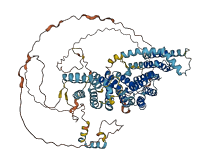
Descriptions
The autoinhibited protein was predicted that may have potential autoinhibitory elements via cis-regPred.
Autoinhibitory domains (AIDs)
Target domain |
|
Relief mechanism |
|
Assay |
cis-regPred |
Accessory elements
No accessory elements
Autoinhibited structure

Activated structure
1 structures for Q9VIF0
| Entry ID | Method | Resolution | Chain | Position | Source |
|---|---|---|---|---|---|
| AF-Q9VIF0-F1 | Predicted | AlphaFoldDB |
No variants for Q9VIF0
| Variant ID(s) | Position | Change | Description | Diseaes Association | Provenance |
|---|---|---|---|---|---|
| No variants for Q9VIF0 | |||||
No associated diseases with Q9VIF0
No regional properties for Q9VIF0
| Type | Name | Position | InterPro Accession |
|---|---|---|---|
| No domain, repeats, and functional sites for Q9VIF0 | |||
4 GO annotations of cellular component
| Name | Definition |
|---|---|
| Noc1p-Noc2p complex | A heterodimer associated with 90S and 66S preribosomes. Predominantly, but not exclusively, nucleolar; involved in ribosomal large subunit biogenesis. |
| Noc2p-Noc3p complex | A heterodimer associated with 66S preribosomes; predominantly nucleoplasmic, but also locates to the nucleolus; involved in ribosomal large subunit biogenesis. |
| nucleolus | A small, dense body one or more of which are present in the nucleus of eukaryotic cells. It is rich in RNA and protein, is not bounded by a limiting membrane, and is not seen during mitosis. Its prime function is the transcription of the nucleolar DNA into 45S ribosomal-precursor RNA, the processing of this RNA into 5.8S, 18S, and 28S components of ribosomal RNA, and the association of these components with 5S RNA and proteins synthesized outside the nucleolus. This association results in the formation of ribonucleoprotein precursors; these pass into the cytoplasm and mature into the 40S and 60S subunits of the ribosome. |
| nucleoplasm | That part of the nuclear content other than the chromosomes or the nucleolus. |
2 GO annotations of molecular function
| Name | Definition |
|---|---|
| histone binding | Binding to a histone, any of a group of water-soluble proteins found in association with the DNA of eukaryotic or archaeal chromosomes. They are involved in the condensation and coiling of chromosomes during cell division and have also been implicated in gene regulation and DNA replication. They may be chemically modified (methylated, acetlyated and others) to regulate gene transcription. |
| transcription corepressor activity | A transcription coregulator activity that represses or decreases the transcription of specific gene sets via binding to a DNA-bound DNA-binding transcription factor, either on its own or as part of a complex. Corepressors often act by altering chromatin structure and modifications. For example, one class of transcription corepressors modifies chromatin structure through covalent modification of histones. A second class remodels the conformation of chromatin in an ATP-dependent fashion. A third class modulates interactions of DNA-bound DNA-binding transcription factors with other transcription coregulators. |
3 GO annotations of biological process
| Name | Definition |
|---|---|
| negative regulation of histone acetylation | Any process that stops, prevents, or reduces the frequency, rate or extent of the addition of an acetyl group to a histone protein. |
| negative regulation of transcription by RNA polymerase II | Any process that stops, prevents, or reduces the frequency, rate or extent of transcription mediated by RNA polymerase II. |
| ribosomal large subunit biogenesis | A cellular process that results in the biosynthesis of constituent macromolecules, assembly, and arrangement of constituent parts of a large ribosomal subunit; includes transport to the sites of protein synthesis. |
5 homologous proteins in AiPD
| UniProt AC | Gene Name | Protein Name | Species | Evidence Code |
|---|---|---|---|---|
| P39744 | NOC2 | Nucleolar complex protein 2 | Saccharomyces cerevisiae (strain ATCC 204508 / S288c) (Baker's yeast) | PR |
| Q3SYU1 | NOC2L | Nucleolar complex protein 2 homolog | Bos taurus (Bovine) | PR |
| Q9Y3T9 | NOC2L | Nucleolar complex protein 2 homolog | Homo sapiens (Human) | PR |
| Q9WV70 | Noc2l | Nucleolar complex protein 2 homolog | Mus musculus (Mouse) | PR |
| O17580 | pro-2 | Nucleolar complex protein 2 homolog | Caenorhabditis elegans | PR |
| 10 | 20 | 30 | 40 | 50 | 60 |
| MKLATKKIKT | LGKSKPDLSK | KKPAKDAIRK | TKPQTTSETK | VTPRNPKQKV | AEPVKNGKTT |
| 70 | 80 | 90 | 100 | 110 | 120 |
| KKGFKKSHKE | ELEGLKDIDP | EFYDFLKNND | KKLLDFNLLD | TDDDDDEEGD | EEDKEDTVTK |
| 130 | 140 | 150 | 160 | 170 | 180 |
| ESKDDEDDEE | KYHKPSKDLE | VASDESDFEV | DEEDDAAAGG | IQKITLNLLH | QWEQQLGQAN |
| 190 | 200 | 210 | 220 | 230 | 240 |
| ISIDIVRKVI | QAFNSALASI | SADGADGGEN | KHNAAAFKVV | GAAAFNGVIQ | LCVIHLQPAI |
| 250 | 260 | 270 | 280 | 290 | 300 |
| IRLLGVRPNS | SLPLHKHKKW | VKVRGCLRYY | LTDLIRLVEQ | VSSPNILGVL | LKHLHQMAGM |
| 310 | 320 | 330 | 340 | 350 | 360 |
| VVPFSALGKT | ILKRLVVLWS | TGDETVRVLA | FLCILKITRK | QQATMLNHVL | KAMYLAYVRN |
| 370 | 380 | 390 | 400 | 410 | 420 |
| SKFVSPNTLP | GINFMRRSLV | EMFALDLNVS | YQHVFLYIRQ | LAIHLRNAVI | LKKKDSFQAV |
| 430 | 440 | 450 | 460 | 470 | 480 |
| YNWQFINSLR | LWADLLGASA | NKPQLQPLIY | PLVTIATGVI | RLIPTAQYFP | LRFHCLQTLI |
| 490 | 500 | 510 | 520 | 530 | 540 |
| SLAKETNTYV | PVLPLIVEVL | KSNTFNRKHS | AVSMKPVQFT | CVLRLNKGQL | AENGFRDEVI |
| 550 | 560 | 570 | 580 | 590 | 600 |
| EQVCGLLLEY | LAHESTSLAF | SDLVVPTVMA | IKTYLKECRN | ANYARKLKQL | LEKIQESARF |
| 610 | 620 | 630 | 640 | 650 | 660 |
| IEQQRGKSSV | TFDIKDAQAV | AAWEQQLRLK | RTPLDVYYAS | WLKTHETKKR | RQAAHTDEIN |
| 670 | 680 | 690 | 700 | 710 | 720 |
| ADYDVPKLKK | LPVKTGVPVR | NENGEVELFP | SDSEDEGDDG | LHLGSDDDDD | EDVQEEEEVE |
| 730 | 740 | 750 | 760 | ||
| VEHPKAKKAK | KEKPEKQKPR | PATVEDDYDE | AGGAVDIVKD | LDLNEW |