Q9R092
Gene name |
Hsd17b6 (Gm182, Hsd17b9, Rdh8) |
Protein name |
17-beta-hydroxysteroid dehydrogenase type 6 |
Names |
17-beta-HSD 6, 17-beta-HSD6, 17-beta-HSD9, 3-alpha->beta-hydroxysteroid epimerase, 3-alpha->beta-HSE, Oxidative 3-alpha hydroxysteroid dehydrogenase |
Species |
Mus musculus (Mouse) |
KEGG Pathway |
mmu:27400 |
EC number |
1.1.1.53: With NAD(+) or NADP(+) as acceptor |
Protein Class |
|
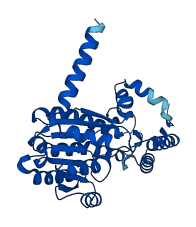
Descriptions
The autoinhibited protein was predicted that may have potential autoinhibitory elements via cis-regPred.
Autoinhibitory domains (AIDs)
Target domain |
|
Relief mechanism |
|
Assay |
cis-regPred |
Accessory elements
No accessory elements
Autoinhibited structure

Activated structure
1 structures for Q9R092
| Entry ID | Method | Resolution | Chain | Position | Source |
|---|---|---|---|---|---|
| AF-Q9R092-F1 | Predicted | AlphaFoldDB |
14 variants for Q9R092
| Variant ID(s) | Position | Change | Description | Diseaes Association | Provenance |
|---|---|---|---|---|---|
| rs3389098932 | 12 | Y>* | No | EVA | |
| rs3389145237 | 57 | L>* | No | EVA | |
| rs255401265 | 63 | E>K | No | EVA | |
| rs220453773 | 68 | E>Q | No | EVA | |
| rs3389145248 | 72 | K>N | No | EVA | |
| rs234845224 | 100 | R>C | No | EVA | |
| rs3389135759 | 155 | A>V | No | EVA | |
| rs238454963 | 156 | R>Q | No | EVA | |
| rs3389142928 | 184 | E>Q | No | EVA | |
| rs232685361 | 194 | V>I | No | EVA | |
| rs258551132 | 275 | T>M | No | EVA | |
| rs245268574 | 290 | F>L | No | EVA | |
| rs3389142909 | 296 | Y>F | No | EVA | |
| rs257694648 | 299 | A>T | No | EVA |
No associated diseases with Q9R092
1 regional properties for Q9R092
| Type | Name | Position | InterPro Accession |
|---|---|---|---|
| conserved_site | Short-chain dehydrogenase/reductase, conserved site | 163 - 191 | IPR020904 |
Functions
| Description | ||
|---|---|---|
| EC Number | 1.1.1.53 | With NAD(+) or NADP(+) as acceptor |
| Subcellular Localization |
|
|
| PANTHER Family | ||
| PANTHER Subfamily | ||
| PANTHER Protein Class | ||
| PANTHER Pathway Category | No pathway information available | |
3 GO annotations of cellular component
| Name | Definition |
|---|---|
| early endosome membrane | The lipid bilayer surrounding an early endosome. |
| endoplasmic reticulum | The irregular network of unit membranes, visible only by electron microscopy, that occurs in the cytoplasm of many eukaryotic cells. The membranes form a complex meshwork of tubular channels, which are often expanded into slitlike cavities called cisternae. The ER takes two forms, rough (or granular), with ribosomes adhering to the outer surface, and smooth (with no ribosomes attached). |
| intracellular membrane-bounded organelle | Organized structure of distinctive morphology and function, bounded by a single or double lipid bilayer membrane and occurring within the cell. Includes the nucleus, mitochondria, plastids, vacuoles, and vesicles. Excludes the plasma membrane. |
10 GO annotations of molecular function
| Name | Definition |
|---|---|
| 17-beta-hydroxysteroid dehydrogenase (NAD+) activity | Catalysis of the reaction: a 17-beta-hydroxysteroid + NAD+ = a 17-oxosteroid + NADH + H+. |
| 5alpha-androstane-3beta,17beta-diol dehydrogenase activity | Catalysis of the reaction: 5alpha-androstane-3beta,17beta-diol + NADP(+) = 17beta-hydroxy-5alpha-androstan-3-one + H(+) + NADPH. |
| androstan-3-alpha,17-beta-diol dehydrogenase activity | Catalysis of the reaction: NAD+ + androstan-3-alpha,17-beta-diol = 17-beta-hydroxyandrostan-3-one + NADH + H+. |
| androsterone dehydrogenase activity | Catalysis of the reaction: NAD(P)+ + androsterone = NAD(P)H + H+ + 5-alpha-androstane-3,17-dione. |
| estradiol 17-beta-dehydrogenase activity | Catalysis of the reaction: estradiol-17-beta + NADP+ = estrone + NADPH + H+. |
| NAD-retinol dehydrogenase activity | Catalysis of the reaction: retinol + NAD+ = retinal + NADH + H+. |
| oxidoreductase activity | Catalysis of an oxidation-reduction (redox) reaction, a reversible chemical reaction in which the oxidation state of an atom or atoms within a molecule is altered. One substrate acts as a hydrogen or electron donor and becomes oxidized, while the other acts as hydrogen or electron acceptor and becomes reduced. |
| steroid dehydrogenase activity | Catalysis of an oxidation-reduction (redox) reaction in which one substrate is a sterol derivative. |
| testosterone 17-beta-dehydrogenase (NADP+) activity | Catalysis of the reaction: NADP+ + testosterone = NADPH + H+ + androst-4-ene-3,17-dione. |
| testosterone dehydrogenase (NAD+) activity | Catalysis of the reaction: testosterone + NAD+ = androst-4-ene-3,17-dione + NADH. |
3 GO annotations of biological process
| Name | Definition |
|---|---|
| brexanolone catabolic process | The chemical reactions and pathways resulting in the breakdown of brexanolone. |
| retinol metabolic process | The chemical reactions and pathways involving retinol, one of the three compounds that makes up vitamin A. |
| steroid metabolic process | The chemical reactions and pathways involving steroids, compounds with a 1,2,cyclopentanoperhydrophenanthrene nucleus. |
7 homologous proteins in AiPD
| UniProt AC | Gene Name | Protein Name | Species | Evidence Code |
|---|---|---|---|---|
| Q02337 | BDH1 | D-beta-hydroxybutyrate dehydrogenase, mitochondrial | Bos taurus (Bovine) | PR |
| Q8NEX9 | SDR9C7 | Short-chain dehydrogenase/reductase family 9C member 7 | Homo sapiens (Human) | PR |
| P80365 | HSD11B2 | 11-beta-hydroxysteroid dehydrogenase type 2 | Homo sapiens (Human) | PR |
| Q02338 | BDH1 | D-beta-hydroxybutyrate dehydrogenase, mitochondrial | Homo sapiens (Human) | PR |
| O75452 | RDH16 | Retinol dehydrogenase 16 | Homo sapiens (Human) | PR |
| P50233 | Hsd11b2 | 11-beta-hydroxysteroid dehydrogenase type 2 | Rattus norvegicus (Rat) | PR |
| O54753 | Hsd17b6 | 17-beta-hydroxysteroid dehydrogenase type 6 | Rattus norvegicus (Rat) | PR |
| 10 | 20 | 30 | 40 | 50 | 60 |
| MWFYLVTLVG | LYHLLRWYRE | RQVVSHLQDK | YVFITGCDSG | FGNLLARQLD | RRGMRVLAAC |
| 70 | 80 | 90 | 100 | 110 | 120 |
| LTEKGAEELR | NKTSDRLETV | ILDVTKTESI | VAATQWVKER | VGDRGLWGLV | NNAGVLQPFA |
| 130 | 140 | 150 | 160 | 170 | 180 |
| YIEWYRPEDY | MPIFQVNLIG | LTQVTISMLF | LVKKARGRIV | NVSSALGRVA | LFGGFYSCSK |
| 190 | 200 | 210 | 220 | 230 | 240 |
| YGVEAFSDVL | RHEVQDFGVK | VSIIEPGSFK | TEMTDAELTI | ERTKKVWEAA | PEHIKESYGQ |
| 250 | 260 | 270 | 280 | 290 | 300 |
| QFFDDFCSTT | KRELMKCSRN | LSLVTDCMEH | ALTSTHPRTR | YSAGWDAKFF | FIPLSYLPAS |
| 310 | |||||
| LVDYLLAISR | GKPAQAA |