P50233
Gene name |
Hsd11b2 (Hsd11k) |
Protein name |
11-beta-hydroxysteroid dehydrogenase type 2 |
Names |
11-DH2, 11-beta-HSD2, Corticosteroid 11-beta-dehydrogenase isozyme 2, NAD-dependent 11-beta-hydroxysteroid dehydrogenase |
Species |
Rattus norvegicus (Rat) |
KEGG Pathway |
rno:25117 |
EC number |
|
Protein Class |
|
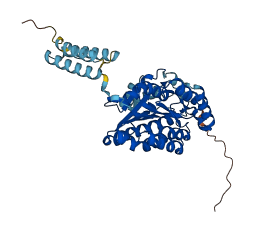
Descriptions
The autoinhibited protein was predicted that may have potential autoinhibitory elements via cis-regPred.
Autoinhibitory domains (AIDs)
Target domain |
|
Relief mechanism |
|
Assay |
cis-regPred |
Accessory elements
No accessory elements
Autoinhibited structure

Activated structure
1 structures for P50233
| Entry ID | Method | Resolution | Chain | Position | Source |
|---|---|---|---|---|---|
| AF-P50233-F1 | Predicted | AlphaFoldDB |
1 variants for P50233
| Variant ID(s) | Position | Change | Description | Diseaes Association | Provenance |
|---|---|---|---|---|---|
| rs198344769 | 388 | T>S | No | EVA |
No associated diseases with P50233
1 regional properties for P50233
| Type | Name | Position | InterPro Accession |
|---|---|---|---|
| conserved_site | Short-chain dehydrogenase/reductase, conserved site | 219 - 247 | IPR020904 |
5 GO annotations of cellular component
| Name | Definition |
|---|---|
| cytoplasm | The contents of a cell excluding the plasma membrane and nucleus, but including other subcellular structures. |
| endoplasmic reticulum | The irregular network of unit membranes, visible only by electron microscopy, that occurs in the cytoplasm of many eukaryotic cells. The membranes form a complex meshwork of tubular channels, which are often expanded into slitlike cavities called cisternae. The ER takes two forms, rough (or granular), with ribosomes adhering to the outer surface, and smooth (with no ribosomes attached). |
| intracellular membrane-bounded organelle | Organized structure of distinctive morphology and function, bounded by a single or double lipid bilayer membrane and occurring within the cell. Includes the nucleus, mitochondria, plastids, vacuoles, and vesicles. Excludes the plasma membrane. |
| lipid droplet | An intracellular non-membrane-bounded organelle comprising a matrix of coalesced lipids surrounded by a phospholipid monolayer. May include associated proteins. |
| nucleoplasm | That part of the nuclear content other than the chromosomes or the nucleolus. |
5 GO annotations of molecular function
| Name | Definition |
|---|---|
| 11-beta-hydroxysteroid dehydrogenase (NAD+) activity | Catalysis of the reaction: an 11-beta-hydroxysteroid + NAD+ = an 11-oxosteroid + NADH + H+. |
| NAD binding | Binding to nicotinamide adenine dinucleotide, a coenzyme involved in many redox and biosynthetic reactions; binding may be to either the oxidized form, NAD+, or the reduced form, NADH. |
| oxidoreductase activity | Catalysis of an oxidation-reduction (redox) reaction, a reversible chemical reaction in which the oxidation state of an atom or atoms within a molecule is altered. One substrate acts as a hydrogen or electron donor and becomes oxidized, while the other acts as hydrogen or electron acceptor and becomes reduced. |
| steroid binding | Binding to a steroid, any of a large group of substances that have in common a ring system based on 1,2-cyclopentanoperhydrophenanthrene. |
| steroid dehydrogenase activity | Catalysis of an oxidation-reduction (redox) reaction in which one substrate is a sterol derivative. |
11 GO annotations of biological process
| Name | Definition |
|---|---|
| cortisol metabolic process | The chemical reactions and pathways involving cortisol, the steroid hormone 11-beta-17,21-trihydroxypregn-4-ene-3,20-dione. Cortisol is synthesized from cholesterol in the adrenal gland and controls carbohydrate, fat and protein metabolism and has anti-inflammatory properties. |
| female pregnancy | The set of physiological processes that allow an embryo or foetus to develop within the body of a female animal. It covers the time from fertilization of a female ovum by a male spermatozoon until birth. |
| glucocorticoid metabolic process | The chemical reactions and pathways involving glucocorticoids, hormonal C21 corticosteroids synthesized from cholesterol. Glucocorticoids act primarily on carbohydrate and protein metabolism, and have anti-inflammatory effects. |
| regulation of blood volume by renal aldosterone | The process in which the hormone aldosterone decreases the rate of diuresis and natriuresis resulting in increased blood volume. |
| response to food | Any process that results in a change in state or activity of a cell or an organism (in terms of movement, secretion, enzyme production, gene expression, etc.) as a result of a food stimulus; food is anything which, when taken into the body, serves to nourish or build up the tissues or to supply body heat. |
| response to glucocorticoid | Any process that results in a change in state or activity of a cell or an organism (in terms of movement, secretion, enzyme production, gene expression, etc.) as a result of a glucocorticoid stimulus. Glucocorticoids are hormonal C21 corticosteroids synthesized from cholesterol with the ability to bind with the cortisol receptor and trigger similar effects. Glucocorticoids act primarily on carbohydrate and protein metabolism, and have anti-inflammatory effects. |
| response to hypoxia | Any process that results in a change in state or activity of a cell or an organism (in terms of movement, secretion, enzyme production, gene expression, etc.) as a result of a stimulus indicating lowered oxygen tension. Hypoxia, defined as a decline in O2 levels below normoxic levels of 20.8 - 20.95%, results in metabolic adaptation at both the cellular and organismal level. |
| response to insulin | Any process that results in a change in state or activity of a cell or an organism (in terms of movement, secretion, enzyme production, gene expression, etc.) as a result of an insulin stimulus. Insulin is a polypeptide hormone produced by the islets of Langerhans of the pancreas in mammals, and by the homologous organs of other organisms. |
| response to steroid hormone | Any process that results in a change in state or activity of a cell or an organism (in terms of movement, secretion, enzyme production, gene expression, etc.) as a result of a steroid hormone stimulus. |
| response to xenobiotic stimulus | Any process that results in a change in state or activity of a cell or an organism (in terms of movement, secretion, enzyme production, gene expression, etc.) as a result of a stimulus from a xenobiotic, a compound foreign to the organim exposed to it. It may be synthesized by another organism (like ampicilin) or it can be a synthetic chemical. |
| steroid metabolic process | The chemical reactions and pathways involving steroids, compounds with a 1,2,cyclopentanoperhydrophenanthrene nucleus. |
7 homologous proteins in AiPD
| UniProt AC | Gene Name | Protein Name | Species | Evidence Code |
|---|---|---|---|---|
| Q02337 | BDH1 | D-beta-hydroxybutyrate dehydrogenase, mitochondrial | Bos taurus (Bovine) | PR |
| Q8NEX9 | SDR9C7 | Short-chain dehydrogenase/reductase family 9C member 7 | Homo sapiens (Human) | PR |
| Q02338 | BDH1 | D-beta-hydroxybutyrate dehydrogenase, mitochondrial | Homo sapiens (Human) | PR |
| O75452 | RDH16 | Retinol dehydrogenase 16 | Homo sapiens (Human) | PR |
| P80365 | HSD11B2 | 11-beta-hydroxysteroid dehydrogenase type 2 | Homo sapiens (Human) | PR |
| Q9R092 | Hsd17b6 | 17-beta-hydroxysteroid dehydrogenase type 6 | Mus musculus (Mouse) | PR |
| O54753 | Hsd17b6 | 17-beta-hydroxysteroid dehydrogenase type 6 | Rattus norvegicus (Rat) | PR |
| 10 | 20 | 30 | 40 | 50 | 60 |
| MERWPWPSGG | AWLLVAARAL | LQLLRSDLRL | GRPLLAALAL | LAALDWLCQR | LLPPPAALVV |
| 70 | 80 | 90 | 100 | 110 | 120 |
| LAGAGWIALS | RLARPPRLPV | ATRAVLITGC | DTGFGKETAK | KLDAMGFTVL | ATVLDLNGPG |
| 130 | 140 | 150 | 160 | 170 | 180 |
| ALELRARCSP | RLKLLQMDLT | KPEDISRVLE | ITKAHTASTG | LWGLVNNAGL | NMVVADVELS |
| 190 | 200 | 210 | 220 | 230 | 240 |
| PVVTFRECME | VNFFGALELT | KGLLPLLRHS | RGRIVTVGSP | AGDMPYPCLA | AYGTSKAAIA |
| 250 | 260 | 270 | 280 | 290 | 300 |
| LLMDTFSCEL | LPWGIKVSII | QPGCFKTEAV | TNVNLWEKRK | QLLLANLPRE | LLQAYGEDYI |
| 310 | 320 | 330 | 340 | 350 | 360 |
| EHLHGQFLNS | LRMALPDLSP | VVDAIIDALL | AAQPRSRYYT | GRGLGLMYFI | HHYLPGGLRR |
| 370 | 380 | 390 | |||
| RFLQNFFISH | LLPRALRPGQ | PGPVHDTTQD | PNPSPTVSAL |