Q9PTR5
Gene name |
PAFAH1B1 |
Protein name |
Lissencephaly-1 homolog |
Names |
|
Species |
Gallus gallus (Chicken) |
KEGG Pathway |
gga:374224 |
EC number |
|
Protein Class |
|
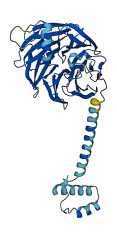
Descriptions
The autoinhibited protein was predicted that may have potential autoinhibitory elements via cis-regPred.
Autoinhibitory domains (AIDs)
Target domain |
|
Relief mechanism |
|
Assay |
cis-regPred |
Accessory elements
No accessory elements
Autoinhibited structure

Activated structure
1 structures for Q9PTR5
| Entry ID | Method | Resolution | Chain | Position | Source |
|---|---|---|---|---|---|
| AF-Q9PTR5-F1 | Predicted | AlphaFoldDB |
4 variants for Q9PTR5
| Variant ID(s) | Position | Change | Description | Diseaes Association | Provenance |
|---|---|---|---|---|---|
| rs312523033 | 92 | K>R | No | Ensembl | |
| rs314998780 | 236 | W>C | No | Ensembl | |
| rs732533440 | 284 | W>G | No | Ensembl | |
| rs739639901 | 378 | A>V | No | Ensembl |
No associated diseases with Q9PTR5
10 regional properties for Q9PTR5
| Type | Name | Position | InterPro Accession |
|---|---|---|---|
| repeat | WD40 repeat | 97 - 410 | IPR001680 |
| domain | LIS1 homology motif | 7 - 39 | IPR006594 |
| conserved_site | WD40 repeat, conserved site | 165 - 179 | IPR019775-1 |
| conserved_site | WD40 repeat, conserved site | 207 - 221 | IPR019775-2 |
| conserved_site | WD40 repeat, conserved site | 311 - 325 | IPR019775-3 |
| conserved_site | WD40 repeat, conserved site | 353 - 367 | IPR019775-4 |
| conserved_site | WD40 repeat, conserved site | 395 - 409 | IPR019775-5 |
| repeat | G-protein beta WD-40 repeat | 123 - 137 | IPR020472-1 |
| repeat | G-protein beta WD-40 repeat | 207 - 221 | IPR020472-2 |
| repeat | G-protein beta WD-40 repeat | 311 - 325 | IPR020472-3 |
Functions
16 GO annotations of cellular component
| Name | Definition |
|---|---|
| 1-alkyl-2-acetylglycerophosphocholine esterase complex | An enzyme complex composed of two catalytic alpha subunits, which form a catalytic dimer, and a non-catalytic, regulatory beta subunit; the catalytic dimer may be an alpha1/alpha1 or alpha2/alpha2 homodimer, or an alpha1/alpha2 heterodimer. Modulates the action of platelet-activating factor (PAF). |
| astral microtubule | Any of the spindle microtubules that radiate in all directions from the spindle poles and are thought to contribute to the forces that separate the poles and position them in relation to the rest of the cell. |
| axon cytoplasm | Any cytoplasm that is part of a axon. |
| cell cortex | The region of a cell that lies just beneath the plasma membrane and often, but not always, contains a network of actin filaments and associated proteins. |
| cell leading edge | The area of a motile cell closest to the direction of movement. |
| centrosome | A structure comprised of a core structure (in most organisms, a pair of centrioles) and peripheral material from which a microtubule-based structure, such as a spindle apparatus, is organized. Centrosomes occur close to the nucleus during interphase in many eukaryotic cells, though in animal cells it changes continually during the cell-division cycle. |
| cytoplasmic microtubule | Any microtubule in the cytoplasm of a cell. |
| kinetochore | A multisubunit complex that is located at the centromeric region of DNA and provides an attachment point for the spindle microtubules. |
| microtubule associated complex | Any multimeric complex connected to a microtubule. |
| motile cilium | A cilium which may have a variable arrangement of axonemal microtubules and also contains molecular motors. It may beat with a whip-like pattern that promotes cell motility or transport of fluids and other cells across a cell surface, such as on epithelial cells that line the lumenal ducts of various tissues; or they may display a distinct twirling motion that directs fluid flow asymmetrically across the cellular surface to affect asymmetric body plan organization. Motile cilia can be found in single as well as multiple copies per cell. |
| neuron projection | A prolongation or process extending from a nerve cell, e.g. an axon or dendrite. |
| neuronal cell body | The portion of a neuron that includes the nucleus, but excludes cell projections such as axons and dendrites. |
| nuclear envelope | The double lipid bilayer enclosing the nucleus and separating its contents from the rest of the cytoplasm; includes the intermembrane space, a gap of width 20-40 nm (also called the perinuclear space). |
| perinuclear region of cytoplasm | Cytoplasm situated near, or occurring around, the nucleus. |
| stereocilium | An actin-based protrusion from the apical surface of auditory and vestibular hair cells and of neuromast cells. These protrusions are supported by a bundle of cross-linked actin filaments (an actin cable), oriented such that the plus (barbed) ends are at the tip of the protrusion, capped by a tip complex which bridges to the plasma. Bundles of stereocilia act as mechanosensory organelles. |
| synapse | The junction between an axon of one neuron and a dendrite of another neuron, a muscle fiber or a glial cell. As the axon approaches the synapse it enlarges into a specialized structure, the presynaptic terminal bouton, which contains mitochondria and synaptic vesicles. At the tip of the terminal bouton is the presynaptic membrane; facing it, and separated from it by a minute cleft (the synaptic cleft) is a specialized area of membrane on the receiving cell, known as the postsynaptic membrane. In response to the arrival of nerve impulses, the presynaptic terminal bouton secretes molecules of neurotransmitters into the synaptic cleft. These diffuse across the cleft and transmit the signal to the postsynaptic membrane. |
5 GO annotations of molecular function
| Name | Definition |
|---|---|
| dynein complex binding | Binding to a dynein complex, a protein complex that contains two or three dynein heavy chains and several light chains, and has microtubule motor activity. |
| identical protein binding | Binding to an identical protein or proteins. |
| microtubule plus-end binding | Binding to the plus end of a microtubule. |
| phosphoprotein binding | Binding to a phosphorylated protein. |
| protein heterodimerization activity | Binding to a nonidentical protein to form a heterodimer. |
41 GO annotations of biological process
| Name | Definition |
|---|---|
| acrosome assembly | The formation of the acrosome from the spermatid Golgi. |
| actin cytoskeleton organization | A process that is carried out at the cellular level which results in the assembly, arrangement of constituent parts, or disassembly of cytoskeletal structures comprising actin filaments and their associated proteins. |
| adult locomotory behavior | Locomotory behavior in a fully developed and mature organism. |
| ameboidal-type cell migration | Cell migration that is accomplished by extension and retraction of a pseudopodium. |
| auditory receptor cell development | The process whose specific outcome is the progression of an auditory receptor cell over time, from its formation to the mature structure. Cell development does not include the steps involved in committing a cell to a specific fate. |
| brain morphogenesis | The process in which the anatomical structures of the brain are generated and organized. The brain is one of the two components of the central nervous system and is the center of thought and emotion. It is responsible for the coordination and control of bodily activities and the interpretation of information from the senses (sight, hearing, smell, etc.). |
| cell division | The process resulting in division and partitioning of components of a cell to form more cells; may or may not be accompanied by the physical separation of a cell into distinct, individually membrane-bounded daughter cells. |
| chemical synaptic transmission | The vesicular release of classical neurotransmitter molecules from a presynapse, across a chemical synapse, the subsequent activation of neurotransmitter receptors at the postsynapse of a target cell (neuron, muscle, or secretory cell) and the effects of this activation on the postsynaptic membrane potential and ionic composition of the postsynaptic cytosol. This process encompasses both spontaneous and evoked release of neurotransmitter and all parts of synaptic vesicle exocytosis. Evoked transmission starts with the arrival of an action potential at the presynapse. |
| cochlea development | The progression of the cochlea over time from its formation to the mature structure. The cochlea is the snail-shaped portion of the inner ear that is responsible for the detection of sound. |
| corpus callosum morphogenesis | The process in which the anatomical structures of the corpus callosum are generated and organized. The corpus callosum is a thick bundle of nerve fibers comprising a commissural plate connecting the two cerebral hemispheres. It consists of contralateral axon projections that provides communications between the right and left cerebral hemispheres. |
| cortical microtubule organization | A process that is carried out at the cellular level which results in the assembly, arrangement of constituent parts, or disassembly of structures formed of microtubules and associated proteins in the cell cortex, i.e. just beneath the plasma membrane of a cell. |
| establishment of mitotic spindle orientation | A cell cycle process that sets the alignment of mitotic spindle relative to other cellular structures. |
| establishment of planar polarity of embryonic epithelium | Coordinated organization of groups of cells in the plane of an embryonic epithelium, such that they all orient to similar coordinates. |
| germ cell development | The process whose specific outcome is the progression of an immature germ cell over time, from its formation to the mature structure (gamete). A germ cell is any reproductive cell in a multicellular organism. |
| hippocampus development | The progression of the hippocampus over time from its initial formation until its mature state. |
| interneuron migration | The orderly movement of an interneuron from one site to another. |
| JNK cascade | An intracellular protein kinase cascade containing at least a JNK (a MAPK), a JNKK (a MAPKK) and a JUN3K (a MAP3K). The cascade can also contain an additional tier: the upstream MAP4K. The kinases in each tier phosphorylate and activate the kinases in the downstream tier to transmit a signal within a cell. |
| layer formation in cerebral cortex | The detachment of cells from radial glial fibers at the appropriate time when they cease to migrate and form distinct layer in the cerebral cortex. |
| learning or memory | The acquisition and processing of information and/or the storage and retrieval of this information over time. |
| maintenance of centrosome location | Any process in which a centrosome is maintained in a specific location within a cell and prevented from moving elsewhere. |
| microtubule cytoskeleton organization involved in establishment of planar polarity | A process that is carried out at the cellular level which results in the assembly, arrangement of constituent parts, or disassembly of cytoskeletal structures comprising microtubules and their associated proteins and contributes to the establishment of planar polarity. |
| microtubule organizing center organization | A process that is carried out at the cellular level which results in the assembly, arrangement of constituent parts, or disassembly of a microtubule organizing center, a structure from which microtubules grow. |
| microtubule sliding | The movement of one microtubule along another microtubule. |
| myeloid leukocyte migration | The movement of a myeloid leukocyte within or between different tissues and organs of the body. |
| negative regulation of JNK cascade | Any process that stops, prevents, or reduces the frequency, rate or extent of signal transduction mediated by the JNK cascade. |
| neuroblast proliferation | The expansion of a neuroblast population by cell division. A neuroblast is any cell that will divide and give rise to a neuron. |
| neuromuscular process controlling balance | Any process that an organism uses to control its balance, the orientation of the organism (or the head of the organism) in relation to the source of gravity. In humans and animals, balance is perceived through visual cues, the labyrinth system of the inner ears and information from skin pressure receptors and muscle and joint receptors. |
| nuclear membrane disassembly | The controlled breakdown of the nuclear membranes, for example during cellular division. |
| nuclear migration | The directed movement of the nucleus to a specific location within a cell. |
| osteoclast development | The process whose specific outcome is the progression of a osteoclast from its formation to the mature structure. Cell development does not include the steps involved in committing a cell to a specific fate. An osteoclast is a specialized phagocytic cell associated with the absorption and removal of the mineralized matrix of bone tissue. |
| positive regulation of cytokine-mediated signaling pathway | Any process that activates or increases the frequency, rate or extent of a cytokine mediated signaling pathway. |
| positive regulation of dendritic spine morphogenesis | Any process that increases the rate, frequency, or extent of dendritic spine morphogenesis, the process in which the anatomical structures of a dendritic spine are generated and organized. A dendritic spine is a protrusion from a dendrite and a specialized subcellular compartment involved in synaptic transmission. |
| positive regulation of embryonic development | Any process that activates or increases the frequency, rate or extent of embryonic development. |
| protein secretion | The controlled release of proteins from a cell. |
| radial glia-guided pyramidal neuron migration | The radial migration of a pyramidal neuron along radial glial cells. |
| reelin-mediated signaling pathway | The series of molecular signals initiated by the binding of reelin (a secreted glycoprotein) to a receptor on the surface of a target cell, and ending with the regulation of a downstream cellular process, e.g. transcription. |
| regulation of GTPase activity | Any process that modulates the rate of GTP hydrolysis by a GTPase. |
| regulation of microtubule cytoskeleton organization | Any process that modulates the frequency, rate or extent of the formation, arrangement of constituent parts, or disassembly of cytoskeletal structures comprising microtubules and their associated proteins. |
| retrograde axonal transport | The directed movement of organelles or molecules along microtubules from the cell periphery toward the cell body in nerve cell axons. |
| transmission of nerve impulse | The neurological system process in which a signal is transmitted through the nervous system by a combination of action potential propagation and synaptic transmission. |
| vesicle transport along microtubule | The directed movement of a vesicle along a microtubule, mediated by motor proteins. This process begins with the attachment of a vesicle to a microtubule, and ends when the vesicle reaches its final destination. |
12 homologous proteins in AiPD
| UniProt AC | Gene Name | Protein Name | Species | Evidence Code |
|---|---|---|---|---|
| P43033 | PAFAH1B1 | Platelet-activating factor acetylhydrolase IB subunit beta | Bos taurus (Bovine) | PR |
| B0LSW3 | PAFAH1B1 | Platelet-activating factor acetylhydrolase IB subunit beta | Felis catus (Cat) (Felis silvestris catus) | PR |
| Q5IS43 | PAFAH1B1 | Platelet-activating factor acetylhydrolase IB subunit alpha | Pan troglodytes (Chimpanzee) | PR |
| Q7KNS3 | Lis-1 | Lissencephaly-1 homolog | Drosophila melanogaster (Fruit fly) | PR |
| Q96DN5 | TBC1D31 | TBC1 domain family member 31 | Homo sapiens (Human) | PR |
| P43034 | PAFAH1B1 | Platelet-activating factor acetylhydrolase IB subunit beta | Homo sapiens (Human) | PR |
| P63005 | Pafah1b1 | Platelet-activating factor acetylhydrolase IB subunit beta | Mus musculus (Mouse) | PR |
| Q9GL51 | PAFAH1B1 | Platelet-activating factor acetylhydrolase IB subunit alpha | Sus scrofa (Pig) | PR |
| P63004 | Pafah1b1 | Platelet-activating factor acetylhydrolase IB subunit alpha | Rattus norvegicus (Rat) | PR |
| Q6NZH4 | pafah1b1 | Lissencephaly-1 homolog | Xenopus tropicalis (Western clawed frog) (Silurana tropicalis) | PR |
| Q7T394 | pafah1b1a | Lissencephaly-1 homolog A | Danio rerio (Zebrafish) (Brachydanio rerio) | PR |
| Q803D2 | pafah1b1b | Lissencephaly-1 homolog B | Danio rerio (Zebrafish) (Brachydanio rerio) | PR |
| 10 | 20 | 30 | 40 | 50 | 60 |
| MVLSQRQRDE | LNRAIADYLR | SNGYEEAYSV | FKKEAELDVN | EELDKKYAGL | LEKKWTSVIR |
| 70 | 80 | 90 | 100 | 110 | 120 |
| LQKKVMELES | KLNEAKEEFT | SGGPLGQKRD | PKEWIPRPPE | KYALSGHRSP | VTRVIFHPVF |
| 130 | 140 | 150 | 160 | 170 | 180 |
| SVMVSASEDA | TIKVWDYETG | DFERTLKGHT | DSVQDISFDH | TGKLLASCSA | DMTIKLWDFQ |
| 190 | 200 | 210 | 220 | 230 | 240 |
| GFECIRTMHG | HDHNVSSVAI | MPNGDHIVSA | SRDKTIKMWE | VQTGYCVKTF | TGHREWVRMV |
| 250 | 260 | 270 | 280 | 290 | 300 |
| RPNQDGTLIA | SCSNDQTVRV | WVVATKECKA | ELREHEHVVE | CISWAPESSY | STISEATGSE |
| 310 | 320 | 330 | 340 | 350 | 360 |
| TKKSGKPGPF | LLSGSRDKTI | KMWDISTGMC | LMTLVGHDNW | VRGVLFHSGG | KFILSCADDK |
| 370 | 380 | 390 | 400 | ||
| TLRVWDFKNK | RCMKTLNAHE | HFVTSLDFHK | TAPYVVTGSV | DQTVKVWECR |