P43034
Gene name |
PAFAH1B1 |
Protein name |
Platelet-activating factor acetylhydrolase IB subunit beta |
Names |
Lissencephaly-1 protein, LIS-1, PAF acetylhydrolase 45 kDa subunit, PAF-AH 45 kDa subunit, PAF-AH alpha, PAFAH alpha |
Species |
Homo sapiens (Human) |
KEGG Pathway |
hsa:5048 |
EC number |
|
Protein Class |
|
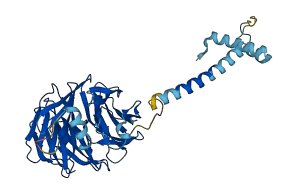
Descriptions
The autoinhibited protein was predicted that may have potential autoinhibitory elements via cis-regPred.
Autoinhibitory domains (AIDs)
Target domain |
|
Relief mechanism |
|
Assay |
cis-regPred |
Accessory elements
No accessory elements

272 variants for P43034
| Variant ID(s) | Position | Change | Description | Diseaes Association | Provenance |
|---|---|---|---|---|---|
|
RCV000147036 rs587784265 |
1 | M>I | Lissencephaly due to LIS1 mutation [ClinVar] | Yes |
ClinVar dbSNP |
|
RCV001291181 rs2068649745 |
7 | Q>* | Lissencephaly [ClinVar] | Yes |
ClinVar dbSNP |
|
RCV000008549 RCV001851741 CA119279 RCV000008548 RCV001255338 RCV001291182 rs121434489 |
8 | R>* | Intellectual disability Lissencephaly Subcortical band heterotopia Lissencephaly due to LIS1 mutation [ClinVar] | Yes |
ClinGen ClinVar Ensembl dbSNP |
|
CA272401 rs587784262 RCV000147032 |
13 | R>* | Lissencephaly due to LIS1 mutation [ClinVar] | Yes |
ClinGen ClinVar TOPMed dbSNP gnomAD |
|
RCV000147045 rs587784272 CA272419 |
19 | L>R | Lissencephaly due to LIS1 mutation [ClinVar] | Yes |
ClinGen ClinVar Ensembl dbSNP |
|
rs587784285 RCV000147059 CA272439 |
24 | Y>* | Lissencephaly due to LIS1 mutation [ClinVar] | Yes |
ClinGen ClinVar Ensembl dbSNP |
|
rs797045866 RCV000194082 |
25 | E>missing | Lissencephaly due to LIS1 mutation [ClinVar] | Yes |
ClinVar dbSNP |
|
rs369259961 RCV000147064 CA272447 |
28 | Y>* | Lissencephaly due to LIS1 mutation [ClinVar] | Yes |
ClinGen ClinVar ESP ExAC dbSNP gnomAD |
|
CA254315 rs121434486 VAR_015398 RCV000008545 |
31 | F>S | Lissencephaly due to LIS1 mutation LIS1 [ClinVar, UniProt] | Yes |
ClinGen ClinVar UniProt Ensembl dbSNP |
|
RCV000147019 rs587784250 CA272382 RCV000484701 |
41 | E>K | Lissencephaly due to LIS1 mutation [ClinVar] | Yes |
ClinGen ClinVar dbSNP gnomAD |
|
rs587784252 RCV000147021 |
46 | K>missing | Lissencephaly due to LIS1 mutation [ClinVar] | Yes |
ClinVar dbSNP |
|
rs768437076 RCV001262146 |
47 | Y>C | Lissencephaly due to LIS1 mutation [ClinVar] | Yes |
ClinVar dbSNP |
|
RCV000147022 RCV002515970 rs587784253 |
51 | L>missing | Lissencephaly due to LIS1 mutation [ClinVar] | Yes |
ClinVar dbSNP |
|
rs2069103320 RCV001291183 |
52 | E>missing | Lissencephaly [ClinVar] | Yes |
ClinVar dbSNP |
|
RCV000020302 RCV000255298 rs113994198 |
54 | K>missing | Lissencephaly due to LIS1 mutation [ClinVar] | Yes |
ClinVar dbSNP |
|
RCV001255331 RCV002247373 RCV000364082 RCV000020303 rs113994198 |
55 | W>missing | Intellectual disability Lissencephaly due to LIS1 mutation [ClinVar] | Yes |
ClinVar dbSNP |
|
RCV001555095 RCV000147023 CA272388 RCV001266155 rs587784254 |
55 | W>R | Inborn genetic diseases Lissencephaly due to LIS1 mutation [ClinVar] | Yes |
ClinGen ClinVar Ensembl dbSNP |
|
rs1555526309 RCV000677424 |
60 | R>missing | Lissencephaly due to LIS1 mutation [ClinVar] | Yes |
ClinVar dbSNP |
|
CA272393 rs587784257 RCV000147027 |
64 | K>N | Lissencephaly due to LIS1 mutation [ClinVar] | Yes |
ClinGen ClinVar Ensembl dbSNP |
|
RCV000429627 RCV000147028 rs587784258 CA272395 |
89 | R>* | Lissencephaly due to LIS1 mutation [ClinVar] | Yes |
ClinGen ClinVar Ensembl dbSNP |
|
RCV000193550 rs797045858 |
97 | R>missing | Lissencephaly due to LIS1 mutation [ClinVar] | Yes |
ClinVar dbSNP |
|
RCV000147029 CA272397 rs587784259 |
102 | Y>* | Lissencephaly due to LIS1 mutation [ClinVar] | Yes |
ClinGen ClinVar Ensembl dbSNP |
|
rs797045859 RCV000192650 |
117 | H>missing | Lissencephaly due to LIS1 mutation [ClinVar] | Yes |
ClinVar dbSNP |
|
CA272399 rs587784261 RCV000147031 |
124 | V>D | Lissencephaly due to LIS1 mutation [ClinVar] | Yes |
ClinGen ClinVar Ensembl dbSNP |
|
CA272403 rs587784263 RCV000147033 |
129 | D>V | Lissencephaly due to LIS1 mutation [ClinVar] | Yes |
ClinGen ClinVar Ensembl dbSNP |
|
rs587784266 CA272408 RCV000147037 |
135 | W>* | Lissencephaly due to LIS1 mutation [ClinVar] | Yes |
ClinGen ClinVar Ensembl dbSNP |
|
CA272410 rs587784267 COSM1479341 RCV000147038 RCV000255123 |
144 | R>* | Variant assessed as Somatic; impact. breast Lissencephaly due to LIS1 mutation [NCI-TCGA, Cosmic, ClinVar] | Yes |
ClinGen cosmic curated ClinVar Ensembl NCI-TCGA dbSNP |
|
rs797045861 RCV000481949 RCV000194728 |
148 | G>missing | Lissencephaly due to LIS1 mutation [ClinVar] | Yes |
ClinVar dbSNP |
|
RCV002512912 CA254311 rs121434482 RCV000008540 VAR_007724 |
149 | H>R | Lissencephaly due to LIS1 mutation LIS1; abrogates interaction with NDE1 and reduces neuronal migration in vitro [ClinVar, UniProt] | Yes |
ClinGen ClinVar UniProt Ensembl dbSNP |
|
rs587784268 RCV000147039 |
152 | S>missing | Lissencephaly due to LIS1 mutation [ClinVar] | Yes |
ClinVar dbSNP |
|
CA272413 RCV000147040 rs587784269 |
154 | Q>* | Lissencephaly due to LIS1 mutation [ClinVar] | Yes |
ClinGen ClinVar Ensembl dbSNP |
|
VAR_015399 rs121434487 RCV000008546 CA254316 |
162 | G>S | Variant assessed as Somatic; impact. Lissencephaly due to LIS1 mutation LIS1 [NCI-TCGA, ClinVar, UniProt] | Yes |
ClinGen ClinVar UniProt Ensembl NCI-TCGA dbSNP |
|
RCV000147041 rs200390886 CA272415 |
168 | C>Y | Lissencephaly due to LIS1 mutation [ClinVar] | Yes |
ClinGen ClinVar 1000Genomes TOPMed dbSNP |
|
RCV000008543 CA119277 VAR_010203 rs121434484 |
169 | S>P | Subcortical band heterotopia SBH; abrogates interaction with NDE1 and reduces neuronal migration in vitro [ClinVar, UniProt] | Yes |
ClinGen ClinVar UniProt Ensembl dbSNP |
|
rs1555526718 RCV000502531 |
172 | M>missing | Lissencephaly due to LIS1 mutation [ClinVar] | Yes |
ClinVar dbSNP |
|
RCV000147042 rs587784270 |
175 | K>missing | Lissencephaly due to LIS1 mutation [ClinVar] | Yes |
ClinVar dbSNP |
|
CA276155 rs797045061 RCV000191116 |
175 | K>* | Lissencephaly due to LIS1 mutation [ClinVar] | Yes |
ClinGen ClinVar Ensembl dbSNP |
|
RCV000192553 rs587784271 RCV000147043 |
180 | Q>missing | Lissencephaly due to LIS1 mutation [ClinVar] | Yes |
ClinVar dbSNP |
|
CA272421 RCV000147046 RCV003128583 rs587784273 |
211 | S>* | Lissencephaly due to LIS1 mutation [ClinVar] | Yes |
ClinGen ClinVar Ensembl dbSNP |
|
RCV000147047 rs587784274 |
215 | T>missing | Lissencephaly due to LIS1 mutation [ClinVar] | Yes |
ClinVar dbSNP |
|
RCV002514825 rs587784275 RCV000147048 |
216 | I>missing | Lissencephaly due to LIS1 mutation [ClinVar] | Yes |
ClinVar dbSNP |
|
RCV000147049 rs587784276 CA272425 |
219 | W>* | Lissencephaly due to LIS1 mutation [ClinVar] | Yes |
ClinGen ClinVar ExAC dbSNP gnomAD |
|
RCV001291185 rs2069200834 |
219 | W>G | Lissencephaly [ClinVar] | Yes |
ClinVar dbSNP |
|
rs587784277 RCV000147050 |
220 | E>missing | Lissencephaly due to LIS1 mutation [ClinVar] | Yes |
ClinVar dbSNP |
|
RCV002298899 RCV001197820 CA397641516 rs1262666760 |
221 | V>M | Lissencephaly due to LIS1 mutation [ClinVar] | Yes |
ClinGen ClinVar dbSNP gnomAD |
|
RCV000147051 CA272428 rs587784278 |
222 | Q>* | Lissencephaly due to LIS1 mutation [ClinVar] | Yes |
ClinGen ClinVar Ensembl dbSNP |
|
RCV000194642 rs797045864 |
223 | T>missing | Lissencephaly due to LIS1 mutation [ClinVar] | Yes |
ClinVar dbSNP |
|
rs587784281 RCV000147054 CA272432 |
224 | G>D | Lissencephaly due to LIS1 mutation [ClinVar] | Yes |
ClinGen ClinVar Ensembl dbSNP |
|
rs587784282 CA272434 RCV000147055 |
225 | Y>* | Lissencephaly due to LIS1 mutation [ClinVar] | Yes |
ClinGen ClinVar dbSNP gnomAD |
|
RCV001291186 rs2069226261 |
227 | V>missing | Lissencephaly [ClinVar] | Yes |
ClinVar dbSNP |
|
RCV000623963 rs797045865 RCV000192866 RCV000599007 |
235 | E>missing | Inborn genetic diseases Lissencephaly due to LIS1 mutation [ClinVar] | Yes |
ClinVar dbSNP |
|
rs587784284 RCV000147058 |
239 | M>missing | Lissencephaly due to LIS1 mutation [ClinVar] | Yes |
ClinVar dbSNP |
|
rs2069227227 RCV001291187 |
241 | R>missing | Lissencephaly [ClinVar] | Yes |
ClinVar dbSNP |
|
CA119278 RCV000008547 RCV001851740 VAR_037300 rs121434488 |
241 | R>P | Subcortical band heterotopia SBH; somatic mosaicism in 18% of lymphocytes and 21% of hair root cells [ClinVar, UniProt] | Yes |
ClinGen ClinVar UniProt 1000Genomes ExAC dbSNP gnomAD |
|
CA272441 rs587784286 RCV000147060 |
244 | Q>* | Lissencephaly due to LIS1 mutation [ClinVar] | Yes |
ClinGen ClinVar Ensembl dbSNP |
|
RCV000194563 rs797045867 |
245 | D>missing | Lissencephaly due to LIS1 mutation [ClinVar] | Yes |
ClinVar dbSNP |
|
RCV001291188 rs2069227815 |
248 | L>P | Lissencephaly [ClinVar] | Yes |
ClinVar dbSNP |
|
RCV000147061 rs587784287 CA272443 |
251 | S>R | Lissencephaly due to LIS1 mutation [ClinVar] | Yes |
ClinGen ClinVar Ensembl dbSNP |
|
rs797045868 RCV000192780 |
257 | T>missing | Lissencephaly due to LIS1 mutation [ClinVar] | Yes |
ClinVar dbSNP |
|
rs797045869 RCV000194019 |
258 | V>missing | Lissencephaly due to LIS1 mutation [ClinVar] | Yes |
ClinVar dbSNP |
|
RCV000255710 CA254312 rs121434483 RCV000008541 |
273 | R>* | Variant assessed as Somatic; impact. Lissencephaly due to LIS1 mutation [NCI-TCGA, ClinVar] | Yes |
ClinGen ClinVar Ensembl NCI-TCGA dbSNP |
|
CA275460 RCV000184018 rs794729199 |
273 | R>Q | Lissencephaly due to LIS1 mutation [ClinVar] | Yes |
ClinGen ClinVar Ensembl dbSNP |
|
rs797045870 RCV000195211 |
277 | H>missing | Lissencephaly due to LIS1 mutation [ClinVar] | Yes |
ClinVar dbSNP |
|
VAR_037301 RCV000008550 rs121434490 CA254317 |
277 | H>P | Lissencephaly due to LIS1 mutation LIS1 [ClinVar, UniProt] | Yes |
ClinGen ClinVar UniProt Ensembl dbSNP |
|
CA272445 RCV000147063 rs587784288 |
281 | C>R | Lissencephaly due to LIS1 mutation [ClinVar] | Yes |
ClinGen ClinVar Ensembl dbSNP |
|
RCV000680056 rs1567559851 RCV002544696 CA397642002 |
284 | W>* | Lissencephaly due to LIS1 mutation [ClinVar] | Yes |
ClinGen ClinVar Ensembl dbSNP |
|
RCV000147065 rs587784289 CA272449 |
284 | W>* | Lissencephaly due to LIS1 mutation [ClinVar] | Yes |
ClinGen ClinVar Ensembl dbSNP |
|
RCV000500981 CA397642106 rs587784291 |
300 | E>D | Lissencephaly due to LIS1 mutation [ClinVar] | Yes |
ClinGen ClinVar Ensembl dbSNP |
|
RCV000504340 rs1555527149 CA397642104 |
300 | E>G | Lissencephaly due to LIS1 mutation [ClinVar] | Yes |
ClinGen ClinVar Ensembl dbSNP |
|
RCV000147068 rs587784292 |
304 | S>missing | Lissencephaly due to LIS1 mutation [ClinVar] | Yes |
ClinVar dbSNP |
|
rs797045871 RCV000193085 |
304 | S>missing | Lissencephaly due to LIS1 mutation [ClinVar] | Yes |
ClinVar dbSNP |
|
RCV000193935 rs797045872 |
312 | L>missing | Lissencephaly due to LIS1 mutation [ClinVar] | Yes |
ClinVar dbSNP |
|
RCV000147069 CA272455 rs587784293 |
313 | S>F | Lissencephaly due to LIS1 mutation [ClinVar] | Yes |
ClinGen ClinVar Ensembl dbSNP |
|
VAR_015400 rs121434485 CA254314 RCV000008544 |
317 | D>H | Lissencephaly due to LIS1 mutation LIS1; reduces neuronal migration in vitro [ClinVar, UniProt] | Yes |
ClinGen ClinVar UniProt Ensembl dbSNP |
|
CA272457 rs587784294 RCV000147070 |
322 | M>R | Lissencephaly due to LIS1 mutation [ClinVar] | Yes |
ClinGen ClinVar Ensembl dbSNP |
|
RCV001031005 rs2069271269 |
323 | W>R | Lissencephaly due to LIS1 mutation [ClinVar] | Yes |
ClinVar dbSNP |
|
CA272356 RCV000147004 rs587784236 |
337 | H>D | Lissencephaly due to LIS1 mutation [ClinVar] | Yes |
ClinGen ClinVar Ensembl dbSNP |
|
CA272358 RCV000147005 rs587784236 |
337 | H>Y | Lissencephaly due to LIS1 mutation [ClinVar] | Yes |
ClinGen ClinVar Ensembl dbSNP |
|
rs797045855 RCV000194197 |
340 | W>missing | Lissencephaly due to LIS1 mutation [ClinVar] | Yes |
ClinVar dbSNP |
|
rs587784237 RCV000147006 |
342 | R>missing | Lissencephaly due to LIS1 mutation [ClinVar] | Yes |
ClinVar dbSNP |
|
rs2069358559 RCV001291189 |
349 | G>missing | Lissencephaly [ClinVar] | Yes |
ClinVar dbSNP |
|
RCV000020299 rs113994200 RCV000020298 RCV000254776 |
351 | K>missing | Lissencephaly due to LIS1 mutation [ClinVar] | Yes |
ClinVar dbSNP |
|
rs587784238 RCV000147007 |
355 | S>missing | Lissencephaly due to LIS1 mutation [ClinVar] | Yes |
ClinVar dbSNP |
|
CA272362 rs587784239 RCV000147008 |
355 | S>N | Lissencephaly due to LIS1 mutation [ClinVar] | Yes |
ClinGen ClinVar Ensembl dbSNP |
|
RCV001262144 rs2069359971 |
363 | R>C | Lissencephaly due to LIS1 mutation [ClinVar] | Yes |
ClinVar dbSNP |
|
rs587784240 RCV000147009 |
367 | Y>missing | Lissencephaly due to LIS1 mutation [ClinVar] | Yes |
ClinVar dbSNP |
|
CA272365 RCV000147010 RCV001291190 rs587784241 RCV002273962 |
371 | R>* | Lissencephaly Lissencephaly due to LIS1 mutation [ClinVar] | Yes |
ClinGen ClinVar Ensembl dbSNP |
|
RCV000147011 rs587784242 CA272367 |
379 | H>Y | Lissencephaly due to LIS1 mutation [ClinVar] | Yes |
ClinGen ClinVar Ensembl dbSNP |
|
RCV001198277 rs2069361452 |
381 | H>R | Lissencephaly due to LIS1 mutation [ClinVar] | Yes |
ClinVar dbSNP |
|
CA272370 RCV000147013 rs587784244 |
387 | D>Y | Lissencephaly due to LIS1 mutation [ClinVar] | Yes |
ClinGen ClinVar Ensembl dbSNP |
|
rs587784245 RCV000147014 CA272372 |
389 | H>Y | Lissencephaly due to LIS1 mutation [ClinVar] | Yes |
ClinGen ClinVar Ensembl dbSNP |
|
RCV001696917 CA397643102 RCV000709855 rs1131691295 |
397 | T>I | Lissencephaly due to LIS1 mutation [ClinVar] | Yes |
ClinGen ClinVar Ensembl dbSNP |
|
rs587784247 CA272376 RCV000147016 |
398 | G>D | Lissencephaly due to LIS1 mutation [ClinVar] | Yes |
ClinGen ClinVar Ensembl dbSNP |
|
RCV000147017 rs587784248 CA272378 |
399 | S>T | Lissencephaly due to LIS1 mutation [ClinVar] | Yes |
ClinGen ClinVar Ensembl dbSNP |
|
rs587784249 RCV000147018 CA272380 |
401 | D>H | Lissencephaly due to LIS1 mutation [ClinVar] | Yes |
ClinGen ClinVar Ensembl dbSNP |
|
CA272384 rs587784251 RCV000147020 |
411 | R>C | Lissencephaly due to LIS1 mutation [ClinVar] | Yes |
ClinGen ClinVar Ensembl dbSNP |
|
CA286582006 rs748501310 |
3 | L>M | No |
ClinGen Ensembl |
|
|
rs200258896 CA286582007 |
6 | R>G | No |
ClinGen 1000Genomes |
|
| TCGA novel | 7 | Q>E | Variant assessed as Somatic; impact. [NCI-TCGA] | No | NCI-TCGA |
|
rs372974127 COSM976690 CA8283062 |
8 | R>Q | Variant assessed as Somatic; 0.0 impact. endometrium [NCI-TCGA, Cosmic] | No |
ClinGen cosmic curated ESP ExAC NCI-TCGA TOPMed gnomAD |
|
CA8283063 rs779221879 |
9 | D>N | No |
ClinGen ExAC gnomAD |
|
|
CA397637878 rs587784262 |
13 | R>G | No |
ClinGen TOPMed gnomAD |
|
|
RCV000078811 rs374766360 CA220821 |
13 | R>Q | No |
ClinGen ClinVar ESP ExAC TOPMed dbSNP gnomAD |
|
|
rs1252829293 CA397637889 |
14 | A>G | No |
ClinGen gnomAD |
|
|
CA8283095 rs770331294 |
14 | A>T | No |
ClinGen ExAC gnomAD |
|
|
rs774411293 CA8283096 |
15 | I>V | No |
ClinGen ExAC TOPMed gnomAD |
|
|
CA397637906 rs1185006115 |
16 | A>T | Variant assessed as Somatic; impact. [NCI-TCGA] | No |
ClinGen NCI-TCGA TOPMed |
|
CA8283097 rs759371674 |
17 | D>N | No |
ClinGen ExAC TOPMed gnomAD |
|
|
CA286904828 rs975702095 |
20 | R>G | No |
ClinGen Ensembl |
|
|
CA286904832 rs1030300693 |
20 | R>L | No |
ClinGen Ensembl |
|
|
CA397637963 rs975702095 RCV000500121 |
20 | R>S | No |
ClinGen ClinVar Ensembl dbSNP |
|
|
rs1567554574 CA397637979 RCV000760706 |
21 | S>* | No |
ClinGen ClinVar Ensembl dbSNP |
|
| TCGA novel | 22 | N>M | Variant assessed as Somatic; impact. [NCI-TCGA] | No | NCI-TCGA |
|
CA8283098 rs771951756 |
24 | Y>C | No |
ClinGen ExAC TOPMed gnomAD |
|
|
rs984548299 CA286904839 |
24 | Y>N | No |
ClinGen TOPMed |
|
|
rs955541680 CA286904856 |
37 | L>F | No |
ClinGen Ensembl |
|
|
CA243167 RCV000177065 rs767670214 |
38 | D>N | No |
ClinGen ClinVar ExAC TOPMed dbSNP gnomAD |
|
|
rs767670214 CA8283100 |
38 | D>Y | No |
ClinGen ExAC TOPMed gnomAD |
|
|
CA397638208 rs1454875471 |
39 | V>A | No |
ClinGen gnomAD |
|
|
rs746864477 CA8283122 |
46 | K>R | No |
ClinGen ExAC gnomAD |
|
|
CA8283123 rs768437076 |
47 | Y>F | No |
ClinGen ExAC gnomAD |
|
|
CA397638363 rs1197988240 |
48 | A>T | No |
ClinGen gnomAD |
|
|
CA397638378 rs1266351305 |
49 | G>D | No |
ClinGen gnomAD |
|
|
CA397638384 rs1177684964 |
50 | L>V | No |
ClinGen gnomAD |
|
| rs587784253 | 51 | L>W | Variant assessed as Somatic; impact. [NCI-TCGA] | No | NCI-TCGA |
| rs113994198 | 54 | K>N | Variant assessed as Somatic; 0.0001007 impact. [NCI-TCGA] | No | NCI-TCGA |
|
rs757993270 CA286905022 |
55 | W>L | No |
ClinGen Ensembl |
|
|
rs773195662 CA8283127 |
59 | I>T | No |
ClinGen ExAC gnomAD |
|
|
CA286905327 rs1010388307 |
74 | E>A | No |
ClinGen TOPMed |
|
|
CA397638606 rs1370319961 |
78 | E>Q | No |
ClinGen gnomAD |
|
|
CA286905332 COSM267100 rs1020067108 |
80 | T>M | large_intestine Variant assessed as Somatic; impact. [Cosmic, NCI-TCGA] | No |
ClinGen cosmic curated NCI-TCGA TOPMed |
| TCGA novel | 84 | P>A | Variant assessed as Somatic; impact. [NCI-TCGA] | No | NCI-TCGA |
|
CA8283157 rs139434124 |
85 | L>F | No |
ClinGen ESP ExAC TOPMed gnomAD |
|
|
rs1183035372 CA397638652 |
85 | L>H | No |
ClinGen TOPMed |
|
| TCGA novel | 86 | G>A | Variant assessed as Somatic; impact. [NCI-TCGA] | No | NCI-TCGA |
|
rs756443284 CA8283158 |
95 | I>V | No |
ClinGen ExAC gnomAD |
|
|
CA8283159 rs764855780 |
98 | P>L | No |
ClinGen ExAC gnomAD |
|
|
CA397638867 rs1160093635 |
103 | A>S | No |
ClinGen gnomAD |
|
| TCGA novel | 105 | S>N | Variant assessed as Somatic; impact. [NCI-TCGA] | No | NCI-TCGA |
|
CA397638887 rs1210768389 |
105 | S>R | No |
ClinGen TOPMed |
|
|
CA286905374 rs772135892 |
112 | T>S | No |
ClinGen Ensembl |
|
|
rs886041341 RCV000276564 CA10603585 |
113 | R>* | No |
ClinGen ClinVar TOPMed dbSNP |
|
|
rs886041341 CA397638993 |
113 | R>G | No |
ClinGen TOPMed |
|
| TCGA novel | 113 | R>Q | Variant assessed as Somatic; impact. [NCI-TCGA] | No | NCI-TCGA |
|
rs1389070949 CA397639010 |
115 | I>V | No |
ClinGen gnomAD |
|
| TCGA novel | 116 | F>S | Variant assessed as Somatic; impact. [NCI-TCGA] | No | NCI-TCGA |
|
CA206983 rs797045860 RCV000193470 |
117 | H>R | No |
ClinGen ClinVar Ensembl dbSNP |
|
|
COSM1749935 rs1451577273 CA397639050 |
118 | P>S | Variant assessed as Somatic; 0.0 impact. urinary_tract [NCI-TCGA, Cosmic] | No |
ClinGen cosmic curated NCI-TCGA gnomAD |
|
rs1230408042 CA397639093 |
122 | V>L | No |
ClinGen TOPMed |
|
|
rs1334642659 CA397639109 |
123 | M>T | No |
ClinGen TOPMed gnomAD |
|
|
CA397639762 rs1259396933 |
134 | V>A | No |
ClinGen gnomAD |
|
|
rs779220451 CA8283187 |
134 | V>L | No |
ClinGen ExAC gnomAD |
|
|
rs772188120 CA8283189 |
138 | E>D | No |
ClinGen ExAC gnomAD |
|
|
CA397639858 rs1226589466 |
141 | D>G | No |
ClinGen TOPMed |
|
|
CA397639851 RCV000591042 rs1555526698 |
141 | D>N | No |
ClinGen ClinVar Ensembl dbSNP |
|
| TCGA novel | 146 | L>R | Variant assessed as Somatic; impact. [NCI-TCGA] | No | NCI-TCGA |
|
rs897228864 CA286906530 |
148 | G>E | No |
ClinGen Ensembl |
|
| TCGA novel | 148 | G>R | Variant assessed as Somatic; impact. [NCI-TCGA] | No | NCI-TCGA |
|
CA397639970 rs1174082142 |
150 | T>I | No |
ClinGen TOPMed gnomAD |
|
|
CA286906541 rs201201710 |
151 | D>G | No |
ClinGen 1000Genomes |
|
|
rs116237011 CA286906550 |
158 | F>L | No |
ClinGen 1000Genomes ESP ExAC TOPMed gnomAD |
|
|
CA286906555 rs753583241 |
159 | D>N | No |
ClinGen Ensembl |
|
|
rs1411169520 CA397640163 |
166 | A>T | No |
ClinGen gnomAD |
|
|
rs1308101130 CA397640171 |
166 | A>V | No |
ClinGen gnomAD |
|
|
rs200390886 CA286906578 |
168 | C>S | No |
ClinGen 1000Genomes TOPMed |
|
|
CA8283195 rs773975872 |
169 | S>C | No |
ClinGen ExAC |
|
|
rs759035644 CA8283196 |
172 | M>I | No |
ClinGen ExAC gnomAD |
|
|
CA397640235 rs1285642396 |
172 | M>V | No |
ClinGen gnomAD |
|
|
CA8283198 rs752624395 |
180 | Q>E | No |
ClinGen ExAC gnomAD |
|
| TCGA novel | 181 | G>D | Variant assessed as Somatic; impact. [NCI-TCGA] | No | NCI-TCGA |
|
rs997298510 CA286906601 |
184 | C>Y | No |
ClinGen Ensembl |
|
|
CA8283200 rs764058081 |
186 | R>T | No |
ClinGen ExAC TOPMed |
|
|
rs753701331 CA8283201 |
187 | T>S | No |
ClinGen ExAC TOPMed gnomAD |
|
|
rs1478372648 CA397640440 |
188 | M>T | No |
ClinGen TOPMed |
|
|
CA286906610 rs1030536153 |
189 | H>P | No |
ClinGen TOPMed gnomAD |
|
|
rs757106171 CA8283202 |
189 | H>Y | No |
ClinGen ExAC gnomAD |
|
|
rs747123825 COSM436202 CA8283227 |
201 | M>I | breast [Cosmic] | No |
ClinGen cosmic curated ExAC gnomAD |
|
CA8283226 rs780076557 |
201 | M>V | No |
ClinGen ExAC gnomAD |
|
|
CA397641225 rs377583144 |
203 | N>I | No |
ClinGen ESP ExAC TOPMed gnomAD |
|
|
rs377583144 CA8283228 |
203 | N>S | No |
ClinGen ESP ExAC TOPMed gnomAD |
|
|
CA8283229 rs781710874 RCV003052919 |
206 | H>Q | No |
ClinGen ClinVar ExAC TOPMed dbSNP gnomAD |
|
|
CA286907475 rs142842676 |
207 | I>T | No |
ClinGen ESP |
|
|
CA397641319 rs1217691247 |
209 | S>T | No |
ClinGen TOPMed |
|
| TCGA novel | 212 | R>S | Variant assessed as Somatic; impact. [NCI-TCGA] | No | NCI-TCGA |
|
CA8283231 rs770192064 |
215 | T>S | No |
ClinGen ExAC gnomAD |
|
|
CA8283232 rs555806037 |
216 | I>V | No |
ClinGen 1000Genomes ExAC gnomAD |
|
|
rs1305223107 CA397641446 |
217 | K>I | No |
ClinGen TOPMed |
|
| TCGA novel | 217 | K>Q | Variant assessed as Somatic; impact. [NCI-TCGA] | No | NCI-TCGA |
|
CA397641472 rs1297179070 |
218 | M>I | No |
ClinGen TOPMed |
|
|
CA8283233 rs587784276 |
219 | W>C | No |
ClinGen ExAC gnomAD |
|
|
rs1309916378 CA397641612 |
226 | C>S | No |
ClinGen gnomAD |
|
|
CA397641633 RCV000762194 rs1567559660 |
228 | K>N | No |
ClinGen ClinVar Ensembl dbSNP |
|
| TCGA novel | 228 | K>Q | Variant assessed as Somatic; impact. [NCI-TCGA] | No | NCI-TCGA |
|
rs868052564 CA286907862 |
238 | R>H | Variant assessed as Somatic; 0.0 impact. [NCI-TCGA] | No |
ClinGen NCI-TCGA gnomAD |
|
rs1597575294 CA397641718 |
240 | V>G | No |
ClinGen Ensembl |
|
|
CA8283250 rs121434488 |
241 | R>Q | No |
ClinGen 1000Genomes ExAC gnomAD |
|
|
rs906198937 COSM1219112 CA286907866 |
241 | R>W | large_intestine Variant assessed as Somatic; impact. [Cosmic, NCI-TCGA] | No |
ClinGen cosmic curated Ensembl NCI-TCGA |
|
rs746638515 CA8283252 |
248 | L>V | No |
ClinGen ExAC gnomAD |
|
|
rs2069227856 RCV001041792 |
250 | A>missing | No |
ClinVar dbSNP |
|
|
CA8283253 rs768378326 |
250 | A>V | No |
ClinGen ExAC gnomAD |
|
|
rs140360173 CA8283254 |
252 | C>S | No |
ClinGen ESP ExAC TOPMed gnomAD |
|
|
CA397641823 rs1198271089 |
257 | T>A | No |
ClinGen gnomAD |
|
|
CA8283255 rs769869336 |
263 | V>I | Variant assessed as Somatic; 0.0 impact. [NCI-TCGA] | No |
ClinGen ExAC NCI-TCGA TOPMed gnomAD |
|
rs138020781 CA286907899 |
264 | A>G | No |
ClinGen ESP |
|
|
CA8283256 rs201199675 |
264 | A>S | No |
ClinGen 1000Genomes ExAC gnomAD |
|
|
RCV001857140 CA8283257 RCV000502563 rs769280736 |
265 | T>I | No |
ClinGen ClinVar ExAC TOPMed dbSNP gnomAD |
|
|
CA8283259 rs751856745 |
267 | E>K | No |
ClinGen ExAC gnomAD |
|
|
CA8283261 rs767684662 |
269 | K>R | No |
ClinGen ExAC gnomAD |
|
|
RCV000255588 CA10588646 rs886039665 |
276 | E>* | No |
ClinGen ClinVar Ensembl dbSNP |
|
|
CA397641969 rs1395194347 |
279 | V>A | No |
ClinGen TOPMed |
|
|
rs752776848 CA8283262 |
282 | I>V | No |
ClinGen ExAC TOPMed gnomAD |
|
|
CA397642007 rs1275216248 |
285 | A>P | No |
ClinGen gnomAD |
|
|
rs141041867 CA286907940 |
288 | S>R | No |
ClinGen ESP TOPMed |
|
|
CA397642042 rs1361236733 |
290 | Y>C | No |
ClinGen gnomAD |
|
|
rs772930611 CA286907953 |
296 | A>G | No |
ClinGen Ensembl |
|
|
CA8283264 rs778412717 |
297 | T>A | No |
ClinGen ExAC TOPMed gnomAD |
|
|
rs778412717 CA8283265 |
297 | T>P | No |
ClinGen ExAC TOPMed gnomAD |
|
|
CA397642088 rs1210438471 |
298 | G>R | No |
ClinGen gnomAD |
|
|
CA397642125 rs1327563467 |
302 | K>E | No |
ClinGen TOPMed gnomAD |
|
|
rs1327563467 CA397642124 |
302 | K>Q | No |
ClinGen TOPMed gnomAD |
|
|
RCV000180504 rs587784292 |
303 | K>missing | No |
ClinVar dbSNP |
|
|
CA8283284 rs757738669 |
304 | S>G | No |
ClinGen ExAC gnomAD |
|
| rs587784292 | 304 | S>V | Variant assessed as Somatic; 0.0 impact. [NCI-TCGA] | No | NCI-TCGA |
| TCGA novel | 307 | P>H | Variant assessed as Somatic; impact. [NCI-TCGA] | No | NCI-TCGA |
|
rs1248372404 CA397642188 |
311 | L>V | No |
ClinGen gnomAD |
|
|
rs758825045 CA8283287 |
312 | L>M | No |
ClinGen ExAC gnomAD |
|
|
RCV000996450 CA397642208 rs1597577296 |
314 | G>V | No |
ClinGen ClinVar Ensembl dbSNP |
|
|
rs1388077142 CA397642242 |
319 | T>I | No |
ClinGen TOPMed |
|
|
rs1064793990 RCV000483846 CA16620348 |
320 | I>S* | No |
ClinGen ClinVar Ensembl dbSNP |
|
|
RCV000180503 rs144659773 CA247975 RCV001545406 |
320 | I>V | No |
ClinGen ClinVar ESP ExAC TOPMed dbSNP gnomAD |
|
|
CA397642259 rs1402375075 |
322 | M>V | No |
ClinGen TOPMed |
|
| TCGA novel | 327 | T>A | Variant assessed as Somatic; impact. [NCI-TCGA] | No | NCI-TCGA |
|
rs1405984785 CA397642301 |
327 | T>I | No |
ClinGen gnomAD |
|
|
CA397642314 rs1194042667 |
329 | M>I | No |
ClinGen gnomAD |
|
|
rs1408387783 CA397642312 |
329 | M>T | No |
ClinGen TOPMed |
|
|
rs138622703 CA8283292 |
331 | L>I | No |
ClinGen 1000Genomes ESP ExAC gnomAD |
|
|
rs1451784292 CA397642334 |
332 | M>T | No |
ClinGen TOPMed gnomAD |
|
| TCGA novel | 332 | M>V | Variant assessed as Somatic; impact. [NCI-TCGA] | No | NCI-TCGA |
|
rs1452249667 CA397642344 |
333 | T>I | No |
ClinGen gnomAD |
|
|
CA397642415 rs1160436108 |
342 | R>C | No |
ClinGen TOPMed |
|
|
CA397642432 rs1411254406 |
345 | L>V | No |
ClinGen gnomAD |
|
|
rs1480224569 CA397642461 |
349 | G>E | No |
ClinGen TOPMed |
|
|
CA286912290 rs980416636 |
350 | G>V | No |
ClinGen Ensembl |
|
|
CA397642470 rs1345313290 COSM1219115 |
351 | K>E | Variant assessed as Somatic; 0.0 impact. large_intestine [NCI-TCGA, Cosmic] | No |
ClinGen cosmic curated NCI-TCGA gnomAD |
|
CA286912300 rs745785490 |
351 | K>M | No |
ClinGen ExAC TOPMed gnomAD |
|
|
CA8283313 rs745785490 |
351 | K>R | No |
ClinGen ExAC TOPMed gnomAD |
|
|
rs1484185583 CA397642567 |
361 | T>S | No |
ClinGen gnomAD |
|
|
rs1272529010 CA397642561 |
361 | T>S | No |
ClinGen gnomAD |
|
|
CA8283316 rs768778197 |
364 | V>I | No |
ClinGen ExAC TOPMed gnomAD |
|
|
rs1480306161 CA397642635 |
366 | D>E | No |
ClinGen TOPMed gnomAD |
|
|
CA8283317 rs776901912 |
367 | Y>S | No |
ClinGen ExAC gnomAD |
|
|
CA286912351 rs747896060 |
368 | K>R | No |
ClinGen Ensembl |
|
|
rs761868887 CA8283318 |
369 | N>K | No |
ClinGen ExAC gnomAD |
|
|
CA286912386 rs910626467 COSM1381878 |
371 | R>Q | large_intestine Variant assessed as Somatic; impact. [Cosmic, NCI-TCGA] | No |
ClinGen cosmic curated Ensembl NCI-TCGA |
|
CA397642722 rs1478297734 |
372 | C>S | No |
ClinGen gnomAD |
|
|
CA397642728 rs1268498334 |
372 | C>Y | No |
ClinGen TOPMed |
|
|
CA397642809 rs1167470350 |
377 | N>S | Variant assessed as Somatic; 0.0 impact. [NCI-TCGA] | No |
ClinGen NCI-TCGA TOPMed gnomAD |
|
CA397642826 rs1320896171 |
378 | A>V | No |
ClinGen TOPMed |
|
|
CA397642856 rs1308269662 |
380 | E>Q | No |
ClinGen gnomAD |
|
|
CA397642901 rs1233281843 |
383 | V>L | No |
ClinGen TOPMed |
|
|
rs763573429 CA8283321 |
384 | T>S | No |
ClinGen ExAC TOPMed |
|
| TCGA novel | 388 | F>V | Variant assessed as Somatic; impact. [NCI-TCGA] | No | NCI-TCGA |
|
CA8283349 rs757892852 |
391 | T>M | Variant assessed as Somatic; 0.001017 impact. [NCI-TCGA] | No |
ClinGen ExAC NCI-TCGA TOPMed gnomAD |
|
rs751486460 CA8283351 |
392 | A>T | No |
ClinGen ExAC TOPMed gnomAD |
|
|
CA286913509 rs1021693420 |
393 | P>S | No |
ClinGen gnomAD |
|
|
RCV001960775 CA8283352 rs754775447 |
394 | Y>C | No |
ClinGen ClinVar ExAC TOPMed dbSNP gnomAD |
|
| TCGA novel | 396 | V>A | Variant assessed as Somatic; impact. [NCI-TCGA] | No | NCI-TCGA |
|
rs781058937 CA8283353 |
396 | V>I | No |
ClinGen ExAC TOPMed gnomAD |
|
|
rs1436423271 CA397643156 |
406 | V>M | No |
ClinGen gnomAD |
|
| TCGA novel | 407 | W>G | Variant assessed as Somatic; impact. [NCI-TCGA] | No | NCI-TCGA |
|
rs1292467643 CA397643189 |
410 | R>C | No |
ClinGen TOPMed |
|
|
CA397643190 rs1377109322 |
410 | R>H | No |
ClinGen gnomAD |
3 associated diseases with P43034
[MIM: 607432]: Lissencephaly 1 (LIS1)
A classical lissencephaly. It is characterized by agyria or pachygyria and disorganization of the clear neuronal lamination of normal six-layered cortex. The cortex is abnormally thick and poorly organized with 4 primitive layers. Associated with enlarged and dysmorphic ventricles and often hypoplasia of the corpus callosum. {ECO:0000269|PubMed:11163258, ECO:0000269|PubMed:11502906, ECO:0000269|PubMed:15007136, ECO:0000269|PubMed:15173193, ECO:0000269|PubMed:9063735}. Note=The disease is caused by variants affecting the gene represented in this entry.
[MIM: 607432]: Subcortical band heterotopia (SBH)
SBH is a mild brain malformation of the lissencephaly spectrum. It is characterized by bilateral and symmetric plates or bands of gray matter found in the central white matter between the cortex and cerebral ventricles, cerebral convolutions usually appearing normal. {ECO:0000269|PubMed:10441340, ECO:0000269|PubMed:14581661}. Note=The disease is caused by variants affecting the gene represented in this entry.
[MIM: 247200]: Miller-Dieker lissencephaly syndrome (MDLS)
A contiguous gene deletion syndrome of chromosome 17p13.3, characterized by classical lissencephaly and distinct facial features. Additional congenital malformations can be part of the condition. Note=The disease is caused by variants affecting the gene represented in this entry.
Without disease ID
- A classical lissencephaly. It is characterized by agyria or pachygyria and disorganization of the clear neuronal lamination of normal six-layered cortex. The cortex is abnormally thick and poorly organized with 4 primitive layers. Associated with enlarged and dysmorphic ventricles and often hypoplasia of the corpus callosum. {ECO:0000269|PubMed:11163258, ECO:0000269|PubMed:11502906, ECO:0000269|PubMed:15007136, ECO:0000269|PubMed:15173193, ECO:0000269|PubMed:9063735}. Note=The disease is caused by variants affecting the gene represented in this entry.
- SBH is a mild brain malformation of the lissencephaly spectrum. It is characterized by bilateral and symmetric plates or bands of gray matter found in the central white matter between the cortex and cerebral ventricles, cerebral convolutions usually appearing normal. {ECO:0000269|PubMed:10441340, ECO:0000269|PubMed:14581661}. Note=The disease is caused by variants affecting the gene represented in this entry.
- A contiguous gene deletion syndrome of chromosome 17p13.3, characterized by classical lissencephaly and distinct facial features. Additional congenital malformations can be part of the condition. Note=The disease is caused by variants affecting the gene represented in this entry.
9 regional properties for P43034
| Type | Name | Position | InterPro Accession |
|---|---|---|---|
| repeat | WD40 repeat | 97 - 410 | IPR001680 |
| domain | LIS1 homology motif | 7 - 39 | IPR006594 |
| conserved_site | WD40 repeat, conserved site | 165 - 179 | IPR019775-1 |
| conserved_site | WD40 repeat, conserved site | 207 - 221 | IPR019775-2 |
| conserved_site | WD40 repeat, conserved site | 311 - 325 | IPR019775-3 |
| conserved_site | WD40 repeat, conserved site | 395 - 409 | IPR019775-4 |
| repeat | G-protein beta WD-40 repeat | 123 - 137 | IPR020472-1 |
| repeat | G-protein beta WD-40 repeat | 207 - 221 | IPR020472-2 |
| repeat | G-protein beta WD-40 repeat | 311 - 325 | IPR020472-3 |
Functions
21 GO annotations of cellular component
| Name | Definition |
|---|---|
| 1-alkyl-2-acetylglycerophosphocholine esterase complex | An enzyme complex composed of two catalytic alpha subunits, which form a catalytic dimer, and a non-catalytic, regulatory beta subunit; the catalytic dimer may be an alpha1/alpha1 or alpha2/alpha2 homodimer, or an alpha1/alpha2 heterodimer. Modulates the action of platelet-activating factor (PAF). |
| astral microtubule | Any of the spindle microtubules that radiate in all directions from the spindle poles and are thought to contribute to the forces that separate the poles and position them in relation to the rest of the cell. |
| axon cytoplasm | Any cytoplasm that is part of a axon. |
| cell cortex | The region of a cell that lies just beneath the plasma membrane and often, but not always, contains a network of actin filaments and associated proteins. |
| cell leading edge | The area of a motile cell closest to the direction of movement. |
| central region of growth cone | The center of the migrating motile tip of a growing nerve cell axon or dendrite. |
| centrosome | A structure comprised of a core structure (in most organisms, a pair of centrioles) and peripheral material from which a microtubule-based structure, such as a spindle apparatus, is organized. Centrosomes occur close to the nucleus during interphase in many eukaryotic cells, though in animal cells it changes continually during the cell-division cycle. |
| cytoplasmic microtubule | Any microtubule in the cytoplasm of a cell. |
| cytosol | The part of the cytoplasm that does not contain organelles but which does contain other particulate matter, such as protein complexes. |
| extracellular exosome | A vesicle that is released into the extracellular region by fusion of the limiting endosomal membrane of a multivesicular body with the plasma membrane. Extracellular exosomes, also simply called exosomes, have a diameter of about 40-100 nm. |
| kinesin complex | Any complex that includes a dimer of molecules from the kinesin superfamily, a group of related proteins that contain an extended region of predicted alpha-helical coiled coil in the main chain that likely produces dimerization. The native complexes of several kinesin family members have also been shown to contain additional peptides, often designated light chains as all of the noncatalytic subunits that are currently known are smaller than the chain that contains the motor unit. Kinesin complexes generally possess a force-generating enzymatic activity, or motor, which converts the free energy of the gamma phosphate bond of ATP into mechanical work. |
| kinetochore | A multisubunit complex that is located at the centromeric region of DNA and provides an attachment point for the spindle microtubules. |
| microtubule associated complex | Any multimeric complex connected to a microtubule. |
| motile cilium | A cilium which may have a variable arrangement of axonemal microtubules and also contains molecular motors. It may beat with a whip-like pattern that promotes cell motility or transport of fluids and other cells across a cell surface, such as on epithelial cells that line the lumenal ducts of various tissues; or they may display a distinct twirling motion that directs fluid flow asymmetrically across the cellular surface to affect asymmetric body plan organization. Motile cilia can be found in single as well as multiple copies per cell. |
| neuron projection | A prolongation or process extending from a nerve cell, e.g. an axon or dendrite. |
| neuronal cell body | The portion of a neuron that includes the nucleus, but excludes cell projections such as axons and dendrites. |
| nuclear envelope | The double lipid bilayer enclosing the nucleus and separating its contents from the rest of the cytoplasm; includes the intermembrane space, a gap of width 20-40 nm (also called the perinuclear space). |
| nuclear membrane | Either of the lipid bilayers that surround the nucleus and form the nuclear envelope; excludes the intermembrane space. |
| perinuclear region of cytoplasm | Cytoplasm situated near, or occurring around, the nucleus. |
| stereocilium | An actin-based protrusion from the apical surface of auditory and vestibular hair cells and of neuromast cells. These protrusions are supported by a bundle of cross-linked actin filaments (an actin cable), oriented such that the plus (barbed) ends are at the tip of the protrusion, capped by a tip complex which bridges to the plasma. Bundles of stereocilia act as mechanosensory organelles. |
| synapse | The junction between an axon of one neuron and a dendrite of another neuron, a muscle fiber or a glial cell. As the axon approaches the synapse it enlarges into a specialized structure, the presynaptic terminal bouton, which contains mitochondria and synaptic vesicles. At the tip of the terminal bouton is the presynaptic membrane; facing it, and separated from it by a minute cleft (the synaptic cleft) is a specialized area of membrane on the receiving cell, known as the postsynaptic membrane. In response to the arrival of nerve impulses, the presynaptic terminal bouton secretes molecules of neurotransmitters into the synaptic cleft. These diffuse across the cleft and transmit the signal to the postsynaptic membrane. |
10 GO annotations of molecular function
| Name | Definition |
|---|---|
| dynactin binding | Binding to a dynactin complex; a large protein complex that activates dynein-based motor activity. |
| dynein complex binding | Binding to a dynein complex, a protein complex that contains two or three dynein heavy chains and several light chains, and has microtubule motor activity. |
| dynein intermediate chain binding | Binding to an intermediate chain of the dynein complex. |
| heparin binding | Binding to heparin, a member of a group of glycosaminoglycans found mainly as an intracellular component of mast cells and which consist predominantly of alternating alpha-(1->4)-linked D-galactose and N-acetyl-D-glucosamine-6-sulfate residues. |
| identical protein binding | Binding to an identical protein or proteins. |
| microtubule binding | Binding to a microtubule, a filament composed of tubulin monomers. |
| microtubule plus-end binding | Binding to the plus end of a microtubule. |
| phospholipase binding | Binding to a phospholipase. |
| phosphoprotein binding | Binding to a phosphorylated protein. |
| protein heterodimerization activity | Binding to a nonidentical protein to form a heterodimer. |
52 GO annotations of biological process
| Name | Definition |
|---|---|
| acrosome assembly | The formation of the acrosome from the spermatid Golgi. |
| actin cytoskeleton organization | A process that is carried out at the cellular level which results in the assembly, arrangement of constituent parts, or disassembly of cytoskeletal structures comprising actin filaments and their associated proteins. |
| adult locomotory behavior | Locomotory behavior in a fully developed and mature organism. |
| ameboidal-type cell migration | Cell migration that is accomplished by extension and retraction of a pseudopodium. |
| auditory receptor cell development | The process whose specific outcome is the progression of an auditory receptor cell over time, from its formation to the mature structure. Cell development does not include the steps involved in committing a cell to a specific fate. |
| brain morphogenesis | The process in which the anatomical structures of the brain are generated and organized. The brain is one of the two components of the central nervous system and is the center of thought and emotion. It is responsible for the coordination and control of bodily activities and the interpretation of information from the senses (sight, hearing, smell, etc.). |
| cerebral cortex development | The progression of the cerebral cortex over time from its initial formation until its mature state. The cerebral cortex is the outer layered region of the telencephalon. |
| cerebral cortex neuron differentiation | The process in which a relatively unspecialized cell acquires specialized features of a neuron residing in the cerebral cortex. |
| chemical synaptic transmission | The vesicular release of classical neurotransmitter molecules from a presynapse, across a chemical synapse, the subsequent activation of neurotransmitter receptors at the postsynapse of a target cell (neuron, muscle, or secretory cell) and the effects of this activation on the postsynaptic membrane potential and ionic composition of the postsynaptic cytosol. This process encompasses both spontaneous and evoked release of neurotransmitter and all parts of synaptic vesicle exocytosis. Evoked transmission starts with the arrival of an action potential at the presynapse. |
| cochlea development | The progression of the cochlea over time from its formation to the mature structure. The cochlea is the snail-shaped portion of the inner ear that is responsible for the detection of sound. |
| corpus callosum morphogenesis | The process in which the anatomical structures of the corpus callosum are generated and organized. The corpus callosum is a thick bundle of nerve fibers comprising a commissural plate connecting the two cerebral hemispheres. It consists of contralateral axon projections that provides communications between the right and left cerebral hemispheres. |
| cortical microtubule organization | A process that is carried out at the cellular level which results in the assembly, arrangement of constituent parts, or disassembly of structures formed of microtubules and associated proteins in the cell cortex, i.e. just beneath the plasma membrane of a cell. |
| establishment of centrosome localization | The directed movement of the centrosome to a specific location. |
| establishment of mitotic spindle orientation | A cell cycle process that sets the alignment of mitotic spindle relative to other cellular structures. |
| establishment of planar polarity of embryonic epithelium | Coordinated organization of groups of cells in the plane of an embryonic epithelium, such that they all orient to similar coordinates. |
| germ cell development | The process whose specific outcome is the progression of an immature germ cell over time, from its formation to the mature structure (gamete). A germ cell is any reproductive cell in a multicellular organism. |
| hippocampus development | The progression of the hippocampus over time from its initial formation until its mature state. |
| interneuron migration | The orderly movement of an interneuron from one site to another. |
| JNK cascade | An intracellular protein kinase cascade containing at least a JNK (a MAPK), a JNKK (a MAPKK) and a JUN3K (a MAP3K). The cascade can also contain an additional tier: the upstream MAP4K. The kinases in each tier phosphorylate and activate the kinases in the downstream tier to transmit a signal within a cell. |
| layer formation in cerebral cortex | The detachment of cells from radial glial fibers at the appropriate time when they cease to migrate and form distinct layer in the cerebral cortex. |
| learning or memory | The acquisition and processing of information and/or the storage and retrieval of this information over time. |
| lipid catabolic process | The chemical reactions and pathways resulting in the breakdown of lipids, compounds soluble in an organic solvent but not, or sparingly, in an aqueous solvent. |
| maintenance of centrosome location | Any process in which a centrosome is maintained in a specific location within a cell and prevented from moving elsewhere. |
| microtubule cytoskeleton organization | A process that is carried out at the cellular level which results in the assembly, arrangement of constituent parts, or disassembly of cytoskeletal structures comprising microtubules and their associated proteins. |
| microtubule cytoskeleton organization involved in establishment of planar polarity | A process that is carried out at the cellular level which results in the assembly, arrangement of constituent parts, or disassembly of cytoskeletal structures comprising microtubules and their associated proteins and contributes to the establishment of planar polarity. |
| microtubule organizing center organization | A process that is carried out at the cellular level which results in the assembly, arrangement of constituent parts, or disassembly of a microtubule organizing center, a structure from which microtubules grow. |
| microtubule sliding | The movement of one microtubule along another microtubule. |
| microtubule-based process | Any cellular process that depends upon or alters the microtubule cytoskeleton, that part of the cytoskeleton comprising microtubules and their associated proteins. |
| myeloid leukocyte migration | The movement of a myeloid leukocyte within or between different tissues and organs of the body. |
| negative regulation of JNK cascade | Any process that stops, prevents, or reduces the frequency, rate or extent of signal transduction mediated by the JNK cascade. |
| negative regulation of neuron projection development | Any process that decreases the rate, frequency or extent of neuron projection development. Neuron projection development is the process whose specific outcome is the progression of a neuron projection over time, from its formation to the mature structure. A neuron projection is any process extending from a neural cell, such as axons or dendrites (collectively called neurites). |
| neuroblast proliferation | The expansion of a neuroblast population by cell division. A neuroblast is any cell that will divide and give rise to a neuron. |
| neuromuscular process controlling balance | Any process that an organism uses to control its balance, the orientation of the organism (or the head of the organism) in relation to the source of gravity. In humans and animals, balance is perceived through visual cues, the labyrinth system of the inner ears and information from skin pressure receptors and muscle and joint receptors. |
| neuron migration | The characteristic movement of an immature neuron from germinal zones to specific positions where they will reside as they mature. |
| nuclear membrane disassembly | The controlled breakdown of the nuclear membranes, for example during cellular division. |
| nuclear migration | The directed movement of the nucleus to a specific location within a cell. |
| osteoclast development | The process whose specific outcome is the progression of a osteoclast from its formation to the mature structure. Cell development does not include the steps involved in committing a cell to a specific fate. An osteoclast is a specialized phagocytic cell associated with the absorption and removal of the mineralized matrix of bone tissue. |
| platelet activating factor metabolic process | The chemical reactions and pathways involving platelet activating factor, 1-O-alkyl-2-acetyl-sn-glycerol 3-phosphocholine, where alkyl = hexadecyl or octadecyl. Platelet activating factor is an inflammatory mediator released from a variety of cells in response to various stimuli. |
| positive regulation of axon extension | Any process that activates or increases the frequency, rate or extent of axon extension. |
| positive regulation of cytokine-mediated signaling pathway | Any process that activates or increases the frequency, rate or extent of a cytokine mediated signaling pathway. |
| positive regulation of dendritic spine morphogenesis | Any process that increases the rate, frequency, or extent of dendritic spine morphogenesis, the process in which the anatomical structures of a dendritic spine are generated and organized. A dendritic spine is a protrusion from a dendrite and a specialized subcellular compartment involved in synaptic transmission. |
| positive regulation of embryonic development | Any process that activates or increases the frequency, rate or extent of embryonic development. |
| positive regulation of mitotic cell cycle | Any process that activates or increases the rate or extent of progression through the mitotic cell cycle. |
| protein secretion | The controlled release of proteins from a cell. |
| radial glia-guided pyramidal neuron migration | The radial migration of a pyramidal neuron along radial glial cells. |
| reelin-mediated signaling pathway | The series of molecular signals initiated by the binding of reelin (a secreted glycoprotein) to a receptor on the surface of a target cell, and ending with the regulation of a downstream cellular process, e.g. transcription. |
| regulation of GTPase activity | Any process that modulates the rate of GTP hydrolysis by a GTPase. |
| regulation of microtubule cytoskeleton organization | Any process that modulates the frequency, rate or extent of the formation, arrangement of constituent parts, or disassembly of cytoskeletal structures comprising microtubules and their associated proteins. |
| retrograde axonal transport | The directed movement of organelles or molecules along microtubules from the cell periphery toward the cell body in nerve cell axons. |
| stem cell division | The self-renewing division of a stem cell. A stem cell is an undifferentiated cell, in the embryo or adult, that can undergo unlimited division and give rise to one or several different cell types. |
| transmission of nerve impulse | The neurological system process in which a signal is transmitted through the nervous system by a combination of action potential propagation and synaptic transmission. |
| vesicle transport along microtubule | The directed movement of a vesicle along a microtubule, mediated by motor proteins. This process begins with the attachment of a vesicle to a microtubule, and ends when the vesicle reaches its final destination. |
12 homologous proteins in AiPD
| UniProt AC | Gene Name | Protein Name | Species | Evidence Code |
|---|---|---|---|---|
| P43033 | PAFAH1B1 | Platelet-activating factor acetylhydrolase IB subunit beta | Bos taurus (Bovine) | PR |
| B0LSW3 | PAFAH1B1 | Platelet-activating factor acetylhydrolase IB subunit beta | Felis catus (Cat) (Felis silvestris catus) | PR |
| Q9PTR5 | PAFAH1B1 | Lissencephaly-1 homolog | Gallus gallus (Chicken) | PR |
| Q5IS43 | PAFAH1B1 | Platelet-activating factor acetylhydrolase IB subunit alpha | Pan troglodytes (Chimpanzee) | PR |
| Q7KNS3 | Lis-1 | Lissencephaly-1 homolog | Drosophila melanogaster (Fruit fly) | PR |
| Q96DN5 | TBC1D31 | TBC1 domain family member 31 | Homo sapiens (Human) | PR |
| P63005 | Pafah1b1 | Platelet-activating factor acetylhydrolase IB subunit beta | Mus musculus (Mouse) | PR |
| Q9GL51 | PAFAH1B1 | Platelet-activating factor acetylhydrolase IB subunit alpha | Sus scrofa (Pig) | PR |
| P63004 | Pafah1b1 | Platelet-activating factor acetylhydrolase IB subunit alpha | Rattus norvegicus (Rat) | PR |
| Q6NZH4 | pafah1b1 | Lissencephaly-1 homolog | Xenopus tropicalis (Western clawed frog) (Silurana tropicalis) | PR |
| Q803D2 | pafah1b1b | Lissencephaly-1 homolog B | Danio rerio (Zebrafish) (Brachydanio rerio) | PR |
| Q7T394 | pafah1b1a | Lissencephaly-1 homolog A | Danio rerio (Zebrafish) (Brachydanio rerio) | PR |
| 10 | 20 | 30 | 40 | 50 | 60 |
| MVLSQRQRDE | LNRAIADYLR | SNGYEEAYSV | FKKEAELDVN | EELDKKYAGL | LEKKWTSVIR |
| 70 | 80 | 90 | 100 | 110 | 120 |
| LQKKVMELES | KLNEAKEEFT | SGGPLGQKRD | PKEWIPRPPE | KYALSGHRSP | VTRVIFHPVF |
| 130 | 140 | 150 | 160 | 170 | 180 |
| SVMVSASEDA | TIKVWDYETG | DFERTLKGHT | DSVQDISFDH | SGKLLASCSA | DMTIKLWDFQ |
| 190 | 200 | 210 | 220 | 230 | 240 |
| GFECIRTMHG | HDHNVSSVAI | MPNGDHIVSA | SRDKTIKMWE | VQTGYCVKTF | TGHREWVRMV |
| 250 | 260 | 270 | 280 | 290 | 300 |
| RPNQDGTLIA | SCSNDQTVRV | WVVATKECKA | ELREHEHVVE | CISWAPESSY | SSISEATGSE |
| 310 | 320 | 330 | 340 | 350 | 360 |
| TKKSGKPGPF | LLSGSRDKTI | KMWDVSTGMC | LMTLVGHDNW | VRGVLFHSGG | KFILSCADDK |
| 370 | 380 | 390 | 400 | ||
| TLRVWDYKNK | RCMKTLNAHE | HFVTSLDFHK | TAPYVVTGSV | DQTVKVWECR |