P43033
Gene name |
PAFAH1B1 |
Protein name |
Platelet-activating factor acetylhydrolase IB subunit beta |
Names |
Lissencephaly-1 protein, LIS-1, PAF acetylhydrolase 45 kDa subunit, PAF-AH 45 kDa subunit, PAF-AH alpha, PAFAH alpha |
Species |
Bos taurus (Bovine) |
KEGG Pathway |
bta:282513 |
EC number |
|
Protein Class |
|
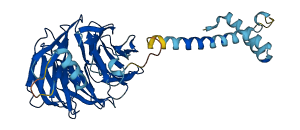
Descriptions
The autoinhibited protein was predicted that may have potential autoinhibitory elements via cis-regPred.
Autoinhibitory domains (AIDs)
Target domain |
|
Relief mechanism |
|
Assay |
cis-regPred |
Accessory elements
No accessory elements
Autoinhibited structure

Activated structure
1 structures for P43033
| Entry ID | Method | Resolution | Chain | Position | Source |
|---|---|---|---|---|---|
| AF-P43033-F1 | Predicted | AlphaFoldDB |
No variants for P43033
| Variant ID(s) | Position | Change | Description | Diseaes Association | Provenance |
|---|---|---|---|---|---|
| No variants for P43033 | |||||
No associated diseases with P43033
9 regional properties for P43033
| Type | Name | Position | InterPro Accession |
|---|---|---|---|
| repeat | WD40 repeat | 97 - 410 | IPR001680 |
| domain | LIS1 homology motif | 7 - 39 | IPR006594 |
| conserved_site | WD40 repeat, conserved site | 165 - 179 | IPR019775-1 |
| conserved_site | WD40 repeat, conserved site | 207 - 221 | IPR019775-2 |
| conserved_site | WD40 repeat, conserved site | 311 - 325 | IPR019775-3 |
| conserved_site | WD40 repeat, conserved site | 395 - 409 | IPR019775-4 |
| repeat | G-protein beta WD-40 repeat | 123 - 137 | IPR020472-1 |
| repeat | G-protein beta WD-40 repeat | 207 - 221 | IPR020472-2 |
| repeat | G-protein beta WD-40 repeat | 311 - 325 | IPR020472-3 |
Functions
7 GO annotations of cellular component
| Name | Definition |
|---|---|
| 1-alkyl-2-acetylglycerophosphocholine esterase complex | An enzyme complex composed of two catalytic alpha subunits, which form a catalytic dimer, and a non-catalytic, regulatory beta subunit; the catalytic dimer may be an alpha1/alpha1 or alpha2/alpha2 homodimer, or an alpha1/alpha2 heterodimer. Modulates the action of platelet-activating factor (PAF). |
| cytosol | The part of the cytoplasm that does not contain organelles but which does contain other particulate matter, such as protein complexes. |
| microtubule | Any of the long, generally straight, hollow tubes of internal diameter 12-15 nm and external diameter 24 nm found in a wide variety of eukaryotic cells; each consists (usually) of 13 protofilaments of polymeric tubulin, staggered in such a manner that the tubulin monomers are arranged in a helical pattern on the microtubular surface, and with the alpha/beta axes of the tubulin subunits parallel to the long axis of the tubule; exist in equilibrium with pool of tubulin monomers and can be rapidly assembled or disassembled in response to physiological stimuli; concerned with force generation, e.g. in the spindle. |
| microtubule associated complex | Any multimeric complex connected to a microtubule. |
| microtubule organizing center | An intracellular structure that can catalyze gamma-tubulin-dependent microtubule nucleation and that can anchor microtubules by interacting with their minus ends, plus ends or sides. |
| nuclear membrane | Either of the lipid bilayers that surround the nucleus and form the nuclear envelope; excludes the intermembrane space. |
| spindle | The array of microtubules and associated molecules that forms between opposite poles of a eukaryotic cell during mitosis or meiosis and serves to move the duplicated chromosomes apart. |
6 GO annotations of molecular function
| Name | Definition |
|---|---|
| dynactin binding | Binding to a dynactin complex; a large protein complex that activates dynein-based motor activity. |
| dynein complex binding | Binding to a dynein complex, a protein complex that contains two or three dynein heavy chains and several light chains, and has microtubule motor activity. |
| heparin binding | Binding to heparin, a member of a group of glycosaminoglycans found mainly as an intracellular component of mast cells and which consist predominantly of alternating alpha-(1->4)-linked D-galactose and N-acetyl-D-glucosamine-6-sulfate residues. |
| microtubule binding | Binding to a microtubule, a filament composed of tubulin monomers. |
| phospholipase binding | Binding to a phospholipase. |
| protein heterodimerization activity | Binding to a nonidentical protein to form a heterodimer. |
8 GO annotations of biological process
| Name | Definition |
|---|---|
| cell differentiation | The process in which relatively unspecialized cells, e.g. embryonic or regenerative cells, acquire specialized structural and/or functional features that characterize the cells, tissues, or organs of the mature organism or some other relatively stable phase of the organism's life history. Differentiation includes the processes involved in commitment of a cell to a specific fate and its subsequent development to the mature state. |
| cell division | The process resulting in division and partitioning of components of a cell to form more cells; may or may not be accompanied by the physical separation of a cell into distinct, individually membrane-bounded daughter cells. |
| establishment of mitotic spindle orientation | A cell cycle process that sets the alignment of mitotic spindle relative to other cellular structures. |
| lipid catabolic process | The chemical reactions and pathways resulting in the breakdown of lipids, compounds soluble in an organic solvent but not, or sparingly, in an aqueous solvent. |
| microtubule sliding | The movement of one microtubule along another microtubule. |
| nervous system development | The process whose specific outcome is the progression of nervous tissue over time, from its formation to its mature state. |
| platelet activating factor metabolic process | The chemical reactions and pathways involving platelet activating factor, 1-O-alkyl-2-acetyl-sn-glycerol 3-phosphocholine, where alkyl = hexadecyl or octadecyl. Platelet activating factor is an inflammatory mediator released from a variety of cells in response to various stimuli. |
| reelin-mediated signaling pathway | The series of molecular signals initiated by the binding of reelin (a secreted glycoprotein) to a receptor on the surface of a target cell, and ending with the regulation of a downstream cellular process, e.g. transcription. |
12 homologous proteins in AiPD
| UniProt AC | Gene Name | Protein Name | Species | Evidence Code |
|---|---|---|---|---|
| B0LSW3 | PAFAH1B1 | Platelet-activating factor acetylhydrolase IB subunit beta | Felis catus (Cat) (Felis silvestris catus) | PR |
| Q9PTR5 | PAFAH1B1 | Lissencephaly-1 homolog | Gallus gallus (Chicken) | PR |
| Q5IS43 | PAFAH1B1 | Platelet-activating factor acetylhydrolase IB subunit alpha | Pan troglodytes (Chimpanzee) | PR |
| Q7KNS3 | Lis-1 | Lissencephaly-1 homolog | Drosophila melanogaster (Fruit fly) | PR |
| Q96DN5 | TBC1D31 | TBC1 domain family member 31 | Homo sapiens (Human) | PR |
| P43034 | PAFAH1B1 | Platelet-activating factor acetylhydrolase IB subunit beta | Homo sapiens (Human) | PR |
| P63005 | Pafah1b1 | Platelet-activating factor acetylhydrolase IB subunit beta | Mus musculus (Mouse) | PR |
| Q9GL51 | PAFAH1B1 | Platelet-activating factor acetylhydrolase IB subunit alpha | Sus scrofa (Pig) | PR |
| P63004 | Pafah1b1 | Platelet-activating factor acetylhydrolase IB subunit alpha | Rattus norvegicus (Rat) | PR |
| Q6NZH4 | pafah1b1 | Lissencephaly-1 homolog | Xenopus tropicalis (Western clawed frog) (Silurana tropicalis) | PR |
| Q7T394 | pafah1b1a | Lissencephaly-1 homolog A | Danio rerio (Zebrafish) (Brachydanio rerio) | PR |
| Q803D2 | pafah1b1b | Lissencephaly-1 homolog B | Danio rerio (Zebrafish) (Brachydanio rerio) | PR |
| 10 | 20 | 30 | 40 | 50 | 60 |
| MVLSQRQRDE | LNRAIADYLR | SNGYEAAYSV | FKKEAELDMN | EELDKKYAGL | LEKKWTSVIR |
| 70 | 80 | 90 | 100 | 110 | 120 |
| LQKKVMELES | KLNEAKEEFT | SGGPLGQKRD | PKEWIPRPPE | KYALSGHRSP | VTRVIFHPVF |
| 130 | 140 | 150 | 160 | 170 | 180 |
| SVMVSASEDA | TIKVWDYETG | DFERTLKGHT | DSVEDISFDH | SGKLLASCSA | DMTIKLWDFQ |
| 190 | 200 | 210 | 220 | 230 | 240 |
| GFECIRTMHG | HDHNVSSVAI | MPNGDHIVSA | SRDKTIKMWE | VQTGYCVKTF | TGHREWVRMV |
| 250 | 260 | 270 | 280 | 290 | 300 |
| RPNQDGTLIA | SCSNDQTVRV | WVVATKECKA | ELREHEHVVE | CISWAPESSY | SSISEATGSE |
| 310 | 320 | 330 | 340 | 350 | 360 |
| TKKSGKPGPF | LLSGSRDKTI | KMWDVSTGMC | LMTLVGHDNW | VRGVLFHSGG | KFILSCADDK |
| 370 | 380 | 390 | 400 | ||
| TLRVWDYKNK | RCMKTLNAHE | HFVTSLDFHK | TAPYVVTGSV | DQTVKVWECR |