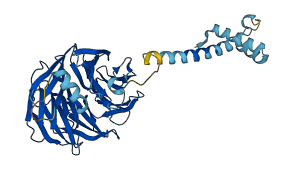
| acrosome assembly |
The formation of the acrosome from the spermatid Golgi. |
| actin cytoskeleton organization |
A process that is carried out at the cellular level which results in the assembly, arrangement of constituent parts, or disassembly of cytoskeletal structures comprising actin filaments and their associated proteins. |
| adult locomotory behavior |
Locomotory behavior in a fully developed and mature organism. |
| ameboidal-type cell migration |
Cell migration that is accomplished by extension and retraction of a pseudopodium. |
| auditory receptor cell development |
The process whose specific outcome is the progression of an auditory receptor cell over time, from its formation to the mature structure. Cell development does not include the steps involved in committing a cell to a specific fate. |
| brain development |
The process whose specific outcome is the progression of the brain over time, from its formation to the mature structure. Brain development begins with patterning events in the neural tube and ends with the mature structure that is the center of thought and emotion. The brain is responsible for the coordination and control of bodily activities and the interpretation of information from the senses (sight, hearing, smell, etc.). |
| brain morphogenesis |
The process in which the anatomical structures of the brain are generated and organized. The brain is one of the two components of the central nervous system and is the center of thought and emotion. It is responsible for the coordination and control of bodily activities and the interpretation of information from the senses (sight, hearing, smell, etc.). |
| cell migration |
The controlled self-propelled movement of a cell from one site to a destination guided by molecular cues. Cell migration is a central process in the development and maintenance of multicellular organisms. |
| cerebral cortex development |
The progression of the cerebral cortex over time from its initial formation until its mature state. The cerebral cortex is the outer layered region of the telencephalon. |
| cerebral cortex neuron differentiation |
The process in which a relatively unspecialized cell acquires specialized features of a neuron residing in the cerebral cortex. |
| chemical synaptic transmission |
The vesicular release of classical neurotransmitter molecules from a presynapse, across a chemical synapse, the subsequent activation of neurotransmitter receptors at the postsynapse of a target cell (neuron, muscle, or secretory cell) and the effects of this activation on the postsynaptic membrane potential and ionic composition of the postsynaptic cytosol. This process encompasses both spontaneous and evoked release of neurotransmitter and all parts of synaptic vesicle exocytosis. Evoked transmission starts with the arrival of an action potential at the presynapse. |
| cochlea development |
The progression of the cochlea over time from its formation to the mature structure. The cochlea is the snail-shaped portion of the inner ear that is responsible for the detection of sound. |
| corpus callosum morphogenesis |
The process in which the anatomical structures of the corpus callosum are generated and organized. The corpus callosum is a thick bundle of nerve fibers comprising a commissural plate connecting the two cerebral hemispheres. It consists of contralateral axon projections that provides communications between the right and left cerebral hemispheres. |
| cortical microtubule organization |
A process that is carried out at the cellular level which results in the assembly, arrangement of constituent parts, or disassembly of structures formed of microtubules and associated proteins in the cell cortex, i.e. just beneath the plasma membrane of a cell. |
| establishment of centrosome localization |
The directed movement of the centrosome to a specific location. |
| establishment of localization in cell |
Any process, occuring in a cell, that localizes a substance or cellular component. This may occur via movement, tethering or selective degradation. |
| establishment of mitotic spindle orientation |
A cell cycle process that sets the alignment of mitotic spindle relative to other cellular structures. |
| establishment of planar polarity of embryonic epithelium |
Coordinated organization of groups of cells in the plane of an embryonic epithelium, such that they all orient to similar coordinates. |
| germ cell development |
The process whose specific outcome is the progression of an immature germ cell over time, from its formation to the mature structure (gamete). A germ cell is any reproductive cell in a multicellular organism. |
| hippocampus development |
The progression of the hippocampus over time from its initial formation until its mature state. |
| interneuron migration |
The orderly movement of an interneuron from one site to another. |
| JNK cascade |
An intracellular protein kinase cascade containing at least a JNK (a MAPK), a JNKK (a MAPKK) and a JUN3K (a MAP3K). The cascade can also contain an additional tier: the upstream MAP4K. The kinases in each tier phosphorylate and activate the kinases in the downstream tier to transmit a signal within a cell. |
| layer formation in cerebral cortex |
The detachment of cells from radial glial fibers at the appropriate time when they cease to migrate and form distinct layer in the cerebral cortex. |
| learning or memory |
The acquisition and processing of information and/or the storage and retrieval of this information over time. |
| lipid catabolic process |
The chemical reactions and pathways resulting in the breakdown of lipids, compounds soluble in an organic solvent but not, or sparingly, in an aqueous solvent. |
| maintenance of centrosome location |
Any process in which a centrosome is maintained in a specific location within a cell and prevented from moving elsewhere. |
| microtubule cytoskeleton organization |
A process that is carried out at the cellular level which results in the assembly, arrangement of constituent parts, or disassembly of cytoskeletal structures comprising microtubules and their associated proteins. |
| microtubule cytoskeleton organization involved in establishment of planar polarity |
A process that is carried out at the cellular level which results in the assembly, arrangement of constituent parts, or disassembly of cytoskeletal structures comprising microtubules and their associated proteins and contributes to the establishment of planar polarity. |
| microtubule organizing center organization |
A process that is carried out at the cellular level which results in the assembly, arrangement of constituent parts, or disassembly of a microtubule organizing center, a structure from which microtubules grow. |
| microtubule sliding |
The movement of one microtubule along another microtubule. |
| microtubule-based process |
Any cellular process that depends upon or alters the microtubule cytoskeleton, that part of the cytoskeleton comprising microtubules and their associated proteins. |
| myeloid leukocyte migration |
The movement of a myeloid leukocyte within or between different tissues and organs of the body. |
| negative regulation of JNK cascade |
Any process that stops, prevents, or reduces the frequency, rate or extent of signal transduction mediated by the JNK cascade. |
| negative regulation of neuron projection development |
Any process that decreases the rate, frequency or extent of neuron projection development. Neuron projection development is the process whose specific outcome is the progression of a neuron projection over time, from its formation to the mature structure. A neuron projection is any process extending from a neural cell, such as axons or dendrites (collectively called neurites). |
| neuroblast proliferation |
The expansion of a neuroblast population by cell division. A neuroblast is any cell that will divide and give rise to a neuron. |
| neuromuscular process controlling balance |
Any process that an organism uses to control its balance, the orientation of the organism (or the head of the organism) in relation to the source of gravity. In humans and animals, balance is perceived through visual cues, the labyrinth system of the inner ears and information from skin pressure receptors and muscle and joint receptors. |
| neuron migration |
The characteristic movement of an immature neuron from germinal zones to specific positions where they will reside as they mature. |
| nuclear membrane disassembly |
The controlled breakdown of the nuclear membranes, for example during cellular division. |
| nuclear migration |
The directed movement of the nucleus to a specific location within a cell. |
| osteoclast development |
The process whose specific outcome is the progression of a osteoclast from its formation to the mature structure. Cell development does not include the steps involved in committing a cell to a specific fate. An osteoclast is a specialized phagocytic cell associated with the absorption and removal of the mineralized matrix of bone tissue. |
| positive regulation of axon extension |
Any process that activates or increases the frequency, rate or extent of axon extension. |
| positive regulation of cellular component organization |
Any process that activates or increases the frequency, rate or extent of a process involved in the formation, arrangement of constituent parts, or disassembly of cell structures, including the plasma membrane and any external encapsulating structures such as the cell wall and cell envelope. |
| positive regulation of cytokine-mediated signaling pathway |
Any process that activates or increases the frequency, rate or extent of a cytokine mediated signaling pathway. |
| positive regulation of dendritic spine morphogenesis |
Any process that increases the rate, frequency, or extent of dendritic spine morphogenesis, the process in which the anatomical structures of a dendritic spine are generated and organized. A dendritic spine is a protrusion from a dendrite and a specialized subcellular compartment involved in synaptic transmission. |
| positive regulation of embryonic development |
Any process that activates or increases the frequency, rate or extent of embryonic development. |
| positive regulation of mitotic cell cycle |
Any process that activates or increases the rate or extent of progression through the mitotic cell cycle. |
| protein secretion |
The controlled release of proteins from a cell. |
| radial glia-guided pyramidal neuron migration |
The radial migration of a pyramidal neuron along radial glial cells. |
| reelin-mediated signaling pathway |
The series of molecular signals initiated by the binding of reelin (a secreted glycoprotein) to a receptor on the surface of a target cell, and ending with the regulation of a downstream cellular process, e.g. transcription. |
| regulation of GTPase activity |
Any process that modulates the rate of GTP hydrolysis by a GTPase. |
| regulation of microtubule cytoskeleton organization |
Any process that modulates the frequency, rate or extent of the formation, arrangement of constituent parts, or disassembly of cytoskeletal structures comprising microtubules and their associated proteins. |
| retrograde axonal transport |
The directed movement of organelles or molecules along microtubules from the cell periphery toward the cell body in nerve cell axons. |
| stem cell division |
The self-renewing division of a stem cell. A stem cell is an undifferentiated cell, in the embryo or adult, that can undergo unlimited division and give rise to one or several different cell types. |
| transmission of nerve impulse |
The neurological system process in which a signal is transmitted through the nervous system by a combination of action potential propagation and synaptic transmission. |
| vesicle transport along microtubule |
The directed movement of a vesicle along a microtubule, mediated by motor proteins. This process begins with the attachment of a vesicle to a microtubule, and ends when the vesicle reaches its final destination. |