Q9LRM7
Gene name |
NCED6 (At3g24220, MUJ8.12) |
Protein name |
9-cis-epoxycarotenoid dioxygenase NCED6, chloroplastic |
Names |
AtNCED6 |
Species |
Arabidopsis thaliana (Mouse-ear cress) |
KEGG Pathway |
ath:AT3G24220 |
EC number |
1.13.11.51: With incorporation of two atoms of oxygen |
Protein Class |
|
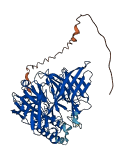
Descriptions
The autoinhibited protein was predicted that may have potential autoinhibitory elements via cis-regPred.
Autoinhibitory domains (AIDs)
Target domain |
|
Relief mechanism |
|
Assay |
cis-regPred |
Accessory elements
No accessory elements
Autoinhibited structure

Activated structure
1 structures for Q9LRM7
| Entry ID | Method | Resolution | Chain | Position | Source |
|---|---|---|---|---|---|
| AF-Q9LRM7-F1 | Predicted | AlphaFoldDB |
67 variants for Q9LRM7
| Variant ID(s) | Position | Change | Description | Diseaes Association | Provenance |
|---|---|---|---|---|---|
| ENSVATH02191674 | 8 | D>N | No | 1000Genomes | |
| ENSVATH10929932 | 13 | K>E | No | 1000Genomes | |
| ENSVATH05902219 | 30 | S>T | No | 1000Genomes | |
| ENSVATH05902220 | 31 | R>Q | No | 1000Genomes | |
| ENSVATH10929933 | 35 | I>M | No | 1000Genomes | |
| tmp_3_8761558_A_G | 40 | I>M | No | 1000Genomes | |
| tmp_3_8761575_T_A | 46 | L>H | No | 1000Genomes | |
| tmp_3_8761589_C_T | 51 | P>S | No | 1000Genomes | |
| ENSVATH05902221 | 52 | S>P | No | 1000Genomes | |
| tmp_3_8761596_C_T | 53 | P>L | No | 1000Genomes | |
| ENSVATH10929934 | 67 | Q>K | No | 1000Genomes | |
| ENSVATH02191675 | 80 | S>T | No | 1000Genomes | |
| tmp_3_8761681_C_G | 81 | I>M | No | 1000Genomes | |
| ENSVATH00344864 | 90 | P>Q | No | 1000Genomes | |
| ENSVATH02191676 | 102 | S>A | No | 1000Genomes | |
| ENSVATH05902222 | 116 | G>D | No | 1000Genomes | |
| ENSVATH10929955 | 122 | Q>R | No | 1000Genomes | |
| ENSVATH00344865 | 132 | I>V | No | 1000Genomes | |
| ENSVATH10929956 | 136 | A>P | No | 1000Genomes | |
| tmp_3_8761882_A_C | 148 | L>F | No | 1000Genomes | |
| tmp_3_8761914_G_T | 159 | S>I | No | 1000Genomes | |
| ENSVATH05902223 | 163 | D>E | No | 1000Genomes | |
| ENSVATH05902224 | 187 | S>P | No | 1000Genomes | |
| tmp_3_8762031_G_A | 198 | G>D | No | 1000Genomes | |
| ENSVATH00344866 | 213 | G>R | No | 1000Genomes | |
| ENSVATH10929957 | 219 | G>R | No | 1000Genomes | |
| ENSVATH00344867 | 231 | V>I | No | 1000Genomes | |
| tmp_3_8762192_G_C | 252 | D>H | No | 1000Genomes | |
| tmp_3_8762207_C_G | 257 | L>V | No | 1000Genomes | |
| ENSVATH00344869 | 264 | G>R | No | 1000Genomes | |
| ENSVATH10929958 | 273 | V>M | No | 1000Genomes | |
| tmp_3_8762273_G_T | 279 | V>L | No | 1000Genomes | |
| tmp_3_8762279_G_A | 281 | A>T | No | 1000Genomes | |
| ENSVATH10929959 | 281 | A>V | No | 1000Genomes | |
| ENSVATH00344870 | 286 | L>F | No | 1000Genomes | |
| tmp_3_8762297_C_T | 287 | H>Y | No | 1000Genomes | |
| ENSVATH02191678 | 299 | L>V | No | 1000Genomes | |
| tmp_3_8762347_A_T | 303 | K>N | No | 1000Genomes | |
| ENSVATH05902227 | 307 | C>W | No | 1000Genomes | |
| ENSVATH02191679 | 309 | K>E | No | 1000Genomes | |
| tmp_3_8762426_A_G | 330 | T>A | No | 1000Genomes | |
| tmp_3_8762436_T_A,C | 333 | F>S | No | 1000Genomes | |
| tmp_3_8762436_T_A,C | 333 | F>Y | No | 1000Genomes | |
| ENSVATH05902228 | 342 | V>I | No | 1000Genomes | |
| ENSVATH10929960 | 383 | V>E | No | 1000Genomes | |
| ENSVATH05902230 | 417 | D>H | No | 1000Genomes | |
| ENSVATH10929962 | 418 | T>M | No | 1000Genomes | |
| ENSVATH13990555 | 429 | V>I | No | 1000Genomes | |
| ENSVATH00344872 | 430 | E>Q | No | 1000Genomes | |
| ENSVATH05902232 | 432 | S>R | No | 1000Genomes | |
| ENSVATH05902231 | 432 | S>T | No | 1000Genomes | |
| ENSVATH05902233 | 453 | N>D | No | 1000Genomes | |
| tmp_3_8762797_T_G | 453 | N>K | No | 1000Genomes | |
| ENSVATH00344873 | 459 | I>V | No | 1000Genomes | |
| tmp_3_8762900_G_A | 488 | V>I | No | 1000Genomes | |
| ENSVATH13990556 | 490 | I>T | No | 1000Genomes | |
| tmp_3_8762916_G_C | 493 | G>A | No | 1000Genomes | |
| ENSVATH07973860 | 493 | G>S | No | 1000Genomes | |
| ENSVATH02191680 | 495 | V>I | No | 1000Genomes | |
| tmp_3_8762928_A_T | 497 | E>V | No | 1000Genomes | |
| tmp_3_8762982_G_C | 515 | G>A | No | 1000Genomes | |
| tmp_3_8762985_A_G | 516 | E>G | No | 1000Genomes | |
| ENSVATH02191681 | 532 | E>K | No | 1000Genomes | |
| ENSVATH02191682 | 544 | T>M | No | 1000Genomes | |
| ENSVATH05902234 | 553 | R>H | No | 1000Genomes | |
| ENSVATH13990557 | 569 | E>V | No | 1000Genomes | |
| ENSVATH13990558 | 571 | Q>L | No | 1000Genomes |
No associated diseases with Q9LRM7
No regional properties for Q9LRM7
| Type | Name | Position | InterPro Accession |
|---|---|---|---|
| No domain, repeats, and functional sites for Q9LRM7 | |||
Functions
| Description | ||
|---|---|---|
| EC Number | 1.13.11.51 | With incorporation of two atoms of oxygen |
| Subcellular Localization |
|
|
| PANTHER Family | ||
| PANTHER Subfamily | ||
| PANTHER Protein Class | ||
| PANTHER Pathway Category | No pathway information available | |
2 GO annotations of cellular component
| Name | Definition |
|---|---|
| chloroplast stroma | The space enclosed by the double membrane of a chloroplast but excluding the thylakoid space. It contains DNA, ribosomes and some temporary products of photosynthesis. |
| chloroplast thylakoid membrane | The pigmented membrane of a chloroplast thylakoid. An example of this component is found in Arabidopsis thaliana. |
3 GO annotations of molecular function
| Name | Definition |
|---|---|
| 9-cis-epoxycarotenoid dioxygenase activity | Catalysis of the reactions: a 9-cis-epoxycarotenoid + O2 = 2-cis,4-trans-xanthoxin + a 12'-apo-carotenal; 9-cis-violaxanthin + O2 = 2-cis,4-trans-xanthoxin + (3S,5R,6S)-5,6-epoxy-3-hydroxy-5,6-dihydro-12'-apo-beta-caroten-12'-al; and 9'-cis-neoxanthin + O2 = 2-cis,4-trans-xanthoxin + (3S,5R,6R)-5,6-dihydroxy-6,7-didehydro-5,6-dihydro-12'-apo-beta-caroten-12'-al. |
| carotenoid dioxygenase activity | Catalysis of the oxidative cleavage of carotenoids. |
| metal ion binding | Binding to a metal ion. |
4 GO annotations of biological process
| Name | Definition |
|---|---|
| abscisic acid biosynthetic process | The chemical reactions and pathways resulting in the formation of abscisic acid, 5-(1-hydroxy-2,6,6,trimethyl-4-oxocyclohex-2-en-1-y1)-3-methylpenta-2,4-dienoic acid. |
| carotene catabolic process | The chemical reactions and pathways resulting in the breakdown of carotenes, hydrocarbon carotenoids. |
| response to red light | Any process that results in a change in state or activity of a cell or an organism (in terms of movement, secretion, enzyme production, gene expression, etc.) as a result of a red light stimulus. Red light is electromagnetic radiation of wavelength of 580-700nm. An example of this response is seen at the beginning of many plant species developmental stages. These include germination, and the point when cotyledon expansion is triggered. In certain species these processes take place in response to absorption of red light by the pigment molecule phytochrome, but the signal can be reversed by exposure to far red light. During the initial phase the phytochrome molecule is only present in the red light absorbing form, but on absorption of red light it changes to a far red light absorbing form, triggering progress through development. An immediate short period of exposure to far red light entirely returns the pigment to its initial state and prevents triggering of the developmental process. A thirty minute break between red and subsequent far red light exposure renders the red light effect irreversible, and development then occurs regardless of whether far red light exposure subsequently occurs. |
| response to red or far red light | Any process that results in a change in state or activity of a cell or an organism (in terms of movement, secretion, enzyme production, gene expression, etc.) as a result of a red or far red light stimulus. Red light is electromagnetic radiation of wavelength of 580-700nm. Far red light is electromagnetic radiation of wavelength 700-800nm. An example of this response is seen at the beginning of many plant species developmental stages. These include germination, and the point when cotyledon expansion is triggered. In certain species these processes take place in response to absorption of red light by the pigment molecule phytochrome, but the signal can be reversed by exposure to far red light. During the initial phase the phytochrome molecule is only present in the red light absorbing form, but on absorption of red light it changes to a far red light absorbing form, triggering progress through development. An immediate short period of exposure to far red light entirely returns the pigment to its initial state and prevents triggering of the developmental process. A thirty minute break between red and subsequent far red light exposure renders the red light effect irreversible, and development then occurs regardless of whether far red light exposure subsequently occurs. |
9 homologous proteins in AiPD
| UniProt AC | Gene Name | Protein Name | Species | Evidence Code |
|---|---|---|---|---|
| Q28175 | RPE65 | Retinoid isomerohydrolase | Bos taurus (Bovine) | PR |
| Q9YGX2 | RPE65 | Retinoid isomerohydrolase | Gallus gallus (Chicken) | PR |
| Q16518 | RPE65 | Retinoid isomerohydrolase | Homo sapiens (Human) | PR |
| O24592 | VP14 | 9-cis-epoxycarotenoid dioxygenase 1, chloroplastic | Zea mays (Maize) | PR |
| Q91ZQ5 | Rpe65 | Retinoid isomerohydrolase | Mus musculus (Mouse) | PR |
| O70276 | Rpe65 | Retinoid isomerohydrolase | Rattus norvegicus (Rat) | PR |
| Q8LIY8 | CCD8B | Carotenoid cleavage dioxygenase 8 homolog B, chloroplastic | Oryza sativa subsp japonica (Rice) | PR |
| Q9C6Z1 | NCED5 | Probable 9-cis-epoxycarotenoid dioxygenase NCED5, chloroplastic | Arabidopsis thaliana (Mouse-ear cress) | PR |
| Q9LRR7 | NCED3 | 9-cis-epoxycarotenoid dioxygenase NCED3, chloroplastic | Arabidopsis thaliana (Mouse-ear cress) | PR |
| 10 | 20 | 30 | 40 | 50 | 60 |
| MQHSLRSDLL | PTKTSPRSHL | LPQPKNANIS | RRILINPFKI | PTLPDLTSPV | PSPVKLKPTY |
| 70 | 80 | 90 | 100 | 110 | 120 |
| PNLNLLQKLA | ATMLDKIESS | IVIPMEQNRP | LPKPTDPAVQ | LSGNFAPVNE | CPVQNGLEVV |
| 130 | 140 | 150 | 160 | 170 | 180 |
| GQIPSCLKGV | YIRNGANPMF | PPLAGHHLFD | GDGMIHAVSI | GFDNQVSYSC | RYTKTNRLVQ |
| 190 | 200 | 210 | 220 | 230 | 240 |
| ETALGRSVFP | KPIGELHGHS | GLARLALFTA | RAGIGLVDGT | RGMGVANAGV | VFFNGRLLAM |
| 250 | 260 | 270 | 280 | 290 | 300 |
| SEDDLPYQVK | IDGQGDLETI | GRFGFDDQID | SSVIAHPKVD | ATTGDLHTLS | YNVLKKPHLR |
| 310 | 320 | 330 | 340 | 350 | 360 |
| YLKFNTCGKK | TRDVEITLPE | PTMIHDFAIT | ENFVVIPDQQ | MVFKLSEMIR | GGSPVIYVKE |
| 370 | 380 | 390 | 400 | 410 | 420 |
| KMARFGVLSK | QDLTGSDINW | VDVPDCFCFH | LWNAWEERTE | EGDPVIVVIG | SCMSPPDTIF |
| 430 | 440 | 450 | 460 | 470 | 480 |
| SESGEPTRVE | LSEIRLNMRT | KESNRKVIVT | GVNLEAGHIN | RSYVGRKSQF | VYIAIADPWP |
| 490 | 500 | 510 | 520 | 530 | 540 |
| KCSGIAKVDI | QNGTVSEFNY | GPSRFGGEPC | FVPEGEGEED | KGYVMGFVRD | EEKDESEFVV |
| 550 | 560 | 570 | |||
| VDATDMKQVA | AVRLPERVPY | GFHGTFVSEN | QLKEQVF |