Q91ZQ5
Gene name |
Rpe65 |
Protein name |
Retinoid isomerohydrolase |
Names |
All-trans-retinyl-palmitate hydrolase, Lutein isomerase, Meso-zeaxanthin isomerase, Retinal pigment epithelium-specific 65 kDa protein, Retinol isomerase |
Species |
Mus musculus (Mouse) |
KEGG Pathway |
mmu:19892 |
EC number |
3.1.1.64: Carboxylic ester hydrolases |
Protein Class |
|
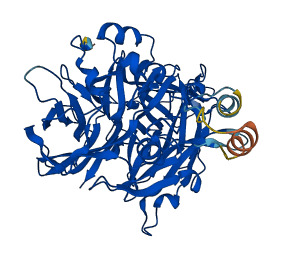
Descriptions
The autoinhibited protein was predicted that may have potential autoinhibitory elements via cis-regPred.
Autoinhibitory domains (AIDs)
Target domain |
|
Relief mechanism |
|
Assay |
cis-regPred |
Accessory elements
No accessory elements
Autoinhibited structure

Activated structure
1 structures for Q91ZQ5
| Entry ID | Method | Resolution | Chain | Position | Source |
|---|---|---|---|---|---|
| AF-Q91ZQ5-F1 | Predicted | AlphaFoldDB |
19 variants for Q91ZQ5
| Variant ID(s) | Position | Change | Description | Diseaes Association | Provenance |
|---|---|---|---|---|---|
| rs213942576 | 52 | V>I | No | EVA | |
| rs3388664853 | 110 | D>H | No | EVA | |
| rs3388669600 | 110 | D>V | No | EVA | |
| rs213144104 | 124 | K>R | No | EVA | |
| rs3393890692 | 171 | Y>* | No | EVA | |
| rs3388671745 | 172 | I>T | No | EVA | |
| rs3388671431 | 179 | A>G | No | EVA | |
| rs3388659145 | 200 | F>L | No | EVA | |
| rs3388651351 | 230 | P>T | No | EVA | |
| rs3388660674 | 257 | V>L | No | EVA | |
| rs3388664903 | 262 | F>S | No | EVA | |
| rs3388660656 | 263 | K>* | No | EVA | |
| rs3388666880 | 269 | S>R | No | EVA | |
| rs3388671460 | 293 | D>V | No | EVA | |
| rs3388671427 | 294 | K>N | No | EVA | |
| rs3388659121 | 340 | Y>H | No | EVA | |
| rs3388651300 | 376 | K>N | No | EVA | |
| rs3388672363 | 417 | E>K | No | EVA | |
| rs37197650 | 450 | M>L | increased light damage susceptibility [UniProt] | No | EVA |
1 associated diseases with Q91ZQ5
Without disease ID
No regional properties for Q91ZQ5
| Type | Name | Position | InterPro Accession |
|---|---|---|---|
| No domain, repeats, and functional sites for Q91ZQ5 | |||
Functions
| Description | ||
|---|---|---|
| EC Number | 3.1.1.64 | Carboxylic ester hydrolases |
| Subcellular Localization |
|
|
| PANTHER Family | ||
| PANTHER Subfamily | ||
| PANTHER Protein Class | ||
| PANTHER Pathway Category | No pathway information available | |
6 GO annotations of cellular component
| Name | Definition |
|---|---|
| cell body | The portion of a cell bearing surface projections such as axons, dendrites, cilia, or flagella that includes the nucleus, but excludes all cell projections. |
| cytoplasm | The contents of a cell excluding the plasma membrane and nucleus, but including other subcellular structures. |
| endoplasmic reticulum membrane | The lipid bilayer surrounding the endoplasmic reticulum. |
| membrane | A lipid bilayer along with all the proteins and protein complexes embedded in it an attached to it. |
| nucleus | A membrane-bounded organelle of eukaryotic cells in which chromosomes are housed and replicated. In most cells, the nucleus contains all of the cell's chromosomes except the organellar chromosomes, and is the site of RNA synthesis and processing. In some species, or in specialized cell types, RNA metabolism or DNA replication may be absent. |
| plasma membrane | The membrane surrounding a cell that separates the cell from its external environment. It consists of a phospholipid bilayer and associated proteins. |
10 GO annotations of molecular function
| Name | Definition |
|---|---|
| all-trans-retinyl-ester hydrolase, 11-cis retinol forming activity | Catalysis of the reaction: H(2)O + all-trans-retinyl ester = 11-cis-retinol + fatty acid. |
| all-trans-retinyl-palmitate hydrolase, 11-cis retinol forming activity | Catalysis of the reaction: H(2)O + all-trans-retinyl palmitate = 11-cis-retinol + H(+) + palmitate. |
| cardiolipin binding | Binding to cardiolipin. |
| isomerase activity | Catalysis of the geometric or structural changes within one molecule. Isomerase is the systematic name for any enzyme of EC class 5. |
| metal ion binding | Binding to a metal ion. |
| oxidoreductase activity, acting on single donors with incorporation of molecular oxygen, incorporation of two atoms of oxygen | Catalysis of an oxidation-reduction (redox) reaction in which hydrogen or electrons are transferred from one donor, and two oxygen atoms is incorporated into a donor. |
| phosphatidylcholine binding | Binding to a phosphatidylcholine, a glycophospholipid in which a phosphatidyl group is esterified to the hydroxyl group of choline. |
| phosphatidylserine binding | Binding to phosphatidylserine, a class of glycophospholipids in which a phosphatidyl group is esterified to the hydroxyl group of L-serine. |
| retinal isomerase activity | Catalysis of the reaction: all-trans-retinal = 11-cis-retinal. |
| retinol isomerase activity | Catalysis of the reaction: all-trans-retinol = 11-cis-retinol. |
14 GO annotations of biological process
| Name | Definition |
|---|---|
| cellular response to electrical stimulus | Any process that results in a change in state or activity of a cell (in terms of movement, secretion, enzyme production, gene expression, etc.) as a result of an electrical stimulus. |
| circadian rhythm | Any biological process in an organism that recurs with a regularity of approximately 24 hours. |
| detection of light stimulus involved in visual perception | The series of events involved in visual perception in which a light stimulus is received and converted into a molecular signal. |
| insulin receptor signaling pathway | The series of molecular signals generated as a consequence of the insulin receptor binding to insulin. |
| neural retina development | The progression of the neural retina over time from its initial formation to the mature structure. The neural retina is the part of the retina that contains neurons and photoreceptor cells. |
| regulation of gene expression | Any process that modulates the frequency, rate or extent of gene expression. Gene expression is the process in which a gene's coding sequence is converted into a mature gene product (protein or RNA). |
| retina development in camera-type eye | The process whose specific outcome is the progression of the retina over time, from its formation to the mature structure. The retina is the innermost layer or coating at the back of the eyeball, which is sensitive to light and in which the optic nerve terminates. |
| retina homeostasis | A tissue homeostatic process involved in the maintenance of an internal equilibrium within the retina of the eye, including control of cellular proliferation and death and control of metabolic function. |
| retina morphogenesis in camera-type eye | The process in which the anatomical structure of the retina is generated and organized. |
| retinal metabolic process | The chemical reactions and pathways involving retinal, a compound that plays an important role in the visual process in most vertebrates. In the retina, retinal combines with opsins to form visual pigments. Retinal is one of the forms of vitamin A. |
| retinoid metabolic process | The chemical reactions and pathways involving retinoids, any member of a class of isoprenoids that contain or are derived from four prenyl groups linked head-to-tail. Retinoids include retinol and retinal and structurally similar natural derivatives or synthetic compounds, but need not have vitamin A activity. |
| retinol metabolic process | The chemical reactions and pathways involving retinol, one of the three compounds that makes up vitamin A. |
| visual perception | The series of events required for an organism to receive a visual stimulus, convert it to a molecular signal, and recognize and characterize the signal. Visual stimuli are detected in the form of photons and are processed to form an image. |
| zeaxanthin biosynthetic process | The chemical reactions and pathways resulting in the formation of zeaxanthin. |
10 homologous proteins in AiPD
| UniProt AC | Gene Name | Protein Name | Species | Evidence Code |
|---|---|---|---|---|
| Q28175 | RPE65 | Retinoid isomerohydrolase | Bos taurus (Bovine) | PR |
| Q9YGX2 | RPE65 | Retinoid isomerohydrolase | Gallus gallus (Chicken) | PR |
| Q9TVB8 | RPE65 | Retinoid isomerohydrolase | Canis lupus familiaris (Dog) (Canis familiaris) | PR |
| Q16518 | RPE65 | Retinoid isomerohydrolase | Homo sapiens (Human) | PR |
| O24592 | VP14 | 9-cis-epoxycarotenoid dioxygenase 1, chloroplastic | Zea mays (Maize) | PR |
| O70276 | Rpe65 | Retinoid isomerohydrolase | Rattus norvegicus (Rat) | PR |
| Q8LIY8 | CCD8B | Carotenoid cleavage dioxygenase 8 homolog B, chloroplastic | Oryza sativa subsp japonica (Rice) | PR |
| Q9C6Z1 | NCED5 | Probable 9-cis-epoxycarotenoid dioxygenase NCED5, chloroplastic | Arabidopsis thaliana (Mouse-ear cress) | PR |
| Q9LRR7 | NCED3 | 9-cis-epoxycarotenoid dioxygenase NCED3, chloroplastic | Arabidopsis thaliana (Mouse-ear cress) | PR |
| Q9LRM7 | NCED6 | 9-cis-epoxycarotenoid dioxygenase NCED6, chloroplastic | Arabidopsis thaliana (Mouse-ear cress) | PR |
| 10 | 20 | 30 | 40 | 50 | 60 |
| MSIQIEHPAG | GYKKLFETVE | ELSSPLTAHV | TGRIPLWLTG | SLLRCGPGLF | EVGSEPFYHL |
| 70 | 80 | 90 | 100 | 110 | 120 |
| FDGQALLHKF | DFKEGHVTYH | RRFIRTDAYV | RAMTEKRIVI | TEFGTCAFPD | PCKNIFSRFF |
| 130 | 140 | 150 | 160 | 170 | 180 |
| SYFKGVEVTD | NALVNIYPVG | EDYYACTETN | FITKINPETL | ETIKQVDLCN | YISVNGATAH |
| 190 | 200 | 210 | 220 | 230 | 240 |
| PHIESDGTVY | NIGNCFGKNF | TVAYNIIKIP | PLKADKEDPI | NKSEVVVQFP | CSDRFKPSYV |
| 250 | 260 | 270 | 280 | 290 | 300 |
| HSFGLTPNYI | VFVETPVKIN | LFKFLSSWSL | WGANYMDCFE | SNESMGVWLH | VADKKRRKYF |
| 310 | 320 | 330 | 340 | 350 | 360 |
| NNKYRTSPFN | LFHHINTYED | NGFLIVDLCC | WKGFEFVYNY | LYLANLRENW | EEVKRNAMKA |
| 370 | 380 | 390 | 400 | 410 | 420 |
| PQPEVRRYVL | PLTIDKVDTG | RNLVTLPHTT | ATATLRSDET | IWLEPEVLFS | GPRQAFEFPQ |
| 430 | 440 | 450 | 460 | 470 | 480 |
| INYQKFGGKP | YTYAYGLGLN | HFVPDKLCKM | NVKTKEIWMW | QEPDSYPSEP | IFVSQPDALE |
| 490 | 500 | 510 | 520 | 530 | |
| EDDGVVLSVV | VSPGAGQKPA | YLLVLNAKDL | SEIARAEVET | NIPVTFHGLF | KRS |