Q9H9E3
Gene name |
COG4 |
Protein name |
Conserved oligomeric Golgi complex subunit 4 |
Names |
COG complex subunit 4, Component of oligomeric Golgi complex 4 |
Species |
Homo sapiens (Human) |
KEGG Pathway |
hsa:25839 |
EC number |
|
Protein Class |
|
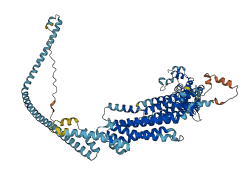
Descriptions
The autoinhibited protein was predicted that may have potential autoinhibitory elements via cis-regPred.
Autoinhibitory domains (AIDs)
Target domain |
|
Relief mechanism |
|
Assay |
cis-regPred |
Accessory elements
No accessory elements
Autoinhibited structure

Activated structure
2 structures for Q9H9E3
| Entry ID | Method | Resolution | Chain | Position | Source |
|---|---|---|---|---|---|
| 3HR0 | X-ray | 190 A | A/B | 525-785 | PDB |
| AF-Q9H9E3-F1 | Predicted | AlphaFoldDB |
3 variants for Q9H9E3
| Variant ID(s) | Position | Change | Description | Diseaes Association | Provenance |
|---|---|---|---|---|---|
|
VAR_081564 rs1555575860 |
512 | G>R | SWILS; delayed anterograde vesicular trafficking from the ER to the Golgi and accelerated retrograde vesicular recycling from the Golgi to the ER, leading to a decrease in Golgi volume, as well as morphologic abnormalities with collapse of the Golgi stacks in affected fibroblasts; altered decorin/DCN Golgi-dependent glycosylation; no effect on protein expression [UniProt] | Yes |
UniProt dbSNP |
| VAR_063767 | 729 | R>W | CDG2J; severe defects in glycosylation [UniProt] | Yes | UniProt |
|
VAR_058009 rs3931036 |
158 | T>I | No |
UniProt dbSNP |
2 associated diseases with Q9H9E3
[MIM: 613489]: Congenital disorder of glycosylation 2J (CDG2J)
A multisystem disorder caused by a defect in glycoprotein biosynthesis and characterized by under-glycosylated serum glycoproteins. Congenital disorders of glycosylation result in a wide variety of clinical features, such as defects in the nervous system development, psychomotor retardation, dysmorphic features, hypotonia, coagulation disorders, and immunodeficiency. The broad spectrum of features reflects the critical role of N-glycoproteins during embryonic development, differentiation, and maintenance of cell functions. {ECO:0000269|PubMed:19494034, ECO:0000269|PubMed:19651599}. Note=The disease is caused by variants affecting the gene represented in this entry.
[MIM: 618150]: Saul-Wilson syndrome (SWILS)
A rare skeletal dysplasia with characteristic dysmorphic and radiographic findings, as well as early developmental delay, primarily involving speech, with eventual normal cognition. Clinical findings include marked short stature, prominent forehead with an enlarged anterior fontanel, prominent eyes with cataracts, narrow nasal bridge with a convex nasal ridge, micrognathia, clubfoot, brachydactyly, and short distal phalanges of fingers. Radiographic changes include platyspondyly, irregular end plates of vertebral bodies, and hypoplasia of the odontoid process with cervical instability in the spine, coxa valga, overtubulation, metaphyseal flaring and megaepiphyses in the long bones, while the hands and feet exhibit short phalanges, metacarpals and metatarsals, cone-shaped epiphyses of phalanges, and accessory ossification centers of metacarpals and metatarsals. {ECO:0000269|PubMed:30290151}. Note=The disease is caused by variants affecting the gene represented in this entry.
Without disease ID
- A multisystem disorder caused by a defect in glycoprotein biosynthesis and characterized by under-glycosylated serum glycoproteins. Congenital disorders of glycosylation result in a wide variety of clinical features, such as defects in the nervous system development, psychomotor retardation, dysmorphic features, hypotonia, coagulation disorders, and immunodeficiency. The broad spectrum of features reflects the critical role of N-glycoproteins during embryonic development, differentiation, and maintenance of cell functions. {ECO:0000269|PubMed:19494034, ECO:0000269|PubMed:19651599}. Note=The disease is caused by variants affecting the gene represented in this entry.
- A rare skeletal dysplasia with characteristic dysmorphic and radiographic findings, as well as early developmental delay, primarily involving speech, with eventual normal cognition. Clinical findings include marked short stature, prominent forehead with an enlarged anterior fontanel, prominent eyes with cataracts, narrow nasal bridge with a convex nasal ridge, micrognathia, clubfoot, brachydactyly, and short distal phalanges of fingers. Radiographic changes include platyspondyly, irregular end plates of vertebral bodies, and hypoplasia of the odontoid process with cervical instability in the spine, coxa valga, overtubulation, metaphyseal flaring and megaepiphyses in the long bones, while the hands and feet exhibit short phalanges, metacarpals and metatarsals, cone-shaped epiphyses of phalanges, and accessory ossification centers of metacarpals and metatarsals. {ECO:0000269|PubMed:30290151}. Note=The disease is caused by variants affecting the gene represented in this entry.
1 regional properties for Q9H9E3
| Type | Name | Position | InterPro Accession |
|---|---|---|---|
| domain | Conserved oligomeric Golgi complex, subunit 4 | 188 - 498 | IPR013167 |
Functions
4 GO annotations of cellular component
| Name | Definition |
|---|---|
| cytosol | The part of the cytoplasm that does not contain organelles but which does contain other particulate matter, such as protein complexes. |
| Golgi membrane | The lipid bilayer surrounding any of the compartments of the Golgi apparatus. |
| Golgi transport complex | A multisubunit tethering complex of the CATCHR family (complexes associated with tethering containing helical rods) that has a role in tethering vesicles to the Golgi prior to fusion. Composed of 8 subunits COG1-8. |
| trans-Golgi network membrane | The lipid bilayer surrounding any of the compartments that make up the trans-Golgi network. |
1 GO annotations of molecular function
| Name | Definition |
|---|---|
| identical protein binding | Binding to an identical protein or proteins. |
6 GO annotations of biological process
| Name | Definition |
|---|---|
| glycosylation | The covalent attachment and further modification of carbohydrate residues to a substrate molecule. |
| Golgi organization | A process that is carried out at the cellular level which results in the assembly, arrangement of constituent parts, or disassembly of the Golgi apparatus. |
| Golgi vesicle prefusion complex stabilization | The binding of specific proteins to the t-SNARE/v-SNARE/SNAP25 complex, by which the Golgi vesicle prefusion complex is stabilized. |
| protein transport | The directed movement of proteins into, out of or within a cell, or between cells, by means of some agent such as a transporter or pore. |
| retrograde transport, vesicle recycling within Golgi | The retrograde movement of substances within the Golgi, mediated by COP I vesicles. Cis-Golgi vesicles are constantly moving forward through the Golgi stack by cisternal progression, eventually becoming trans-Golgi vesicles. They then selectively transport membrane and luminal proteins from the trans- to the medial-Golgi while leaving others behind in the trans-Golgi cisternae; similarly, they selectively move proteins from the medial- to the cis-Golgi. |
| retrograde vesicle-mediated transport, Golgi to endoplasmic reticulum | The directed movement of substances from the Golgi back to the endoplasmic reticulum, mediated by vesicles bearing specific protein coats such as COPI or COG. |
5 homologous proteins in AiPD
| UniProt AC | Gene Name | Protein Name | Species | Evidence Code |
|---|---|---|---|---|
| Q06096 | COG4 | Conserved oligomeric Golgi complex subunit 4 | Saccharomyces cerevisiae (strain ATCC 204508 / S288c) (Baker's yeast) | PR |
| Q3MHG0 | COG4 | Conserved oligomeric Golgi complex subunit 4 | Bos taurus (Bovine) | PR |
| Q95TN4 | Cog4 | Conserved oligomeric Golgi complex subunit 4 | Drosophila melanogaster (Fruit fly) | PR |
| Q8R1U1 | Cog4 | Conserved oligomeric Golgi complex subunit 4 | Mus musculus (Mouse) | PR |
| Q8L838 | COG4 | Conserved oligomeric Golgi complex subunit 4 | Arabidopsis thaliana (Mouse-ear cress) | PR |
| 10 | 20 | 30 | 40 | 50 | 60 |
| MADLDSPPKL | SGVQQPSEGV | GGGRCSEISA | ELIRSLTELQ | ELEAVYERLC | GEEKVVEREL |
| 70 | 80 | 90 | 100 | 110 | 120 |
| DALLEQQNTI | ESKMVTLHRM | GPNLQLIEGD | AKQLAGMITF | TCNLAENVSS | KVRQLDLAKN |
| 130 | 140 | 150 | 160 | 170 | 180 |
| RLYQAIQRAD | DILDLKFCMD | GVQTALRSED | YEQAAAHTHR | YLCLDKSVIE | LSRQGKEGSM |
| 190 | 200 | 210 | 220 | 230 | 240 |
| IDANLKLLQE | AEQRLKAIVA | EKFAIATKEG | DLPQVERFFK | IFPLLGLHEE | GLRKFSEYLC |
| 250 | 260 | 270 | 280 | 290 | 300 |
| KQVASKAEEN | LLMVLGTDMS | DRRAAVIFAD | TLTLLFEGIA | RIVETHQPIV | ETYYGPGRLY |
| 310 | 320 | 330 | 340 | 350 | 360 |
| TLIKYLQVEC | DRQVEKVVDK | FIKQRDYHQQ | FRHVQNNLMR | NSTTEKIEPR | ELDPILTEVT |
| 370 | 380 | 390 | 400 | 410 | 420 |
| LMNARSELYL | RFLKKRISSD | FEVGDSMASE | EVKQEHQKCL | DKLLNNCLLS | CTMQELIGLY |
| 430 | 440 | 450 | 460 | 470 | 480 |
| VTMEEYFMRE | TVNKAVALDT | YEKGQLTSSM | VDDVFYIVKK | CIGRALSSSS | IDCLCAMINL |
| 490 | 500 | 510 | 520 | 530 | 540 |
| ATTELESDFR | DVLCNKLRMG | FPATTFQDIQ | RGVTSAVNIM | HSSLQQGKFD | TKGIESTDEA |
| 550 | 560 | 570 | 580 | 590 | 600 |
| KMSFLVTLNN | VEVCSENIST | LKKTLESDCT | KLFSQGIGGE | QAQAKFDSCL | SDLAAVSNKF |
| 610 | 620 | 630 | 640 | 650 | 660 |
| RDLLQEGLTE | LNSTAIKPQV | QPWINSFFSV | SHNIEEEEFN | DYEANDPWVQ | QFILNLEQQM |
| 670 | 680 | 690 | 700 | 710 | 720 |
| AEFKASLSPV | IYDSLTGLMT | SLVAVELEKV | VLKSTFNRLG | GLQFDKELRS | LIAYLTTVTT |
| 730 | 740 | 750 | 760 | 770 | 780 |
| WTIRDKFARL | SQMATILNLE | RVTEILDYWG | PNSGPLTWRL | TPAEVRQVLA | LRIDFRSEDI |
| KRLRL |