Q06096
Gene name |
COG4 (SEC38, SGF1, YPR105C, P8283.16) |
Protein name |
Conserved oligomeric Golgi complex subunit 4 |
Names |
COG complex subunit 4, Component of oligomeric Golgi complex 4, Protein SEC38 |
Species |
Saccharomyces cerevisiae (strain ATCC 204508 / S288c) (Baker's yeast) |
KEGG Pathway |
sce:YPR105C |
EC number |
|
Protein Class |
|
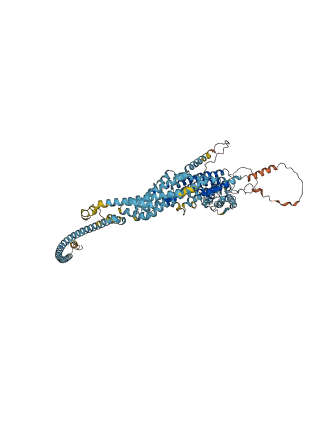
Descriptions
The autoinhibited protein was predicted that may have potential autoinhibitory elements via cis-regPred.
Autoinhibitory domains (AIDs)
Target domain |
|
Relief mechanism |
|
Assay |
cis-regPred |
Accessory elements
No accessory elements
Autoinhibited structure

Activated structure
1 structures for Q06096
| Entry ID | Method | Resolution | Chain | Position | Source |
|---|---|---|---|---|---|
| AF-Q06096-F1 | Predicted | AlphaFoldDB |
12 variants for Q06096
| Variant ID(s) | Position | Change | Description | Diseaes Association | Provenance |
|---|---|---|---|---|---|
| s16-739552 | 6 | S>P | No | SGRP | |
| s16-739131 | 146 | T>I | No | SGRP | |
| s16-738973 | 199 | S>G | No | SGRP | |
| s16-738949 | 207 | E>K | No | SGRP | |
| s16-738538 | 344 | D>N | No | SGRP | |
| s16-738525 | 348 | D>G | No | SGRP | |
| s16-738115 | 485 | V>I | No | SGRP | |
| s16-737722 | 616 | V>I | No | SGRP | |
| s16-737716 | 618 | R>W | No | SGRP | |
| s16-737448 | 707 | R>P | No | SGRP | |
| s16-737359 | 737 | K>Q | No | SGRP | |
| s16-737316 | 751 | N>S | No | SGRP |
No associated diseases with Q06096
1 regional properties for Q06096
| Type | Name | Position | InterPro Accession |
|---|---|---|---|
| domain | Conserved oligomeric Golgi complex, subunit 4 | 190 - 526 | IPR013167 |
3 GO annotations of cellular component
| Name | Definition |
|---|---|
| cytosol | The part of the cytoplasm that does not contain organelles but which does contain other particulate matter, such as protein complexes. |
| Golgi membrane | The lipid bilayer surrounding any of the compartments of the Golgi apparatus. |
| Golgi transport complex | A multisubunit tethering complex of the CATCHR family (complexes associated with tethering containing helical rods) that has a role in tethering vesicles to the Golgi prior to fusion. Composed of 8 subunits COG1-8. |
No GO annotations of molecular function
| Name | Definition |
|---|---|
| No GO annotations for molecular function |
5 GO annotations of biological process
| Name | Definition |
|---|---|
| autophagy of peroxisome | The process in which peroxisomes are delivered to a type of vacuole and degraded in response to changing nutrient conditions. |
| cytoplasm to vacuole transport by the Cvt pathway | A cytoplasm to vacuole targeting pathway that uses machinery common with autophagy. The Cvt vesicle is formed when the receptor protein, Atg19, binds to the complexes of the target protein (aminopeptidase or alpha-mannosidase homododecamers), forming the Cvt complex. Atg11 binds to Atg9 and transports the Cvt complex to the pre-autophagosome (PAS). The phagophore membrane expands around the Cvt complex (excluding bulk cytoplasm) forming the Cvt vesicle. This pathway is mostly observed in yeast. |
| intra-Golgi vesicle-mediated transport | The directed movement of substances within the Golgi, mediated by small transport vesicles. These either fuse with the cis-Golgi or with each other to form the membrane stacks known as the cis-Golgi reticulum (network). |
| macroautophagy | The major inducible pathway for the general turnover of cytoplasmic constituents in eukaryotic cells, it is also responsible for the degradation of active cytoplasmic enzymes and organelles during nutrient starvation. Macroautophagy involves the formation of double-membrane-bounded autophagosomes which enclose the cytoplasmic constituent targeted for degradation in a membrane-bounded structure. Autophagosomes then fuse with a lysosome (or vacuole) releasing single-membrane-bounded autophagic bodies that are then degraded within the lysosome (or vacuole). Some types of macroautophagy, e.g. pexophagy, mitophagy, involve selective targeting of the targets to be degraded. |
| retrograde transport, vesicle recycling within Golgi | The retrograde movement of substances within the Golgi, mediated by COP I vesicles. Cis-Golgi vesicles are constantly moving forward through the Golgi stack by cisternal progression, eventually becoming trans-Golgi vesicles. They then selectively transport membrane and luminal proteins from the trans- to the medial-Golgi while leaving others behind in the trans-Golgi cisternae; similarly, they selectively move proteins from the medial- to the cis-Golgi. |
6 homologous proteins in AiPD
| UniProt AC | Gene Name | Protein Name | Species | Evidence Code |
|---|---|---|---|---|
| Q3MHG0 | COG4 | Conserved oligomeric Golgi complex subunit 4 | Bos taurus (Bovine) | PR |
| Q95TN4 | Cog4 | Conserved oligomeric Golgi complex subunit 4 | Drosophila melanogaster (Fruit fly) | PR |
| Q9NX36 | DNAJC28 | DnaJ homolog subfamily C member 28 | Homo sapiens (Human) | PR |
| Q9H9E3 | COG4 | Conserved oligomeric Golgi complex subunit 4 | Homo sapiens (Human) | PR |
| Q8R1U1 | Cog4 | Conserved oligomeric Golgi complex subunit 4 | Mus musculus (Mouse) | PR |
| Q8L838 | COG4 | Conserved oligomeric Golgi complex subunit 4 | Arabidopsis thaliana (Mouse-ear cress) | PR |
| 10 | 20 | 30 | 40 | 50 | 60 |
| MEGQKSNASW | ESSIIEGQLS | KNLARYTLLL | DKLSTLSQID | KLSEVIANDY | AKQSKQLNAF |
| 70 | 80 | 90 | 100 | 110 | 120 |
| VQQSQSSLNK | ESRKLELQRT | NLTTTLTQFH | ETVATISSSN | ARAKAIHDDI | ETVDQERALV |
| 130 | 140 | 150 | 160 | 170 | 180 |
| NKTLQFVKDV | RTLKNNISLA | HSALETKDYL | VAATAINEIR | SLPDKKLIVS | EFAKKVVPSS |
| 190 | 200 | 210 | 220 | 230 | 240 |
| EIPEEPAILI | KNWCKELTSL | FQEQFMEATR | TQDIKELTLM | FKMFPMIGQD | VLGLDLYSKY |
| 250 | 260 | 270 | 280 | 290 | 300 |
| VCDIIADESR | KIMSNSMENS | TKFQGFFSQV | LLHLFKIVST | IINDHSKVIA | TCYGKKHMVH |
| 310 | 320 | 330 | 340 | 350 | 360 |
| VMEKVEKEAD | LQASLILDIF | METRKIERTI | HDINEWEHSQ | KNEDVNIDSN | QSDIETDGET |
| 370 | 380 | 390 | 400 | 410 | 420 |
| EKSSIISIHD | LALLIMEFSQ | ILQNWSMYSR | FYSVKWNEFS | DLHPHVLQPP | PPIADGKFAL |
| 430 | 440 | 450 | 460 | 470 | 480 |
| KLKQDKVFDE | FQVFVLNHLQ | RSFRNSISLE | ELPSLNDLIT | AVPLNDHDNI | SYPVTSVLDD |
| 490 | 500 | 510 | 520 | 530 | 540 |
| LILLVRKNLI | SVVNTGQFKL | LASFLNELVK | FFQNRFLVKF | MQNKFKLLQS | KLASNVSLKR |
| 550 | 560 | 570 | 580 | 590 | 600 |
| YIPKGEEQSA | TSRSVSPPAN | KFSPLSRFTF | RGAAASALTN | IQSNLQAVVA | EDEDSILALH |
| 610 | 620 | 630 | 640 | 650 | 660 |
| HYLIYLNTLY | LSKVYVHRLL | SIEILEDDSQ | RILRDNFPFD | NDAAQLQNLI | INSEKLVLEQ |
| 670 | 680 | 690 | 700 | 710 | 720 |
| TDKLSKWAVK | YLFQNILQNR | VRNLLGTVFV | NSASSNSSTS | NQKNVSRDYS | AGSNQKNYIT |
| 730 | 740 | 750 | 760 | 770 | 780 |
| SIEDFEDLSQ | INSFNSKWNQ | LIIPYKNILH | NEAYAELLSV | IVDYIVTTLE | QRIWTLEFNE |
| 790 | 800 | 810 | 820 | 830 | 840 |
| LGVTKLDREL | SLFIGNMCGL | NYNLREKFLK | LTQIVLLLGL | DDDNFDLTTG | DIKDDFNGTF |
| 850 | 860 | ||||
| DWVINSQERI | KARNMKIDRT | Q |