Q9H1Y0
Gene name |
ATG5 (APG5L, ASP) |
Protein name |
Autophagy protein 5 |
Names |
APG5-like, Apoptosis-specific protein |
Species |
Homo sapiens (Human) |
KEGG Pathway |
hsa:9474 |
EC number |
|
Protein Class |
|
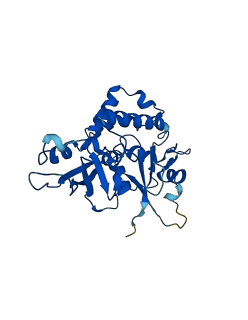
Descriptions
The autoinhibited protein was predicted that may have potential autoinhibitory elements via cis-regPred.
Autoinhibitory domains (AIDs)
Target domain |
|
Relief mechanism |
|
Assay |
cis-regPred |
Accessory elements
No accessory elements
Autoinhibited structure

Activated structure
10 structures for Q9H1Y0
| Entry ID | Method | Resolution | Chain | Position | Source |
|---|---|---|---|---|---|
| 4GDK | X-ray | 270 A | B/E | 1-275 | PDB |
| 4GDL | X-ray | 288 A | B | 1-275 | PDB |
| 4NAW | X-ray | 220 A | B/F/J/N | 1-275 | PDB |
| 4TQ0 | X-ray | 270 A | A/C/E | 1-275 | PDB |
| 4TQ1 | X-ray | 180 A | A | 1-275 | PDB |
| 5D7G | X-ray | 300 A | A/C/E/G | 1-275 | PDB |
| 5NPV | X-ray | 310 A | A/C | 1-275 | PDB |
| 5NPW | X-ray | 310 A | A/C/E/G | 1-275 | PDB |
| 7W36 | X-ray | 300 A | A | 1-275 | PDB |
| AF-Q9H1Y0-F1 | Predicted | AlphaFoldDB |
142 variants for Q9H1Y0
| Variant ID(s) | Position | Change | Description | Diseaes Association | Provenance |
|---|---|---|---|---|---|
|
VAR_079274 CA365319959 rs1131692265 RCV000496077 |
122 | E>D | Spinocerebellar ataxia, autosomal recessive 25 SCAR25; reduced conjugation to ATG12; decrease in autophagy activity [ClinVar, UniProt] | Yes |
ClinGen ClinVar UniProt Ensembl dbSNP |
| TCGA novel | 2 | T>A | Variant assessed as Somatic; impact. [NCI-TCGA] | No | NCI-TCGA |
|
CA3942747 rs770274468 |
3 | D>G | No |
ClinGen ExAC gnomAD |
|
|
CA365321146 rs1471586990 |
4 | D>V | No |
ClinGen TOPMed |
|
|
rs973267606 CA145553951 |
7 | V>M | No |
ClinGen Ensembl |
|
| TCGA novel | 9 | R>H | Variant assessed as Somatic; impact. [NCI-TCGA] | No | NCI-TCGA |
| TCGA novel | 11 | V>A | Variant assessed as Somatic; impact. [NCI-TCGA] | No | NCI-TCGA |
|
CA365321071 rs1562272472 COSM1132070 |
15 | R>* | Variant assessed as Somatic; 0.0 impact. prostate [NCI-TCGA, Cosmic] | No |
ClinGen cosmic curated Ensembl NCI-TCGA |
|
CA3942745 rs373794853 |
15 | R>Q | Variant assessed as Somatic; 0.0 impact. [NCI-TCGA] | No |
ClinGen ESP ExAC NCI-TCGA TOPMed gnomAD |
|
CA3942743 rs747253760 |
18 | T>A | No |
ClinGen ExAC gnomAD |
|
|
rs780471238 CA3942742 |
20 | F>L | No |
ClinGen ExAC gnomAD |
|
|
rs1333025395 CA365321030 |
21 | T>M | No |
ClinGen gnomAD |
|
|
RCV000677279 CA365321031 rs1333025395 |
21 | T>R | No |
ClinGen ClinVar dbSNP gnomAD |
|
| TCGA novel | 24 | Q>H | Variant assessed as Somatic; impact. [NCI-TCGA] | No | NCI-TCGA |
|
rs1317926026 CA365321012 |
24 | Q>R | No |
ClinGen gnomAD |
|
|
CA145553949 CA365321002 rs1003280752 |
25 | D>E | No |
ClinGen TOPMed gnomAD |
|
|
rs779035963 CA3942739 |
27 | I>T | No |
ClinGen ExAC gnomAD |
|
|
rs756019944 CA3942738 |
28 | T>P | No |
ClinGen ExAC gnomAD |
|
|
rs1314441812 CA365320956 |
32 | A>S | No |
ClinGen TOPMed |
|
|
CA365320953 rs1357267494 |
32 | A>V | No |
ClinGen TOPMed |
|
|
CA365320926 rs1582692575 |
36 | Y>C | No |
ClinGen Ensembl |
|
|
rs775992466 CA3942722 |
37 | L>F | No |
ClinGen ExAC gnomAD |
|
|
rs1450101861 CA365320864 |
41 | R>K | Variant assessed as Somatic; 0.0 impact. [NCI-TCGA] | No |
ClinGen NCI-TCGA gnomAD |
|
CA365320827 rs1449767767 |
46 | T>M | No |
ClinGen gnomAD |
|
|
rs1168222596 CA365320809 |
49 | T>S | No |
ClinGen TOPMed |
|
| VAR_036243 | 58 | K>M | a colorectal cancer sample; somatic mutation [UniProt] | No | UniProt |
|
rs77859116 CA3942719 RCV000949303 |
65 | I>V | No |
ClinGen ClinVar 1000Genomes ExAC TOPMed dbSNP gnomAD |
|
|
rs1365555397 CA365320663 |
68 | I>M | No |
ClinGen gnomAD |
|
|
rs757321575 CA3942718 |
70 | F>L | No |
ClinGen ExAC gnomAD |
|
| TCGA novel | 71 | E>Q | Variant assessed as Somatic; impact. [NCI-TCGA] | No | NCI-TCGA |
|
CA365320634 rs1485508522 |
72 | Y>C | No |
ClinGen TOPMed gnomAD |
|
|
rs1445959690 CA365320619 |
74 | G>D | No |
ClinGen Ensembl |
|
|
CA3942717 rs748058789 |
75 | T>A | No |
ClinGen ExAC TOPMed gnomAD |
|
|
rs1330978852 CA365320612 |
75 | T>I | No |
ClinGen gnomAD |
|
|
CA365320616 rs748058789 |
75 | T>S | No |
ClinGen ExAC TOPMed gnomAD |
|
|
CA145551365 rs992870714 |
83 | I>V | No |
ClinGen TOPMed gnomAD |
|
|
CA3942697 rs140900064 |
87 | F>S | No |
ClinGen ESP ExAC |
|
|
CA3942696 rs768642298 |
91 | A>S | No |
ClinGen ExAC TOPMed gnomAD |
|
|
CA365320184 rs1582663248 |
92 | S>T | No |
ClinGen Ensembl |
|
|
CA365320168 rs1174454698 |
94 | S>A | No |
ClinGen TOPMed gnomAD |
|
|
rs115576116 CA3942692 |
95 | A>D | No |
ClinGen 1000Genomes ESP ExAC TOPMed gnomAD |
|
|
CA3942693 rs576645243 |
95 | A>P | No |
ClinGen 1000Genomes ExAC gnomAD |
|
|
rs576645243 CA3942694 |
95 | A>S | No |
ClinGen 1000Genomes ExAC gnomAD |
|
|
CA3942691 rs778666019 |
96 | L>F | No |
ClinGen ExAC gnomAD |
|
|
rs1483277185 CA365320151 |
97 | P>L | No |
ClinGen gnomAD |
|
|
rs959488770 CA145551364 |
100 | I>M | No |
ClinGen TOPMed gnomAD |
|
|
rs1582663178 CA365320121 |
102 | V>I | No |
ClinGen Ensembl |
|
|
rs756853831 CA3942690 |
103 | H>Y | No |
ClinGen ExAC TOPMed gnomAD |
|
|
CA3942662 rs755637632 |
106 | S>N | No |
ClinGen ExAC gnomAD |
|
|
CA365320044 rs1582646689 |
110 | K>T | No |
ClinGen Ensembl |
|
|
rs1482311246 CA365320016 |
114 | H>R | No |
ClinGen gnomAD |
|
|
CA145549930 rs867656702 |
117 | S>F | No |
ClinGen Ensembl |
|
|
CA3942659 rs755438780 |
119 | D>G | No |
ClinGen ExAC TOPMed gnomAD |
|
|
CA365319981 rs755438780 |
119 | D>V | No |
ClinGen ExAC TOPMed gnomAD |
|
|
CA365319973 rs1457699582 |
120 | A>V | Variant assessed as Somatic; 0.0 impact. [NCI-TCGA] | No |
ClinGen NCI-TCGA gnomAD |
|
rs147641218 CA3942658 |
121 | I>V | No |
ClinGen ESP ExAC TOPMed gnomAD |
|
|
CA365319958 rs1199438044 |
123 | A>T | No |
ClinGen TOPMed gnomAD |
|
|
CA145549928 rs1049450383 |
124 | H>L | No |
ClinGen Ensembl |
|
| TCGA novel | 124 | H>R | Variant assessed as Somatic; impact. [NCI-TCGA] | No | NCI-TCGA |
|
CA3942657 rs766597836 |
126 | M>I | No |
ClinGen ExAC gnomAD |
|
|
rs1404575559 CA365319927 |
127 | S>A | No |
ClinGen gnomAD |
|
|
CA365319922 rs1582646600 |
128 | C>R | No |
ClinGen Ensembl |
|
|
RCV000905765 rs34793250 CA3942656 |
129 | M>V | No |
ClinGen ClinVar 1000Genomes ESP ExAC TOPMed dbSNP gnomAD |
|
| TCGA novel | 138 | K>T | Variant assessed as Somatic; impact. [NCI-TCGA] | No | NCI-TCGA |
|
rs1447072698 CA365319837 |
139 | S>N | No |
ClinGen gnomAD |
|
|
rs1220683182 CA365319834 |
139 | S>R | No |
ClinGen TOPMed |
|
|
rs773369099 CA3942655 |
140 | Q>H | No |
ClinGen ExAC TOPMed gnomAD |
|
| TCGA novel | 141 | V>A | Variant assessed as Somatic; impact. [NCI-TCGA] | No | NCI-TCGA |
|
rs765419687 CA3942654 |
141 | V>I | No |
ClinGen ExAC TOPMed gnomAD |
|
|
CA365319801 rs1258822476 |
144 | E>G | No |
ClinGen TOPMed |
|
| TCGA novel | 146 | Q>H | Variant assessed as Somatic; impact. [NCI-TCGA] | No | NCI-TCGA |
|
CA3942653 rs761918751 |
146 | Q>R | No |
ClinGen ExAC gnomAD |
|
|
rs1221242575 CA365319777 |
147 | K>R | No |
ClinGen gnomAD |
|
|
CA3942651 rs772104154 |
149 | D>G | No |
ClinGen ExAC gnomAD |
|
|
rs1294150609 CA365319764 |
149 | D>H | No |
ClinGen gnomAD |
|
| TCGA novel | 152 | Q>* | Variant assessed as Somatic; impact. [NCI-TCGA] | No | NCI-TCGA |
|
rs1364824160 CA365319742 |
152 | Q>K | No |
ClinGen gnomAD |
|
| TCGA novel | 158 | Q>H | Variant assessed as Somatic; impact. [NCI-TCGA] | No | NCI-TCGA |
|
CA365320494 rs376999465 |
167 | A>S | No |
ClinGen ESP ExAC TOPMed gnomAD |
|
|
rs376999465 CA3942628 |
167 | A>T | No |
ClinGen ESP ExAC TOPMed gnomAD |
|
|
CA365320474 rs1434229048 |
169 | N>S | No |
ClinGen gnomAD |
|
|
rs1180410249 CA365320468 |
170 | R>Q | No |
ClinGen gnomAD |
|
|
rs147816294 CA3942627 |
170 | R>W | No |
ClinGen 1000Genomes ESP ExAC TOPMed gnomAD |
|
|
CA365320427 rs1177811286 |
175 | Y>N | No |
ClinGen TOPMed |
|
|
rs1252730257 CA365320376 |
180 | N>K | No |
ClinGen TOPMed gnomAD |
|
|
rs1158686992 CA365320353 |
183 | R>C | Variant assessed as Somatic; impact. [NCI-TCGA] | No |
ClinGen NCI-TCGA TOPMed |
|
CA145546460 rs867445945 |
183 | R>H | No |
ClinGen Ensembl |
|
|
CA365320296 rs1234110848 |
189 | I>M | No |
ClinGen gnomAD |
|
|
CA3942602 rs768319835 |
192 | T>A | No |
ClinGen ExAC gnomAD |
|
|
CA365319648 rs1452647914 |
193 | T>A | No |
ClinGen gnomAD |
|
|
rs746564375 CA3942601 |
193 | T>M | No |
ClinGen ExAC TOPMed gnomAD |
|
|
CA365319637 rs1167250572 |
194 | T>I | No |
ClinGen TOPMed |
|
|
rs779600061 CA3942600 |
196 | R>G | No |
ClinGen ExAC gnomAD |
|
|
rs772578622 CA3942599 |
196 | R>S | No |
ClinGen ExAC gnomAD |
|
|
rs1456721564 CA365319598 |
199 | I>V | No |
ClinGen TOPMed gnomAD |
|
|
CA365319576 rs1368078005 |
201 | K>R | No |
ClinGen gnomAD |
|
|
rs746306169 CA3942598 |
203 | F>S | No |
ClinGen ExAC gnomAD |
|
|
rs267600752 CA145541197 |
204 | R>C | No |
ClinGen TOPMed gnomAD |
|
|
rs779280595 CA3942597 |
204 | R>H | No |
ClinGen ExAC TOPMed gnomAD |
|
|
CA3942596 rs757567992 |
205 | P>S | No |
ClinGen ExAC gnomAD |
|
|
CA365319542 rs1284886017 |
206 | V>M | No |
ClinGen gnomAD |
|
|
CA3942594 rs777898330 |
207 | A>V | No |
ClinGen ExAC |
|
|
CA145541196 rs930548832 |
209 | D>G | No |
ClinGen TOPMed |
|
|
rs756357015 CA3942593 |
209 | D>N | No |
ClinGen ExAC TOPMed gnomAD |
|
|
CA3942591 rs373882027 |
213 | H>D | No |
ClinGen ESP ExAC TOPMed gnomAD |
|
|
CA365319483 rs1246226286 |
213 | H>R | No |
ClinGen gnomAD |
|
|
rs1294756448 CA365319461 |
216 | G>R | No |
ClinGen gnomAD |
|
| TCGA novel | 217 | D>V | Variant assessed as Somatic; impact. [NCI-TCGA] | No | NCI-TCGA |
|
rs1209387079 CA816788699 |
220 | K>* | No |
ClinGen TOPMed |
|
|
CA145541193 rs972289763 |
221 | E>D | No |
ClinGen TOPMed gnomAD |
|
|
rs866038212 CA145541192 |
223 | C>R | No |
ClinGen Ensembl |
|
|
rs1320893508 CA365319411 |
223 | C>Y | No |
ClinGen TOPMed gnomAD |
|
|
rs761736531 CA3942587 |
224 | P>L | No |
ClinGen ExAC gnomAD |
|
|
CA3942588 rs761736531 |
224 | P>R | No |
ClinGen ExAC gnomAD |
|
|
rs750350218 CA3942589 |
224 | P>S | No |
ClinGen ExAC gnomAD |
|
|
rs763708645 CA365319393 |
227 | I>L | No |
ClinGen ExAC TOPMed gnomAD |
|
|
CA3942584 rs760314964 |
227 | I>S | No |
ClinGen ExAC gnomAD |
|
|
CA365319390 rs760314964 |
227 | I>T | No |
ClinGen ExAC gnomAD |
|
|
rs763708645 CA3942585 |
227 | I>V | No |
ClinGen ExAC TOPMed gnomAD |
|
|
rs1475785020 CA365319383 |
228 | D>V | No |
ClinGen gnomAD |
|
|
CA3942564 rs760275075 |
232 | G>E | No |
ClinGen ExAC gnomAD |
|
|
CA145539485 rs898608321 |
233 | E>G | Variant assessed as Somatic; impact. [NCI-TCGA] | No |
ClinGen Ensembl NCI-TCGA |
|
rs1349039369 CA365319327 |
234 | K>R | No |
ClinGen gnomAD |
|
|
CA3942561 rs759096052 |
235 | K>N | No |
ClinGen ExAC TOPMed gnomAD |
|
| TCGA novel | 236 | N>E | Variant assessed as Somatic; impact. [NCI-TCGA] | No | NCI-TCGA |
|
CA3942560 rs773836998 |
236 | N>K | No |
ClinGen ExAC gnomAD |
|
|
rs1356561310 CA365319300 |
238 | V>L | Variant assessed as Somatic; 0.0 impact. [NCI-TCGA] | No |
ClinGen NCI-TCGA gnomAD |
|
rs1332254750 CA365319295 |
239 | M>V | No |
ClinGen gnomAD |
|
|
CA365319276 rs1413986554 |
241 | H>P | No |
ClinGen gnomAD |
|
|
CA145539484 rs914763225 |
246 | M>I | No |
ClinGen TOPMed gnomAD |
|
|
CA365319243 rs1177100869 |
246 | M>V | No |
ClinGen TOPMed gnomAD |
|
|
rs749734336 CA3942558 |
248 | E>G | No |
ClinGen ExAC gnomAD |
|
|
rs1409451289 CA365319229 |
248 | E>K | No |
ClinGen gnomAD |
|
|
rs773459851 CA3942557 |
249 | T>I | No |
ClinGen ExAC gnomAD |
|
| TCGA novel | 250 | P>A | Variant assessed as Somatic; impact. [NCI-TCGA] | No | NCI-TCGA |
|
CA365319215 rs1234270129 |
250 | P>S | No |
ClinGen gnomAD |
|
|
CA3942556 rs770143894 |
251 | L>V | No |
ClinGen ExAC gnomAD |
|
|
rs553100488 CA145539483 |
252 | Q>* | No |
ClinGen Ensembl |
|
|
CA569473382 rs1460510145 |
253 | W>* | No |
ClinGen gnomAD |
|
|
rs748346595 CA3942555 |
257 | H>L | No |
ClinGen ExAC gnomAD |
|
|
CA145539482 rs934767863 |
263 | N>D | No |
ClinGen TOPMed gnomAD |
|
|
rs757158272 CA3942550 |
274 | T>A | No |
ClinGen ExAC TOPMed gnomAD |
1 associated diseases with Q9H1Y0
[MIM: 617584]: Spinocerebellar ataxia, autosomal recessive, 25 (SCAR25)
A form of spinocerebellar ataxia, a clinically and genetically heterogeneous group of cerebellar disorders due to degeneration of the cerebellum with variable involvement of the brainstem and spinal cord. SCAR25 patients manifest delayed psychomotor development with delayed walking, truncal ataxia, dysmetria, and nystagmus, Cerebellar hypoplasia is seen on brain imaging. {ECO:0000269|PubMed:26812546}. Note=The disease is caused by variants affecting the gene represented in this entry.
Without disease ID
- A form of spinocerebellar ataxia, a clinically and genetically heterogeneous group of cerebellar disorders due to degeneration of the cerebellum with variable involvement of the brainstem and spinal cord. SCAR25 patients manifest delayed psychomotor development with delayed walking, truncal ataxia, dysmetria, and nystagmus, Cerebellar hypoplasia is seen on brain imaging. {ECO:0000269|PubMed:26812546}. Note=The disease is caused by variants affecting the gene represented in this entry.
No regional properties for Q9H1Y0
| Type | Name | Position | InterPro Accession |
|---|---|---|---|
| No domain, repeats, and functional sites for Q9H1Y0 | |||
Functions
11 GO annotations of cellular component
| Name | Definition |
|---|---|
| Atg12-Atg5-Atg16 complex | A protein complex required for the expansion of the autophagosomal membrane. In budding yeast, this complex consists of Atg12p, Atg5p and Atg16p. |
| autophagosome | A double-membrane-bounded compartment that engulfs endogenous cellular material as well as invading microorganisms to target them to the lytic vacuole/lysosome for degradation as part of macroautophagy. |
| axon | The long process of a neuron that conducts nerve impulses, usually away from the cell body to the terminals and varicosities, which are sites of storage and release of neurotransmitter. |
| axoneme | The bundle of microtubules and associated proteins that forms the core of cilia (also called flagella) in eukaryotic cells and is responsible for their movements. |
| cytoplasm | The contents of a cell excluding the plasma membrane and nucleus, but including other subcellular structures. |
| cytosol | The part of the cytoplasm that does not contain organelles but which does contain other particulate matter, such as protein complexes. |
| membrane | A lipid bilayer along with all the proteins and protein complexes embedded in it an attached to it. |
| mitochondria-associated endoplasmic reticulum membrane | A zone of apposition between endoplasmic-reticulum and mitochondrial membranes, structured by bridging complexes. These contact sites are thought to facilitate inter-organelle calcium and phospholipid exchange. |
| phagocytic vesicle membrane | The lipid bilayer surrounding a phagocytic vesicle. |
| phagophore assembly site membrane | A cellular membrane associated with the phagophore assembly site. |
| protein-containing complex | A stable assembly of two or more macromolecules, i.e. proteins, nucleic acids, carbohydrates or lipids, in which at least one component is a protein and the constituent parts function together. |
No GO annotations of molecular function
| Name | Definition |
|---|---|
| No GO annotations for molecular function |
44 GO annotations of biological process
| Name | Definition |
|---|---|
| aggrephagy | Selective degradation of protein aggregates by macroautophagy. |
| antigen processing and presentation of endogenous antigen | The process in which an antigen-presenting cell expresses antigen (peptide or lipid) of endogenous origin on its cell surface in association with an MHC protein complex. |
| autophagosome assembly | The formation of a double membrane-bounded structure, the autophagosome, that occurs when a specialized membrane sac, called the isolation membrane, starts to enclose a portion of the cytoplasm. |
| autophagy | The cellular catabolic process in which cells digest parts of their own cytoplasm; allows for both recycling of macromolecular constituents under conditions of cellular stress and remodeling the intracellular structure for cell differentiation. |
| autophagy of mitochondrion | The autophagic process in which mitochondria are delivered to a type of vacuole and degraded in response to changing cellular conditions. |
| autophagy of nucleus | A form of autophagy, by which damaged or non-essential parts of the nucleus, or even an entire nucleus is degraded. |
| blood vessel remodeling | The reorganization or renovation of existing blood vessels. |
| C-terminal protein lipidation | The covalent attachment of a lipid group to the carboxy-terminus of a protein. |
| cardiac muscle cell apoptotic process | A form of programmed cell death induced by external or internal signals that trigger the activity of proteolytic caspases, whose actions dismantle a cardiac muscle cell and result in its death. Cardiac muscle cells are striated muscle cells that are responsible for heart contraction. |
| cellular response to nitrogen starvation | Any process that results in a change in state or activity of a cell (in terms of movement, secretion, enzyme production, gene expression, etc.) as a result of deprivation of nitrogen. |
| cellular response to nitrosative stress | Any process that results in a change in state or activity of a cell (in terms of movement, secretion, enzyme production, gene expression, etc.) as a result of a nitrosative stress stimulus. Nitrosative stress is a state often resulting from exposure to high levels of nitric oxide (NO) or the highly reactive oxidant peroxynitrite, which is produced following interaction of NO with superoxide anions. |
| chaperone-mediated autophagy | The autophagy process which begins when chaperones and co-chaperones recognize a target motif and unfold the substrate protein. The proteins are then transported to the lysosome where they are degraded. |
| establishment of localization in cell | Any process, occuring in a cell, that localizes a substance or cellular component. This may occur via movement, tethering or selective degradation. |
| heart contraction | The multicellular organismal process in which the heart decreases in volume in a characteristic way to propel blood through the body. |
| macroautophagy | The major inducible pathway for the general turnover of cytoplasmic constituents in eukaryotic cells, it is also responsible for the degradation of active cytoplasmic enzymes and organelles during nutrient starvation. Macroautophagy involves the formation of double-membrane-bounded autophagosomes which enclose the cytoplasmic constituent targeted for degradation in a membrane-bounded structure. Autophagosomes then fuse with a lysosome (or vacuole) releasing single-membrane-bounded autophagic bodies that are then degraded within the lysosome (or vacuole). Some types of macroautophagy, e.g. pexophagy, mitophagy, involve selective targeting of the targets to be degraded. |
| mucus secretion | The regulated release of mucus by the mucosa. Mucus is a viscous slimy secretion consisting of mucins and various inorganic salts dissolved in water, with suspended epithelial cells and leukocytes. The mucosa, or mucous membrane, is the membrane covered with epithelium that lines the tubular organs of the body. Mucins are carbohydrate-rich glycoproteins that have a lubricating and protective function. |
| negative regulation of cardiac muscle cell apoptotic process | Any process that decreases the rate or extent of cardiac cell apoptotic process, a form of programmed cell death induced by external or internal signals that trigger the activity of proteolytic caspases whose actions dismantle a cardiac muscle cell and result in its death. |
| negative regulation of cell death | Any process that decreases the rate or frequency of cell death. Cell death is the specific activation or halting of processes within a cell so that its vital functions markedly cease, rather than simply deteriorating gradually over time, which culminates in cell death. |
| negative regulation of defense response to virus | Any process that stops, prevents or reduces the rate or extent of antiviral mechanisms, thereby facilitating viral replication. |
| negative regulation of histone H4-K16 acetylation | Any process that stops, prevents or reduces the frequency, rate or extent of histone H4-K16 acetylation. |
| negative regulation of innate immune response | Any process that stops, prevents, or reduces the frequency, rate or extent of the innate immune response. |
| negative regulation of phagocytosis | Any process that stops, prevents, or reduces the frequency, rate or extent of phagocytosis. |
| negative regulation of protein ubiquitination | Any process that stops, prevents, or reduces the frequency, rate or extent of the addition of ubiquitin groups to a protein. |
| negative regulation of reactive oxygen species metabolic process | Any process that stops, prevents or reduces the frequency, rate or extent of reactive oxygen species metabolic process. |
| negative regulation of type I interferon production | Any process that stops, prevents, or reduces the frequency, rate, or extent of type I interferon production. Type I interferons include the interferon-alpha, beta, delta, episilon, zeta, kappa, tau, and omega gene families. |
| negative stranded viral RNA replication | A viral genome replication process where the template genome is negative stranded, single stranded RNA ((-)ssRNA). |
| negative thymic T cell selection | The process of elimination of immature T cells in the thymus which react strongly with self-antigens. |
| otolith development | The process whose specific outcome is the progression of the otolith over time, from its formation to the mature structure. |
| positive regulation of mucus secretion | Any process that activates or increases the frequency, rate or extent of the regulated release of mucus from a cell or a tissue. |
| positive regulation of viral translation | Any process that activates or increases the frequency, rate or extent of viral translation. |
| post-translational protein modification | The process of covalently altering one or more amino acids in a protein after the protein has been completely translated and released from the ribosome. |
| protein lipidation | The covalent attachment of lipid groups to an amino acid in a protein. |
| protein lipidation involved in autophagosome assembly | The protein lipidation process by which phosphatidylethanolamine is conjugated to a protein of the ATG8 family, leading to membrane insertion of the protein as a step in autophagosome assembly. |
| protein ubiquitination | The process in which one or more ubiquitin groups are added to a protein. |
| regulation of autophagosome maturation | Any process that modulates the frequency, rate or extent of autophagosome maturation. |
| regulation of cilium assembly | Any process that modulates the frequency, rate or extent of cilium assembly. |
| regulation of cytokine production involved in immune response | Any process that modulates the frequency, rate, or extent of cytokine production that contributes to an immune response. |
| regulation of release of sequestered calcium ion into cytosol | Any process that modulates the frequency, rate or extent of the release into the cytosolic compartment of calcium ions sequestered in the endoplasmic reticulum or mitochondria. |
| response to fluoride | Any process that results in a change in state or activity of a cell or an organism (in terms of movement, secretion, enzyme production, gene expression, etc.) as a result of a fluoride stimulus. |
| response to fungus | Any process that results in a change in state or activity of a cell or an organism (in terms of movement, secretion, enzyme production, gene expression, etc.) as a result of a stimulus from a fungus. |
| response to iron(II) ion | Any process that results in a change in state or activity of a cell or an organism (in terms of movement, secretion, enzyme production, gene expression, etc.) as a result of an iron(II) ion stimulus. |
| response to xenobiotic stimulus | Any process that results in a change in state or activity of a cell or an organism (in terms of movement, secretion, enzyme production, gene expression, etc.) as a result of a stimulus from a xenobiotic, a compound foreign to the organim exposed to it. It may be synthesized by another organism (like ampicilin) or it can be a synthetic chemical. |
| vasodilation | An increase in the internal diameter of blood vessels, especially arterioles or capillaries, due to relaxation of smooth muscle cells that line the vessels, and usually resulting in a decrease in blood pressure. |
| ventricular cardiac muscle cell development | The process whose specific outcome is the progression of a ventricular cardiac muscle cell over time, from its formation to the mature state. Cardiac muscle cells are striated muscle cells that are responsible for heart contraction. The ventricle is the part of the heart that pumps blood out of the organ. |
6 homologous proteins in AiPD
| UniProt AC | Gene Name | Protein Name | Species | Evidence Code |
|---|---|---|---|---|
| Q12380 | ATG5 | Autophagy protein 5 | Saccharomyces cerevisiae (strain ATCC 204508 / S288c) (Baker's yeast) | PR |
| Q3MQ24 | ATG5 | Autophagy protein 5 | Bos taurus (Bovine) | PR |
| Q99J83 | Atg5 | Autophagy protein 5 | Mus musculus (Mouse) | PR |
| Q3MQ04 | ATG5 | Autophagy protein 5 | Sus scrofa (Pig) | PR |
| Q3MQ06 | Atg5 | Autophagy protein 5 | Rattus norvegicus (Rat) | PR |
| Q9FFI2 | ATG5 | Autophagy protein 5 | Arabidopsis thaliana (Mouse-ear cress) | PR |
| 10 | 20 | 30 | 40 | 50 | 60 |
| MTDDKDVLRD | VWFGRIPTCF | TLYQDEITER | EAEPYYLLLP | RVSYLTLVTD | KVKKHFQKVM |
| 70 | 80 | 90 | 100 | 110 | 120 |
| RQEDISEIWF | EYEGTPLKWH | YPIGLLFDLL | ASSSALPWNI | TVHFKSFPEK | DLLHCPSKDA |
| 130 | 140 | 150 | 160 | 170 | 180 |
| IEAHFMSCMK | EADALKHKSQ | VINEMQKKDH | KQLWMGLQND | RFDQFWAINR | KLMEYPAEEN |
| 190 | 200 | 210 | 220 | 230 | 240 |
| GFRYIPFRIY | QTTTERPFIQ | KLFRPVAADG | QLHTLGDLLK | EVCPSAIDPE | DGEKKNQVMI |
| 250 | 260 | 270 | |||
| HGIEPMLETP | LQWLSEHLSY | PDNFLHISII | PQPTD |