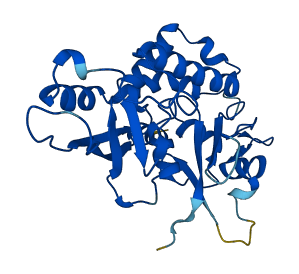
Descriptions
The autoinhibited protein was predicted that may have potential autoinhibitory elements via cis-regPred.
Autoinhibitory domains (AIDs)
Target domain |
|
Relief mechanism |
|
Assay |
cis-regPred |
Accessory elements
No accessory elements
Autoinhibited structure

Activated structure
1 structures for Q3MQ04
| Entry ID | Method | Resolution | Chain | Position | Source |
|---|---|---|---|---|---|
| AF-Q3MQ04-F1 | Predicted | AlphaFoldDB |
No variants for Q3MQ04
| Variant ID(s) | Position | Change | Description | Diseaes Association | Provenance |
|---|---|---|---|---|---|
| No variants for Q3MQ04 | |||||
No associated diseases with Q3MQ04
No regional properties for Q3MQ04
| Type | Name | Position | InterPro Accession |
|---|---|---|---|
| No domain, repeats, and functional sites for Q3MQ04 | |||
Functions
3 GO annotations of cellular component
| Name | Definition |
|---|---|
| Atg12-Atg5-Atg16 complex | A protein complex required for the expansion of the autophagosomal membrane. In budding yeast, this complex consists of Atg12p, Atg5p and Atg16p. |
| axoneme | The bundle of microtubules and associated proteins that forms the core of cilia (also called flagella) in eukaryotic cells and is responsible for their movements. |
| phagophore assembly site membrane | A cellular membrane associated with the phagophore assembly site. |
No GO annotations of molecular function
| Name | Definition |
|---|---|
| No GO annotations for molecular function |
9 GO annotations of biological process
| Name | Definition |
|---|---|
| apoptotic process | A programmed cell death process which begins when a cell receives an internal (e.g. DNA damage) or external signal (e.g. an extracellular death ligand), and proceeds through a series of biochemical events (signaling pathway phase) which trigger an execution phase. The execution phase is the last step of an apoptotic process, and is typically characterized by rounding-up of the cell, retraction of pseudopodes, reduction of cellular volume (pyknosis), chromatin condensation, nuclear fragmentation (karyorrhexis), plasma membrane blebbing and fragmentation of the cell into apoptotic bodies. When the execution phase is completed, the cell has died. |
| autophagosome assembly | The formation of a double membrane-bounded structure, the autophagosome, that occurs when a specialized membrane sac, called the isolation membrane, starts to enclose a portion of the cytoplasm. |
| autophagy | The cellular catabolic process in which cells digest parts of their own cytoplasm; allows for both recycling of macromolecular constituents under conditions of cellular stress and remodeling the intracellular structure for cell differentiation. |
| autophagy of mitochondrion | The autophagic process in which mitochondria are delivered to a type of vacuole and degraded in response to changing cellular conditions. |
| autophagy of nucleus | A form of autophagy, by which damaged or non-essential parts of the nucleus, or even an entire nucleus is degraded. |
| C-terminal protein lipidation | The covalent attachment of a lipid group to the carboxy-terminus of a protein. |
| cellular response to nitrogen starvation | Any process that results in a change in state or activity of a cell (in terms of movement, secretion, enzyme production, gene expression, etc.) as a result of deprivation of nitrogen. |
| immune system process | Any process involved in the development or functioning of the immune system, an organismal system for calibrated responses to potential internal or invasive threats. |
| regulation of cilium assembly | Any process that modulates the frequency, rate or extent of cilium assembly. |
6 homologous proteins in AiPD
| UniProt AC | Gene Name | Protein Name | Species | Evidence Code |
|---|---|---|---|---|
| Q12380 | ATG5 | Autophagy protein 5 | Saccharomyces cerevisiae (strain ATCC 204508 / S288c) (Baker's yeast) | PR |
| Q3MQ24 | ATG5 | Autophagy protein 5 | Bos taurus (Bovine) | PR |
| Q9H1Y0 | ATG5 | Autophagy protein 5 | Homo sapiens (Human) | PR |
| Q99J83 | Atg5 | Autophagy protein 5 | Mus musculus (Mouse) | PR |
| Q3MQ06 | Atg5 | Autophagy protein 5 | Rattus norvegicus (Rat) | PR |
| Q9FFI2 | ATG5 | Autophagy protein 5 | Arabidopsis thaliana (Mouse-ear cress) | PR |
| 10 | 20 | 30 | 40 | 50 | 60 |
| MTDDKDVLRD | VWFGRIPTCF | TLYQDEITER | EAEPYYLLLP | RVSYLTLVTD | KVKKHFQKVM |
| 70 | 80 | 90 | 100 | 110 | 120 |
| RQEDISEIWF | EYEGTPLKWH | YPIGLLFDLL | ASISALPWNI | TVHFKSFPEK | DLLHCPSKDV |
| 130 | 140 | 150 | 160 | 170 | 180 |
| IEAHFMSCVK | EADALKHKSR | VISDMQRKDH | KQLWMGLQND | RFDQFWTINR | KLIEYPPEEN |
| 190 | 200 | 210 | 220 | 230 | 240 |
| GFRYIPFRIY | QTTTERPFIQ | KLFRPVAADG | QLHTLGDLLR | EVCPSAVAPE | DGEKKSQVMI |
| 250 | 260 | 270 | |||
| HGIEPLLETP | LQWLSEHLSY | PDNFLHISIV | PQPTD |