Q9D880
Gene name |
Timm50 (Tim50) |
Protein name |
Mitochondrial import inner membrane translocase subunit TIM50 |
Names |
|
Species |
Mus musculus (Mouse) |
KEGG Pathway |
mmu:66525 |
EC number |
|
Protein Class |
|
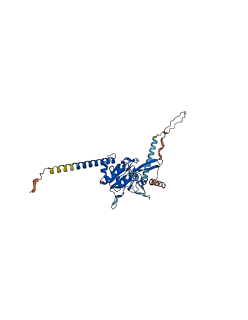
Descriptions
The autoinhibited protein was predicted that may have potential autoinhibitory elements via cis-regPred.
Autoinhibitory domains (AIDs)
Target domain |
|
Relief mechanism |
|
Assay |
cis-regPred |
Accessory elements
No accessory elements
Autoinhibited structure

Activated structure
1 structures for Q9D880
| Entry ID | Method | Resolution | Chain | Position | Source |
|---|---|---|---|---|---|
| AF-Q9D880-F1 | Predicted | AlphaFoldDB |
10 variants for Q9D880
| Variant ID(s) | Position | Change | Description | Diseaes Association | Provenance |
|---|---|---|---|---|---|
| rs225273071 | 45 | G>S | No | EVA | |
| rs3388884030 | 75 | G>V | No | EVA | |
| rs3388852666 | 76 | A>G | No | EVA | |
| rs230008888 | 104 | S>N | No | EVA | |
| rs3388886361 | 246 | V>A | No | EVA | |
| rs3397672232 | 284 | K>M | No | EVA | |
| rs3388891489 | 332 | S>P | No | EVA | |
| rs3397302469 | 335 | Q>P | No | EVA | |
| rs3397672246 | 336 | G>A | No | EVA | |
| rs3388876669 | 350 | S>P | No | EVA |
No associated diseases with Q9D880
No regional properties for Q9D880
| Type | Name | Position | InterPro Accession |
|---|---|---|---|
| No domain, repeats, and functional sites for Q9D880 | |||
6 GO annotations of cellular component
| Name | Definition |
|---|---|
| integral component of membrane | The component of a membrane consisting of the gene products and protein complexes having at least some part of their peptide sequence embedded in the hydrophobic region of the membrane. |
| mitochondrial inner membrane | The inner, i.e. lumen-facing, lipid bilayer of the mitochondrial envelope. It is highly folded to form cristae. |
| mitochondrion | A semiautonomous, self replicating organelle that occurs in varying numbers, shapes, and sizes in the cytoplasm of virtually all eukaryotic cells. It is notably the site of tissue respiration. |
| nuclear speck | A discrete extra-nucleolar subnuclear domain, 20-50 in number, in which splicing factors are seen to be localized by immunofluorescence microscopy. |
| nucleoplasm | That part of the nuclear content other than the chromosomes or the nucleolus. |
| TIM23 mitochondrial import inner membrane translocase complex | The protein transport machinery of the mitochondrial inner membrane that typically transports proteins that possess a matrix-targeting N-terminal presequence. The TIM23 complex contains three essential Tim proteins: Tim17 and Tim23 are thought to build a preprotein translocation channel while Tim44 interacts transiently with the matrix heat-shock protein Hsp70 to form an ATP-driven import motor. |
5 GO annotations of molecular function
| Name | Definition |
|---|---|
| interleukin-2 receptor binding | Binding to an interleukin-2 receptor. |
| phosphoprotein phosphatase activity | Catalysis of the reaction: a phosphoprotein + H2O = a protein + phosphate. Together with protein kinases, these enzymes control the state of phosphorylation of cellular proteins and thereby provide an important mechanism for regulating cellular activity. |
| protein serine/threonine phosphatase activity | Catalysis of the reaction: protein serine phosphate + H2O = protein serine + phosphate, and protein threonine phosphate + H2O = protein threonine + phosphate. |
| protein tyrosine phosphatase activity | Catalysis of the reaction: protein tyrosine phosphate + H2O = protein tyrosine + phosphate. |
| ribonucleoprotein complex binding | Binding to a complex of RNA and protein. |
4 GO annotations of biological process
| Name | Definition |
|---|---|
| mitochondrial membrane organization | A process that is carried out at the cellular level which results in the assembly, arrangement of constituent parts, or disassembly of a mitochondrial membrane, either of the lipid bilayer surrounding a mitochondrion. |
| protein dephosphorylation | The process of removing one or more phosphoric residues from a protein. |
| protein import into mitochondrial matrix | The import of proteins across the outer and inner mitochondrial membranes into the matrix. Unfolded proteins enter the mitochondrial matrix with a chaperone protein; the information required to target the precursor protein from the cytosol to the mitochondrial matrix is contained within its N-terminal matrix-targeting sequence. Translocation of precursors to the matrix occurs at the rare sites where the outer and inner membranes are close together. |
| release of cytochrome c from mitochondria | The process that results in the movement of cytochrome c from the mitochondrial intermembrane space into the cytosol, which is part of the apoptotic signaling pathway and leads to caspase activation. |
5 homologous proteins in AiPD
| UniProt AC | Gene Name | Protein Name | Species | Evidence Code |
|---|---|---|---|---|
| Q3SZB3 | TIMM50 | Mitochondrial import inner membrane translocase subunit TIM50 | Bos taurus (Bovine) | PR |
| P58465 | Ctdspl | CTD small phosphatase-like protein | Mus musculus (Mouse) | PR |
| Q8BX07 | Ctdsp2 | Carboxy-terminal domain RNA polymerase II polypeptide A small phosphatase 2 | Mus musculus (Mouse) | PR |
| Q22647 | scpl-4 | Mitochondrial import inner membrane translocase subunit TIM50 | Caenorhabditis elegans | PR |
| Q6NWD4 | timm50 | Mitochondrial import inner membrane translocase subunit TIM50 | Danio rerio (Zebrafish) (Brachydanio rerio) | PR |
| 10 | 20 | 30 | 40 | 50 | 60 |
| MAASAALFSR | LRSGLRVGAR | GLCTRLAPPP | PRTPEQVTEI | ANRGGSKAQG | PQHQPGSEGP |
| 70 | 80 | 90 | 100 | 110 | 120 |
| SYAKKIALWI | AGLLGAGGTV | SIVYIFGNNP | VDENGTKIPD | EFDSDPILVQ | QLRRTYKYFK |
| 130 | 140 | 150 | 160 | 170 | 180 |
| DYRQMIIEPT | SPCLLPDPLR | EPYYQPPYTL | VLELTGVLLH | PEWSLATGWR | FKKRPGIETL |
| 190 | 200 | 210 | 220 | 230 | 240 |
| FQQLAPLYEI | VIFTSETGMT | AFPLIDSVDP | HGFISYRLFR | DATRYMEGHH | VKDISCLNRD |
| 250 | 260 | 270 | 280 | 290 | 300 |
| PARVVVVDCK | KEAFRLQPFN | GVALRPWDGN | SDDRVLLDLS | AFLKTIALNQ | VEDVRTVLEH |
| 310 | 320 | 330 | 340 | 350 | |
| YALEDDPLEA | FKQRQSRLEQ | EEQQRLAELS | KSNRQGLSFG | SLASRLWPRS | KQP |