Q6NWD4
Gene name |
timm50 (tim50, zgc:66357) |
Protein name |
Mitochondrial import inner membrane translocase subunit TIM50 |
Names |
|
Species |
Danio rerio (Zebrafish) (Brachydanio rerio) |
KEGG Pathway |
dre:393638 |
EC number |
|
Protein Class |
|
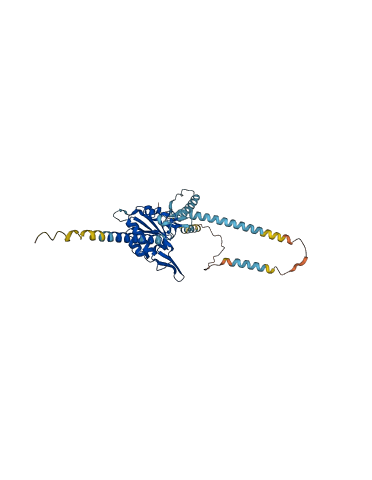
Descriptions
The autoinhibited protein was predicted that may have potential autoinhibitory elements via cis-regPred.
Autoinhibitory domains (AIDs)
Target domain |
|
Relief mechanism |
|
Assay |
cis-regPred |
Accessory elements
No accessory elements
Autoinhibited structure

Activated structure
1 structures for Q6NWD4
| Entry ID | Method | Resolution | Chain | Position | Source |
|---|---|---|---|---|---|
| AF-Q6NWD4-F1 | Predicted | AlphaFoldDB |
No variants for Q6NWD4
| Variant ID(s) | Position | Change | Description | Diseaes Association | Provenance |
|---|---|---|---|---|---|
| No variants for Q6NWD4 | |||||
No associated diseases with Q6NWD4
No regional properties for Q6NWD4
| Type | Name | Position | InterPro Accession |
|---|---|---|---|
| No domain, repeats, and functional sites for Q6NWD4 | |||
3 GO annotations of cellular component
| Name | Definition |
|---|---|
| integral component of membrane | The component of a membrane consisting of the gene products and protein complexes having at least some part of their peptide sequence embedded in the hydrophobic region of the membrane. |
| mitochondrial inner membrane | The inner, i.e. lumen-facing, lipid bilayer of the mitochondrial envelope. It is highly folded to form cristae. |
| TIM23 mitochondrial import inner membrane translocase complex | The protein transport machinery of the mitochondrial inner membrane that typically transports proteins that possess a matrix-targeting N-terminal presequence. The TIM23 complex contains three essential Tim proteins: Tim17 and Tim23 are thought to build a preprotein translocation channel while Tim44 interacts transiently with the matrix heat-shock protein Hsp70 to form an ATP-driven import motor. |
2 GO annotations of molecular function
| Name | Definition |
|---|---|
| protein serine/threonine phosphatase activity | Catalysis of the reaction: protein serine phosphate + H2O = protein serine + phosphate, and protein threonine phosphate + H2O = protein threonine + phosphate. |
| protein tyrosine phosphatase activity | Catalysis of the reaction: protein tyrosine phosphate + H2O = protein tyrosine + phosphate. |
4 GO annotations of biological process
| Name | Definition |
|---|---|
| apoptotic process | A programmed cell death process which begins when a cell receives an internal (e.g. DNA damage) or external signal (e.g. an extracellular death ligand), and proceeds through a series of biochemical events (signaling pathway phase) which trigger an execution phase. The execution phase is the last step of an apoptotic process, and is typically characterized by rounding-up of the cell, retraction of pseudopodes, reduction of cellular volume (pyknosis), chromatin condensation, nuclear fragmentation (karyorrhexis), plasma membrane blebbing and fragmentation of the cell into apoptotic bodies. When the execution phase is completed, the cell has died. |
| mitochondrial membrane organization | A process that is carried out at the cellular level which results in the assembly, arrangement of constituent parts, or disassembly of a mitochondrial membrane, either of the lipid bilayer surrounding a mitochondrion. |
| protein dephosphorylation | The process of removing one or more phosphoric residues from a protein. |
| protein import into mitochondrial matrix | The import of proteins across the outer and inner mitochondrial membranes into the matrix. Unfolded proteins enter the mitochondrial matrix with a chaperone protein; the information required to target the precursor protein from the cytosol to the mitochondrial matrix is contained within its N-terminal matrix-targeting sequence. Translocation of precursors to the matrix occurs at the rare sites where the outer and inner membranes are close together. |
3 homologous proteins in AiPD
| UniProt AC | Gene Name | Protein Name | Species | Evidence Code |
|---|---|---|---|---|
| Q3SZB3 | TIMM50 | Mitochondrial import inner membrane translocase subunit TIM50 | Bos taurus (Bovine) | PR |
| Q9D880 | Timm50 | Mitochondrial import inner membrane translocase subunit TIM50 | Mus musculus (Mouse) | PR |
| Q22647 | scpl-4 | Mitochondrial import inner membrane translocase subunit TIM50 | Caenorhabditis elegans | PR |
| 10 | 20 | 30 | 40 | 50 | 60 |
| MSAVSVYPMC | VRASRGLLRL | RQGARCSTAP | PLLDVVRPLS | ADTSSSSATG | GLAQAILQER |
| 70 | 80 | 90 | 100 | 110 | 120 |
| LQQQQKSQEQ | PPPEGEDSGH | KQDEQGEDKK | QKENTAYAKK | MVLRLAGIMG | LGGTVGIVYI |
| 130 | 140 | 150 | 160 | 170 | 180 |
| FGSNSVDEQG | NKIPDEFDND | VPVIQQLRRT | FKYFKDYRQM | IIEPTSPKLL | PDPLREPYYQ |
| 190 | 200 | 210 | 220 | 230 | 240 |
| PPYTLVLELT | DVLLHPEWSL | ATGWRFKKRP | GIDYLFQQLA | PLYEIVIFTS | ETGMTAYPLI |
| 250 | 260 | 270 | 280 | 290 | 300 |
| DSIDPQGFVM | YRLFRDATRY | MEGHHVKDVS | CLNRDTSKVI | VVDCKREAFG | LQPFNGLALC |
| 310 | 320 | 330 | 340 | 350 | 360 |
| KWDGNSEDRT | LYDLAAFLKT | IATSGVEDVR | SVLENYAHEE | DPIEAFKRRQ | AQLAREEEQR |
| 370 | 380 | ||||
| ISEMAQQKKQ | GFSLGTIAGR | FWSRKQQ |