Q9CZD3
Gene name |
Gars1 (Gars) |
Protein name |
Glycine--tRNA ligase |
Names |
Diadenosine tetraphosphate synthetase, Ap4A synthetase, Glycyl-tRNA synthetase 1, GlyRS |
Species |
Mus musculus (Mouse) |
KEGG Pathway |
mmu:353172 |
EC number |
6.1.1.14: Ligases forming aminoacyl-tRNA and related compounds |
Protein Class |
|
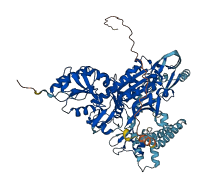
Descriptions
The autoinhibited protein was predicted that may have potential autoinhibitory elements via cis-regPred.
Autoinhibitory domains (AIDs)
Target domain |
|
Relief mechanism |
|
Assay |
cis-regPred |
Accessory elements
No accessory elements
Autoinhibited structure

Activated structure
1 structures for Q9CZD3
| Entry ID | Method | Resolution | Chain | Position | Source |
|---|---|---|---|---|---|
| AF-Q9CZD3-F1 | Predicted | AlphaFoldDB |
41 variants for Q9CZD3
| Variant ID(s) | Position | Change | Description | Diseaes Association | Provenance |
|---|---|---|---|---|---|
| rs227148055 | 6 | P>L | No | EVA | |
| rs240322012 | 21 | P>L | No | EVA | |
| rs3388826359 | 65 | G>V | No | EVA | |
| rs3388831840 | 67 | F>L | No | EVA | |
| rs3411268624 | 92 | K>* | No | EVA | |
| rs3388826945 | 100 | L>V | No | EVA | |
| rs3388837794 | 171 | T>I | No | EVA | |
| rs231412889 | 197 | K>R | No | EVA | |
| rs3388837827 | 255 | S>F | No | EVA | |
| rs3388815668 | 271 | M>T | No | EVA | |
| 278 | P>YK | found in Nmf249 mice, a Charcot-Marie-Tooth 2D model; involved in neuromuscular dysfunction; contrary to the wild-type protein, strongly interacts with NRP1 and competes with VEGFA for NRP1-binding; no effect on subcellular location [UniProt] | No | ||
| rs3388809463 | 302 | L>V | No | EVA | |
| rs3388797702 | 313 | A>V | No | EVA | |
| rs3388831368 | 329 | G>A | No | EVA | |
| rs3396711348 | 349 | E>G | No | EVA | |
| rs3396533797 | 350 | K>I | No | EVA | |
| rs3396711332 | 351 | D>V | No | EVA | |
| rs3396801077 | 352 | H>L | No | EVA | |
| rs3396776032 | 352 | H>Y | No | EVA | |
| rs3396850054 | 353 | P>L | No | EVA | |
| rs3388826316 | 375 | Q>H | No | EVA | |
| rs3388815736 | 390 | V>E | No | EVA | |
| rs3388829306 | 441 | T>M | No | EVA | |
| rs3396754245 | 480 | K>E | No | EVA | |
| rs3412999737 | 481 | T>I | No | EVA | |
| rs3388797684 | 487 | F>I | No | EVA | |
| rs3388826941 | 491 | K>N | No | EVA | |
| rs30101013 | 493 | A>T | No | EVA | |
| rs3388809512 | 546 | V>I | No | EVA | |
| rs3388831835 | 601 | V>A | No | EVA | |
| rs3396534949 | 655 | G>A | No | EVA | |
| rs3388831411 | 686 | R>G | No | EVA | |
| rs13465512 | 694 | N>S | No | EVA | |
| rs263735400 | 697 | R>L | No | EVA | |
| rs3388832945 | 699 | L>V | No | EVA | |
| rs30100034 | 701 | N>K | No | EVA | |
| rs30100036 | 707 | A>V | No | EVA | |
| rs248840688 | 708 | D>E | No | EVA | |
| rs3388797663 | 710 | E>D | No | EVA | |
| rs3388820800 | 712 | R>T | No | EVA | |
| rs3388820859 | 716 | F>S | No | EVA |
1 associated diseases with Q9CZD3
Without disease ID
5 regional properties for Q9CZD3
| Type | Name | Position | InterPro Accession |
|---|---|---|---|
| domain | WHEP-TRS domain | 53 - 112 | IPR000738 |
| domain | Aminoacyl-tRNA synthetase, class II (G/ P/ S/T) | 285 - 350 | IPR002314 |
| domain | Anticodon-binding | 605 - 698 | IPR004154 |
| domain | Aminoacyl-tRNA synthetase, class II | 252 - 598 | IPR006195 |
| domain | Glycyl-tRNA synthetase-like core domain | 114 - 460 | IPR033731 |
Functions
| Description | ||
|---|---|---|
| EC Number | 6.1.1.14 | Ligases forming aminoacyl-tRNA and related compounds |
| Subcellular Localization |
|
|
| PANTHER Family | ||
| PANTHER Subfamily | ||
| PANTHER Protein Class | ||
| PANTHER Pathway Category | No pathway information available | |
6 GO annotations of cellular component
| Name | Definition |
|---|---|
| axon | The long process of a neuron that conducts nerve impulses, usually away from the cell body to the terminals and varicosities, which are sites of storage and release of neurotransmitter. |
| cytoplasm | The contents of a cell excluding the plasma membrane and nucleus, but including other subcellular structures. |
| cytosol | The part of the cytoplasm that does not contain organelles but which does contain other particulate matter, such as protein complexes. |
| extracellular exosome | A vesicle that is released into the extracellular region by fusion of the limiting endosomal membrane of a multivesicular body with the plasma membrane. Extracellular exosomes, also simply called exosomes, have a diameter of about 40-100 nm. |
| mitochondrion | A semiautonomous, self replicating organelle that occurs in varying numbers, shapes, and sizes in the cytoplasm of virtually all eukaryotic cells. It is notably the site of tissue respiration. |
| secretory granule | A small subcellular vesicle, surrounded by a membrane, that is formed from the Golgi apparatus and contains a highly concentrated protein destined for secretion. Secretory granules move towards the periphery of the cell and upon stimulation, their membranes fuse with the cell membrane, and their protein load is exteriorized. Processing of the contained protein may take place in secretory granules. |
6 GO annotations of molecular function
| Name | Definition |
|---|---|
| ATP binding | Binding to ATP, adenosine 5'-triphosphate, a universally important coenzyme and enzyme regulator. |
| bis(5'-nucleosyl)-tetraphosphatase (asymmetrical) activity | Catalysis of the reaction: P(1),P(4)-bis(5'-nucleosyl)tetraphosphate + H2O = NTP + NMP. Acts on bis(5'-guanosyl)-, bis(5'-xanthosyl)-, bis(5'-adenosyl)- and bis(5'-uridyl)-tetraphosphate. |
| glycine-tRNA ligase activity | Catalysis of the reaction: ATP + glycine + tRNA(Gly) = AMP + diphosphate + glycyl-tRNA(Gly). |
| identical protein binding | Binding to an identical protein or proteins. |
| protein dimerization activity | The formation of a protein dimer, a macromolecular structure consists of two noncovalently associated identical or nonidentical subunits. |
| transferase activity | Catalysis of the transfer of a group, e.g. a methyl group, glycosyl group, acyl group, phosphorus-containing, or other groups, from one compound (generally regarded as the donor) to another compound (generally regarded as the acceptor). Transferase is the systematic name for any enzyme of EC class 2. |
4 GO annotations of biological process
| Name | Definition |
|---|---|
| diadenosine tetraphosphate biosynthetic process | The chemical reactions and pathways resulting in the formation of diadenosine tetraphosphate, a derivative of the nucleoside adenosine with four phosphate groups attached. |
| glycyl-tRNA aminoacylation | The process of coupling glycine to glycyl-tRNA, catalyzed by glycyl-tRNA synthetase. The glycyll-tRNA synthetase is a class-II synthetase. The activated amino acid is transferred to the 3'-OH group of a glycine-accepting tRNA. |
| mitochondrial glycyl-tRNA aminoacylation | The process of coupling glycine to glycyl-tRNA in a mitochondrion, catalyzed by glycyl-tRNA synthetase. In tRNA aminoacylation, the amino acid is first activated by linkage to AMP and then transferred to either the 2'- or the 3'-hydroxyl group of the 3'-adenosine residue of the tRNA. |
| tRNA aminoacylation for protein translation | The synthesis of aminoacyl tRNA by the formation of an ester bond between the 3'-hydroxyl group of the most 3' adenosine of the tRNA and the alpha carboxylic acid group of an amino acid, to be used in ribosome-mediated polypeptide synthesis. |
6 homologous proteins in AiPD
| UniProt AC | Gene Name | Protein Name | Species | Evidence Code |
|---|---|---|---|---|
| Q06817 | GRS2 | Glycine--tRNA ligase 2 | Saccharomyces cerevisiae (strain ATCC 204508 / S288c) (Baker's yeast) | PR |
| P38088 | GRS1 | Glycine--tRNA ligase 1, mitochondrial | Saccharomyces cerevisiae (strain ATCC 204508 / S288c) (Baker's yeast) | PR |
| P41250 | GARS1 | Glycine--tRNA ligase | Homo sapiens (Human) | PR |
| Q10039 | gars-1 | Glycine--tRNA ligase | Caenorhabditis elegans | PR |
| Q04451 | GlyRS | Glycine--tRNA ligase | Bombyx mori (Silk moth) | PR |
| Q9FXG2 | At1g29870 | Putative glycine--tRNA ligase, cytoplasmic | Arabidopsis thaliana (Mouse-ear cress) | PR |
| 10 | 20 | 30 | 40 | 50 | 60 |
| MPCLLPSLLR | ATRAALPLLS | PPRVVAASAS | QRLLSAPAQP | AASRSSMDSA | EELLAPLRLA |
| 70 | 80 | 90 | 100 | 110 | 120 |
| VRQQGDFVRK | LKEDKAPQVD | VDRAVAELKA | RKRVLEAKEL | ALQPKDDIVD | RAKMEDTLKR |
| 130 | 140 | 150 | 160 | 170 | 180 |
| RFFYDQAFAI | YGGVSGLYDF | GPVGCALKNN | IIQAWRQHFI | QEEQILEIDC | TMLTPEPVLK |
| 190 | 200 | 210 | 220 | 230 | 240 |
| TSGHVDKFAD | FMVKDVKNGE | CFRADHLLKA | HLQKLMSDKK | CSAEKKSEME | SVLAQLDNYG |
| 250 | 260 | 270 | 280 | 290 | 300 |
| QQELADLFVN | YNVKSPTTGN | DLSPPVPFNL | MFQTFIGPGG | NMPGYLRPET | AQGIFLNFKR |
| 310 | 320 | 330 | 340 | 350 | 360 |
| LLEFNQGKLP | FAAAQIGNSF | RNEISPRSGL | IRVREFTMAE | IEHFVDPTEK | DHPKFQSVAD |
| 370 | 380 | 390 | 400 | 410 | 420 |
| LCLYLYSAKA | QVTGQSARKM | RLGDAVEQGV | INNSVLGYFI | GRIYLYLTKV | GISPDKLRFR |
| 430 | 440 | 450 | 460 | 470 | 480 |
| QHMENEMAHY | ACDCWDAESK | TSYGWIEIVG | CADRSCYDLS | CHARATKVPL | VAEKPLKEPK |
| 490 | 500 | 510 | 520 | 530 | 540 |
| TVNVVQFEPN | KGAVGKAYKK | DAKLVLEYLS | ACDECYISEM | ELLLSEKGEF | TIETEGKTFQ |
| 550 | 560 | 570 | 580 | 590 | 600 |
| LTKDMVSVKR | FQKTLHVEEV | VPSVIEPSFG | LGRIMYTILE | HTFHVREGDE | QRTFFSFPAV |
| 610 | 620 | 630 | 640 | 650 | 660 |
| VAPFKCSVLP | LSQNQEFMPF | VKELSEALTR | NGVSHKVDDS | SGSIGRRYAR | TDEIGVAFGI |
| 670 | 680 | 690 | 700 | 710 | 720 |
| TIDFDTVNKT | PHTATLRDRD | SMRQIRAEVS | ELPNVVRDLA | NGNITWADVE | ARYPLFEGQE |
| TGKKETVEE |