Q99N27
Gene name |
Snx1 |
Protein name |
Sorting nexin-1 |
Names |
|
Species |
Rattus norvegicus (Rat) |
KEGG Pathway |
rno:84471 |
EC number |
|
Protein Class |
|
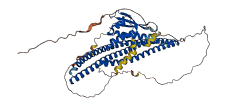
Descriptions
The autoinhibited protein was predicted that may have potential autoinhibitory elements via cis-regPred.
Autoinhibitory domains (AIDs)
Target domain |
|
Relief mechanism |
|
Assay |
cis-regPred |
Accessory elements
No accessory elements
Autoinhibited structure

Activated structure
1 structures for Q99N27
| Entry ID | Method | Resolution | Chain | Position | Source |
|---|---|---|---|---|---|
| AF-Q99N27-F1 | Predicted | AlphaFoldDB |
No variants for Q99N27
| Variant ID(s) | Position | Change | Description | Diseaes Association | Provenance |
|---|---|---|---|---|---|
| No variants for Q99N27 | |||||
No associated diseases with Q99N27
5 regional properties for Q99N27
| Type | Name | Position | InterPro Accession |
|---|---|---|---|
| domain | Phox homology | 141 - 272 | IPR001683 |
| domain | Sorting nexin, N-terminal | 10 - 90 | IPR005329 |
| domain | Sorting nexin/Vps5-like, C-terminal | 286 - 516 | IPR015404 |
| domain | Sorting nexin-1, BAR domain | 286 - 519 | IPR028660 |
| domain | Sorting Nexin 1, PX domain | 145 - 268 | IPR034901 |
Functions
20 GO annotations of cellular component
| Name | Definition |
|---|---|
| cytoplasm | The contents of a cell excluding the plasma membrane and nucleus, but including other subcellular structures. |
| cytosol | The part of the cytoplasm that does not contain organelles but which does contain other particulate matter, such as protein complexes. |
| dendritic spine | A small, membranous protrusion from a dendrite that forms a postsynaptic compartment, typically receiving input from a single presynapse. They function as partially isolated biochemical and an electrical compartments. Spine morphology is variable:they can be thin, stubby, mushroom, or branched, with a continuum of intermediate morphologies. They typically terminate in a bulb shape, linked to the dendritic shaft by a restriction. Spine remodeling is though to be involved in synaptic plasticity. |
| early endosome | A membrane-bounded organelle that receives incoming material from primary endocytic vesicles that have been generated by clathrin-dependent and clathrin-independent endocytosis; vesicles fuse with the early endosome to deliver cargo for sorting into recycling or degradation pathways. |
| early endosome membrane | The lipid bilayer surrounding an early endosome. |
| endosome | A vacuole to which materials ingested by endocytosis are delivered. |
| endosome membrane | The lipid bilayer surrounding an endosome. |
| extrinsic component of postsynaptic endosome membrane | The component of the postsynaptic endosome membrane consisting of gene products and protein complexes that are loosely bound to one of its surfaces, but not integrated into the hydrophobic region. |
| Golgi apparatus | A membrane-bound cytoplasmic organelle of the endomembrane system that further processes the core oligosaccharides (e.g. N-glycans) added to proteins in the endoplasmic reticulum and packages them into membrane-bound vesicles. The Golgi apparatus operates at the intersection of the secretory, lysosomal, and endocytic pathways. |
| lamellipodium | A thin sheetlike process extended by the leading edge of a migrating cell or extending cell process; contains a dense meshwork of actin filaments. |
| lysosome | A small lytic vacuole that has cell cycle-independent morphology found in most animal cells and that contains a variety of hydrolases, most of which have their maximal activities in the pH range 5-6. The contained enzymes display latency if properly isolated. About 40 different lysosomal hydrolases are known and lysosomes have a great variety of morphologies and functions. |
| membrane | A lipid bilayer along with all the proteins and protein complexes embedded in it an attached to it. |
| perinuclear region of cytoplasm | Cytoplasm situated near, or occurring around, the nucleus. |
| postsynaptic density | An electron dense network of proteins within and adjacent to the postsynaptic membrane of an asymmetric, neuron-neuron synapse. Its major components include neurotransmitter receptors and the proteins that spatially and functionally organize them such as anchoring and scaffolding molecules, signaling enzymes and cytoskeletal components. |
| postsynaptic density, intracellular component | A network of proteins adjacent to the postsynaptic membrane forming an electron dense disc. Its major components include neurotransmitter receptors and the proteins that spatially and functionally organize neurotransmitter receptors in the adjacent membrane, such as anchoring and scaffolding molecules, signaling enzymes and cytoskeletal components. |
| presynapse | The part of a synapse that is part of the presynaptic cell. |
| protein-containing complex | A stable assembly of two or more macromolecules, i.e. proteins, nucleic acids, carbohydrates or lipids, in which at least one component is a protein and the constituent parts function together. |
| retromer complex | A conserved hetero-pentameric membrane-associated complex involved in retrograde transport from endosomes to the Golgi apparatus. The budding yeast retromer comprises Vps35p, Vps29p, Vps26p, Vps5p, and Vps17p. The mammalian complex shows slight variation in composition compared to yeast, and comprises SNX1 or SNX2, SNX5 or SNX6, VPS26A or VPS26B, VPS29, and VPS35. |
| retromer, tubulation complex | The dimeric subcomplex of the retromer, believed to be peripherally associated with the membrane. This dimeric complex is responsible for remodelling endosomal membranes to form a tube-structure to which cargo molecules are selected for recycling. The budding yeast complex comprises Vps5p and Vps17p, and may contain multiple copies of a Vps5p/Vps17p dimer. The mammalian complex contains SNX1 or SNX2 dimerized with SNX5 or SNX6. |
| vesicle | Any small, fluid-filled, spherical organelle enclosed by membrane. |
8 GO annotations of molecular function
| Name | Definition |
|---|---|
| epidermal growth factor receptor binding | Binding to an epidermal growth factor receptor. |
| identical protein binding | Binding to an identical protein or proteins. |
| insulin receptor binding | Binding to an insulin receptor. |
| leptin receptor binding | Binding to a leptin receptor. |
| phosphatidylinositol binding | Binding to an inositol-containing glycerophospholipid, i.e. phosphatidylinositol (PtdIns) and its phosphorylated derivatives. |
| protein heterodimerization activity | Binding to a nonidentical protein to form a heterodimer. |
| protein homodimerization activity | Binding to an identical protein to form a homodimer. |
| transferrin receptor binding | Binding to a transferrin receptor. |
9 GO annotations of biological process
| Name | Definition |
|---|---|
| early endosome to Golgi transport | The directed movement of substances from early endosomes to the Golgi. |
| endosomal transport | The directed movement of substances mediated by an endosome, a membrane-bounded organelle that carries materials enclosed in the lumen or located in the endosomal membrane. |
| intracellular protein transport | The directed movement of proteins in a cell, including the movement of proteins between specific compartments or structures within a cell, such as organelles of a eukaryotic cell. |
| lamellipodium morphogenesis | A process that is carried out at the cellular level and in which the structure of a lamellipodium is organized. |
| negative regulation of transforming growth factor beta receptor signaling pathway | Any process that stops, prevents, or reduces the frequency, rate or extent of any TGF-beta receptor signaling pathway. |
| neuron projection development | The process whose specific outcome is the progression of a neuron projection over time, from its formation to the mature structure. A neuron projection is any process extending from a neural cell, such as axons or dendrites (collectively called neurites). |
| positive regulation of protein catabolic process | Any process that activates or increases the frequency, rate or extent of the chemical reactions and pathways resulting in the breakdown of a protein by the destruction of the native, active configuration, with or without the hydrolysis of peptide bonds. |
| receptor internalization | A receptor-mediated endocytosis process that results in the movement of receptors from the plasma membrane to the inside of the cell. The process begins when cell surface receptors are monoubiquitinated following ligand-induced activation. Receptors are subsequently taken up into endocytic vesicles from where they are either targeted to the lysosome or vacuole for degradation or recycled back to the plasma membrane. |
| retrograde transport, endosome to Golgi | The directed movement of membrane-bounded vesicles from endosomes back to the trans-Golgi network where they are recycled for further rounds of transport. |
9 homologous proteins in AiPD
| UniProt AC | Gene Name | Protein Name | Species | Evidence Code |
|---|---|---|---|---|
| Q05B62 | SNX1 | Sorting nexin-1 | Bos taurus (Bovine) | PR |
| Q3ZBM5 | SNX5 | Sorting nexin-5 | Bos taurus (Bovine) | PR |
| O95219 | SNX4 | Sorting nexin-4 | Homo sapiens (Human) | PR |
| O60749 | SNX2 | Sorting nexin-2 | Homo sapiens (Human) | PR |
| Q13596 | SNX1 | Sorting nexin-1 | Homo sapiens (Human) | PR |
| Q9Y5X3 | SNX5 | Sorting nexin-5 | Homo sapiens (Human) | PR |
| Q9CWK8 | Snx2 | Sorting nexin-2 | Mus musculus (Mouse) | PR |
| Q9WV80 | Snx1 | Sorting nexin-1 | Mus musculus (Mouse) | PR |
| Q9FG38 | SNX1 | Sorting nexin 1 | Arabidopsis thaliana (Mouse-ear cress) | PR |
| 10 | 20 | 30 | 40 | 50 | 60 |
| MASGGGGCSA | SERLPPPFPG | MDPESEGAAG | GSEPEAGDSD | TEGEDIFTGA | AAASKPQSPK |
| 70 | 80 | 90 | 100 | 110 | 120 |
| KTTSLFPIKN | GSKENGIHEE | QDQEPQDLFA | DATVELSLDS | TQNNQKTMPG | KTLIPHPTQE |
| 130 | 140 | 150 | 160 | 170 | 180 |
| ATNSPKPQPS | YEELEEEEQE | DQFDLTVGIT | DPEKIGDGMN | AYVAYKVTTQ | TSLPMFRSRQ |
| 190 | 200 | 210 | 220 | 230 | 240 |
| FAVKRRFSDF | LGLYEKLSEK | HSQNGFIVPP | PPEKSLIGMT | KVKVGKEDSS | SAEFLEKRRA |
| 250 | 260 | 270 | 280 | 290 | 300 |
| ALERYLQRIV | NHPTMLQDPD | VREFLEKEEL | PRAVGTQALS | GAGLLKMFNK | ATDAVSKMTI |
| 310 | 320 | 330 | 340 | 350 | 360 |
| KMNESDIWFE | EKLQEVECEE | QRLRKLHAVV | ETLVNHRKEL | ALNTALFAKS | LAMLGSSEDN |
| 370 | 380 | 390 | 400 | 410 | 420 |
| TALSRALSQL | AEVEEKIEQL | HQEQANNDFF | LLAELLSDYI | RLLAIVRAAF | DQRMKTWQRW |
| 430 | 440 | 450 | 460 | 470 | 480 |
| QDAQATLQKK | RESEARLLWA | NKPDKLQQAK | DEITEWESRV | TQYERDFERI | STVVRKEVTR |
| 490 | 500 | 510 | 520 | ||
| FEKEKSKDFK | NHVIKYLETL | LHSQQQLAKY | WEAFLPEARA | IS |