Q96GM5
Gene name |
SMARCD1 |
Protein name |
SWI/SNF-related matrix-associated actin-dependent regulator of chromatin subfamily D member 1 |
Names |
60 kDa BRG-1/Brm-associated factor subunit A, BRG1-associated factor 60A, BAF60A, SWI/SNF complex 60 kDa subunit |
Species |
Homo sapiens (Human) |
KEGG Pathway |
hsa:6602 |
EC number |
|
Protein Class |
|
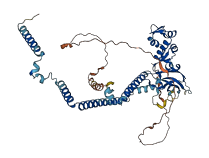
Descriptions
The autoinhibited protein was predicted that may have potential autoinhibitory elements via cis-regPred.
Autoinhibitory domains (AIDs)
Target domain |
|
Relief mechanism |
|
Assay |
cis-regPred |
Accessory elements
No accessory elements
Autoinhibited structure

Activated structure
5 structures for Q96GM5
| Entry ID | Method | Resolution | Chain | Position | Source |
|---|---|---|---|---|---|
| 6LTH | EM | 300 A | P | 1-515 | PDB |
| 6LTJ | EM | 370 A | P | 1-515 | PDB |
| 7VDV | EM | 340 A | Y | 1-515 | PDB |
| 7Y8R | EM | 440 A | P | 1-515 | PDB |
| AF-Q96GM5-F1 | Predicted | AlphaFoldDB |
240 variants for Q96GM5
| Variant ID(s) | Position | Change | Description | Diseaes Association | Provenance |
|---|---|---|---|---|---|
|
CA236743270 rs954124678 RCV001267454 |
50 | R>G | Inborn genetic diseases [ClinVar] | Yes |
ClinGen ClinVar TOPMed dbSNP gnomAD |
|
RCV001003485 CA384792124 VAR_083801 rs1592289150 |
330 | D>E | Coffin-Siris syndrome 11 CSS11; unknown pathological significance; does not affect the interaction with SMARCC1 and SMARCA4 [ClinVar, UniProt] | Yes |
ClinGen ClinVar UniProt Ensembl dbSNP |
|
rs575681571 RCV001267564 CA236725461 |
334 | R>Q | Inborn genetic diseases [ClinVar] | Yes |
ClinGen ClinVar 1000Genomes dbSNP gnomAD |
|
rs762849068 RCV001266208 CA6561306 |
428 | I>V | Inborn genetic diseases [ClinVar] | Yes |
ClinGen ClinVar ExAC TOPMed dbSNP gnomAD |
|
rs1592294569 RCV001003486 CA384795236 VAR_083802 |
446 | R>G | Coffin-Siris syndrome 11 CSS11 [ClinVar, UniProt] | Yes |
ClinGen ClinVar UniProt Ensembl dbSNP |
|
rs1592295890 RCV001003487 CA384797045 |
486 | W>* | Coffin-Siris syndrome 11 [ClinVar] | Yes |
ClinGen ClinVar Ensembl dbSNP |
| VAR_083803 | 486 | W>del | CSS11; does not affect the interaction with SMARCC1 and SMARCA4 [UniProt] | Yes | UniProt |
|
CA384797193 RCV001003488 VAR_083804 rs1592295914 |
495 | F>L | Coffin-Siris syndrome 11 CSS11; does not affect the interaction with SMARCC1 and SMARCA4 [ClinVar, UniProt] | Yes |
ClinGen ClinVar UniProt Ensembl dbSNP |
|
rs372368908 CA384797402 RCV001003489 RCV001564444 |
503 | R>* | Coffin-Siris syndrome 11 [ClinVar] | Yes |
ClinGen ClinVar ESP dbSNP |
| VAR_083805 | 503 | R>del | CSS11 [UniProt] | Yes | UniProt |
|
rs866500998 CA236743222 |
2 | A>V | No |
ClinGen gnomAD |
|
|
rs1317917577 CA384785974 |
3 | A>T | No |
ClinGen gnomAD |
|
|
CA384785986 rs1380592031 |
5 | A>P | No |
ClinGen TOPMed |
|
|
CA6560986 rs752551605 |
5 | A>V | No |
ClinGen ExAC TOPMed gnomAD |
|
|
rs758191233 CA6560987 |
8 | Q>R | No |
ClinGen ExAC gnomAD |
|
|
rs1403677677 CA384786018 |
10 | V>L | No |
ClinGen TOPMed gnomAD |
|
| TCGA novel | 11 | A>S | Variant assessed as Somatic; impact. [NCI-TCGA] | No | NCI-TCGA |
|
rs777484259 CA6560988 |
11 | A>T | No |
ClinGen ExAC gnomAD |
|
|
CA384786036 rs1350043726 |
13 | S>G | No |
ClinGen TOPMed gnomAD |
|
|
rs1294427991 CA384786045 |
14 | G>D | No |
ClinGen TOPMed gnomAD |
|
|
rs1163410674 CA384786048 |
15 | G>C | No |
ClinGen TOPMed |
|
|
rs1223401071 CA384786053 |
15 | G>V | No |
ClinGen gnomAD |
|
|
CA6560989 rs746992940 |
17 | G>R | No |
ClinGen ExAC gnomAD |
|
|
CA384786070 rs1565737172 |
18 | A>V | No |
ClinGen Ensembl |
|
| TCGA novel | 19 | S>L | Variant assessed as Somatic; impact. [NCI-TCGA] | No | NCI-TCGA |
|
CA384786095 rs1249759620 |
23 | G>S | No |
ClinGen gnomAD |
|
|
rs1465716502 CA384786113 |
26 | A>T | No |
ClinGen TOPMed |
|
|
CA384786126 rs1250350590 |
28 | L>V | No |
ClinGen TOPMed |
|
|
rs1484269487 CA384786142 |
30 | P>L | No |
ClinGen gnomAD |
|
|
rs749309509 CA6560992 |
30 | P>S | No |
ClinGen ExAC |
|
|
rs1419469844 CA384786146 |
31 | G>D | No |
ClinGen gnomAD |
|
|
rs1592285392 CA384786166 |
34 | P>L | No |
ClinGen Ensembl |
|
|
CA236743257 rs71464994 |
35 | G>E | No |
ClinGen Ensembl |
|
|
rs1161194005 CA384786176 |
36 | P>L | No |
ClinGen TOPMed gnomAD |
|
|
rs774710402 CA6560994 |
36 | P>S | No |
ClinGen ExAC gnomAD |
|
|
CA236743258 rs1013610690 |
37 | P>S | No |
ClinGen TOPMed |
|
|
CA384786184 rs1230183672 |
38 | V>L | No |
ClinGen TOPMed |
|
|
rs1484625902 CA384786192 |
39 | R>L | No |
ClinGen gnomAD |
|
|
rs1357450761 CA384786211 |
42 | P>L | No |
ClinGen TOPMed |
|
|
CA384786216 rs1195605857 |
43 | A>T | No |
ClinGen gnomAD |
|
|
rs976962586 CA236743261 |
44 | P>L | No |
ClinGen Ensembl |
|
|
CA384786228 rs1419937026 |
45 | G>D | No |
ClinGen gnomAD |
|
|
rs548902421 CA6560995 |
48 | L>V | No |
ClinGen 1000Genomes ExAC TOPMed gnomAD |
|
|
CA384786250 rs1247702230 |
49 | Y>H | No |
ClinGen Ensembl |
|
|
CA236743272 rs985342530 |
53 | M>I | No |
ClinGen TOPMed |
|
|
CA384786288 rs1378914960 |
55 | G>R | No |
ClinGen gnomAD |
|
|
CA384786298 rs1344323730 |
56 | A>G | No |
ClinGen TOPMed |
|
|
rs1426158199 CA384786311 |
58 | Y>F | No |
ClinGen TOPMed |
|
|
rs1434810348 CA384786314 |
59 | P>S | No |
ClinGen gnomAD |
|
|
rs1555186210 CA384786342 |
61 | P>Q | No |
ClinGen Ensembl |
|
|
rs1269022704 CA384786348 |
62 | G>D | No |
ClinGen gnomAD |
|
|
CA6561009 rs759423387 |
63 | M>I | No |
ClinGen ExAC TOPMed gnomAD |
|
|
CA6561008 rs751284712 |
63 | M>R | No |
ClinGen ExAC gnomAD |
|
|
rs993328878 CA236743623 |
67 | S>I | No |
ClinGen Ensembl |
|
|
CA236743628 rs764685953 |
68 | R>L | Variant assessed as Somatic; 0.0 impact. [NCI-TCGA] | No |
ClinGen NCI-TCGA gnomAD |
|
rs149183221 CA6561010 |
71 | P>S | No |
ClinGen ESP ExAC TOPMed gnomAD |
|
|
rs749452857 CA6561011 |
72 | Q>E | No |
ClinGen ExAC gnomAD |
|
|
rs201417018 CA236743638 |
72 | Q>H | No |
ClinGen 1000Genomes |
|
|
CA384786421 rs1346247648 |
74 | P>A | No |
ClinGen TOPMed gnomAD |
|
|
CA384786427 rs1565737619 |
75 | S>P | No |
ClinGen Ensembl |
|
|
CA6561012 rs755116252 |
76 | M>V | No |
ClinGen ExAC gnomAD |
|
|
rs1438963550 CA384786443 |
77 | G>E | No |
ClinGen gnomAD |
|
|
CA384786450 rs1184153838 |
78 | P>R | No |
ClinGen TOPMed gnomAD |
|
|
rs908439045 CA384786447 |
78 | P>S | No |
ClinGen TOPMed |
|
|
CA236743659 rs908439045 |
78 | P>T | No |
ClinGen TOPMed |
|
|
rs200449405 CA6561013 |
81 | Y>C | No |
ClinGen 1000Genomes ExAC gnomAD |
|
|
CA6561016 rs372851900 |
84 | N>I | No |
ClinGen ESP ExAC TOPMed gnomAD |
|
|
CA6561015 rs372851900 |
84 | N>S | No |
ClinGen ESP ExAC TOPMed gnomAD |
|
|
CA384786485 rs372851900 |
84 | N>T | No |
ClinGen ESP ExAC TOPMed gnomAD |
|
|
CA6561018 rs771531874 |
85 | P>S | No |
ClinGen ExAC gnomAD |
|
|
CA6561019 rs777005085 |
87 | V>L | No |
ClinGen ExAC gnomAD |
|
|
rs759976916 CA6561020 |
88 | R>* | No |
ClinGen ExAC gnomAD |
|
|
rs762563780 CA236743677 |
89 | P>L | No |
ClinGen Ensembl |
|
|
CA6561021 rs764745969 |
90 | G>V | No |
ClinGen ExAC gnomAD |
|
|
rs936279527 CA236743697 |
99 | S>F | No |
ClinGen Ensembl |
|
| TCGA novel | 101 | K>N | Variant assessed as Somatic; impact. [NCI-TCGA] | No | NCI-TCGA |
|
rs1592286215 CA384786599 |
102 | R>S | No |
ClinGen Ensembl |
|
|
CA384786596 rs1281446767 |
102 | R>T | No |
ClinGen TOPMed |
|
|
CA6561027 rs767276698 |
103 | P>L | No |
ClinGen ExAC TOPMed gnomAD |
|
|
CA384786634 rs1462225107 |
108 | I>V | No |
ClinGen gnomAD |
|
|
CA6561030 rs139120093 |
112 | Q>H | No |
ClinGen 1000Genomes ESP ExAC TOPMed gnomAD |
|
|
CA6561029 rs201326977 |
112 | Q>R | No |
ClinGen ExAC gnomAD |
|
|
CA384786686 rs1444464777 |
115 | A>S | No |
ClinGen gnomAD |
|
|
rs376164103 CA6561031 |
115 | A>V | Variant assessed as Somatic; 0.0 impact. [NCI-TCGA] | No |
ClinGen ESP ExAC NCI-TCGA gnomAD |
|
CA384786707 rs1565737755 |
118 | N>S | No |
ClinGen Ensembl |
|
|
rs1565737763 CA384786727 |
121 | H>R | No |
ClinGen Ensembl |
|
|
CA6561035 rs747185206 |
122 | N>S | No |
ClinGen ExAC TOPMed gnomAD |
|
| TCGA novel | 122 | N>missing | Variant assessed as Somatic; impact. [NCI-TCGA] | No | NCI-TCGA |
|
CA6561063 rs773865025 |
123 | A>T | No |
ClinGen ExAC gnomAD |
|
|
rs761404946 CA6561064 |
123 | A>V | No |
ClinGen ExAC gnomAD |
|
|
CA384786775 rs1376019458 |
126 | K>R | No |
ClinGen gnomAD |
|
|
CA6561066 rs773197299 |
131 | K>N | No |
ClinGen ExAC gnomAD |
|
|
rs1446694595 CA384786814 |
131 | K>R | No |
ClinGen TOPMed |
|
|
CA6561068 rs143055223 |
135 | Q>E | No |
ClinGen ESP ExAC TOPMed gnomAD |
|
|
CA384786845 rs1565737974 |
136 | R>T | No |
ClinGen Ensembl |
|
|
CA384786862 rs1369599783 |
137 | I>V | No |
ClinGen gnomAD |
|
|
CA6561082 rs559383300 |
138 | R>C | No |
ClinGen 1000Genomes ExAC gnomAD |
|
|
CA6561083 rs147034181 |
138 | R>H | Variant assessed as Somatic; 0.0 impact. [NCI-TCGA] | No |
ClinGen ESP ExAC NCI-TCGA TOPMed gnomAD |
|
CA6561084 rs147034181 |
138 | R>L | No |
ClinGen ESP ExAC TOPMed gnomAD |
|
| TCGA novel | 139 | E>* | Variant assessed as Somatic; impact. [NCI-TCGA] | No | NCI-TCGA |
|
CA236743970 rs148076461 |
145 | Q>P | No |
ClinGen ESP |
|
|
CA6561087 rs141789236 |
146 | A>S | No |
ClinGen ESP ExAC TOPMed gnomAD |
|
|
rs1253766969 CA384786984 |
155 | R>K | No |
ClinGen gnomAD |
|
|
CA384787040 rs1185283310 |
163 | R>G | No |
ClinGen TOPMed |
|
|
rs1453885968 CA384787065 |
167 | D>H | No |
ClinGen gnomAD |
|
|
CA384787099 rs1196764647 |
171 | A>D | No |
ClinGen gnomAD |
|
|
CA236743982 rs200814150 |
174 | R>C | No |
ClinGen Ensembl |
|
| TCGA novel | 175 | P>H | Variant assessed as Somatic; impact. [NCI-TCGA] | No | NCI-TCGA |
|
rs1255216266 CA384787132 |
176 | I>T | No |
ClinGen TOPMed |
|
| TCGA novel | 177 | K>= | Variant assessed as Somatic; impact. [NCI-TCGA] | No | NCI-TCGA |
|
rs762741274 CA6561108 |
189 | T>S | No |
ClinGen ExAC TOPMed gnomAD |
|
|
rs773237567 CA6561111 CA6561110 |
190 | F>L | No |
ClinGen ExAC TOPMed gnomAD |
|
|
rs767607029 CA6561109 |
190 | F>S | No |
ClinGen ExAC TOPMed gnomAD |
|
|
CA384787304 rs1235560708 |
200 | G>R | No |
ClinGen gnomAD |
|
|
rs774922403 CA236744315 |
203 | T>M | No |
ClinGen TOPMed gnomAD |
|
| TCGA novel | 204 | V>A | Variant assessed as Somatic; impact. [NCI-TCGA] | No | NCI-TCGA |
|
rs1242838568 CA384787335 |
205 | A>P | No |
ClinGen gnomAD |
|
|
CA384787404 rs1212964901 |
215 | L>P | No |
ClinGen TOPMed gnomAD |
|
|
CA384787406 rs1264073352 |
216 | L>M | No |
ClinGen TOPMed |
|
|
CA6561119 rs746493397 |
216 | L>P | No |
ClinGen ExAC |
|
|
CA384787580 rs1318804285 |
220 | A>V | No |
ClinGen gnomAD |
|
| TCGA novel | 226 | A>V | Variant assessed as Somatic; impact. [NCI-TCGA] | No | NCI-TCGA |
|
rs940298273 CA236744828 |
230 | K>R | No |
ClinGen Ensembl |
|
| TCGA novel | 232 | K>* | Variant assessed as Somatic; impact. [NCI-TCGA] | No | NCI-TCGA |
|
CA384787667 rs1365459236 |
232 | K>N | No |
ClinGen gnomAD |
|
|
rs952333987 CA236744835 |
238 | K>E | No |
ClinGen TOPMed |
|
|
CA6561154 rs752129292 |
239 | S>T | No |
ClinGen ExAC TOPMed gnomAD |
|
|
CA384787727 rs1380178581 |
241 | V>G | No |
ClinGen TOPMed |
|
|
rs762365851 CA6561155 |
241 | V>L | No |
ClinGen ExAC gnomAD |
|
|
rs749871443 CA6561157 |
242 | I>F | No |
ClinGen ExAC gnomAD |
|
|
CA384787771 rs755841124 |
248 | L>M | No |
ClinGen ExAC gnomAD |
|
|
CA384787784 rs1349417787 |
250 | G>R | No |
ClinGen Ensembl |
|
| TCGA novel | 251 | P>S | Variant assessed as Somatic; impact. [NCI-TCGA] | No | NCI-TCGA |
|
rs753419051 CA6561160 |
254 | H>Y | No |
ClinGen ExAC gnomAD |
|
|
CA6561180 rs765056152 |
262 | A>D | No |
ClinGen ExAC TOPMed gnomAD |
|
|
rs370452075 CA6561179 |
262 | A>T | No |
ClinGen ESP ExAC TOPMed gnomAD |
|
|
CA236745240 rs765056152 |
262 | A>V | No |
ClinGen ExAC TOPMed gnomAD |
|
| TCGA novel | 268 | D>N | Variant assessed as Somatic; impact. [NCI-TCGA] | No | NCI-TCGA |
|
CA6561184 rs746898820 |
275 | P>L | No |
ClinGen ExAC gnomAD |
|
|
rs200921207 CA6561187 |
278 | V>M | No |
ClinGen 1000Genomes ExAC TOPMed gnomAD |
|
|
CA6561189 rs774908560 |
281 | R>Q | No |
ClinGen ExAC TOPMed gnomAD |
|
|
rs768972786 CA6561188 |
281 | R>W | No |
ClinGen ExAC gnomAD |
|
|
rs1466269749 CA384788044 |
287 | M>I | No |
ClinGen TOPMed |
|
|
CA384788051 rs1476501644 |
289 | D>N | No |
ClinGen gnomAD |
|
|
CA384788065 rs1189341542 |
290 | Y>* | No |
ClinGen gnomAD |
|
|
CA384791279 rs1378153515 |
292 | P>R | No |
ClinGen gnomAD |
|
|
rs577197555 CA236725376 |
293 | P>H | No |
ClinGen 1000Genomes |
|
|
rs377735931 CA236725358 |
293 | P>S | No |
ClinGen ESP TOPMed gnomAD |
|
|
rs778155149 CA6561211 |
294 | Q>H | No |
ClinGen ExAC gnomAD |
|
|
CA6561212 rs747506587 |
298 | D>A | No |
ClinGen ExAC gnomAD |
|
|
rs771405936 CA6561213 |
298 | D>E | No |
ClinGen ExAC gnomAD |
|
|
CA384791369 rs1400988399 |
299 | P>H | No |
ClinGen TOPMed gnomAD |
|
|
rs1400988399 CA384791373 |
299 | P>L | No |
ClinGen TOPMed gnomAD |
|
|
rs1319486448 CA384791380 |
300 | R>C | No |
ClinGen gnomAD |
|
|
rs1319486448 CA384791377 |
300 | R>S | No |
ClinGen gnomAD |
|
|
rs1442501952 CA384791429 |
303 | R>Q | Variant assessed as Somatic; 0.0 impact. [NCI-TCGA] | No |
ClinGen NCI-TCGA gnomAD |
|
rs759040978 CA6561215 |
306 | G>S | No |
ClinGen ExAC gnomAD |
|
|
rs1224165549 CA384791511 |
307 | I>L | No |
ClinGen gnomAD |
|
|
rs1592289119 CA384791602 |
310 | Q>E | No |
ClinGen Ensembl |
|
|
rs1229326795 CA384791651 |
312 | R>C | No |
ClinGen gnomAD |
|
|
CA6561222 rs767552392 |
321 | Q>H | No |
ClinGen ExAC gnomAD |
|
|
CA384791925 rs1268104437 |
322 | Y>H | No |
ClinGen gnomAD |
|
|
rs1451030258 CA384792056 |
326 | H>R | No |
ClinGen gnomAD |
|
|
CA6561225 rs778999277 |
333 | E>K | No |
ClinGen ExAC gnomAD |
|
|
rs1158090723 CA384792216 |
336 | F>L | No |
ClinGen gnomAD |
|
|
rs1419433648 CA384792225 |
337 | V>D | No |
ClinGen TOPMed |
|
|
CA6561228 rs778044064 |
338 | I>V | No |
ClinGen ExAC gnomAD |
|
|
CA384792258 rs1163404131 |
339 | C>F | No |
ClinGen gnomAD |
|
|
CA6561229 rs747385757 |
341 | K>R | No |
ClinGen ExAC gnomAD |
|
|
CA6561231 rs202011906 |
343 | L>M | No |
ClinGen 1000Genomes ExAC TOPMed gnomAD |
|
|
rs1235074031 CA384792343 |
344 | Q>R | No |
ClinGen gnomAD |
|
|
CA384792441 rs1313708909 |
346 | I>M | No |
ClinGen TOPMed gnomAD |
|
|
CA236725602 rs1140541 |
349 | S>T | No |
ClinGen Ensembl |
|
|
CA384792527 rs1253128772 |
351 | R>C | No |
ClinGen TOPMed gnomAD |
|
|
CA6561250 rs746406610 |
351 | R>H | Variant assessed as Somatic; 0.0 impact. [NCI-TCGA] | No |
ClinGen ExAC NCI-TCGA TOPMed gnomAD |
|
CA384792546 rs1329250524 |
352 | M>T | No |
ClinGen gnomAD |
|
| TCGA novel | 356 | E>Q | Variant assessed as Somatic; impact. [NCI-TCGA] | No | NCI-TCGA |
|
rs1257479769 CA384792638 |
358 | P>S | No |
ClinGen TOPMed |
|
|
CA6561252 rs779479858 |
359 | Q>P | No |
ClinGen ExAC gnomAD |
|
|
CA6561254 rs150612896 |
360 | R>Q | No |
ClinGen 1000Genomes ESP ExAC TOPMed gnomAD |
|
|
CA6561253 rs141728974 |
360 | R>W | Variant assessed as Somatic; 0.0 impact. [NCI-TCGA] | No |
ClinGen ESP ExAC NCI-TCGA TOPMed gnomAD |
|
rs202030504 CA6561256 |
362 | H>Y | No |
ClinGen 1000Genomes ExAC gnomAD |
|
|
CA6561257 rs772020844 |
363 | A>V | No |
ClinGen ExAC gnomAD |
|
|
rs773107459 CA6561258 |
370 | P>L | No |
ClinGen ExAC gnomAD |
|
|
rs756882231 CA236725637 |
371 | I>T | No |
ClinGen gnomAD |
|
|
CA384792853 rs1565739863 |
372 | I>M | No |
ClinGen Ensembl |
|
|
rs759341144 CA6561280 |
379 | V>I | No |
ClinGen ExAC gnomAD |
|
|
rs768814175 CA6561281 |
381 | P>L | No |
ClinGen ExAC gnomAD |
|
| TCGA novel | 387 | T>K | Variant assessed as Somatic; impact. [NCI-TCGA] | No | NCI-TCGA |
|
rs1268404251 CA384793974 |
392 | I>V | No |
ClinGen gnomAD |
|
|
rs762072154 CA6561283 |
395 | E>G | No |
ClinGen ExAC gnomAD |
|
|
CA6561284 rs767713363 |
396 | V>M | No |
ClinGen ExAC gnomAD |
|
|
rs61751611 CA236728433 |
399 | T>I | No |
ClinGen Ensembl |
|
|
rs1489788433 CA384794038 |
401 | K>R | No |
ClinGen gnomAD |
|
|
CA384794045 rs1192299426 |
402 | T>N | No |
ClinGen gnomAD |
|
| TCGA novel | 404 | M>I | Variant assessed as Somatic; impact. [NCI-TCGA] | No | NCI-TCGA |
|
CA6561285 rs750857733 |
406 | S>C | No |
ClinGen ExAC gnomAD |
|
|
CA384794077 rs750857733 |
406 | S>Y | Variant assessed as Somatic; impact. [NCI-TCGA] | No |
ClinGen ExAC NCI-TCGA gnomAD |
|
rs1198501700 CA384794106 |
411 | T>I | No |
ClinGen gnomAD |
|
| TCGA novel | 416 | E>G | Variant assessed as Somatic; impact. [NCI-TCGA] | No | NCI-TCGA |
|
CA384794153 rs1161770206 |
418 | A>T | No |
ClinGen gnomAD |
|
| TCGA novel | 421 | D>H | Variant assessed as Somatic; impact. [NCI-TCGA] | No | NCI-TCGA |
|
rs766597549 CA6561287 |
422 | N>H | No |
ClinGen ExAC gnomAD |
|
| rs201193664 | 424 | I>= | Variant assessed as Somatic; 0.0 impact. [NCI-TCGA] | No | NCI-TCGA |
|
rs757979933 CA236730654 |
425 | H>R | No |
ClinGen Ensembl |
|
|
CA6561304 rs376180827 |
425 | H>Y | No |
ClinGen ESP ExAC TOPMed gnomAD |
|
|
CA6561305 rs754127724 |
427 | T>A | No |
ClinGen ExAC gnomAD |
|
| TCGA novel | 429 | E>A | Variant assessed as Somatic; impact. [NCI-TCGA] | No | NCI-TCGA |
|
rs765831618 CA6561307 |
430 | T>A | No |
ClinGen ExAC gnomAD |
|
|
rs753187860 CA6561308 |
434 | L>M | No |
ClinGen ExAC TOPMed gnomAD |
|
|
rs757995403 CA6561309 |
434 | L>P | No |
ClinGen ExAC gnomAD |
|
|
CA384795098 rs1473235153 |
438 | R>G | No |
ClinGen TOPMed gnomAD |
|
|
CA6561310 rs777367839 |
438 | R>Q | No |
ClinGen ExAC gnomAD |
|
|
CA384795100 rs1473235153 |
438 | R>W | Variant assessed as Somatic; impact. [NCI-TCGA] | No |
ClinGen NCI-TCGA TOPMed gnomAD |
| TCGA novel | 443 | S>K | Variant assessed as Somatic; impact. [NCI-TCGA] | No | NCI-TCGA |
|
CA384795194 rs1411711630 |
443 | S>N | Variant assessed as Somatic; 0.0 impact. [NCI-TCGA] | No |
ClinGen NCI-TCGA gnomAD |
|
CA384795269 rs527458559 |
447 | D>E | No |
ClinGen 1000Genomes ExAC gnomAD |
|
|
CA384795276 rs1592294583 |
448 | P>S | No |
ClinGen Ensembl |
|
|
CA6561312 rs756829509 |
454 | D>V | No |
ClinGen ExAC gnomAD |
|
| TCGA novel | 454 | D>Y | Variant assessed as Somatic; impact. [NCI-TCGA] | No | NCI-TCGA |
|
CA6561313 rs781091669 |
461 | R>S | No |
ClinGen ExAC gnomAD |
|
| TCGA novel | 462 | D>V | Variant assessed as Somatic; impact. [NCI-TCGA] | No | NCI-TCGA |
|
CA6561332 rs756994091 |
465 | T>R | No |
ClinGen ExAC gnomAD |
|
|
rs1346166266 CA384796750 |
467 | T>S | No |
ClinGen gnomAD |
|
|
rs1218967833 CA384796757 |
468 | D>N | No |
ClinGen gnomAD |
|
|
rs1209486937 CA384796787 |
469 | V>A | No |
ClinGen gnomAD |
|
|
rs767072864 CA6561334 |
469 | V>M | No |
ClinGen ExAC gnomAD |
|
|
CA384796850 rs1247489056 |
474 | E>K | No |
ClinGen TOPMed gnomAD |
|
|
rs1200935521 CA384796914 |
477 | R>H | No |
ClinGen gnomAD |
|
|
CA384796923 rs1247141490 |
478 | R>* | Variant assessed as Somatic; 0.0 impact. [NCI-TCGA] | No |
ClinGen NCI-TCGA gnomAD |
|
CA6561335 rs750026102 |
478 | R>Q | No |
ClinGen ExAC gnomAD |
|
|
rs1173923000 CA384796933 |
479 | A>S | No |
ClinGen gnomAD |
|
|
rs1413778804 CA384796939 |
479 | A>V | No |
ClinGen gnomAD |
|
|
CA6561336 rs541161761 |
487 | A>G | No |
ClinGen 1000Genomes ExAC gnomAD |
|
|
rs1592295899 CA384797093 |
488 | Q>R | No |
ClinGen Ensembl |
|
|
CA6561338 rs557865219 |
497 | S>C | No |
ClinGen 1000Genomes ExAC TOPMed gnomAD |
|
|
rs1450076419 CA384797578 |
513 | R>Q | No |
ClinGen TOPMed |
|
|
CA384797594 rs1289355349 |
514 | N>S | No |
ClinGen TOPMed |
|
|
CA384797614 rs1215265267 |
515 | T>I | No |
ClinGen TOPMed |
|
|
rs780624422 CA6561364 |
516 | T>Q | No |
ClinGen ExAC gnomAD |
1 associated diseases with Q96GM5
[MIM: 618779]: Coffin-Siris syndrome 11 (CSS11)
A form of Coffin-Siris syndrome, a congenital multiple malformation syndrome with broad phenotypic and genetic variability. Cardinal features are intellectual disability, coarse facial features, hypertrichosis, and hypoplastic or absent fifth digit nails or phalanges. Additional features include malformations of the cardiac, gastrointestinal, genitourinary, and/or central nervous systems. Sucking/feeding difficulties, poor growth, ophthalmologic abnormalities, hearing impairment, and spinal anomalies are common findings. CSS11 is an autosomal dominant form characterized by developmental delay, intellectual disability, hypotonia, feeding difficulties, and small hands and feet. {ECO:0000269|PubMed:30879640}. Note=The disease is caused by variants affecting the gene represented in this entry.
Without disease ID
- A form of Coffin-Siris syndrome, a congenital multiple malformation syndrome with broad phenotypic and genetic variability. Cardinal features are intellectual disability, coarse facial features, hypertrichosis, and hypoplastic or absent fifth digit nails or phalanges. Additional features include malformations of the cardiac, gastrointestinal, genitourinary, and/or central nervous systems. Sucking/feeding difficulties, poor growth, ophthalmologic abnormalities, hearing impairment, and spinal anomalies are common findings. CSS11 is an autosomal dominant form characterized by developmental delay, intellectual disability, hypotonia, feeding difficulties, and small hands and feet. {ECO:0000269|PubMed:30879640}. Note=The disease is caused by variants affecting the gene represented in this entry.
12 GO annotations of cellular component
| Name | Definition |
|---|---|
| brahma complex | A SWI/SNF-type complex that contains 8 to 14 proteins, including both conserved (core) and nonconserved components; contains the ATPase product of the Drosophila brm (brahma) or mammalian SMARCA2/BAF190B/BRM gene, or an ortholog thereof. |
| chromatin | The ordered and organized complex of DNA, protein, and sometimes RNA, that forms the chromosome. |
| GBAF complex | A SWI/SNF subcomplex that incorporates two mutually exclusive paralogs, GLTSCR1 (glioma tumor suppressor candidate region gene 1) or GLTSCR1L (GLTSCR1-like), BRD9 (bromodomain-containing 9) and the BAF subunits BAF155, BAF60, SS18, BAF53a, and BRG1/BRM. |
| intracellular membrane-bounded organelle | Organized structure of distinctive morphology and function, bounded by a single or double lipid bilayer membrane and occurring within the cell. Includes the nucleus, mitochondria, plastids, vacuoles, and vesicles. Excludes the plasma membrane. |
| kinetochore | A multisubunit complex that is located at the centromeric region of DNA and provides an attachment point for the spindle microtubules. |
| nBAF complex | A SWI/SNF-type complex that is found in post-mitotic neurons, and in human contains actin and proteins encoded by the ARID1A/BAF250A or ARID1B/BAF250B, SMARCD1/BAF60A, SMARCD3/BAF60C, SMARCA2/BRM/BAF190B, SMARCA4/BRG1/BAF190A, SMARCB1/BAF47, SMARCC1/BAF155, SMARCE1/BAF57, SMARCC2/BAF170, DPF1/BAF45B, DPF3/BAF45C, ACTL6B/BAF53B genes. The nBAF complex along with CREST plays a role regulating the activity of genes essential for dendrite growth. |
| npBAF complex | A SWI/SNF-type complex that is found in neural stem or progenitor cells, and in human contains actin and proteins encoded by the ARID1A/BAF250A or ARID1B/BAF250B, SMARCD1/BAF60A, SMARCD3/BAF60C, SMARCA2/BRM/BAF190B, SMARCA4/BRG1/BAF190A, SMARCB1/BAF47, SMARCC1/BAF155, SMARCE1/BAF57, SMARCC2/BAF170, PHF10/BAF45A, ACTL6A/BAF53A genes. The npBAF complex is essential for the self-renewal/proliferative capacity of the multipotent neural stem cells. |
| nuclear matrix | The dense fibrillar network lying on the inner side of the nuclear membrane. |
| nucleoplasm | That part of the nuclear content other than the chromosomes or the nucleolus. |
| nucleus | A membrane-bounded organelle of eukaryotic cells in which chromosomes are housed and replicated. In most cells, the nucleus contains all of the cell's chromosomes except the organellar chromosomes, and is the site of RNA synthesis and processing. In some species, or in specialized cell types, RNA metabolism or DNA replication may be absent. |
| RSC-type complex | A SWI/SNF-type complex that contains a bromodomain containing-protein, such as yeast Rsc1 or Rsc4 or mammalian PB1/BAF180. The RSC complex is generally recruited to RNA polymerase III promoters and is specifically recruited to RNA polymerase II promoters by transcriptional activators and repressors; it is also involved in non-homologous end joining. |
| SWI/SNF complex | A SWI/SNF-type complex that contains 8 to 14 proteins, including both conserved (core) and nonconserved components; contains the ATPase product of the yeast SNF2 or mammalian SMARCA4/BAF190A/BRG1 gene, or an ortholog thereof. |
5 GO annotations of molecular function
| Name | Definition |
|---|---|
| chromatin binding | Binding to chromatin, the network of fibers of DNA, protein, and sometimes RNA, that make up the chromosomes of the eukaryotic nucleus during interphase. |
| molecular adaptor activity | The binding activity of a molecule that brings together two or more molecules through a selective, non-covalent, often stoichiometric interaction, permitting those molecules to function in a coordinated way. |
| signaling receptor binding | Binding to one or more specific sites on a receptor molecule, a macromolecule that undergoes combination with a hormone, neurotransmitter, drug or intracellular messenger to initiate a change in cell function. |
| transcription coactivator activity | A transcription coregulator activity that activates or increases the transcription of specific gene sets via binding to a DNA-bound DNA-binding transcription factor, either on its own or as part of a complex. Coactivators often act by altering chromatin structure and modifications. For example, one class of transcription coactivators modifies chromatin structure through covalent modification of histones. A second class remodels the conformation of chromatin in an ATP-dependent fashion. A third class modulates interactions of DNA-bound DNA-binding transcription factors with other transcription coregulators. A fourth class of coactivator activity is the bridging of a DNA-binding transcription factor to the general (basal) transcription machinery. The Mediator complex, which bridges sequence-specific DNA binding transcription factors and RNA polymerase, is also a transcription coactivator. |
| transcription coregulator activity | A transcription regulator activity that modulates the transcription of specific gene sets via binding to a DNA-bound DNA-binding transcription factor, either on its own or as part of a complex. Coregulators often act by altering chromatin structure and modifications. For example, one class of transcription coregulators modifies chromatin structure through covalent modification of histones. A second class remodels the conformation of chromatin in an ATP-dependent fashion. A third class modulates interactions of DNA-bound DNA-binding transcription factors with other transcription coregulators. |
17 GO annotations of biological process
| Name | Definition |
|---|---|
| cellular response to fatty acid | Any process that results in a change in state or activity of a cell (in terms of movement, secretion, enzyme production, gene expression, etc.) as a result of a fatty acid stimulus. |
| chromatin remodeling | A dynamic process of chromatin reorganization resulting in changes to chromatin structure. These changes allow DNA metabolic processes such as transcriptional regulation, DNA recombination, DNA repair, and DNA replication. |
| epigenetic maintenance of chromatin in transcription-competent conformation | An epigenetic process that capacitates gene expression by remodelling of chromatin by either modifying the chromatin fiber, the nucleosomal histones, or the DNA. |
| negative regulation of cell differentiation | Any process that stops, prevents, or reduces the frequency, rate or extent of cell differentiation. |
| nervous system development | The process whose specific outcome is the progression of nervous tissue over time, from its formation to its mature state. |
| nucleosome disassembly | The controlled breakdown of nucleosomes, the beadlike structural units of eukaryotic chromatin composed of histones and DNA. |
| positive regulation of cell differentiation | Any process that activates or increases the frequency, rate or extent of cell differentiation. |
| positive regulation of cell population proliferation | Any process that activates or increases the rate or extent of cell proliferation. |
| positive regulation of double-strand break repair | Any process that activates or increases the frequency, rate or extent of double-strand break repair. |
| positive regulation of myoblast differentiation | Any process that activates or increases the frequency, rate or extent of myoblast differentiation. A myoblast is a mononucleate cell type that, by fusion with other myoblasts, gives rise to the myotubes that eventually develop into skeletal muscle fibers. |
| positive regulation of stem cell population maintenance | Any process that activates or increases the frequency, rate or extent of stem cell population maintenance. |
| positive regulation of T cell differentiation | Any process that activates or increases the frequency, rate or extent of T cell differentiation. |
| regulation of G0 to G1 transition | A cell cycle process that modulates the rate or extent of the transition from the G0 quiescent state to the G1 phase. |
| regulation of G1/S transition of mitotic cell cycle | Any signalling pathway that modulates the activity of a cell cycle cyclin-dependent protein kinase to modulate the switch from G1 phase to S phase of the mitotic cell cycle. |
| regulation of mitotic metaphase/anaphase transition | Any process that modulates the frequency, rate or extent of the cell cycle process in which a cell progresses from metaphase to anaphase during mitosis, triggered by the activation of the anaphase promoting complex by Cdc20/Sleepy homolog which results in the degradation of Securin. |
| regulation of nucleotide-excision repair | Any process that modulates the frequency, rate or extent of nucleotide-excision repair. |
| regulation of transcription by RNA polymerase II | Any process that modulates the frequency, rate or extent of transcription mediated by RNA polymerase II. |
9 homologous proteins in AiPD
| UniProt AC | Gene Name | Protein Name | Species | Evidence Code |
|---|---|---|---|---|
| E1BJD1 | SMARCD2 | SWI/SNF-related matrix-associated actin-dependent regulator of chromatin subfamily D member 2 | Bos taurus (Bovine) | PR |
| Q2TBN1 | SMARCD1 | SWI/SNF-related matrix-associated actin-dependent regulator of chromatin subfamily D member 1 | Bos taurus (Bovine) | PR |
| Q9VYG2 | Bap60 | Brahma-associated protein of 60 kDa | Drosophila melanogaster (Fruit fly) | PR |
| Q6STE5 | SMARCD3 | SWI/SNF-related matrix-associated actin-dependent regulator of chromatin subfamily D member 3 | Homo sapiens (Human) | PR |
| Q92925 | SMARCD2 | SWI/SNF-related matrix-associated actin-dependent regulator of chromatin subfamily D member 2 | Homo sapiens (Human) | PR |
| Q6P9Z1 | Smarcd3 | SWI/SNF-related matrix-associated actin-dependent regulator of chromatin subfamily D member 3 | Mus musculus (Mouse) | PR |
| Q99JR8 | Smarcd2 | SWI/SNF-related matrix-associated actin-dependent regulator of chromatin subfamily D member 2 | Mus musculus (Mouse) | PR |
| Q61466 | Smarcd1 | SWI/SNF-related matrix-associated actin-dependent regulator of chromatin subfamily D member 1 | Mus musculus (Mouse) | PR |
| O54772 | Smarcd2 | SWI/SNF-related matrix-associated actin-dependent regulator of chromatin subfamily D member 2 | Rattus norvegicus (Rat) | PR |
| 10 | 20 | 30 | 40 | 50 | 60 |
| MAARAGFQSV | APSGGAGASG | GAGAAAALGP | GGTPGPPVRM | GPAPGQGLYR | SPMPGAAYPR |
| 70 | 80 | 90 | 100 | 110 | 120 |
| PGMLPGSRMT | PQGPSMGPPG | YGGNPSVRPG | LAQSGMDQSR | KRPAPQQIQQ | VQQQAVQNRN |
| 130 | 140 | 150 | 160 | 170 | 180 |
| HNAKKKKMAD | KILPQRIREL | VPESQAYMDL | LAFERKLDQT | IMRKRLDIQE | ALKRPIKQKR |
| 190 | 200 | 210 | 220 | 230 | 240 |
| KLRIFISNTF | NPAKSDAEDG | EGTVASWELR | VEGRLLEDSA | LSKYDATKQK | RKFSSFFKSL |
| 250 | 260 | 270 | 280 | 290 | 300 |
| VIELDKDLYG | PDNHLVEWHR | TATTQETDGF | QVKRPGDVNV | RCTVLLMLDY | QPPQFKLDPR |
| 310 | 320 | 330 | 340 | 350 | 360 |
| LARLLGIHTQ | TRPVIIQALW | QYIKTHKLQD | PHEREFVICD | KYLQQIFESQ | RMKFSEIPQR |
| 370 | 380 | 390 | 400 | 410 | 420 |
| LHALLMPPEP | IIINHVISVD | PNDQKKTACY | DIDVEVDDTL | KTQMNSFLLS | TASQQEIATL |
| 430 | 440 | 450 | 460 | 470 | 480 |
| DNKIHETIET | INQLKTQREF | MLSFARDPQG | FINDWLQSQC | RDLKTMTDVV | GNPEEERRAE |
| 490 | 500 | 510 | |||
| FYFQPWAQEA | VCRYFYSKVQ | QRRQELEQAL | GIRNT |