Q6P9Z1
Gene name |
Smarcd3 (Baf60c) |
Protein name |
SWI/SNF-related matrix-associated actin-dependent regulator of chromatin subfamily D member 3 |
Names |
60 kDa BRG-1/Brm-associated factor subunit C, BRG1-associated factor 60C, BAF60C, mBAF60c |
Species |
Mus musculus (Mouse) |
KEGG Pathway |
mmu:66993 |
EC number |
|
Protein Class |
|
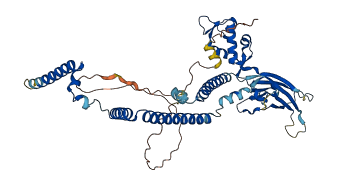
Descriptions
The autoinhibited protein was predicted that may have potential autoinhibitory elements via cis-regPred.
Autoinhibitory domains (AIDs)
Target domain |
|
Relief mechanism |
|
Assay |
cis-regPred |
Accessory elements
No accessory elements
Autoinhibited structure

Activated structure
1 structures for Q6P9Z1
| Entry ID | Method | Resolution | Chain | Position | Source |
|---|---|---|---|---|---|
| AF-Q6P9Z1-F1 | Predicted | AlphaFoldDB |
20 variants for Q6P9Z1
| Variant ID(s) | Position | Change | Description | Diseaes Association | Provenance |
|---|---|---|---|---|---|
| rs3388732195 | 120 | Q>R | No | EVA | |
| rs3388744301 | 139 | K>E | No | EVA | |
| rs3388732180 | 141 | V>M | No | EVA | |
| rs3388751468 | 146 | A>P | No | EVA | |
| rs3388747540 | 165 | F>I | No | EVA | |
| rs3388732168 | 165 | F>Y | No | EVA | |
| rs3388744246 | 193 | D>N | No | EVA | |
| rs3388732207 | 231 | T>I | No | EVA | |
| rs3388740378 | 252 | L>P | No | EVA | |
| rs3388744156 | 286 | A>S | No | EVA | |
| rs3388736832 | 311 | F>Y | No | EVA | |
| rs3388744163 | 329 | L>P | No | EVA | |
| rs3388748075 | 358 | Y>* | No | EVA | |
| rs3388751458 | 363 | E>V | No | EVA | |
| rs3388748652 | 384 | E>K | No | EVA | |
| rs3388740377 | 388 | L>M | No | EVA | |
| rs3388736886 | 389 | D>G | No | EVA | |
| rs3412992117 | 431 | L>F | No | EVA | |
| rs3388744196 | 432 | K>N | No | EVA | |
| rs3388742302 | 449 | F>L | No | EVA |
No associated diseases with Q6P9Z1
14 regional properties for Q6P9Z1
| Type | Name | Position | InterPro Accession |
|---|---|---|---|
| repeat | HAT (Half-A-TPR) repeat | 48 - 80 | IPR003107-1 |
| repeat | HAT (Half-A-TPR) repeat | 93 - 122 | IPR003107-2 |
| repeat | HAT (Half-A-TPR) repeat | 124 - 158 | IPR003107-3 |
| repeat | HAT (Half-A-TPR) repeat | 270 - 305 | IPR003107-4 |
| repeat | HAT (Half-A-TPR) repeat | 409 - 445 | IPR003107-5 |
| repeat | HAT (Half-A-TPR) repeat | 447 - 496 | IPR003107-6 |
| repeat | HAT (Half-A-TPR) repeat | 498 - 530 | IPR003107-7 |
| repeat | HAT (Half-A-TPR) repeat | 532 - 566 | IPR003107-8 |
| repeat | HAT (Half-A-TPR) repeat | 571 - 605 | IPR003107-9 |
| repeat | HAT (Half-A-TPR) repeat | 607 - 641 | IPR003107-10 |
| repeat | HAT (Half-A-TPR) repeat | 679 - 713 | IPR003107-11 |
| repeat | Tetratricopeptide repeat | 256 - 289 | IPR019734-1 |
| repeat | Tetratricopeptide repeat | 395 - 428 | IPR019734-2 |
| repeat | Tetratricopeptide repeat | 433 - 466 | IPR019734-3 |
8 GO annotations of cellular component
| Name | Definition |
|---|---|
| brahma complex | A SWI/SNF-type complex that contains 8 to 14 proteins, including both conserved (core) and nonconserved components; contains the ATPase product of the Drosophila brm (brahma) or mammalian SMARCA2/BAF190B/BRM gene, or an ortholog thereof. |
| chromatin | The ordered and organized complex of DNA, protein, and sometimes RNA, that forms the chromosome. |
| cytoplasm | The contents of a cell excluding the plasma membrane and nucleus, but including other subcellular structures. |
| nBAF complex | A SWI/SNF-type complex that is found in post-mitotic neurons, and in human contains actin and proteins encoded by the ARID1A/BAF250A or ARID1B/BAF250B, SMARCD1/BAF60A, SMARCD3/BAF60C, SMARCA2/BRM/BAF190B, SMARCA4/BRG1/BAF190A, SMARCB1/BAF47, SMARCC1/BAF155, SMARCE1/BAF57, SMARCC2/BAF170, DPF1/BAF45B, DPF3/BAF45C, ACTL6B/BAF53B genes. The nBAF complex along with CREST plays a role regulating the activity of genes essential for dendrite growth. |
| npBAF complex | A SWI/SNF-type complex that is found in neural stem or progenitor cells, and in human contains actin and proteins encoded by the ARID1A/BAF250A or ARID1B/BAF250B, SMARCD1/BAF60A, SMARCD3/BAF60C, SMARCA2/BRM/BAF190B, SMARCA4/BRG1/BAF190A, SMARCB1/BAF47, SMARCC1/BAF155, SMARCE1/BAF57, SMARCC2/BAF170, PHF10/BAF45A, ACTL6A/BAF53A genes. The npBAF complex is essential for the self-renewal/proliferative capacity of the multipotent neural stem cells. |
| nucleoplasm | That part of the nuclear content other than the chromosomes or the nucleolus. |
| nucleus | A membrane-bounded organelle of eukaryotic cells in which chromosomes are housed and replicated. In most cells, the nucleus contains all of the cell's chromosomes except the organellar chromosomes, and is the site of RNA synthesis and processing. In some species, or in specialized cell types, RNA metabolism or DNA replication may be absent. |
| SWI/SNF complex | A SWI/SNF-type complex that contains 8 to 14 proteins, including both conserved (core) and nonconserved components; contains the ATPase product of the yeast SNF2 or mammalian SMARCA4/BAF190A/BRG1 gene, or an ortholog thereof. |
7 GO annotations of molecular function
| Name | Definition |
|---|---|
| chromatin binding | Binding to chromatin, the network of fibers of DNA, protein, and sometimes RNA, that make up the chromosomes of the eukaryotic nucleus during interphase. |
| DNA-binding transcription factor binding | Binding to a DNA-binding transcription factor, a protein that interacts with a specific DNA sequence (sometimes referred to as a motif) within the regulatory region of a gene to modulate transcription. |
| nuclear receptor binding | Binding to a nuclear receptor protein. Nuclear receptor proteins are DNA-binding transcription factors which are regulated by binding to a ligand. |
| nuclear receptor coactivator activity | A transcription coactivator activity that activates or increases the transcription of specific gene sets via binding to a DNA-bound nuclear receptor, either on its own or as part of a complex. Coactivators often act by altering chromatin structure and modifications. For example, one class of transcription coregulators modifies chromatin structure through covalent modification of histones. A second class remodels the conformation of chromatin in an ATP-dependent fashion. A third class modulates interactions of DNA-bound DNA-binding transcription factors with other transcription coregulators. A fourth class of coactivator activity is the bridging of a DNA-binding transcription factor to the general (basal) transcription machinery. The Mediator complex, which bridges sequence-specific DNA binding transcription factors and RNA polymerase, is also a transcription coactivator. |
| signaling receptor binding | Binding to one or more specific sites on a receptor molecule, a macromolecule that undergoes combination with a hormone, neurotransmitter, drug or intracellular messenger to initiate a change in cell function. |
| transcription coregulator activity | A transcription regulator activity that modulates the transcription of specific gene sets via binding to a DNA-bound DNA-binding transcription factor, either on its own or as part of a complex. Coregulators often act by altering chromatin structure and modifications. For example, one class of transcription coregulators modifies chromatin structure through covalent modification of histones. A second class remodels the conformation of chromatin in an ATP-dependent fashion. A third class modulates interactions of DNA-bound DNA-binding transcription factors with other transcription coregulators. |
| transcription coregulator binding | Binding to a transcription coregulator, a protein involved in regulation of transcription via protein-protein interactions with transcription factors and other transcription regulatory proteins. Cofactors do not bind DNA directly, but rather mediate protein-protein interactions between regulatory transcription factors and the basal transcription machinery. |
22 GO annotations of biological process
| Name | Definition |
|---|---|
| cardiac right ventricle formation | The developmental process pertaining to the initial formation of a right cardiac ventricle from unspecified parts. |
| chromatin remodeling | A dynamic process of chromatin reorganization resulting in changes to chromatin structure. These changes allow DNA metabolic processes such as transcriptional regulation, DNA recombination, DNA repair, and DNA replication. |
| heart morphogenesis | The developmental process in which the heart is generated and organized. The heart is a hollow, muscular organ, which, by contracting rhythmically, keeps up the circulation of the blood. |
| muscle cell differentiation | The process in which a relatively unspecialized cell acquires specialized features of a muscle cell. |
| nervous system development | The process whose specific outcome is the progression of nervous tissue over time, from its formation to its mature state. |
| neural retina development | The progression of the neural retina over time from its initial formation to the mature structure. The neural retina is the part of the retina that contains neurons and photoreceptor cells. |
| nucleosome disassembly | The controlled breakdown of nucleosomes, the beadlike structural units of eukaryotic chromatin composed of histones and DNA. |
| positive regulation of cell differentiation | Any process that activates or increases the frequency, rate or extent of cell differentiation. |
| positive regulation of DNA-templated transcription | Any process that activates or increases the frequency, rate or extent of cellular DNA-templated transcription. |
| positive regulation of double-strand break repair | Any process that activates or increases the frequency, rate or extent of double-strand break repair. |
| positive regulation of G2/M transition of mitotic cell cycle | Any signalling pathway that activates or increases the activity of a cell cycle cyclin-dependent protein kinase to modulate the switch from G2 phase to M phase of the mitotic cell cycle. |
| positive regulation of myoblast differentiation | Any process that activates or increases the frequency, rate or extent of myoblast differentiation. A myoblast is a mononucleate cell type that, by fusion with other myoblasts, gives rise to the myotubes that eventually develop into skeletal muscle fibers. |
| positive regulation of neuroblast proliferation | Any process that activates or increases the rate of neuroblast proliferation. |
| positive regulation of smooth muscle cell differentiation | Any process that activates or increases the frequency, rate or extent of smooth muscle cell differentiation. |
| positive regulation of T cell differentiation | Any process that activates or increases the frequency, rate or extent of T cell differentiation. |
| regulation of G0 to G1 transition | A cell cycle process that modulates the rate or extent of the transition from the G0 quiescent state to the G1 phase. |
| regulation of G1/S transition of mitotic cell cycle | Any signalling pathway that modulates the activity of a cell cycle cyclin-dependent protein kinase to modulate the switch from G1 phase to S phase of the mitotic cell cycle. |
| regulation of mitotic metaphase/anaphase transition | Any process that modulates the frequency, rate or extent of the cell cycle process in which a cell progresses from metaphase to anaphase during mitosis, triggered by the activation of the anaphase promoting complex by Cdc20/Sleepy homolog which results in the degradation of Securin. |
| regulation of nucleotide-excision repair | Any process that modulates the frequency, rate or extent of nucleotide-excision repair. |
| regulation of protein binding | Any process that modulates the frequency, rate or extent of protein binding. |
| regulation of transcription by RNA polymerase II | Any process that modulates the frequency, rate or extent of transcription mediated by RNA polymerase II. |
| secondary heart field specification | The process that results in the delineation of a specific region of the lateral mesoderm into the area which will form the majority of the mesodermal component of the right ventricle, arterial pole (outflow tract) and venous pole (inflow tract). |
9 homologous proteins in AiPD
| UniProt AC | Gene Name | Protein Name | Species | Evidence Code |
|---|---|---|---|---|
| Q2TBN1 | SMARCD1 | SWI/SNF-related matrix-associated actin-dependent regulator of chromatin subfamily D member 1 | Bos taurus (Bovine) | PR |
| E1BJD1 | SMARCD2 | SWI/SNF-related matrix-associated actin-dependent regulator of chromatin subfamily D member 2 | Bos taurus (Bovine) | PR |
| Q9VYG2 | Bap60 | Brahma-associated protein of 60 kDa | Drosophila melanogaster (Fruit fly) | PR |
| Q92925 | SMARCD2 | SWI/SNF-related matrix-associated actin-dependent regulator of chromatin subfamily D member 2 | Homo sapiens (Human) | PR |
| Q96GM5 | SMARCD1 | SWI/SNF-related matrix-associated actin-dependent regulator of chromatin subfamily D member 1 | Homo sapiens (Human) | PR |
| Q6STE5 | SMARCD3 | SWI/SNF-related matrix-associated actin-dependent regulator of chromatin subfamily D member 3 | Homo sapiens (Human) | PR |
| Q61466 | Smarcd1 | SWI/SNF-related matrix-associated actin-dependent regulator of chromatin subfamily D member 1 | Mus musculus (Mouse) | PR |
| Q99JR8 | Smarcd2 | SWI/SNF-related matrix-associated actin-dependent regulator of chromatin subfamily D member 2 | Mus musculus (Mouse) | PR |
| O54772 | Smarcd2 | SWI/SNF-related matrix-associated actin-dependent regulator of chromatin subfamily D member 2 | Rattus norvegicus (Rat) | PR |
| 10 | 20 | 30 | 40 | 50 | 60 |
| MAADEVAGGA | RKATKSKLFE | FLVHGVRPGM | PSGARMPHQG | APMGPPGSPY | MGSPAVRPGL |
| 70 | 80 | 90 | 100 | 110 | 120 |
| APAGMEPARK | RAAPPPGQSQ | AQGQGQPVPT | APARSRSAKR | RKMADKILPQ | RIRELVPESQ |
| 130 | 140 | 150 | 160 | 170 | 180 |
| AYMDLLAFER | KLDQTIMRKR | VDIQEALKRP | MKQKRKLRLY | ISNTFNPAKP | DAEDSDGSIA |
| 190 | 200 | 210 | 220 | 230 | 240 |
| SWELRVEGKL | LDDPSKQKRK | FSSFFKSLVI | ELDKDLYGPD | NHLVEWHRTP | TTQETDGFQV |
| 250 | 260 | 270 | 280 | 290 | 300 |
| KRPGDLSVRC | TLLLMLDYQP | PQFKLDPRLA | RLLGLHTQSR | SAIVQALWQY | VKTNRLQDSH |
| 310 | 320 | 330 | 340 | 350 | 360 |
| DKEYINGDKY | FQQIFDCPRL | KFSEIPQRLT | ALLLPPDPIV | INHVISVDPS | DQKKTACYDI |
| 370 | 380 | 390 | 400 | 410 | 420 |
| DVEVEEPLKG | QMSSFLLSTA | NQQEISALDS | KIHETIESIN | QLKIQRDFML | SFSRDPKGYV |
| 430 | 440 | 450 | 460 | 470 | 480 |
| QDLLRSQSRD | LKVMTDVAGN | PEEERRAEFY | HQPWSQEAVS | RYFYCKIQQR | RQELEQSLVV |
| RNT |