Q96524
Gene name |
CRY2 |
Protein name |
Cryptochrome-2 |
Names |
Atcry2, Blue light photoreceptor, Protein PHR homolog 1, AtPHH1, Protein SUPPRESSOR OF elf3 20 |
Species |
Arabidopsis thaliana (Mouse-ear cress) |
KEGG Pathway |
ath:AT1G04400 |
EC number |
|
Protein Class |
|
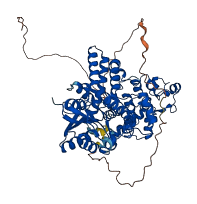
Descriptions
The autoinhibited protein was predicted that may have potential autoinhibitory elements via cis-regPred.
Autoinhibitory domains (AIDs)
Target domain |
|
Relief mechanism |
|
Assay |
cis-regPred |
Accessory elements
No accessory elements
Autoinhibited structure

Activated structure
7 structures for Q96524
40 variants for Q96524
| Variant ID(s) | Position | Change | Description | Diseaes Association | Provenance |
|---|---|---|---|---|---|
| tmp_1_1187889_T_C | 5 | K>E | No | 1000Genomes | |
| ENSVATH00005476 | 24 | A>T | No | 1000Genomes | |
| ENSVATH04518025 | 83 | I>V | strain: cv. Chi-1, cv. Co-1, cv. Kon, cv. PHW-1 and cv. Sha [UniProt] | No | 1000Genomes |
| ENSVATH04518018 | 127 | Q>* | No | 1000Genomes | |
| ENSVATH04518016 | 127 | Q>H | No | 1000Genomes | |
| ENSVATH04518017 | 127 | Q>P | No | 1000Genomes | |
| ENSVATH04518017 | 127 | Q>R | No | 1000Genomes | |
| 127 | Q>S | strain: cv. Bu-0, cv. Da(1)-12, cv. Di-G, cv. Landsberg erecta, cv. Le-0, cv. Lip-0, cv. Mrk-0, cv. Stw-0 and cv. Ta-0 [UniProt] | No | ||
| tmp_1_1187350_T_C | 150 | S>G | No | 1000Genomes | |
| ENSVATH04518015 | 152 | N>S | No | 1000Genomes | |
| ENSVATH13852541 | 163 | I>T | No | 1000Genomes | |
| tmp_1_1187161_G_A | 181 | A>V | No | 1000Genomes | |
| tmp_1_1187155_G_T | 183 | A>E | No | 1000Genomes | |
| ENSVATH04518010 | 198 | A>T | No | 1000Genomes | |
| ENSVATH10567354 | 220 | L>I | No | 1000Genomes | |
| ENSVATH00005469 | 269 | Q>K | No | 1000Genomes | |
| ENSVATH10567348 | 274 | R>K | No | 1000Genomes | |
| ENSVATH10567347 | 278 | S>R | No | 1000Genomes | |
| tmp_1_1186730_C_G | 325 | V>L | No | 1000Genomes | |
| ENSVATH00005468 | 326 | D>E | strain: cv. Chi-1, cv. Co-1, cv. Kon, cv. PHW-1 and cv. Sha [UniProt] | No | 1000Genomes |
| tmp_1_1186641_C_T | 354 | M>I | No | 1000Genomes | |
| ENSVATH00005465 | 367 | V>M | strain: cv. Cvi-0 [UniProt] | No | 1000Genomes |
| tmp_1_1186552_G_A | 384 | T>I | No | 1000Genomes | |
| tmp_1_1186155_G_A | 468 | A>V | No | 1000Genomes | |
| ENSVATH00005460 | 476 | T>I | strain: cv. Cvi-0 [UniProt] | No | 1000Genomes |
| tmp_1_1186126_G_A | 478 | R>C | No | 1000Genomes | |
| tmp_1_1186123_C_T | 479 | E>K | No | 1000Genomes | |
| ENSVATH04517990 | 482 | A>G | strain: cv. Chi-1, cv. Co-1, cv. Kon, cv. PHW-1 and cv. Sha [UniProt] | No | 1000Genomes |
| ENSVATH04517987 | 498 | A>S | strain: cv. Chi-1, cv. Co-1, cv. Kon, cv. PHW-1 and cv. Sha [UniProt] | No | 1000Genomes |
| ENSVATH00005459 | 507 | F>L | strain: cv. Chi-1, cv. Co-1, cv. Kon, cv. PHW-1 and cv. Sha [UniProt] | No | 1000Genomes |
| ENSVATH10567059 | 507 | F>V | No | 1000Genomes | |
| ENSVATH04517986 | 511 | G>E | strain: cv. Chi-1, cv. Co-1, cv. Kon, cv. PHW-1 and cv. Sha [UniProt] | No | 1000Genomes |
| tmp_1_1186014_A_T | 515 | I>N | No | 1000Genomes | |
| tmp_1_1185951_C_T | 536 | R>H | No | 1000Genomes | |
| ENSVATH10567058 | 538 | N>S | No | 1000Genomes | |
| ENSVATH04517983 | 543 | V>L | strain: cv. Chi-1, cv. Co-1, cv. Kon, cv. PHW-1 and cv. Sha [UniProt] | No | 1000Genomes |
| ENSVATH04517979 | 564 | L>F | No | 1000Genomes | |
| tmp_1_1185777_C_A | 594 | G>V | No | 1000Genomes | |
| tmp_1_1185729_C_T | 610 | G>D | No | 1000Genomes | |
| ENSVATH04517976 | 611 | C>Y | strain: cv. Chi-1, cv. Co-1, cv. Kon, cv. PHW-1 and cv. Sha [UniProt] | No | 1000Genomes |
No associated diseases with Q96524
4 regional properties for Q96524
| Type | Name | Position | InterPro Accession |
|---|---|---|---|
| domain | Cryptochrome/DNA photolyase, FAD-binding domain | 287 - 485 | IPR005101 |
| domain | DNA photolyase, N-terminal | 5 - 160 | IPR006050 |
| conserved_site | Cryptochrome/DNA photolyase class 1, conserved site, C-terminal | 336 - 348 | IPR018394-1 |
| conserved_site | Cryptochrome/DNA photolyase class 1, conserved site, C-terminal | 356 - 375 | IPR018394-2 |
Functions
5 GO annotations of cellular component
| Name | Definition |
|---|---|
| cytoplasm | The contents of a cell excluding the plasma membrane and nucleus, but including other subcellular structures. |
| nuclear body | Extra-nucleolar nuclear domains usually visualized by confocal microscopy and fluorescent antibodies to specific proteins. |
| nucleus | A membrane-bounded organelle of eukaryotic cells in which chromosomes are housed and replicated. In most cells, the nucleus contains all of the cell's chromosomes except the organellar chromosomes, and is the site of RNA synthesis and processing. In some species, or in specialized cell types, RNA metabolism or DNA replication may be absent. |
| plant-type vacuole | A closed structure that is completely surrounded by a unit membrane, contains liquid, and retains the same shape regardless of cell cycle phase. An example of this structure is found in Arabidopsis thaliana. |
| PML body | A class of nuclear body; they react against SP100 auto-antibodies (PML, promyelocytic leukemia); cells typically contain 10-30 PML bodies per nucleus; alterations in the localization of PML bodies occurs after viral infection. |
8 GO annotations of molecular function
| Name | Definition |
|---|---|
| ATP binding | Binding to ATP, adenosine 5'-triphosphate, a universally important coenzyme and enzyme regulator. |
| blue light photoreceptor activity | The function of absorbing and responding to electromagnetic radiation with a wavelength of approximately 400-470nm. The response may involve a change in conformation. |
| deoxyribodipyrimidine photo-lyase activity | Catalysis of the reaction: cyclobutadipyrimidine (in DNA) = 2 pyrimidine residues (in DNA). This reaction represents the reactivation of irradiated DNA by light. |
| DNA binding | Any molecular function by which a gene product interacts selectively and non-covalently with DNA (deoxyribonucleic acid). |
| FAD binding | Binding to the oxidized form, FAD, of flavin-adenine dinucleotide, the coenzyme or the prosthetic group of various flavoprotein oxidoreductase enzymes. |
| identical protein binding | Binding to an identical protein or proteins. |
| metal ion binding | Binding to a metal ion. |
| protein homodimerization activity | Binding to an identical protein to form a homodimer. |
25 GO annotations of biological process
| Name | Definition |
|---|---|
| blue light signaling pathway | The series of molecular signals initiated upon sensing of blue light by photoreceptor molecule, at a wavelength between 400nm and 470nm. |
| chromatin organization | The assembly or remodeling of chromatin composed of DNA complexed with histones, other associated proteins, and sometimes RNA. |
| chromatin remodeling | A dynamic process of chromatin reorganization resulting in changes to chromatin structure. These changes allow DNA metabolic processes such as transcriptional regulation, DNA recombination, DNA repair, and DNA replication. |
| circadian regulation of calcium ion oscillation | Any process that modulates the concentration of cytosolic free calcium ion |
| circadian regulation of gene expression | Any process that modulates the frequency, rate or extent of gene expression such that an expression pattern recurs with a regularity of approximately 24 hours. |
| circadian rhythm | Any biological process in an organism that recurs with a regularity of approximately 24 hours. |
| defense response to virus | Reactions triggered in response to the presence of a virus that act to protect the cell or organism. |
| entrainment of circadian clock by photoperiod | The synchronization of a circadian rhythm to photoperiod, the intermittent cycle of light (day) and dark (night). |
| flavin adenine dinucleotide metabolic process | The chemical reactions and pathways involving flavin adenine dinucleotide, which acts as a coenzyme or prosthetic group of various flavoprotein oxidoreductase enzymes. |
| long-day photoperiodism, flowering | A change from the vegetative to the reproductive phase as a result of detection of, or exposure to, a period of light that exceeds the critical day length. The critical day length varies between species. Although the term is long-day is used, most species actually respond to the duration of the night, so that the response will occur when a period of darkness falls short of the number of hours defined by 24 minus the critical day length. |
| phototropism | The movement of an organism, or part of an organism, in response to a light stimulus, usually toward or away from it. |
| positive regulation of flower development | Any process that activates or increases the frequency, rate or extent of flower development. |
| positive regulation of reactive oxygen species metabolic process | Any process that activates or increases the frequency, rate or extent of reactive oxygen species metabolic process. |
| regulation of circadian rhythm | Any process that modulates the frequency, rate or extent of a circadian rhythm. A circadian rhythm is a biological process in an organism that recurs with a regularity of approximately 24 hours. |
| regulation of flower development | Any process that modulates the frequency, rate or extent of flower development. |
| regulation of leaf morphogenesis | Any process that modulates the frequency, rate or extent of leaf morphogenesis. |
| regulation of meristem growth | Any process involved in maintaining the size and shape of a meristem. |
| regulation of photoperiodism, flowering | Any process that modulates the frequency, rate or extent of photoperiodism, flowering. |
| response to absence of light | Any process that results in a change in state or activity of a cell or an organism (in terms of movement, secretion, enzyme production, gene expression, etc.) as a result of an absence of light stimuli. |
| response to blue light | Any process that results in a change in state or activity of a cell or an organism (in terms of movement, secretion, enzyme production, gene expression, etc.) as a result of a blue light stimulus. Blue light is electromagnetic radiation with a wavelength of between 440 and 500nm. |
| response to light stimulus | Any process that results in a change in state or activity of a cell or an organism (in terms of movement, secretion, enzyme production, gene expression, etc.) as a result of a light stimulus, electromagnetic radiation of wavelengths classified as infrared, visible or ultraviolet light. |
| response to low fluence blue light stimulus by blue low-fluence system | Any process that results in a change in state or activity of a cell or an organism (in terms of movement, secretion, enzyme production, gene expression, etc.) as a result of the detection of a low fluence blue light stimulus by the blue low-fluence system. Blue light is electromagnetic radiation with a wavelength of between 440 and 500nm. The blue low-fluence system responds to blue light at or below 0.1 micromols/m2. In certain species excitation of the blue low fluence system induces the transcription of a number of nuclear and plastid coded genes. |
| response to strigolactone | Any process that results in a change in state or activity of a cell or an organism (in terms of movement, secretion, enzyme production, gene expression, etc.) as a result of a strigolactone stimulus. |
| response to water deprivation | Any process that results in a change in state or activity of a cell or an organism (in terms of movement, secretion, enzyme production, gene expression, etc.) as a result of a water deprivation stimulus, prolonged deprivation of water. |
| stomatal movement | The process of opening or closing of stomata, which is directly related to the stomatal conductance (measuring rate of passage of either water vapor or carbon dioxide (CO2) through stomata). |
8 homologous proteins in AiPD
| UniProt AC | Gene Name | Protein Name | Species | Evidence Code |
|---|---|---|---|---|
| Q8QG60 | CRY2 | Cryptochrome-2 | Gallus gallus (Chicken) | PR |
| Q16526 | CRY1 | Cryptochrome-1 | Homo sapiens (Human) | PR |
| Q49AN0 | CRY2 | Cryptochrome-2 | Homo sapiens (Human) | PR |
| P97784 | Cry1 | Cryptochrome-1 | Mus musculus (Mouse) | PR |
| Q9R194 | Cry2 | Cryptochrome-2 | Mus musculus (Mouse) | PR |
| Q923I8 | Cry2 | Cryptochrome-2 | Rattus norvegicus (Rat) | PR |
| Q0E2Y1 | UVR3 | (6-4)DNA photolyase | Oryza sativa subsp japonica (Rice) | PR |
| O48652 | UVR3 | (6-4)DNA photolyase | Arabidopsis thaliana (Mouse-ear cress) | PR |
| 10 | 20 | 30 | 40 | 50 | 60 |
| MKMDKKTIVW | FRRDLRIEDN | PALAAAAHEG | SVFPVFIWCP | EEEGQFYPGR | ASRWWMKQSL |
| 70 | 80 | 90 | 100 | 110 | 120 |
| AHLSQSLKAL | GSDLTLIKTH | NTISAILDCI | RVTGATKVVF | NHLYDPVSLV | RDHTVKEKLV |
| 130 | 140 | 150 | 160 | 170 | 180 |
| ERGISVQSYN | GDLLYEPWEI | YCEKGKPFTS | FNSYWKKCLD | MSIESVMLPP | PWRLMPITAA |
| 190 | 200 | 210 | 220 | 230 | 240 |
| AEAIWACSIE | ELGLENEAEK | PSNALLTRAW | SPGWSNADKL | LNEFIEKQLI | DYAKNSKKVV |
| 250 | 260 | 270 | 280 | 290 | 300 |
| GNSTSLLSPY | LHFGEISVRH | VFQCARMKQI | IWARDKNSEG | EESADLFLRG | IGLREYSRYI |
| 310 | 320 | 330 | 340 | 350 | 360 |
| CFNFPFTHEQ | SLLSHLRFFP | WDADVDKFKA | WRQGRTGYPL | VDAGMRELWA | TGWMHNRIRV |
| 370 | 380 | 390 | 400 | 410 | 420 |
| IVSSFAVKFL | LLPWKWGMKY | FWDTLLDADL | ECDILGWQYI | SGSIPDGHEL | DRLDNPALQG |
| 430 | 440 | 450 | 460 | 470 | 480 |
| AKYDPEGEYI | RQWLPELARL | PTEWIHHPWD | APLTVLKASG | VELGTNYAKP | IVDIDTAREL |
| 490 | 500 | 510 | 520 | 530 | 540 |
| LAKAISRTRE | AQIMIGAAPD | EIVADSFEAL | GANTIKEPGL | CPSVSSNDQQ | VPSAVRYNGS |
| 550 | 560 | 570 | 580 | 590 | 600 |
| KRVKPEEEEE | RDMKKSRGFD | ERELFSTAES | SSSSSVFFVS | QSCSLASEGK | NLEGIQDSSD |
| 610 | |||||
| QITTSLGKNG | CK |