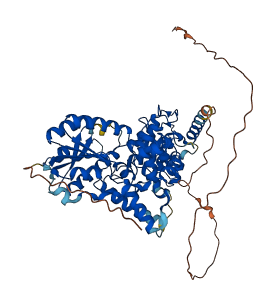
Descriptions
The autoinhibited protein was predicted that may have potential autoinhibitory elements via cis-regPred.
Autoinhibitory domains (AIDs)
Target domain |
|
Relief mechanism |
|
Assay |
cis-regPred |
Accessory elements
No accessory elements
Autoinhibited structure

Activated structure
1 structures for Q923I8
| Entry ID | Method | Resolution | Chain | Position | Source |
|---|---|---|---|---|---|
| AF-Q923I8-F1 | Predicted | AlphaFoldDB |
No variants for Q923I8
| Variant ID(s) | Position | Change | Description | Diseaes Association | Provenance |
|---|---|---|---|---|---|
| No variants for Q923I8 | |||||
No associated diseases with Q923I8
4 GO annotations of cellular component
| Name | Definition |
|---|---|
| cytoplasm | The contents of a cell excluding the plasma membrane and nucleus, but including other subcellular structures. |
| extracellular region | The space external to the outermost structure of a cell. For cells without external protective or external encapsulating structures this refers to space outside of the plasma membrane. This term covers the host cell environment outside an intracellular parasite. |
| mitochondrion | A semiautonomous, self replicating organelle that occurs in varying numbers, shapes, and sizes in the cytoplasm of virtually all eukaryotic cells. It is notably the site of tissue respiration. |
| nucleus | A membrane-bounded organelle of eukaryotic cells in which chromosomes are housed and replicated. In most cells, the nucleus contains all of the cell's chromosomes except the organellar chromosomes, and is the site of RNA synthesis and processing. In some species, or in specialized cell types, RNA metabolism or DNA replication may be absent. |
10 GO annotations of molecular function
| Name | Definition |
|---|---|
| damaged DNA binding | Binding to damaged DNA. |
| DNA binding | Any molecular function by which a gene product interacts selectively and non-covalently with DNA (deoxyribonucleic acid). |
| FAD binding | Binding to the oxidized form, FAD, of flavin-adenine dinucleotide, the coenzyme or the prosthetic group of various flavoprotein oxidoreductase enzymes. |
| kinase binding | Binding to a kinase, any enzyme that catalyzes the transfer of a phosphate group. |
| nuclear receptor binding | Binding to a nuclear receptor protein. Nuclear receptor proteins are DNA-binding transcription factors which are regulated by binding to a ligand. |
| phosphatase binding | Binding to a phosphatase. |
| photoreceptor activity | The function of absorbing and responding to incidental electromagnetic radiation, particularly visible light. The response may involve a change in conformation. |
| protein kinase binding | Binding to a protein kinase, any enzyme that catalyzes the transfer of a phosphate group, usually from ATP, to a protein substrate. |
| single-stranded DNA binding | Binding to single-stranded DNA. |
| transcription cis-regulatory region binding | Binding to a specific sequence of DNA that is part of a regulatory region that controls transcription of that section of the DNA. The transcribed region might be described as a gene, cistron, or operon. |
17 GO annotations of biological process
| Name | Definition |
|---|---|
| circadian regulation of gene expression | Any process that modulates the frequency, rate or extent of gene expression such that an expression pattern recurs with a regularity of approximately 24 hours. |
| circadian rhythm | Any biological process in an organism that recurs with a regularity of approximately 24 hours. |
| entrainment of circadian clock by photoperiod | The synchronization of a circadian rhythm to photoperiod, the intermittent cycle of light (day) and dark (night). |
| glucose homeostasis | Any process involved in the maintenance of an internal steady state of glucose within an organism or cell. |
| lipid storage | The accumulation and maintenance in cells or tissues of lipids, compounds soluble in organic solvents but insoluble or sparingly soluble in aqueous solvents. Lipid reserves can be accumulated during early developmental stages for mobilization and utilization at later stages of development. |
| negative regulation of circadian rhythm | Any process that stops, prevents, or reduces the frequency, rate or extent of a circadian rhythm behavior. |
| negative regulation of DNA-templated transcription | Any process that stops, prevents, or reduces the frequency, rate or extent of cellular DNA-templated transcription. |
| negative regulation of glucocorticoid receptor signaling pathway | Any process that stops, prevents or reduces the frequency, rate or extent of glucocorticoid receptor signaling pathway. |
| negative regulation of glucocorticoid secretion | Any process that stops, prevents or reduces the frequency, rate or extent of glucocorticoid secretion. |
| negative regulation of phosphoprotein phosphatase activity | Any process that stops or reduces the activity of a phosphoprotein phosphatase. |
| negative regulation of transcription by RNA polymerase II | Any process that stops, prevents, or reduces the frequency, rate or extent of transcription mediated by RNA polymerase II. |
| protein import into nucleus | The directed movement of a protein from the cytoplasm to the nucleus. |
| regulation of circadian rhythm | Any process that modulates the frequency, rate or extent of a circadian rhythm. A circadian rhythm is a biological process in an organism that recurs with a regularity of approximately 24 hours. |
| regulation of sodium-dependent phosphate transport | Any process that modulates the frequency, rate or extent of sodium-dependent phosphate transport. |
| response to activity | Any process that results in a change in state or activity of a cell or an organism (in terms of movement, secretion, enzyme production, gene expression, etc.) as a result of an activity stimulus. |
| response to insulin | Any process that results in a change in state or activity of a cell or an organism (in terms of movement, secretion, enzyme production, gene expression, etc.) as a result of an insulin stimulus. Insulin is a polypeptide hormone produced by the islets of Langerhans of the pancreas in mammals, and by the homologous organs of other organisms. |
| response to light stimulus | Any process that results in a change in state or activity of a cell or an organism (in terms of movement, secretion, enzyme production, gene expression, etc.) as a result of a light stimulus, electromagnetic radiation of wavelengths classified as infrared, visible or ultraviolet light. |
8 homologous proteins in AiPD
| UniProt AC | Gene Name | Protein Name | Species | Evidence Code |
|---|---|---|---|---|
| Q8QG60 | CRY2 | Cryptochrome-2 | Gallus gallus (Chicken) | PR |
| Q16526 | CRY1 | Cryptochrome-1 | Homo sapiens (Human) | PR |
| Q49AN0 | CRY2 | Cryptochrome-2 | Homo sapiens (Human) | PR |
| P97784 | Cry1 | Cryptochrome-1 | Mus musculus (Mouse) | PR |
| Q9R194 | Cry2 | Cryptochrome-2 | Mus musculus (Mouse) | PR |
| Q0E2Y1 | UVR3 | (6-4)DNA photolyase | Oryza sativa subsp japonica (Rice) | PR |
| Q96524 | CRY2 | Cryptochrome-2 | Arabidopsis thaliana (Mouse-ear cress) | PR |
| O48652 | UVR3 | (6-4)DNA photolyase | Arabidopsis thaliana (Mouse-ear cress) | PR |
| 10 | 20 | 30 | 40 | 50 | 60 |
| MAAAAVVAAT | VPVQSMGADG | ASSVHWFRKG | LRLHDNPALL | AAVRGARCVR | CVYILDPWFA |
| 70 | 80 | 90 | 100 | 110 | 120 |
| ASSSVGINRW | RFLLQSLEDL | DTSLRKLNSR | LFVVRGQPAD | VFPRLFKEWG | VTRLTFEYDS |
| 130 | 140 | 150 | 160 | 170 | 180 |
| EPFGKERDAA | IMKMAKEAGV | EVVTENSHTL | YDLDRIIELN | GQKPPLTYKR | FQALISRMEL |
| 190 | 200 | 210 | 220 | 230 | 240 |
| PKKPVGAVSS | QHMENCRAEI | QENHDDTYGV | PSLEELGFPT | EGLGPAVWQG | GETEALVRLD |
| 250 | 260 | 270 | 280 | 290 | 300 |
| KHLERKAWVA | NYERPRMNAN | SLLASPTGLS | PYLRFGCLSC | RLFYYRLWDL | YRKVKRNSTP |
| 310 | 320 | 330 | 340 | 350 | 360 |
| PLSLFGQLLW | REFFYTAATN | NPRFDRMEGN | PICIQIPWDR | NPEALAKWAE | GKTGFPWIDA |
| 370 | 380 | 390 | 400 | 410 | 420 |
| IMTQLRQEGW | IHHLARHAVA | CFLTRGDLWV | SWESGVRVFD | ELLLDADFSV | NAGSWMWLSC |
| 430 | 440 | 450 | 460 | 470 | 480 |
| SAFFQQFFHC | YCPVGFGRRT | DPSGDYIRRY | LPKLKGFPSR | YIYEPWNAPE | SVQKAANCII |
| 490 | 500 | 510 | 520 | 530 | 540 |
| GVDYPRPIVN | HAETSRLNIE | RMKQIYQQLS | RYRGLCLWAS | VPSCVEDLSH | PVAEPGSSQA |
| 550 | 560 | 570 | 580 | 590 | |
| GSISNTGPRP | LSSGPASPKR | KLEAAEEPPG | EELSKRARVT | VTQMPAQEPP | SKDS |