Q960N3
Gene name |
cort |
Protein name |
Protein cortex |
Names |
|
Species |
Drosophila melanogaster (Fruit fly) |
KEGG Pathway |
dme:Dmel_CG11330 |
EC number |
|
Protein Class |
|
Descriptions
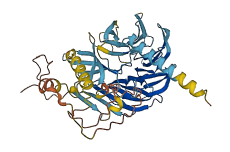
The autoinhibited protein was predicted that may have potential autoinhibitory elements via cis-regPred.
Autoinhibitory domains (AIDs)
Target domain |
|
Relief mechanism |
|
Assay |
cis-regPred |
Accessory elements
No accessory elements
Autoinhibited structure

Activated structure
1 structures for Q960N3
| Entry ID | Method | Resolution | Chain | Position | Source |
|---|---|---|---|---|---|
| AF-Q960N3-F1 | Predicted | AlphaFoldDB |
No variants for Q960N3
| Variant ID(s) | Position | Change | Description | Diseaes Association | Provenance |
|---|---|---|---|---|---|
| No variants for Q960N3 | |||||
No associated diseases with Q960N3
No regional properties for Q960N3
| Type | Name | Position | InterPro Accession |
|---|---|---|---|
| No domain, repeats, and functional sites for Q960N3 | |||
2 GO annotations of cellular component
| Name | Definition |
|---|---|
| anaphase-promoting complex | A ubiquitin ligase complex that degrades mitotic cyclins and anaphase inhibitory protein, thereby triggering sister chromatid separation and exit from mitosis. Substrate recognition by APC occurs through degradation signals, the most common of which is termed the Dbox degradation motif, originally discovered in cyclin B. |
| cytoplasm | The contents of a cell excluding the plasma membrane and nucleus, but including other subcellular structures. |
2 GO annotations of molecular function
| Name | Definition |
|---|---|
| anaphase-promoting complex binding | Binding to an anaphase-promoting complex. A ubiquitin ligase complex that degrades mitotic cyclins and anaphase inhibitory protein, thereby triggering sister chromatid separation and exit from mitosis. |
| ubiquitin ligase activator activity | Binds to and increases the activity of a ubiquitin ligase. |
11 GO annotations of biological process
| Name | Definition |
|---|---|
| anaphase-promoting complex-dependent catabolic process | The chemical reactions and pathways resulting in the breakdown of a protein or peptide by hydrolysis of its peptide bonds, initiated by the covalent attachment of ubiquitin, with ubiquitin-protein ligation catalyzed by the anaphase-promoting complex, and mediated by the proteasome. |
| cellularization | The separation of a multi-nucleate cell or syncytium into individual cells. An example of this is found in Drosophila melanogaster embryo development. |
| egg activation | The process in which the egg becomes metabolically active, initiates protein and DNA synthesis and undergoes structural changes to its cortex and/or cytoplasm. |
| female meiosis I | The cell cycle process in which the first meiotic division occurs in the female germline. |
| female meiosis II | The cell cycle process in which the second meiotic division occurs in the female germline. |
| female meiotic nuclear division | A cell cycle process by which the cell nucleus divides as part of a meiotic cell cycle in the female germline. |
| homologous chromosome segregation | The cell cycle process in which replicated homologous chromosomes are organized and then physically separated and apportioned to two sets during the first division of the meiotic cell cycle. Each replicated chromosome, composed of two sister chromatids, aligns at the cell equator, paired with its homologous partner; this pairing off, referred to as synapsis, permits genetic recombination. One homolog (both sister chromatids) of each morphologic type goes into each of the resulting chromosome sets. |
| oogenesis | The complete process of formation and maturation of an ovum or female gamete from a primordial female germ cell. Examples of this process are found in Mus musculus and Drosophila melanogaster. |
| pole cell formation | Formation of a small group of cells (pole cells) at the posterior pole of the insect blastula. They are the first cells to cellularize after the arrival of nuclei at the end of the syncytial blastula stage and are the precursors to the insect germ cells. |
| positive regulation of anaphase-promoting complex-dependent catabolic process | Any process that activates or increases the frequency, rate or extent of anaphase-promoting complex-dependent catabolic process. |
| positive regulation of ubiquitin protein ligase activity | Any process that activates or increases the frequency, rate or extent of ubiquitin protein ligase activity. |
8 homologous proteins in AiPD
| UniProt AC | Gene Name | Protein Name | Species | Evidence Code |
|---|---|---|---|---|
| P50082 | AMA1 | Meiosis-specific APC/C activator protein AMA1 | Saccharomyces cerevisiae (strain ATCC 204508 / S288c) (Baker's yeast) | PR |
| P26309 | CDC20 | APC/C activator protein CDC20 | Saccharomyces cerevisiae (strain ATCC 204508 / S288c) (Baker's yeast) | PR |
| Q9UM11 | FZR1 | Fizzy-related protein homolog | Homo sapiens (Human) | PR |
| Q12834 | CDC20 | Cell division cycle protein 20 homolog | Homo sapiens (Human) | PR |
| Q9R1K5 | Fzr1 | Fizzy-related protein homolog | Mus musculus (Mouse) | PR |
| Q9JJ66 | Cdc20 | Cell division cycle protein 20 homolog | Mus musculus (Mouse) | PR |
| Q62623 | Cdc20 | Cell division cycle protein 20 homolog | Rattus norvegicus (Rat) | PR |
| Q8LPL5 | FZR3 | Protein FIZZY-RELATED 3 | Arabidopsis thaliana (Mouse-ear cress) | PR |
| 10 | 20 | 30 | 40 | 50 | 60 |
| MFVEMSVCDS | PNKNSKLDKK | SLTPFKKVRR | KNWKQEAAYK | SDTSKGQEVS | YVGERFIPNR |
| 70 | 80 | 90 | 100 | 110 | 120 |
| FERENIEFNL | KYIGKRKERD | ILETGVTLTA | SYWRQSGFIS | NINRTFGIGE | RRLFQFSSQQ |
| 130 | 140 | 150 | 160 | 170 | 180 |
| GTRSRVVDND | SADSDWPCNP | RARPYAIQNA | THEMPGICSP | VDYNMMDWSS | GGMVAMSSGQ |
| 190 | 200 | 210 | 220 | 230 | 240 |
| DVMLWRNLDE | STMVFSVESP | TSLKYSPDGK | HLAIGCMDRN | YPVLDLWEVR | SPTEFLVSYR |
| 250 | 260 | 270 | 280 | 290 | 300 |
| KLFFKSMGYI | SCIEWSHDGK | EVICGTQCGV | IIVLAMPTLN | TLMQLREHRH | TVKKMKFAPT |
| 310 | 320 | 330 | 340 | 350 | 360 |
| HKYFASSDTD | GKIFIFDAVL | KVRLLKLDGR | SIVFDWHPWT | GEDLAVAERS | PASIFIFNIP |
| 370 | 380 | 390 | 400 | 410 | 420 |
| RRQFVASYRR | RDDRIVIKTL | TYSKITGELL | VNVIRRDDAD | LAVCEILVLA | SLNRVVDLMS |
| 430 | 440 | 450 | 460 | 470 | 480 |
| HQDRGTLFLM | WNPDGTKIAT | GGLDDTFSLW | NFFPTYKREA | ILRKQEQKAK | DKCSSLSLYK |
| GIR |