P50082
Gene name |
AMA1 (SPO70, YGR225W, G8541) |
Protein name |
Meiosis-specific APC/C activator protein AMA1 |
Names |
Activator of meiotic APC/C protein 1, Sporulation-specific protein 70 |
Species |
Saccharomyces cerevisiae (strain ATCC 204508 / S288c) (Baker's yeast) |
KEGG Pathway |
sce:YGR225W |
EC number |
|
Protein Class |
|
Descriptions
The autoinhibited protein was predicted that may have potential autoinhibitory elements via cis-regPred.
Autoinhibitory domains (AIDs)
Target domain |
|
Relief mechanism |
|
Assay |
cis-regPred |
Accessory elements
No accessory elements
Autoinhibited structure

Activated structure
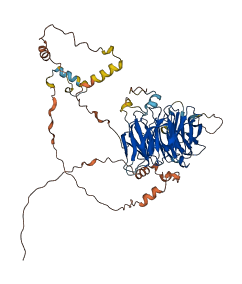
1 structures for P50082
| Entry ID | Method | Resolution | Chain | Position | Source |
|---|---|---|---|---|---|
| AF-P50082-F1 | Predicted | AlphaFoldDB |
8 variants for P50082
| Variant ID(s) | Position | Change | Description | Diseaes Association | Provenance |
|---|---|---|---|---|---|
| s07-945158 | 4 | P>R | No | SGRP | |
| s07-945169 | 8 | H>Y | No | SGRP | |
| s07-945607 | 154 | L>M | No | SGRP | |
| s07-945627 | 160 | I>M | No | SGRP | |
| s07-945740 | 198 | A>V | No | SGRP | |
| s07-945755 | 203 | Q>R | No | SGRP | |
| s07-946231 | 362 | P>S | No | SGRP | |
| s07-946667 | 476 | C>Y | No | SGRP |
No associated diseases with P50082
5 regional properties for P50082
| Type | Name | Position | InterPro Accession |
|---|---|---|---|
| repeat | WD40 repeat | 262 - 301 | IPR001680-1 |
| repeat | WD40 repeat | 313 - 355 | IPR001680-2 |
| repeat | WD40 repeat | 379 - 420 | IPR001680-3 |
| repeat | WD40 repeat | 424 - 465 | IPR001680-4 |
| repeat | WD40 repeat | 516 - 555 | IPR001680-5 |
1 GO annotations of cellular component
| Name | Definition |
|---|---|
| anaphase-promoting complex | A ubiquitin ligase complex that degrades mitotic cyclins and anaphase inhibitory protein, thereby triggering sister chromatid separation and exit from mitosis. Substrate recognition by APC occurs through degradation signals, the most common of which is termed the Dbox degradation motif, originally discovered in cyclin B. |
2 GO annotations of molecular function
| Name | Definition |
|---|---|
| anaphase-promoting complex binding | Binding to an anaphase-promoting complex. A ubiquitin ligase complex that degrades mitotic cyclins and anaphase inhibitory protein, thereby triggering sister chromatid separation and exit from mitosis. |
| ubiquitin ligase activator activity | Binds to and increases the activity of a ubiquitin ligase. |
14 GO annotations of biological process
| Name | Definition |
|---|---|
| anaphase-promoting complex-dependent catabolic process | The chemical reactions and pathways resulting in the breakdown of a protein or peptide by hydrolysis of its peptide bonds, initiated by the covalent attachment of ubiquitin, with ubiquitin-protein ligation catalyzed by the anaphase-promoting complex, and mediated by the proteasome. |
| ascospore formation | The process in which cells that are products of meiosis acquire the specialized features of ascospores. Ascospores are generally found in clusters of four or eight spores within a single mother cell, the ascus, and are characteristic of the ascomycete fungi (phylum Ascomycota). |
| ascospore wall assembly | The aggregation, arrangement and bonding together of a set of components to form an ascospore wall. During sporulation in Ascomycota, each ascospore nucleus becomes surrounded by a specialized spore wall, formed by deposition of spore wall components in the lumenal space between the outer and inner leaflets of the prospore membrane. An example of this process is found in Saccharomyces cerevisiae. |
| cell division | The process resulting in division and partitioning of components of a cell to form more cells; may or may not be accompanied by the physical separation of a cell into distinct, individually membrane-bounded daughter cells. |
| meiosis I | The first meiotic nuclear division in which homologous chromosomes are paired and segregated from each other, producing two haploid daughter nuclei. |
| meiotic chromosome segregation | The process in which genetic material, in the form of chromosomes, is organized into specific structures and then physically separated and apportioned to two or more sets during M phase of the meiotic cell cycle. |
| meiotic DNA integrity checkpoint signaling | A signal transduction process that controls cell cycle progression in response to changes in DNA structure by monitoring the integrity of the DNA during meiosis. The DNA integrity checkpoint begins with detection of DNA damage, defects in DNA structure or DNA replication, and ends with signal transduction. |
| positive regulation of anaphase-promoting complex-dependent catabolic process | Any process that activates or increases the frequency, rate or extent of anaphase-promoting complex-dependent catabolic process. |
| positive regulation of ascospore-type prospore membrane formation | Any process that activates or increases the frequency, rate or extent of formation of an ascospore-type prospore membrane. |
| positive regulation of protein catabolic process | Any process that activates or increases the frequency, rate or extent of the chemical reactions and pathways resulting in the breakdown of a protein by the destruction of the native, active configuration, with or without the hydrolysis of peptide bonds. |
| positive regulation of ubiquitin protein ligase activity | Any process that activates or increases the frequency, rate or extent of ubiquitin protein ligase activity. |
| protein ubiquitination | The process in which one or more ubiquitin groups are added to a protein. |
| regulation of meiotic cell cycle | Any process that modulates the rate or extent of progression through the meiotic cell cycle. |
| synaptonemal complex assembly | The cell cycle process in which the synaptonemal complex is formed. This is a structure that holds paired chromosomes together during prophase I of meiosis and that promotes genetic recombination. |
5 homologous proteins in AiPD
| UniProt AC | Gene Name | Protein Name | Species | Evidence Code |
|---|---|---|---|---|
| P26309 | CDC20 | APC/C activator protein CDC20 | Saccharomyces cerevisiae (strain ATCC 204508 / S288c) (Baker's yeast) | PR |
| Q960N3 | cort | Protein cortex | Drosophila melanogaster (Fruit fly) | PR |
| Q12834 | CDC20 | Cell division cycle protein 20 homolog | Homo sapiens (Human) | PR |
| Q9JJ66 | Cdc20 | Cell division cycle protein 20 homolog | Mus musculus (Mouse) | PR |
| Q62623 | Cdc20 | Cell division cycle protein 20 homolog | Rattus norvegicus (Rat) | PR |
| 10 | 20 | 30 | 40 | 50 | 60 |
| MATPHLYHRY | NSKSSNKNIN | SSGNSTEVDR | FIPKSVSRNA | YKSIPMLNGF | DISYSELCEK |
| 70 | 80 | 90 | 100 | 110 | 120 |
| SPSPERLSSP | EFFNELRNTG | HYESISTTNE | FSMSSISSSS | ESQVTRSGSA | RASRNDYSKL |
| 130 | 140 | 150 | 160 | 170 | 180 |
| TKEQKDHRKN | IAHSLGFQLP | DRVFTFETTS | AEILEKNKAI | KNCFGPGSCA | EIRSTFDFST |
| 190 | 200 | 210 | 220 | 230 | 240 |
| LSPDVARYYI | ANSNARSASP | QRQIQRPAKR | VKSHIPYRVL | DAPCLRNDFY | SNLISWSRTT |
| 250 | 260 | 270 | 280 | 290 | 300 |
| NNVLVGLGCS | VYIWSEKEGA | VSILDHQYLS | EKRDLVTCVS | FCPYNTYFIV | GTKFGRILLY |
| 310 | 320 | 330 | 340 | 350 | 360 |
| DQKEFFHSSN | TNEKEPVFVF | QTESFKGICC | LEWFKPGEIC | KFYVGEENGN | VSLFEIKSLH |
| 370 | 380 | 390 | 400 | 410 | 420 |
| FPIKNWSKRQ | KLEDENLIGL | KLHSTYQAQA | QQVCGISLNE | HANLLAVGGN | DNSCSLWDIS |
| 430 | 440 | 450 | 460 | 470 | 480 |
| DLDKPIKKFV | LPHKAAVKAI | AFCPWSKSLL | ATGGGSKDRC | IKFWHTSTGT | LLDEICTSGQ |
| 490 | 500 | 510 | 520 | 530 | 540 |
| VTSLIWSLRH | KQIVATFGFG | DTKNPVLITL | YSYPKLSKLL | EVRSPNPLRV | LSAVISPSSM |
| 550 | 560 | 570 | 580 | 590 | |
| AICVATNDET | IRFYELWNDK | EEIINEIQES | GIYGSNIIEY | MEGIETTHNK | RIR |