Q62623
Gene name |
Cdc20 |
Protein name |
Cell division cycle protein 20 homolog |
Names |
p55CDC |
Species |
Rattus norvegicus (Rat) |
KEGG Pathway |
rno:64515 |
EC number |
|
Protein Class |
|
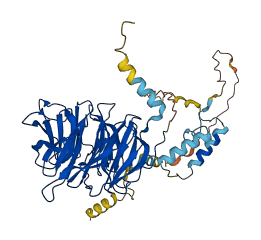
Descriptions
The autoinhibited protein was predicted that may have potential autoinhibitory elements via cis-regPred.
Autoinhibitory domains (AIDs)
Target domain |
|
Relief mechanism |
|
Assay |
cis-regPred |
Accessory elements
No accessory elements
Autoinhibited structure

Activated structure
1 structures for Q62623
| Entry ID | Method | Resolution | Chain | Position | Source |
|---|---|---|---|---|---|
| AF-Q62623-F1 | Predicted | AlphaFoldDB |
No variants for Q62623
| Variant ID(s) | Position | Change | Description | Diseaes Association | Provenance |
|---|---|---|---|---|---|
| No variants for Q62623 | |||||
No associated diseases with Q62623
Functions
8 GO annotations of cellular component
| Name | Definition |
|---|---|
| anaphase-promoting complex | A ubiquitin ligase complex that degrades mitotic cyclins and anaphase inhibitory protein, thereby triggering sister chromatid separation and exit from mitosis. Substrate recognition by APC occurs through degradation signals, the most common of which is termed the Dbox degradation motif, originally discovered in cyclin B. |
| centrosome | A structure comprised of a core structure (in most organisms, a pair of centrioles) and peripheral material from which a microtubule-based structure, such as a spindle apparatus, is organized. Centrosomes occur close to the nucleus during interphase in many eukaryotic cells, though in animal cells it changes continually during the cell-division cycle. |
| cytosol | The part of the cytoplasm that does not contain organelles but which does contain other particulate matter, such as protein complexes. |
| mitotic checkpoint complex | A multiprotein complex that functions as a mitotic checkpoint inhibitor of the anaphase-promoting complex/cyclosome (APC/C). In budding yeast this complex consists of Mad2p, Mad3p, Bub3p and Cdc20p, and in mammalian cells it consists of MAD2, BUBR1, BUB3, and CDC20. |
| nucleoplasm | That part of the nuclear content other than the chromosomes or the nucleolus. |
| perinuclear region of cytoplasm | Cytoplasm situated near, or occurring around, the nucleus. |
| protein-containing complex | A stable assembly of two or more macromolecules, i.e. proteins, nucleic acids, carbohydrates or lipids, in which at least one component is a protein and the constituent parts function together. |
| spindle pole | Either of the ends of a spindle, where spindle microtubules are organized; usually contains a microtubule organizing center and accessory molecules, spindle microtubules and astral microtubules. |
5 GO annotations of molecular function
| Name | Definition |
|---|---|
| anaphase-promoting complex binding | Binding to an anaphase-promoting complex. A ubiquitin ligase complex that degrades mitotic cyclins and anaphase inhibitory protein, thereby triggering sister chromatid separation and exit from mitosis. |
| enzyme binding | Binding to an enzyme, a protein with catalytic activity. |
| histone deacetylase binding | Binding to histone deacetylase. |
| protein C-terminus binding | Binding to a protein C-terminus, the end of a peptide chain at which the 1-carboxyl function of a constituent amino acid is not attached in peptide linkage to another amino-acid residue. |
| ubiquitin ligase activator activity | Binds to and increases the activity of a ubiquitin ligase. |
13 GO annotations of biological process
| Name | Definition |
|---|---|
| anaphase-promoting complex-dependent catabolic process | The chemical reactions and pathways resulting in the breakdown of a protein or peptide by hydrolysis of its peptide bonds, initiated by the covalent attachment of ubiquitin, with ubiquitin-protein ligation catalyzed by the anaphase-promoting complex, and mediated by the proteasome. |
| cell division | The process resulting in division and partitioning of components of a cell to form more cells; may or may not be accompanied by the physical separation of a cell into distinct, individually membrane-bounded daughter cells. |
| mitotic sister chromatid cohesion | The cell cycle process in which the sister chromatids of a replicated chromosome are joined along the entire length of the chromosome, from their formation in S phase through metaphase during a mitotic cell cycle. This cohesion cycle is critical for high fidelity chromosome transmission. |
| mitotic spindle assembly | Mitotic bipolar spindle assembly begins with spindle microtubule nucleation from the separated spindle pole body, includes spindle elongation during prometaphase, and is complete when all kinetochores are stably attached the spindle, and the spindle assembly checkpoint is satisfied. |
| negative regulation of ubiquitin-protein transferase activity | Any process that stops, prevents, or reduces the frequency, rate or extent of ubiquitin transferase activity. |
| positive regulation of anaphase-promoting complex-dependent catabolic process | Any process that activates or increases the frequency, rate or extent of anaphase-promoting complex-dependent catabolic process. |
| positive regulation of cell population proliferation | Any process that activates or increases the rate or extent of cell proliferation. |
| positive regulation of synapse maturation | Any process that increases the extent of synapse maturation, the process that organizes a synapse so that it attains its fully functional state. |
| positive regulation of synaptic plasticity | A process that increases synaptic plasticity, the ability of synapses to change as circumstances require. They may alter function, such as increasing or decreasing their sensitivity, or they may increase or decrease in actual numbers. |
| positive regulation of ubiquitin protein ligase activity | Any process that activates or increases the frequency, rate or extent of ubiquitin protein ligase activity. |
| protein ubiquitination | The process in which one or more ubiquitin groups are added to a protein. |
| regulation of dendrite development | Any process that modulates the frequency, rate or extent of dendrite development. |
| regulation of meiotic nuclear division | Any process that modulates the frequency, rate or extent of meiotic nuclear division, the process in which the nucleus of a diploid cell divides twice forming four haploid cells, one or more of which usually function as gametes. |
8 homologous proteins in AiPD
| UniProt AC | Gene Name | Protein Name | Species | Evidence Code |
|---|---|---|---|---|
| P50082 | AMA1 | Meiosis-specific APC/C activator protein AMA1 | Saccharomyces cerevisiae (strain ATCC 204508 / S288c) (Baker's yeast) | PR |
| P26309 | CDC20 | APC/C activator protein CDC20 | Saccharomyces cerevisiae (strain ATCC 204508 / S288c) (Baker's yeast) | PR |
| Q960N3 | cort | Protein cortex | Drosophila melanogaster (Fruit fly) | PR |
| Q9UM11 | FZR1 | Fizzy-related protein homolog | Homo sapiens (Human) | PR |
| Q12834 | CDC20 | Cell division cycle protein 20 homolog | Homo sapiens (Human) | PR |
| Q9R1K5 | Fzr1 | Fizzy-related protein homolog | Mus musculus (Mouse) | PR |
| Q9JJ66 | Cdc20 | Cell division cycle protein 20 homolog | Mus musculus (Mouse) | PR |
| Q8LPL5 | FZR3 | Protein FIZZY-RELATED 3 | Arabidopsis thaliana (Mouse-ear cress) | PR |
| 10 | 20 | 30 | 40 | 50 | 60 |
| MAQFVFESDL | HSLLQLDAPI | PNAPIARWQR | KAKEATGPAP | SPMRAANRSH | SAGRTPGRTP |
| 70 | 80 | 90 | 100 | 110 | 120 |
| GKSNSKVQTT | PSKPGGDRYI | PQRSASQMEV | ASFLLSKENQ | PEDGGTPTKK | EHQKAWARNL |
| 130 | 140 | 150 | 160 | 170 | 180 |
| NGFDVEEAKI | LRLSGKPQNA | PEGYQNRLKV | LYSQKATPGS | SRKACRYIPS | LPDRILDAPE |
| 190 | 200 | 210 | 220 | 230 | 240 |
| IRNDYYLNLV | DWSSGNVLAV | ALDNSVYLWN | AGSGDILQLL | QMEQPGDYIS | SVAWIKEGNY |
| 250 | 260 | 270 | 280 | 290 | 300 |
| LAVGTSNAEV | QLWDVQQQKR | LRNMTSHSAR | VSSLSWNSYI | LSSGSRSGHI | HHHDVRVAEH |
| 310 | 320 | 330 | 340 | 350 | 360 |
| HVATLSGHSQ | EVCGLRWAPD | GRHLASGGND | NIVNVWPSGP | GESGWVPLQT | FTQHQGAVKA |
| 370 | 380 | 390 | 400 | 410 | 420 |
| VAWCPWQSNI | LATGGGTSDR | HIRIWNVCSG | ACLSAVDVHS | QVCSILWSPH | YKELISGHGF |
| 430 | 440 | 450 | 460 | 470 | 480 |
| AQNQLVIWKY | PTMAKVAELK | GHTARVLSLT | MSPDGATVAS | AAADETLRLW | RCFELDPALR |
| 490 | |||||
| REREKASTSK | SSLIHQGIR |