Q9R1K5
Gene name |
Fzr1 (Fyr, Fzr) |
Protein name |
Fizzy-related protein homolog |
Names |
Fzr, Cdh1/Hct1 homolog |
Species |
Mus musculus (Mouse) |
KEGG Pathway |
mmu:56371 |
EC number |
|
Protein Class |
|
Descriptions
The autoinhibited protein was predicted that may have potential autoinhibitory elements via cis-regPred.
Autoinhibitory domains (AIDs)
Target domain |
|
Relief mechanism |
|
Assay |
cis-regPred |
Accessory elements
No accessory elements
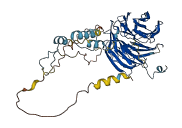
Autoinhibited structure

Activated structure
1 structures for Q9R1K5
| Entry ID | Method | Resolution | Chain | Position | Source |
|---|---|---|---|---|---|
| AF-Q9R1K5-F1 | Predicted | AlphaFoldDB |
21 variants for Q9R1K5
| Variant ID(s) | Position | Change | Description | Diseaes Association | Provenance |
|---|---|---|---|---|---|
| rs3389116228 | 28 | R>W | No | EVA | |
| rs3389113673 | 42 | S>C | No | EVA | |
| rs3389084289 | 45 | G>C | No | EVA | |
| rs3389105621 | 70 | S>F | No | EVA | |
| rs3413122865 | 77 | A>S | No | EVA | |
| rs3401142970 | 108 | Q>H | No | EVA | |
| rs3389126708 | 159 | K>N | No | EVA | |
| rs3389116208 | 201 | L>F | No | EVA | |
| rs3389113678 | 225 | L>F | No | EVA | |
| rs3389118945 | 241 | G>A | No | EVA | |
| rs3389105659 | 252 | F>I | No | EVA | |
| rs3413025511 | 261 | G>W | No | EVA | |
| rs3389105696 | 269 | G>D | No | EVA | |
| rs3389118940 | 299 | R>L | No | EVA | |
| rs3389105634 | 300 | T>I | No | EVA | |
| rs3389105627 | 320 | K>N | No | EVA | |
| rs3389116365 | 332 | G>D | No | EVA | |
| rs3389120556 | 339 | V>M | No | EVA | |
| rs3389116453 | 434 | T>R | No | EVA | |
| rs3389126714 | 465 | E>G | No | EVA | |
| rs3389116339 | 487 | N>S | No | EVA |
No associated diseases with Q9R1K5
6 regional properties for Q9R1K5
| Type | Name | Position | InterPro Accession |
|---|---|---|---|
| repeat | WD40 repeat | 218 - 297 | IPR001680-1 |
| repeat | WD40 repeat | 302 - 386 | IPR001680-2 |
| repeat | WD40 repeat | 389 - 429 | IPR001680-3 |
| repeat | WD40 repeat | 432 - 480 | IPR001680-4 |
| conserved_site | WD40 repeat, conserved site | 458 - 472 | IPR019775 |
| domain | Anaphase-promoting complex subunit 4-like, WD40 domain | 226 - 281 | IPR024977 |
3 GO annotations of cellular component
| Name | Definition |
|---|---|
| anaphase-promoting complex | A ubiquitin ligase complex that degrades mitotic cyclins and anaphase inhibitory protein, thereby triggering sister chromatid separation and exit from mitosis. Substrate recognition by APC occurs through degradation signals, the most common of which is termed the Dbox degradation motif, originally discovered in cyclin B. |
| nuclear membrane | Either of the lipid bilayers that surround the nucleus and form the nuclear envelope; excludes the intermembrane space. |
| nucleoplasm | That part of the nuclear content other than the chromosomes or the nucleolus. |
2 GO annotations of molecular function
| Name | Definition |
|---|---|
| anaphase-promoting complex binding | Binding to an anaphase-promoting complex. A ubiquitin ligase complex that degrades mitotic cyclins and anaphase inhibitory protein, thereby triggering sister chromatid separation and exit from mitosis. |
| ubiquitin ligase activator activity | Binds to and increases the activity of a ubiquitin ligase. |
12 GO annotations of biological process
| Name | Definition |
|---|---|
| anaphase-promoting complex-dependent catabolic process | The chemical reactions and pathways resulting in the breakdown of a protein or peptide by hydrolysis of its peptide bonds, initiated by the covalent attachment of ubiquitin, with ubiquitin-protein ligation catalyzed by the anaphase-promoting complex, and mediated by the proteasome. |
| cell division | The process resulting in division and partitioning of components of a cell to form more cells; may or may not be accompanied by the physical separation of a cell into distinct, individually membrane-bounded daughter cells. |
| DNA repair | The process of restoring DNA after damage. Genomes are subject to damage by chemical and physical agents in the environment (e.g. UV and ionizing radiations, chemical mutagens, fungal and bacterial toxins, etc.) and by free radicals or alkylating agents endogenously generated in metabolism. DNA is also damaged because of errors during its replication. A variety of different DNA repair pathways have been reported that include direct reversal, base excision repair, nucleotide excision repair, photoreactivation, bypass, double-strand break repair pathway, and mismatch repair pathway. |
| lens fiber cell differentiation | The process in which a relatively unspecialized cell acquires specialized features of a lens fiber cell, any of the elongated, tightly packed cells that make up the bulk of the mature lens in the camera-type eye. The cytoplasm of a lens fiber cell is devoid of most intracellular organelles including the cell nucleus, and contains primarily crystallins, a group of water-soluble proteins expressed in vary large quantities. |
| mitotic G2 DNA damage checkpoint signaling | A mitotic cell cycle checkpoint that detects and negatively regulates progression through the G2/M transition of the cell cycle in response to DNA damage. |
| negative regulation of cellular senescence | Any process that stops, prevents or reduces the frequency, rate or extent of cellular senescence. |
| positive regulation of anaphase-promoting complex-dependent catabolic process | Any process that activates or increases the frequency, rate or extent of anaphase-promoting complex-dependent catabolic process. |
| positive regulation of cell population proliferation | Any process that activates or increases the rate or extent of cell proliferation. |
| positive regulation of ubiquitin protein ligase activity | Any process that activates or increases the frequency, rate or extent of ubiquitin protein ligase activity. |
| protein ubiquitination | The process in which one or more ubiquitin groups are added to a protein. |
| proteolysis involved in protein catabolic process | The hydrolysis of a peptide bond or bonds within a protein as part of the chemical reactions and pathways resulting in the breakdown of a protein by individual cells. |
| regulation of meiotic nuclear division | Any process that modulates the frequency, rate or extent of meiotic nuclear division, the process in which the nucleus of a diploid cell divides twice forming four haploid cells, one or more of which usually function as gametes. |
6 homologous proteins in AiPD
| UniProt AC | Gene Name | Protein Name | Species | Evidence Code |
|---|---|---|---|---|
| Q960N3 | cort | Protein cortex | Drosophila melanogaster (Fruit fly) | PR |
| Q12834 | CDC20 | Cell division cycle protein 20 homolog | Homo sapiens (Human) | PR |
| Q9UM11 | FZR1 | Fizzy-related protein homolog | Homo sapiens (Human) | PR |
| Q9JJ66 | Cdc20 | Cell division cycle protein 20 homolog | Mus musculus (Mouse) | PR |
| Q62623 | Cdc20 | Cell division cycle protein 20 homolog | Rattus norvegicus (Rat) | PR |
| Q8LPL5 | FZR3 | Protein FIZZY-RELATED 3 | Arabidopsis thaliana (Mouse-ear cress) | PR |
| 10 | 20 | 30 | 40 | 50 | 60 |
| MDQDYERRLL | RQIIIQNENT | VPCVSEMRRT | LTPANSPVSS | PSKHGDRFIP | SRAGANWSVN |
| 70 | 80 | 90 | 100 | 110 | 120 |
| FHRINENEKS | PSQNRKAKDA | TSDNGKDGLA | YSALLKNELL | GAGIEKVQDP | QTEDRRLQPS |
| 130 | 140 | 150 | 160 | 170 | 180 |
| TPEHKGLFTY | SLSSKRSSPD | DGNDVSPYSL | SPVSNKSQKL | LRSPRKPTRK | ISKIPFKVLD |
| 190 | 200 | 210 | 220 | 230 | 240 |
| APELQDDFYL | NLVDWSSLNV | LSVGLGTCVY | LWSACTSQVT | RLCDLSVEGD | SVTSVGWSER |
| 250 | 260 | 270 | 280 | 290 | 300 |
| GNLVAVGTHK | GFVQIWDAAA | GKKLSMLEGH | TARVGALAWN | ADQLSSGSRD | RMILQRDIRT |
| 310 | 320 | 330 | 340 | 350 | 360 |
| PPLQSERRLQ | GHRQEVCGLK | WSTDHQLLAS | GGNDNKLLVW | NHSSLSPVQQ | YTEHLAAVKA |
| 370 | 380 | 390 | 400 | 410 | 420 |
| IAWSPHQHGL | LASGGGTADR | CIRFWNTLTG | QPLQCIDTGS | QVCNLAWSKH | ANELVSTHGY |
| 430 | 440 | 450 | 460 | 470 | 480 |
| SQNQILVWKY | PSLTQVAKLT | GHSYRVLYLA | MSPDGEAIVT | GAGDETLRFW | NVFSKTRSTK |
| 490 | |||||
| ESVSVLNLFT | RIR |