Q8R511
Gene name |
Fnbp1 (Fbp17) |
Protein name |
Formin-binding protein 1 |
Names |
Formin-binding protein 17, Rapostlin |
Species |
Rattus norvegicus (Rat) |
KEGG Pathway |
rno:192348 |
EC number |
|
Protein Class |
|
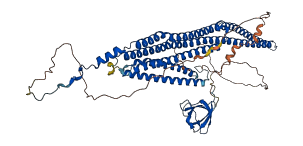
Descriptions
The autoinhibited protein was predicted that may have potential autoinhibitory elements via cis-regPred.
Autoinhibitory domains (AIDs)
Target domain |
|
Relief mechanism |
|
Assay |
cis-regPred |
Accessory elements
No accessory elements
Autoinhibited structure

Activated structure
1 structures for Q8R511
| Entry ID | Method | Resolution | Chain | Position | Source |
|---|---|---|---|---|---|
| AF-Q8R511-F1 | Predicted | AlphaFoldDB |
No variants for Q8R511
| Variant ID(s) | Position | Change | Description | Diseaes Association | Provenance |
|---|---|---|---|---|---|
| No variants for Q8R511 | |||||
No associated diseases with Q8R511
No regional properties for Q8R511
| Type | Name | Position | InterPro Accession |
|---|---|---|---|
| No domain, repeats, and functional sites for Q8R511 | |||
Functions
5 GO annotations of cellular component
| Name | Definition |
|---|---|
| cell cortex | The region of a cell that lies just beneath the plasma membrane and often, but not always, contains a network of actin filaments and associated proteins. |
| clathrin-coated pit | A part of the endomembrane system in the form of an invagination of a membrane upon which a clathrin coat forms, and that can be converted by vesicle budding into a clathrin-coated vesicle. Coated pits form on the plasma membrane, where they are involved in receptor-mediated selective transport of many proteins and other macromolecules across the cell membrane, in the trans-Golgi network, and on some endosomes. |
| cytoplasmic vesicle | A vesicle found in the cytoplasm of a cell. |
| cytoskeleton | A cellular structure that forms the internal framework of eukaryotic and prokaryotic cells. The cytoskeleton includes intermediate filaments, microfilaments, microtubules, the microtrabecular lattice, and other structures characterized by a polymeric filamentous nature and long-range order within the cell. The various elements of the cytoskeleton not only serve in the maintenance of cellular shape but also have roles in other cellular functions, including cellular movement, cell division, endocytosis, and movement of organelles. |
| lysosome | A small lytic vacuole that has cell cycle-independent morphology found in most animal cells and that contains a variety of hydrolases, most of which have their maximal activities in the pH range 5-6. The contained enzymes display latency if properly isolated. About 40 different lysosomal hydrolases are known and lysosomes have a great variety of morphologies and functions. |
2 GO annotations of molecular function
| Name | Definition |
|---|---|
| identical protein binding | Binding to an identical protein or proteins. |
| lipid binding | Binding to a lipid. |
4 GO annotations of biological process
| Name | Definition |
|---|---|
| cell differentiation | The process in which relatively unspecialized cells, e.g. embryonic or regenerative cells, acquire specialized structural and/or functional features that characterize the cells, tissues, or organs of the mature organism or some other relatively stable phase of the organism's life history. Differentiation includes the processes involved in commitment of a cell to a specific fate and its subsequent development to the mature state. |
| endocytosis | A vesicle-mediated transport process in which cells take up external materials or membrane constituents by the invagination of a small region of the plasma membrane to form a new membrane-bounded vesicle. |
| nervous system development | The process whose specific outcome is the progression of nervous tissue over time, from its formation to its mature state. |
| signal transduction | The cellular process in which a signal is conveyed to trigger a change in the activity or state of a cell. Signal transduction begins with reception of a signal (e.g. a ligand binding to a receptor or receptor activation by a stimulus such as light), or for signal transduction in the absence of ligand, signal-withdrawal or the activity of a constitutively active receptor. Signal transduction ends with regulation of a downstream cellular process, e.g. regulation of transcription or regulation of a metabolic process. Signal transduction covers signaling from receptors located on the surface of the cell and signaling via molecules located within the cell. For signaling between cells, signal transduction is restricted to events at and within the receiving cell. |
15 homologous proteins in AiPD
| UniProt AC | Gene Name | Protein Name | Species | Evidence Code |
|---|---|---|---|---|
| Q5T0N5 | FNBP1L | Formin-binding protein 1-like | Homo sapiens (Human) | PR |
| Q7Z6B7 | SRGAP1 | SLIT-ROBO Rho GTPase-activating protein 1 | Homo sapiens (Human) | PR |
| O94868 | FCHSD2 | F-BAR and double SH3 domains protein 2 | Homo sapiens (Human) | PR |
| O75044 | SRGAP2 | SLIT-ROBO Rho GTPase-activating protein 2 | Homo sapiens (Human) | PR |
| Q96RU3 | FNBP1 | Formin-binding protein 1 | Homo sapiens (Human) | PR |
| Q91Z69 | Srgap1 | SLIT-ROBO Rho GTPase-activating protein 1 | Mus musculus (Mouse) | PR |
| Q3USJ8 | Fchsd2 | F-BAR and double SH3 domains protein 2 | Mus musculus (Mouse) | PR |
| Q6PFY1 | Fchsd1 | F-BAR and double SH3 domains protein 1 | Mus musculus (Mouse) | PR |
| Q812A2 | Srgap3 | SLIT-ROBO Rho GTPase-activating protein 3 | Mus musculus (Mouse) | PR |
| Q91Z67 | Srgap2 | SLIT-ROBO Rho GTPase-activating protein 2 | Mus musculus (Mouse) | PR |
| Q8K012 | Fnbp1l | Formin-binding protein 1-like | Mus musculus (Mouse) | PR |
| Q8CJ53 | Trip10 | Cdc42-interacting protein 4 | Mus musculus (Mouse) | PR |
| Q80TY0 | Fnbp1 | Formin-binding protein 1 | Mus musculus (Mouse) | PR |
| D4A208 | Srgap2 | SLIT-ROBO Rho GTPase-activating protein 2 | Rattus norvegicus (Rat) | PR |
| Q2HWF0 | Fnbp1l | Formin-binding protein 1-like | Rattus norvegicus (Rat) | PR |
| 10 | 20 | 30 | 40 | 50 | 60 |
| MSWGTELWDQ | FDNLEKHTQW | GIDILEKYIK | FVKERTEIEL | SYAKQLRNLS | KKYQPKKNSK |
| 70 | 80 | 90 | 100 | 110 | 120 |
| EEEEYKYTAC | KAFLSTLNEL | NDYAGQHEVI | SENMTSQITV | DLVRYVQELK | QERKSNFHDG |
| 130 | 140 | 150 | 160 | 170 | 180 |
| RKAQQHIETC | WKQLESSKRR | FERDCKEADR | AQQYFEKMDA | DINVTKADVE | KARQQAQMRQ |
| 190 | 200 | 210 | 220 | 230 | 240 |
| QMAEDSKADY | SLILQRFNQE | QWEYYHTHIP | NIFQKIQEME | ERRIVRIGES | MKTYAEVDRQ |
| 250 | 260 | 270 | 280 | 290 | 300 |
| VIPIIGKCLD | GIVKAAESID | QKNDSQLVVE | AYKSGFEPPG | DIEFEDYTQP | MKRTVSDNSL |
| 310 | 320 | 330 | 340 | 350 | 360 |
| SSSKEGKPEL | KFGGKSRGKL | WPFIKKNKLM | TLLTSPHQPP | PPPPASASPS | AVPNGPQSPK |
| 370 | 380 | 390 | 400 | 410 | 420 |
| QQKEPLSHRF | NEFMTSKPKI | HCFRSLKRGL | SLKLGVTPED | FSNFPPEQRR | KKLQQKVDDL |
| 430 | 440 | 450 | 460 | 470 | 480 |
| NKEIQKETDQ | RDAITKMKDV | YLKNPQMGDP | ASLDHKLAEV | TQNIEKLRLE | AHKFEAWLAE |
| 490 | 500 | 510 | 520 | 530 | 540 |
| VEGRLPARSE | QARRQSGLYD | GQTHQTVTNC | AQDRESPDGS | YTEEQSQESE | HKVLATDFDD |
| 550 | 560 | 570 | 580 | 590 | 600 |
| EFDDEEPLPA | IGTCKALYTF | EGQNEGTISV | VEGETLSVIE | EDKGDGWTRI | RRNEDEEGYV |
| 610 | |||||
| PTSYVEVYLD | KNAKGS |