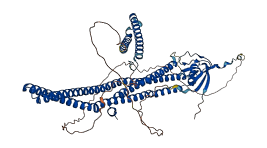
Descriptions
The autoinhibited protein was predicted that may have potential autoinhibitory elements via cis-regPred.
Autoinhibitory domains (AIDs)
Target domain |
|
Relief mechanism |
|
Assay |
cis-regPred |
Accessory elements
No accessory elements
Autoinhibited structure

Activated structure
1 structures for Q8K012
| Entry ID | Method | Resolution | Chain | Position | Source |
|---|---|---|---|---|---|
| AF-Q8K012-F1 | Predicted | AlphaFoldDB |
No variants for Q8K012
| Variant ID(s) | Position | Change | Description | Diseaes Association | Provenance |
|---|---|---|---|---|---|
| No variants for Q8K012 | |||||
No associated diseases with Q8K012
Functions
6 GO annotations of cellular component
| Name | Definition |
|---|---|
| cell cortex | The region of a cell that lies just beneath the plasma membrane and often, but not always, contains a network of actin filaments and associated proteins. |
| cytoplasm | The contents of a cell excluding the plasma membrane and nucleus, but including other subcellular structures. |
| cytoplasmic vesicle | A vesicle found in the cytoplasm of a cell. |
| cytoskeleton | A cellular structure that forms the internal framework of eukaryotic and prokaryotic cells. The cytoskeleton includes intermediate filaments, microfilaments, microtubules, the microtrabecular lattice, and other structures characterized by a polymeric filamentous nature and long-range order within the cell. The various elements of the cytoskeleton not only serve in the maintenance of cellular shape but also have roles in other cellular functions, including cellular movement, cell division, endocytosis, and movement of organelles. |
| cytosol | The part of the cytoplasm that does not contain organelles but which does contain other particulate matter, such as protein complexes. |
| plasma membrane | The membrane surrounding a cell that separates the cell from its external environment. It consists of a phospholipid bilayer and associated proteins. |
2 GO annotations of molecular function
| Name | Definition |
|---|---|
| GTPase binding | Binding to a GTPase, any enzyme that catalyzes the hydrolysis of GTP. |
| lipid binding | Binding to a lipid. |
10 GO annotations of biological process
| Name | Definition |
|---|---|
| autophagy | The cellular catabolic process in which cells digest parts of their own cytoplasm; allows for both recycling of macromolecular constituents under conditions of cellular stress and remodeling the intracellular structure for cell differentiation. |
| cilium assembly | The assembly of a cilium, a specialized eukaryotic organelle that consists of a filiform extrusion of the cell surface. Each cilium is bounded by an extrusion of the cytoplasmic membrane, and contains a regular longitudinal array of microtubules, anchored basally in a centriole. |
| clathrin-dependent endocytosis | An endocytosis process that begins when material is taken up into clathrin-coated pits, which then pinch off to form clathrin-coated endocytic vesicles. |
| membrane invagination | The infolding of a membrane. |
| plasma membrane tubulation | A membrane tubulation process occurring in a plasma membrane. |
| positive regulation of filopodium assembly | Any process that activates or increases the frequency, rate or extent of the assembly of a filopodium, a thin, stiff protrusion extended by the leading edge of a motile cell such as a crawling fibroblast or amoeba, or an axonal growth cone. |
| signal transduction | The cellular process in which a signal is conveyed to trigger a change in the activity or state of a cell. Signal transduction begins with reception of a signal (e.g. a ligand binding to a receptor or receptor activation by a stimulus such as light), or for signal transduction in the absence of ligand, signal-withdrawal or the activity of a constitutively active receptor. Signal transduction ends with regulation of a downstream cellular process, e.g. regulation of transcription or regulation of a metabolic process. Signal transduction covers signaling from receptors located on the surface of the cell and signaling via molecules located within the cell. For signaling between cells, signal transduction is restricted to events at and within the receiving cell. |
| vesicle budding from membrane | The evagination of a membrane, resulting in formation of a vesicle. |
| vesicle organization | A process that is carried out at the cellular level which results in the assembly, arrangement of constituent parts, or disassembly of a vesicle. |
| vesicle transport along actin filament | Movement of a vesicle along an actin filament, mediated by motor proteins. |
16 homologous proteins in AiPD
| UniProt AC | Gene Name | Protein Name | Species | Evidence Code |
|---|---|---|---|---|
| Q7Z6B7 | SRGAP1 | SLIT-ROBO Rho GTPase-activating protein 1 | Homo sapiens (Human) | PR |
| O94868 | FCHSD2 | F-BAR and double SH3 domains protein 2 | Homo sapiens (Human) | PR |
| Q96RU3 | FNBP1 | Formin-binding protein 1 | Homo sapiens (Human) | PR |
| O75044 | SRGAP2 | SLIT-ROBO Rho GTPase-activating protein 2 | Homo sapiens (Human) | PR |
| Q5T0N5 | FNBP1L | Formin-binding protein 1-like | Homo sapiens (Human) | PR |
| Q91Z69 | Srgap1 | SLIT-ROBO Rho GTPase-activating protein 1 | Mus musculus (Mouse) | PR |
| Q812A2 | Srgap3 | SLIT-ROBO Rho GTPase-activating protein 3 | Mus musculus (Mouse) | PR |
| Q91Z67 | Srgap2 | SLIT-ROBO Rho GTPase-activating protein 2 | Mus musculus (Mouse) | PR |
| Q3USJ8 | Fchsd2 | F-BAR and double SH3 domains protein 2 | Mus musculus (Mouse) | PR |
| Q6PFY1 | Fchsd1 | F-BAR and double SH3 domains protein 1 | Mus musculus (Mouse) | PR |
| Q80TY0 | Fnbp1 | Formin-binding protein 1 | Mus musculus (Mouse) | PR |
| Q8CJ53 | Trip10 | Cdc42-interacting protein 4 | Mus musculus (Mouse) | PR |
| D4A208 | Srgap2 | SLIT-ROBO Rho GTPase-activating protein 2 | Rattus norvegicus (Rat) | PR |
| Q8R511 | Fnbp1 | Formin-binding protein 1 | Rattus norvegicus (Rat) | PR |
| Q2HWF0 | Fnbp1l | Formin-binding protein 1-like | Rattus norvegicus (Rat) | PR |
| Q6GUF4 | fnbp1l | Formin-binding protein 1-like | Xenopus tropicalis (Western clawed frog) (Silurana tropicalis) | PR |
| 10 | 20 | 30 | 40 | 50 | 60 |
| MSWGTELWDQ | FDSLDKHTQW | GIDFLERYAK | FVKERIEIEQ | NYAKQLRNLV | KKYCPKRSSK |
| 70 | 80 | 90 | 100 | 110 | 120 |
| DEEPRFTSCI | AFFNILNELN | DYAGQREVVA | EEMAHRVYGE | LMRYAHDLKT | ERKMHLQEGR |
| 130 | 140 | 150 | 160 | 170 | 180 |
| KAQQYLDMCW | KQMDNSKKKF | ERECREAEKA | QQSYERLDND | TNATKADVEK | AKQQLNLRTH |
| 190 | 200 | 210 | 220 | 230 | 240 |
| MADENKNEYA | AQLQNFNGEQ | HKHFYVVIPQ | IYKQLQEMDE | RRTIKLSECY | RGFADSERKV |
| 250 | 260 | 270 | 280 | 290 | 300 |
| IPIISKCLEG | MILAAKSVDE | RRDSQMVVDS | FKSGFEPPGD | FPFEDYSQHI | YRTISDGTIS |
| 310 | 320 | 330 | 340 | 350 | 360 |
| AAKQESGKMD | SKSTVGKAKG | KLWLFGKKPK | PQSPPLTPTS | LFTSSTPNGS | QFLTLSIEPV |
| 370 | 380 | 390 | 400 | 410 | 420 |
| HYCMNEIKTG | KPRIPSFRSL | KRGVSLIMGP | ALEDFSHLPP | EQRRKKLQQR | IDELNRGLQK |
| 430 | 440 | 450 | 460 | 470 | 480 |
| EADQKEALNK | MKDVYEKNPQ | MGDPGSLQPK | LAETMNNIDR | LRMEIHKNEA | WLSEVEGKTG |
| 490 | 500 | 510 | 520 | 530 | 540 |
| IRGDRRHSSD | INHLVTQGRE | SPEGSYTDDA | NQEVRGPPQQ | HGHHSEFDDE | FEDDDPLPAI |
| 550 | 560 | 570 | 580 | 590 | 600 |
| GHCKAIYPFD | GHNEGTLAMK | EGEVLYIIEE | DKGDGWTRAR | RQNGEEGYVP | TTYIDVTLEK |
| SSKGS |