Q8CJ53
Gene name |
Trip10 (Cip4) |
Protein name |
Cdc42-interacting protein 4 |
Names |
Thyroid receptor-interacting protein 10, TR-interacting protein 10, TRIP-10 |
Species |
Mus musculus (Mouse) |
KEGG Pathway |
mmu:106628 |
EC number |
|
Protein Class |
|
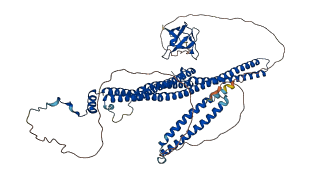
Descriptions
The autoinhibited protein was predicted that may have potential autoinhibitory elements via cis-regPred.
Autoinhibitory domains (AIDs)
Target domain |
|
Relief mechanism |
|
Assay |
cis-regPred |
Accessory elements
No accessory elements
Autoinhibited structure

Activated structure
1 structures for Q8CJ53
| Entry ID | Method | Resolution | Chain | Position | Source |
|---|---|---|---|---|---|
| AF-Q8CJ53-F1 | Predicted | AlphaFoldDB |
20 variants for Q8CJ53
| Variant ID(s) | Position | Change | Description | Diseaes Association | Provenance |
|---|---|---|---|---|---|
| rs3389474211 | 5 | T>S | No | EVA | |
| rs3389454669 | 18 | T>M | No | EVA | |
| rs3389468227 | 19 | Q>L | No | EVA | |
| rs3389468179 | 41 | A>V | No | EVA | |
| rs3389468858 | 110 | K>T | No | EVA | |
| rs3389474181 | 133 | Q>L | No | EVA | |
| rs3389441625 | 162 | I>S | No | EVA | |
| rs3389486473 | 183 | A>S | No | EVA | |
| rs3389386517 | 205 | Y>F | No | EVA | |
| rs3389441574 | 205 | Y>N | No | EVA | |
| rs3406828243 | 227 | L>P | No | EVA | |
| rs3389441629 | 254 | V>L | No | EVA | |
| rs3412895740 | 265 | S>* | No | EVA | |
| rs3389454750 | 332 | P>A | No | EVA | |
| rs3389469229 | 400 | R>I | No | EVA | |
| rs3407205336 | 413 | E>* | No | EVA | |
| rs3389486431 | 538 | E>G | No | EVA | |
| rs3389435095 | 554 | E>D | No | EVA | |
| rs3389386490 | 560 | T>I | No | EVA | |
| rs3389476946 | 567 | E>K | No | EVA |
No associated diseases with Q8CJ53
Functions
8 GO annotations of cellular component
| Name | Definition |
|---|---|
| cell cortex | The region of a cell that lies just beneath the plasma membrane and often, but not always, contains a network of actin filaments and associated proteins. |
| cell projection | A prolongation or process extending from a cell, e.g. a flagellum or axon. |
| Golgi apparatus | A membrane-bound cytoplasmic organelle of the endomembrane system that further processes the core oligosaccharides (e.g. N-glycans) added to proteins in the endoplasmic reticulum and packages them into membrane-bound vesicles. The Golgi apparatus operates at the intersection of the secretory, lysosomal, and endocytic pathways. |
| intracellular membrane-bounded organelle | Organized structure of distinctive morphology and function, bounded by a single or double lipid bilayer membrane and occurring within the cell. Includes the nucleus, mitochondria, plastids, vacuoles, and vesicles. Excludes the plasma membrane. |
| lysosome | A small lytic vacuole that has cell cycle-independent morphology found in most animal cells and that contains a variety of hydrolases, most of which have their maximal activities in the pH range 5-6. The contained enzymes display latency if properly isolated. About 40 different lysosomal hydrolases are known and lysosomes have a great variety of morphologies and functions. |
| microtubule | Any of the long, generally straight, hollow tubes of internal diameter 12-15 nm and external diameter 24 nm found in a wide variety of eukaryotic cells; each consists (usually) of 13 protofilaments of polymeric tubulin, staggered in such a manner that the tubulin monomers are arranged in a helical pattern on the microtubular surface, and with the alpha/beta axes of the tubulin subunits parallel to the long axis of the tubule; exist in equilibrium with pool of tubulin monomers and can be rapidly assembled or disassembled in response to physiological stimuli; concerned with force generation, e.g. in the spindle. |
| nucleoplasm | That part of the nuclear content other than the chromosomes or the nucleolus. |
| phagocytic cup | An invagination of the cell membrane formed by an actin dependent process during phagocytosis. Following internalization it is converted into a phagosome. |
2 GO annotations of molecular function
| Name | Definition |
|---|---|
| identical protein binding | Binding to an identical protein or proteins. |
| lipid binding | Binding to a lipid. |
7 GO annotations of biological process
| Name | Definition |
|---|---|
| actin cytoskeleton organization | A process that is carried out at the cellular level which results in the assembly, arrangement of constituent parts, or disassembly of cytoskeletal structures comprising actin filaments and their associated proteins. |
| endocytosis | A vesicle-mediated transport process in which cells take up external materials or membrane constituents by the invagination of a small region of the plasma membrane to form a new membrane-bounded vesicle. |
| epithelial to mesenchymal transition | A transition where an epithelial cell loses apical/basolateral polarity, severs intercellular adhesive junctions, degrades basement membrane components and becomes a migratory mesenchymal cell. |
| hyperosmotic salinity response | Any process that results in a change in state or activity of a cell or an organism (in terms of movement, secretion, enzyme production, gene expression, etc.) as a result of detection of, or exposure to, an increase in the concentration of salt (particularly but not exclusively sodium and chloride ions) in the environment. |
| negative regulation of cardiac muscle cell apoptotic process | Any process that decreases the rate or extent of cardiac cell apoptotic process, a form of programmed cell death induced by external or internal signals that trigger the activity of proteolytic caspases whose actions dismantle a cardiac muscle cell and result in its death. |
| positive regulation of cell growth involved in cardiac muscle cell development | Any process that increases the rate, frequency, or extent of the growth of a cardiac muscle cell, where growth contributes to the progression of the cell over time from its initial formation to its mature state. |
| signal transduction | The cellular process in which a signal is conveyed to trigger a change in the activity or state of a cell. Signal transduction begins with reception of a signal (e.g. a ligand binding to a receptor or receptor activation by a stimulus such as light), or for signal transduction in the absence of ligand, signal-withdrawal or the activity of a constitutively active receptor. Signal transduction ends with regulation of a downstream cellular process, e.g. regulation of transcription or regulation of a metabolic process. Signal transduction covers signaling from receptors located on the surface of the cell and signaling via molecules located within the cell. For signaling between cells, signal transduction is restricted to events at and within the receiving cell. |
15 homologous proteins in AiPD
| UniProt AC | Gene Name | Protein Name | Species | Evidence Code |
|---|---|---|---|---|
| Q5T0N5 | FNBP1L | Formin-binding protein 1-like | Homo sapiens (Human) | PR |
| Q7Z6B7 | SRGAP1 | SLIT-ROBO Rho GTPase-activating protein 1 | Homo sapiens (Human) | PR |
| O94868 | FCHSD2 | F-BAR and double SH3 domains protein 2 | Homo sapiens (Human) | PR |
| O75044 | SRGAP2 | SLIT-ROBO Rho GTPase-activating protein 2 | Homo sapiens (Human) | PR |
| Q96RU3 | FNBP1 | Formin-binding protein 1 | Homo sapiens (Human) | PR |
| Q91Z69 | Srgap1 | SLIT-ROBO Rho GTPase-activating protein 1 | Mus musculus (Mouse) | PR |
| Q812A2 | Srgap3 | SLIT-ROBO Rho GTPase-activating protein 3 | Mus musculus (Mouse) | PR |
| Q91Z67 | Srgap2 | SLIT-ROBO Rho GTPase-activating protein 2 | Mus musculus (Mouse) | PR |
| Q80TY0 | Fnbp1 | Formin-binding protein 1 | Mus musculus (Mouse) | PR |
| Q6PFY1 | Fchsd1 | F-BAR and double SH3 domains protein 1 | Mus musculus (Mouse) | PR |
| Q3USJ8 | Fchsd2 | F-BAR and double SH3 domains protein 2 | Mus musculus (Mouse) | PR |
| Q8K012 | Fnbp1l | Formin-binding protein 1-like | Mus musculus (Mouse) | PR |
| D4A208 | Srgap2 | SLIT-ROBO Rho GTPase-activating protein 2 | Rattus norvegicus (Rat) | PR |
| Q2HWF0 | Fnbp1l | Formin-binding protein 1-like | Rattus norvegicus (Rat) | PR |
| Q8R511 | Fnbp1 | Formin-binding protein 1 | Rattus norvegicus (Rat) | PR |
| 10 | 20 | 30 | 40 | 50 | 60 |
| MDWGTELWDQ | FEVLERHTQW | GLDLLDKYVK | FVKERAEVEQ | AYAKQLRSLV | KKYLPKRPTK |
| 70 | 80 | 90 | 100 | 110 | 120 |
| DDPEVKFSQQ | QSFVQLLQEV | NDFAGQRELV | AESLGIRVCL | ELAKYSQEMK | QERKMHFQEG |
| 130 | 140 | 150 | 160 | 170 | 180 |
| RRAQQQLENG | FKQLENSKRK | FERDCREAEK | AAHTAERLDQ | DINATKADVE | KAKQQAHLRN |
| 190 | 200 | 210 | 220 | 230 | 240 |
| HMAEESKNEY | AAQLQRFNRD | QAHFYFSQMP | QIFDKLQDMD | ERRATRLGAG | YGLLSEAELQ |
| 250 | 260 | 270 | 280 | 290 | 300 |
| VVPIIGKCLE | GMKVAAESVD | AKNDSQVLIE | LHKSGFARPG | DLEFEDFSQV | INRVPSDSSL |
| 310 | 320 | 330 | 340 | 350 | 360 |
| GTPDGRPELR | AASSRSRAKR | WPFGKKNKPR | PPSLSLLGGH | LPSTLSDGPS | SPRSGRDPLA |
| 370 | 380 | 390 | 400 | 410 | 420 |
| ILSEISKSVK | PRLASFRSFR | GGRGTVATED | FSHLPPEQQR | KRLQQQLEER | NRELQKEEDQ |
| 430 | 440 | 450 | 460 | 470 | 480 |
| REALKKMKDV | YEKTPQMGDP | ASLEPRIAET | LGNIERLKLE | VQKYEAWLAE | AESRVLSNRG |
| 490 | 500 | 510 | 520 | 530 | 540 |
| DSLSRHARPP | DPPTTAPPDS | SSSSTNSGSQ | DNKESSSEEP | PSEGQDTPIY | TEFDEDFEEP |
| 550 | 560 | 570 | 580 | 590 | 600 |
| ASPIGQCVAI | YHFEGSSEGT | VSMSEGEDLS | LMEEDKGDGW | TRVRRKQGAE | GYVPTSYLRV |
| TLN |