Q8K3K7
Gene name |
Agpat2 |
Protein name |
1-acyl-sn-glycerol-3-phosphate acyltransferase beta |
Names |
1-acylglycerol-3-phosphate O-acyltransferase 2, 1-AGP acyltransferase 2, 1-AGPAT 2, Lysophosphatidic acid acyltransferase beta, LPAAT-beta |
Species |
Mus musculus (Mouse) |
KEGG Pathway |
mmu:67512 |
EC number |
2.3.1.51: Transferring groups other than amino-acyl groups |
Protein Class |
|
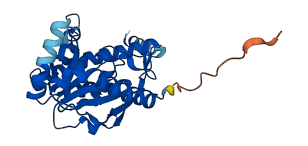
Descriptions
The autoinhibited protein was predicted that may have potential autoinhibitory elements via cis-regPred.
Autoinhibitory domains (AIDs)
Target domain |
|
Relief mechanism |
|
Assay |
cis-regPred |
Accessory elements
No accessory elements
Autoinhibited structure

Activated structure
1 structures for Q8K3K7
| Entry ID | Method | Resolution | Chain | Position | Source |
|---|---|---|---|---|---|
| AF-Q8K3K7-F1 | Predicted | AlphaFoldDB |
7 variants for Q8K3K7
| Variant ID(s) | Position | Change | Description | Diseaes Association | Provenance |
|---|---|---|---|---|---|
| rs3388539461 | 124 | M>L | No | EVA | |
| rs3388536043 | 134 | Y>* | No | EVA | |
| rs3388536821 | 134 | Y>* | No | EVA | |
| rs3388533842 | 209 | S>Y | No | EVA | |
| rs3391242747 | 220 | S>* | No | EVA | |
| rs3388534997 | 225 | V>I | No | EVA | |
| rs3391398077 | 266 | N>K | No | EVA |
No associated diseases with Q8K3K7
No regional properties for Q8K3K7
| Type | Name | Position | InterPro Accession |
|---|---|---|---|
| No domain, repeats, and functional sites for Q8K3K7 | |||
Functions
| Description | ||
|---|---|---|
| EC Number | 2.3.1.51 | Transferring groups other than amino-acyl groups |
| Subcellular Localization |
|
|
| PANTHER Family | ||
| PANTHER Subfamily | ||
| PANTHER Protein Class | ||
| PANTHER Pathway Category | No pathway information available | |
3 GO annotations of cellular component
| Name | Definition |
|---|---|
| endoplasmic reticulum | The irregular network of unit membranes, visible only by electron microscopy, that occurs in the cytoplasm of many eukaryotic cells. The membranes form a complex meshwork of tubular channels, which are often expanded into slitlike cavities called cisternae. The ER takes two forms, rough (or granular), with ribosomes adhering to the outer surface, and smooth (with no ribosomes attached). |
| endoplasmic reticulum membrane | The lipid bilayer surrounding the endoplasmic reticulum. |
| integral component of membrane | The component of a membrane consisting of the gene products and protein complexes having at least some part of their peptide sequence embedded in the hydrophobic region of the membrane. |
1 GO annotations of molecular function
| Name | Definition |
|---|---|
| 1-acylglycerol-3-phosphate O-acyltransferase activity | Catalysis of the reaction: acyl-CoA + 1-acyl-sn-glycerol-3-phosphate = CoA + 1,2-diacyl-sn-glycerol-3-phosphate. |
6 GO annotations of biological process
| Name | Definition |
|---|---|
| CDP-diacylglycerol biosynthetic process | The chemical reactions and pathways resulting in the formation of CDP-diacylglycerol, CDP-1,2-diacylglycerol, a substance composed of diacylglycerol in glycosidic linkage with cytidine diphosphate. |
| epidermis development | The process whose specific outcome is the progression of the epidermis over time, from its formation to the mature structure. The epidermis is the outer epithelial layer of an animal, it may be a single layer that produces an extracellular material (e.g. the cuticle of arthropods) or a complex stratified squamous epithelium, as in the case of many vertebrate species. |
| phosphatidic acid biosynthetic process | The chemical reactions and pathways resulting in the formation of phosphatidic acid, any derivative of glycerol phosphate in which both the remaining hydroxyl groups of the glycerol moiety are esterified with fatty acids. |
| phospholipid biosynthetic process | The chemical reactions and pathways resulting in the formation of a phospholipid, a lipid containing phosphoric acid as a mono- or diester. |
| positive regulation of cytokine production | Any process that activates or increases the frequency, rate or extent of production of a cytokine. |
| response to xenobiotic stimulus | Any process that results in a change in state or activity of a cell or an organism (in terms of movement, secretion, enzyme production, gene expression, etc.) as a result of a stimulus from a xenobiotic, a compound foreign to the organim exposed to it. It may be synthesized by another organism (like ampicilin) or it can be a synthetic chemical. |
6 homologous proteins in AiPD
| UniProt AC | Gene Name | Protein Name | Species | Evidence Code |
|---|---|---|---|---|
| P33333 | SLC1 | 1-acyl-sn-glycerol-3-phosphate acyltransferase | Saccharomyces cerevisiae (strain ATCC 204508 / S288c) (Baker's yeast) | PR |
| Q95JH2 | AGPAT1 | 1-acyl-sn-glycerol-3-phosphate acyltransferase alpha | Bos taurus (Bovine) | PR |
| Q99943 | AGPAT1 | 1-acyl-sn-glycerol-3-phosphate acyltransferase alpha | Homo sapiens (Human) | PR |
| O15120 | AGPAT2 | 1-acyl-sn-glycerol-3-phosphate acyltransferase beta | Homo sapiens (Human) | PR |
| Q9LLY4 | BAT2 | 1-acyl-sn-glycerol-3-phosphate acyltransferase BAT2, chloroplastic | Brassica napus (Rape) | PR |
| Q8GXU8 | LPAT1 | 1-acyl-sn-glycerol-3-phosphate acyltransferase LPAT1, chloroplastic | Arabidopsis thaliana (Mouse-ear cress) | PR |
| 10 | 20 | 30 | 40 | 50 | 60 |
| MDPWPWLTAA | LLLLLLLVQL | SRTARFYAKV | GLYCVLCLSF | SAAASIVCLL | RHGGRTVDNM |
| 70 | 80 | 90 | 100 | 110 | 120 |
| SIISWFVRSF | KYVYGLRFEV | SGQKKLEVDG | PCVIISNHQS | ILDMMGLMEI | LPKRCVQIAK |
| 130 | 140 | 150 | 160 | 170 | 180 |
| RELMFTGPVG | LIMYLGGVYF | INRQQARTAM | SVMADLGDLM | VKENLKVWIY | PEGTRNDNGD |
| 190 | 200 | 210 | 220 | 230 | 240 |
| LLPFKKGAFY | LAIQAQVPII | PVVYSSFSSF | YNVKTKLFTS | GTIKVQVLDA | VPTNGLTDAD |
| 250 | 260 | 270 | |||
| VTKLVDTCYQ | SMRATFLQIS | QIPQENSAIK | EPGVLPAQ |