Q8HZT6
Gene name |
RDH10 |
Protein name |
Retinol dehydrogenase 10 |
Names |
|
Species |
Bos taurus (Bovine) |
KEGG Pathway |
bta:282852 |
EC number |
1.1.1.300: With NAD(+) or NADP(+) as acceptor |
Protein Class |
|
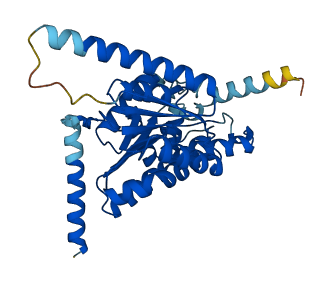
Descriptions
The autoinhibited protein was predicted that may have potential autoinhibitory elements via cis-regPred.
Autoinhibitory domains (AIDs)
Target domain |
|
Relief mechanism |
|
Assay |
cis-regPred |
Accessory elements
No accessory elements
Autoinhibited structure

Activated structure
1 structures for Q8HZT6
| Entry ID | Method | Resolution | Chain | Position | Source |
|---|---|---|---|---|---|
| AF-Q8HZT6-F1 | Predicted | AlphaFoldDB |
65 variants for Q8HZT6
| Variant ID(s) | Position | Change | Description | Diseaes Association | Provenance |
|---|---|---|---|---|---|
| rs449171569 | 2 | N>T | No | EVA | |
| rs435573209 | 2 | N>Y | No | EVA | |
| rs434887155 | 4 | V>G | No | EVA | |
| rs451774745 | 5 | V>G | No | EVA | |
| rs437374864 | 19 | V>G | No | EVA | |
| rs457579419 | 31 | E>A | No | EVA | |
| rs474467673 | 35 | A>G | No | EVA | |
| rs441644203 | 38 | V>G | No | EVA | |
| rs472178651 | 41 | I>F | No | EVA | |
| rs457821252 | 42 | T>A | No | EVA | |
| rs457821252 | 42 | T>P | No | EVA | |
| rs478091069 | 42 | T>R | No | EVA | |
| rs480277382 | 46 | S>G | No | EVA | |
| rs449085372 | 46 | S>R | No | EVA | |
| rs466046249 | 47 | G>V | No | EVA | |
| rs434754634 | 48 | L>R | No | EVA | |
| rs465437173 | 60 | R>P | No | EVA | |
| rs468079213 | 68 | I>F | No | EVA | |
| rs453626456 | 69 | N>Y | No | EVA | |
| rs472215747 | 73 | N>H | No | EVA | |
| rs440774743 | 74 | E>Q | No | EVA | |
| rs471478918 | 79 | M>I | No | EVA | |
| rs451311775 | 79 | M>T | No | EVA | |
| rs443402987 | 82 | H>L | No | EVA | |
| rs443402987 | 82 | H>R | No | EVA | |
| rs463349435 | 84 | Y>H | No | EVA | |
| rs480214217 | 84 | Y>S | No | EVA | |
| rs442702943 | 86 | D>A | No | EVA | |
| rs442702943 | 86 | D>G | No | EVA | |
| rs456873192 | 180 | F>C | No | EVA | |
| rs467634400 | 180 | F>L | No | EVA | |
| rs436145136 | 181 | L>F | No | EVA | |
| rs453186671 | 181 | L>P | No | EVA | |
| rs444390749 | 185 | L>M | No | EVA | |
| rs445651963 | 232 | E>D | No | EVA | |
| rs481628106 | 244 | Y>S | No | EVA | |
| rs450370049 | 245 | L>R | No | EVA | |
| rs467507704 | 246 | V>G | No | EVA | |
| rs446512300 | 250 | M>I | No | EVA | |
| rs481213152 | 250 | M>L | No | EVA | |
| rs466773718 | 252 | R>G | No | EVA | |
| rs432137023 | 255 | R>Q | No | EVA | |
| rs445968577 | 257 | R>G | No | EVA | |
| rs466306817 | 260 | I>L | No | EVA | |
| rs435100252 | 261 | E>K | No | EVA | |
| rs452015350 | 265 | P>T | No | EVA | |
| rs470593545 | 279 | A>P | No | EVA | |
| rs470593545 | 279 | A>S | No | EVA | |
| rs456255299 | 282 | T>P | No | EVA | |
| rs476314162 | 283 | D>A | No | EVA | |
| rs478010476 | 310 | C>S | No | EVA | |
| rs463830934 | 317 | A>E | No | EVA | |
| rs449965843 | 317 | A>S | No | EVA | |
| rs480783005 | 318 | D>E | No | EVA | |
| rs449266923 | 319 | K>R | No | EVA | |
| rs466430264 | 320 | C>G | No | EVA | |
| rs434939314 | 322 | Y>D | No | EVA | |
| rs434939314 | 322 | Y>H | No | EVA | |
| rs445567204 | 322 | Y>S | No | EVA | |
| rs465638942 | 325 | I>N | No | EVA | |
| rs465638942 | 325 | I>T | No | EVA | |
| rs432764012 | 326 | A>P | No | EVA | |
| rs432764012 | 326 | A>S | No | EVA | |
| rs476183093 | 327 | Q>K | No | EVA | |
| rs472273570 | 330 | Q>K | No | EVA |
No associated diseases with Q8HZT6
1 regional properties for Q8HZT6
| Type | Name | Position | InterPro Accession |
|---|---|---|---|
| domain | Interleukin-17 receptor C/E, N-terminal | 55 - 292 | IPR027841 |
Functions
| Description | ||
|---|---|---|
| EC Number | 1.1.1.300 | With NAD(+) or NADP(+) as acceptor |
| Subcellular Localization |
|
|
| PANTHER Family | ||
| PANTHER Subfamily | ||
| PANTHER Protein Class | ||
| PANTHER Pathway Category | No pathway information available | |
3 GO annotations of cellular component
| Name | Definition |
|---|---|
| endoplasmic reticulum membrane | The lipid bilayer surrounding the endoplasmic reticulum. |
| integral component of membrane | The component of a membrane consisting of the gene products and protein complexes having at least some part of their peptide sequence embedded in the hydrophobic region of the membrane. |
| lipid droplet | An intracellular non-membrane-bounded organelle comprising a matrix of coalesced lipids surrounded by a phospholipid monolayer. May include associated proteins. |
3 GO annotations of molecular function
| Name | Definition |
|---|---|
| NAD-retinol dehydrogenase activity | Catalysis of the reaction: retinol + NAD+ = retinal + NADH + H+. |
| NADP-retinol dehydrogenase activity | Catalysis of the reaction: all-trans-retinol + NADP+ = all-trans-retinal + NADPH + H+. |
| oxidoreductase activity, acting on the CH-OH group of donors, NAD or NADP as acceptor | Catalysis of an oxidation-reduction (redox) reaction in which a CH-OH group acts as a hydrogen or electron donor and reduces NAD+ or NADP. |
14 GO annotations of biological process
| Name | Definition |
|---|---|
| bud elongation involved in lung branching | The process in which a bud in the lung grows out from the point where it is formed. |
| ear development | The process whose specific outcome is the progression of the ear over time, from its formation to the mature structure. The ear is the sense organ in vertebrates that is specialized for the detection of sound, and the maintenance of balance. Includes the outer ear and middle ear, which collect and transmit sound waves; and the inner ear, which contains the organs of balance and (except in fish) hearing. Also includes the pinna, the visible part of the outer ear, present in some mammals. |
| embryonic camera-type eye development | The process occurring during the embryonic phase whose specific outcome is the progression of the eye over time, from its formation to the mature structure. |
| embryonic forelimb morphogenesis | The process, occurring in the embryo, by which the anatomical structures of the forelimb are generated and organized. The forelimbs are the front limbs of an animal, e.g. the arms of a human. |
| embryonic viscerocranium morphogenesis | The process in which the anatomical structures of the viscerocranium are generated and organized during the embryonic phase. The viscerocranium is the part of the skull comprising the facial bones. |
| gonad development | The process whose specific outcome is the progression of the gonad over time, from its formation to the mature structure. The gonad is an animal organ that produces gametes; in some species it also produces hormones. |
| in utero embryonic development | The process whose specific outcome is the progression of the embryo in the uterus over time, from formation of the zygote in the oviduct, to birth. An example of this process is found in Mus musculus. |
| metanephros development | The process whose specific outcome is the progression of the metanephros over time, from its formation to the mature structure. In mammals, the metanephros is the excretory organ of the fetus, which develops into the mature kidney and is formed from the rear portion of the nephrogenic cord. The metanephros is an endocrine and metabolic organ that filters the blood and excretes the end products of body metabolism in the form of urine. |
| neural crest cell development | The process aimed at the progression of a neural crest cell over time, from initial commitment of the cell to its specific fate, to the fully functional differentiated cell. |
| nose development | The process whose specific outcome is the progression of the nose over time, from its formation to the mature structure. The nose is the specialized structure of the face that serves as the organ of the sense of smell and as part of the respiratory system. Includes the nasi externus (external nose) and cavitas nasi (nasal cavity). |
| primary lung bud formation | The morphogenetic process in which the foregut region specified to become the lung forms the initial left and right buds. |
| retinal metabolic process | The chemical reactions and pathways involving retinal, a compound that plays an important role in the visual process in most vertebrates. In the retina, retinal combines with opsins to form visual pigments. Retinal is one of the forms of vitamin A. |
| retinoic acid biosynthetic process | The chemical reactions and pathways resulting in the biosynthesis of retinoic acid, one of the three components that makes up vitamin A. |
| visual perception | The series of events required for an organism to receive a visual stimulus, convert it to a molecular signal, and recognize and characterize the signal. Visual stimuli are detected in the form of photons and are processed to form an image. |
8 homologous proteins in AiPD
| UniProt AC | Gene Name | Protein Name | Species | Evidence Code |
|---|---|---|---|---|
| Q8IZV5 | RDH10 | Retinol dehydrogenase 10 | Homo sapiens (Human) | PR |
| Q8VCR2 | Hsd17b13 | 17-beta-hydroxysteroid dehydrogenase 13 | Mus musculus (Mouse) | PR |
| Q05A13 | Sdr16c6 | Short-chain dehydrogenase/reductase family 16C member 6 | Mus musculus (Mouse) | PR |
| Q8VCH7 | Rdh10 | Retinol dehydrogenase 10 | Mus musculus (Mouse) | PR |
| Q80ZF7 | Rdh10 | Retinol dehydrogenase 10 | Rattus norvegicus (Rat) | PR |
| Q5XGF7 | rdh10 | Retinol dehydrogenase 10 | Xenopus tropicalis (Western clawed frog) (Silurana tropicalis) | PR |
| A1L1W4 | rdh10a | Retinol dehydrogenase 10-A | Danio rerio (Zebrafish) (Brachydanio rerio) | PR |
| Q7T2D1 | rdh10b | Retinol dehydrogenase 10-B | Danio rerio (Zebrafish) (Brachydanio rerio) | PR |
| 10 | 20 | 30 | 40 | 50 | 60 |
| MNIVVEFFVV | TFKVLWAFVL | AAARWLVRPK | EKSVAGQVCL | ITGAGSGLGR | LFALEFARRR |
| 70 | 80 | 90 | 100 | 110 | 120 |
| ALLVLWDINT | QSNEETAGMV | RHIYRDLEAA | DAAALQAGNG | EEEILPHCNL | QVFTYTCDVG |
| 130 | 140 | 150 | 160 | 170 | 180 |
| KRENVYLTAE | RVRKEVGEVS | VLVNNAGVVS | GHHLLECPDE | LIERTMMVNC | HAHFWTTKAF |
| 190 | 200 | 210 | 220 | 230 | 240 |
| LPTMLEINHG | HIVTVASSLG | LFSTAGVEDY | CASKFGVVGF | HESLSHELKA | AEKDGIKTTL |
| 250 | 260 | 270 | 280 | 290 | 300 |
| VCPYLVDTGM | FRGCRIRKEI | EPFLPPLKPD | YCVKQAMKAI | LTDQPMICTP | RLMYIVTFMK |
| 310 | 320 | 330 | 340 | ||
| SILPFEAVVC | MYRFLGADKC | MYPFIAQRKQ | ATNNNEAKNG | I |