Q7Z2E3
Gene name |
APTX (AXA1) |
Protein name |
Aprataxin |
Names |
Forkhead-associated domain histidine triad-like protein, FHA-HIT |
Species |
Homo sapiens (Human) |
KEGG Pathway |
hsa:54840 |
EC number |
3.6.1.71: In phosphorus-containing anhydrides |
Protein Class |
|
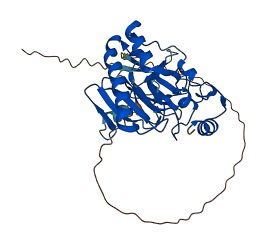
Descriptions
The autoinhibited protein was predicted that may have potential autoinhibitory elements via cis-regPred.
Autoinhibitory domains (AIDs)
Target domain |
|
Relief mechanism |
|
Assay |
cis-regPred |
Accessory elements
No accessory elements
Autoinhibited structure

Activated structure
12 structures for Q7Z2E3
| Entry ID | Method | Resolution | Chain | Position | Source |
|---|---|---|---|---|---|
| 3KT9 | X-ray | 165 A | A | 15-116 | PDB |
| 4NDF | X-ray | 194 A | A/B | 179-356 | PDB |
| 4NDG | X-ray | 254 A | A/B | 179-356 | PDB |
| 4NDH | X-ray | 185 A | A/B | 179-356 | PDB |
| 4NDI | X-ray | 190 A | A/B | 179-356 | PDB |
| 6CVO | X-ray | 240 A | A/B | 179-356 | PDB |
| 6CVP | X-ray | 200 A | A/B | 179-356 | PDB |
| 6CVQ | X-ray | 165 A | A/B | 179-354 | PDB |
| 6CVR | X-ray | 188 A | A/B | 179-356 | PDB |
| 6CVS | X-ray | 211 A | A/B | 179-356 | PDB |
| 6CVT | X-ray | 294 A | A/B | 179-356 | PDB |
| AF-Q7Z2E3-F1 | Predicted | AlphaFoldDB |
9 variants for Q7Z2E3
| Variant ID(s) | Position | Change | Description | Diseaes Association | Provenance |
|---|---|---|---|---|---|
| VAR_018794 | 211 | K>Q | AOA; impairs binding to adenosine-5'-diphospho-5'-(DNA) and deadenylation activity [UniProt] | Yes | UniProt |
|
VAR_018795 rs748165574 |
212 | A>V | AOA; heterozygous [UniProt] | Yes |
UniProt dbSNP |
|
rs150886026 VAR_018796 |
213 | R>H | AOA [UniProt] | Yes |
UniProt dbSNP |
|
rs121908133 VAR_018797 |
215 | H>R | AOA [UniProt] | Yes |
UniProt dbSNP |
|
rs121908131 VAR_018798 |
220 | P>L | AOA [UniProt] | Yes |
UniProt dbSNP |
|
rs267606665 VAR_025365 |
237 | L>P | AOA [UniProt] | Yes |
UniProt dbSNP |
|
VAR_018799 rs121908132 |
277 | V>G | AOA; abolishes DNA-binding and enzymatic activity towards Ap(4)A [UniProt] | Yes |
UniProt dbSNP |
| VAR_018800 | 281 | D>G | AOA; heterozygous [UniProt] | Yes | UniProt |
|
rs773393618 VAR_018801 |
293 | W>R | AOA; heterozygous [UniProt] | Yes |
UniProt dbSNP |
No associated diseases with Q7Z2E3
No regional properties for Q7Z2E3
| Type | Name | Position | InterPro Accession |
|---|---|---|---|
| No domain, repeats, and functional sites for Q7Z2E3 | |||
Functions
| Description | ||
|---|---|---|
| EC Number | 3.6.1.71 | In phosphorus-containing anhydrides |
| Subcellular Localization |
|
|
| PANTHER Family | ||
| PANTHER Subfamily | ||
| PANTHER Protein Class | ||
| PANTHER Pathway Category | No pathway information available | |
5 GO annotations of cellular component
| Name | Definition |
|---|---|
| chromatin | The ordered and organized complex of DNA, protein, and sometimes RNA, that forms the chromosome. |
| cytoplasm | The contents of a cell excluding the plasma membrane and nucleus, but including other subcellular structures. |
| nucleolus | A small, dense body one or more of which are present in the nucleus of eukaryotic cells. It is rich in RNA and protein, is not bounded by a limiting membrane, and is not seen during mitosis. Its prime function is the transcription of the nucleolar DNA into 45S ribosomal-precursor RNA, the processing of this RNA into 5.8S, 18S, and 28S components of ribosomal RNA, and the association of these components with 5S RNA and proteins synthesized outside the nucleolus. This association results in the formation of ribonucleoprotein precursors; these pass into the cytoplasm and mature into the 40S and 60S subunits of the ribosome. |
| nucleoplasm | That part of the nuclear content other than the chromosomes or the nucleolus. |
| nucleus | A membrane-bounded organelle of eukaryotic cells in which chromosomes are housed and replicated. In most cells, the nucleus contains all of the cell's chromosomes except the organellar chromosomes, and is the site of RNA synthesis and processing. In some species, or in specialized cell types, RNA metabolism or DNA replication may be absent. |
14 GO annotations of molecular function
| Name | Definition |
|---|---|
| chromatin binding | Binding to chromatin, the network of fibers of DNA, protein, and sometimes RNA, that make up the chromosomes of the eukaryotic nucleus during interphase. |
| damaged DNA binding | Binding to damaged DNA. |
| DNA 5'-adenosine monophosphate hydrolase activity | Catalysis of the reaction: 5'-AMP-DNA + H2O = AMP + DNA; nucleophilic release of a covalently linked adenylate residue from a DNA strand, leaving a 5' phosphate terminus. |
| DNA-3'-diphospho-5'-guanosine diphosphatase | Catalysis of the reaction: (DNA)-3'-diphospho-5'-guanosine + H2O = (DNA)-3'-phosphate + GMP. |
| double-stranded DNA binding | Binding to double-stranded DNA. |
| double-stranded RNA binding | Binding to double-stranded RNA. |
| metal ion binding | Binding to a metal ion. |
| mismatched DNA binding | Binding to a double-stranded DNA region containing one or more mismatches. |
| phosphoglycolate phosphatase activity | Catalysis of the reaction: 2-phosphoglycolate + H(2)O = glycolate + phosphate. |
| phosphoprotein binding | Binding to a phosphorylated protein. |
| polynucleotide 3'-phosphatase activity | Catalysis of the reaction: 3'-phosphopolynucleotide + H2O = a polynucleotide + phosphate. Hydrolyzes the free 3'-phosphate resulting from single strand breaks in DNA due to oxidative damage. |
| protein N-terminus binding | Binding to a protein N-terminus, the end of any peptide chain at which the 2-amino (or 2-imino) function of a constituent amino acid is not attached in peptide linkage to another amino-acid residue. |
| single-strand break-containing DNA binding | Binding to damaged DNA containing single-strand breaks (SSBs). |
| single-stranded DNA binding | Binding to single-stranded DNA. |
6 GO annotations of biological process
| Name | Definition |
|---|---|
| cellular response to DNA damage stimulus | Any process that results in a change in state or activity of a cell (in terms of movement, secretion, enzyme production, gene expression, etc.) as a result of a stimulus indicating damage to its DNA from environmental insults or errors during metabolism. |
| DNA ligation | The re-formation of a broken phosphodiester bond in the DNA backbone, carried out by DNA ligase. |
| double-strand break repair | The repair of double-strand breaks in DNA via homologous and nonhomologous mechanisms to reform a continuous DNA helix. |
| regulation of protein stability | Any process that affects the structure and integrity of a protein, altering the likelihood of its degradation or aggregation. |
| response to hydrogen peroxide | Any process that results in a change in state or activity of a cell or an organism (in terms of movement, secretion, enzyme production, gene expression, etc.) as a result of a hydrogen peroxide (H2O2) stimulus. |
| single strand break repair | The repair of single strand breaks in DNA. Repair of such breaks is mediated by the same enzyme systems as are used in base excision repair. |
7 homologous proteins in AiPD
| UniProt AC | Gene Name | Protein Name | Species | Evidence Code |
|---|---|---|---|---|
| Q7YRZ2 | APTX | Aprataxin | Bos taurus (Bovine) | PR |
| Q96T60 | PNKP | Bifunctional polynucleotide phosphatase/kinase | Homo sapiens (Human) | PR |
| Q9NQE9 | HINT3 | Adenosine 5'-monophosphoramidase HINT3 | Homo sapiens (Human) | PR |
| Q9JLV6 | Pnkp | Bifunctional polynucleotide phosphatase/kinase | Mus musculus (Mouse) | PR |
| Q7TQC5 | Aptx | Aprataxin | Mus musculus (Mouse) | PR |
| Q7YRZ1 | APTX | Aprataxin | Sus scrofa (Pig) | PR |
| Q19683 | F21D5.5 | Uncharacterized protein F21D5.5 | Caenorhabditis elegans | PR |
| 10 | 20 | 30 | 40 | 50 | 60 |
| MSNVNLSVSD | FWRVMMRVCW | LVRQDSRHQR | IRLPHLEAVV | IGRGPETKIT | DKKCSRQQVQ |
| 70 | 80 | 90 | 100 | 110 | 120 |
| LKAECNKGYV | KVKQVGVNPT | SIDSVVIGKD | QEVKLQPGQV | LHMVNELYPY | IVEFEEEAKN |
| 130 | 140 | 150 | 160 | 170 | 180 |
| PGLETHRKRK | RSGNSDSIER | DAAQEAEAGT | GLEPGSNSGQ | CSVPLKKGKD | APIKKESLGH |
| 190 | 200 | 210 | 220 | 230 | 240 |
| WSQGLKISMQ | DPKMQVYKDE | QVVVIKDKYP | KARYHWLVLP | WTSISSLKAV | AREHLELLKH |
| 250 | 260 | 270 | 280 | 290 | 300 |
| MHTVGEKVIV | DFAGSSKLRF | RLGYHAIPSM | SHVHLHVISQ | DFDSPCLKNK | KHWNSFNTEY |
| 310 | 320 | 330 | 340 | 350 | |
| FLESQAVIEM | VQEAGRVTVR | DGMPELLKLP | LRCHECQQLL | PSIPQLKEHL | RKHWTQ |