Q9JLV6
Gene name |
Pnkp |
Protein name |
Bifunctional polynucleotide phosphatase/kinase |
Names |
DNA 5'-kinase/3'-phosphatase, Polynucleotide kinase-3'-phosphatase |
Species |
Mus musculus (Mouse) |
KEGG Pathway |
|
EC number |
2.7.1.78: Phosphotransferases with an alcohol group as acceptor |
Protein Class |
|
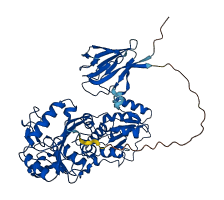
Descriptions
The autoinhibited protein was predicted that may have potential autoinhibitory elements via cis-regPred.
Autoinhibitory domains (AIDs)
Target domain |
|
Relief mechanism |
|
Assay |
cis-regPred |
Accessory elements
No accessory elements
Autoinhibited structure

Activated structure
11 structures for Q9JLV6
| Entry ID | Method | Resolution | Chain | Position | Source |
|---|---|---|---|---|---|
| 1UJX | NMR | - | A | 1-106 | PDB |
| 1YJ5 | X-ray | 280 A | PDB | ||
| 1YJM | X-ray | 220 A | A/B/C | 1-110 | PDB |
| 3U7E | X-ray | 170 A | B | 142-522 | PDB |
| 3U7F | X-ray | 180 A | B | 142-522 | PDB |
| 3U7G | X-ray | 210 A | A | 144-522 | PDB |
| 3U7H | X-ray | 200 A | B | 142-522 | PDB |
| 3ZVL | X-ray | 165 A | A | 111-522 | PDB |
| 3ZVM | X-ray | 200 A | A/B | 111-522 | PDB |
| 3ZVN | X-ray | 215 A | A | 111-522 | PDB |
| AF-Q9JLV6-F1 | Predicted | AlphaFoldDB |
No variants for Q9JLV6
| Variant ID(s) | Position | Change | Description | Diseaes Association | Provenance |
|---|---|---|---|---|---|
| No variants for Q9JLV6 | |||||
No associated diseases with Q9JLV6
1 regional properties for Q9JLV6
| Type | Name | Position | InterPro Accession |
|---|---|---|---|
| domain | YqgF/RNase H-like domain | 4 - 104 | IPR006641 |
Functions
| Description | ||
|---|---|---|
| EC Number | 2.7.1.78 | Phosphotransferases with an alcohol group as acceptor |
| Subcellular Localization |
|
|
| PANTHER Family | ||
| PANTHER Subfamily | ||
| PANTHER Protein Class | ||
| PANTHER Pathway Category | No pathway information available | |
6 GO annotations of cellular component
| Name | Definition |
|---|---|
| mitochondrion | A semiautonomous, self replicating organelle that occurs in varying numbers, shapes, and sizes in the cytoplasm of virtually all eukaryotic cells. It is notably the site of tissue respiration. |
| nucleolus | A small, dense body one or more of which are present in the nucleus of eukaryotic cells. It is rich in RNA and protein, is not bounded by a limiting membrane, and is not seen during mitosis. Its prime function is the transcription of the nucleolar DNA into 45S ribosomal-precursor RNA, the processing of this RNA into 5.8S, 18S, and 28S components of ribosomal RNA, and the association of these components with 5S RNA and proteins synthesized outside the nucleolus. This association results in the formation of ribonucleoprotein precursors; these pass into the cytoplasm and mature into the 40S and 60S subunits of the ribosome. |
| nucleoplasm | That part of the nuclear content other than the chromosomes or the nucleolus. |
| nucleus | A membrane-bounded organelle of eukaryotic cells in which chromosomes are housed and replicated. In most cells, the nucleus contains all of the cell's chromosomes except the organellar chromosomes, and is the site of RNA synthesis and processing. In some species, or in specialized cell types, RNA metabolism or DNA replication may be absent. |
| SCF ubiquitin ligase complex | A ubiquitin ligase complex in which a cullin from the Cul1 subfamily and a RING domain protein form the catalytic core; substrate specificity is conferred by a Skp1 adaptor and an F-box protein. SCF complexes are involved in targeting proteins for degradation by the proteasome. The best characterized complexes are those from yeast and mammals (with core subunits named Cdc53/Cul1, Rbx1/Hrt1/Roc1). |
| site of double-strand break | A region of a chromosome at which a DNA double-strand break has occurred. DNA damage signaling and repair proteins accumulate at the lesion to respond to the damage and repair the DNA to form a continuous DNA helix. |
5 GO annotations of molecular function
| Name | Definition |
|---|---|
| ATP binding | Binding to ATP, adenosine 5'-triphosphate, a universally important coenzyme and enzyme regulator. |
| double-stranded DNA binding | Binding to double-stranded DNA. |
| polydeoxyribonucleotide 5'-hydroxyl-kinase activity | Catalysis of the reaction: ATP + 5'-dephospho-DNA = ADP + 5'-phospho-DNA. |
| polynucleotide 3'-phosphatase activity | Catalysis of the reaction: 3'-phosphopolynucleotide + H2O = a polynucleotide + phosphate. Hydrolyzes the free 3'-phosphate resulting from single strand breaks in DNA due to oxidative damage. |
| ubiquitin ligase-substrate adaptor activity | The binding activity of a molecule that brings together a ubiquitin ligase and its substrate. Usually mediated by F-box BTB/POZ domain proteins. |
12 GO annotations of biological process
| Name | Definition |
|---|---|
| cellular response to DNA damage stimulus | Any process that results in a change in state or activity of a cell (in terms of movement, secretion, enzyme production, gene expression, etc.) as a result of a stimulus indicating damage to its DNA from environmental insults or errors during metabolism. |
| DNA ligation involved in DNA repair | The re-formation of a broken phosphodiester bond in the DNA backbone, carried out by DNA ligase, that contributes to DNA repair. |
| DNA repair | The process of restoring DNA after damage. Genomes are subject to damage by chemical and physical agents in the environment (e.g. UV and ionizing radiations, chemical mutagens, fungal and bacterial toxins, etc.) and by free radicals or alkylating agents endogenously generated in metabolism. DNA is also damaged because of errors during its replication. A variety of different DNA repair pathways have been reported that include direct reversal, base excision repair, nucleotide excision repair, photoreactivation, bypass, double-strand break repair pathway, and mismatch repair pathway. |
| double-strand break repair via nonhomologous end joining | The repair of a double-strand break in DNA in which the two broken ends are rejoined with little or no sequence complementarity. Information at the DNA ends may be lost due to the modification of broken DNA ends. This term covers instances of separate pathways, called classical (or canonical) and alternative nonhomologous end joining (C-NHEJ and A-NHEJ). These in turn may further branch into sub-pathways, but evidence is still unclear. |
| negative regulation of protein ADP-ribosylation | Any process that decreases the frequency, rate or extent of protein ADP-ribosylation. Protein ADP-ribosylation is the transfer, from NAD, of ADP-ribose to protein amino acids. |
| nucleotide phosphorylation | The process of introducing one or more phosphate groups into a nucleotide to produce a phosphorylated nucleoside. |
| positive regulation of double-strand break repair via nonhomologous end joining | Any process that activates or increases the frequency, rate or extent of double-strand break repair via nonhomologous end joining. |
| positive regulation of telomerase activity | Any process that activates or increases the frequency, rate or extent of telomerase activity, the catalysis of the reaction: deoxynucleoside triphosphate + DNA(n) = diphosphate + DNA(n+1). |
| positive regulation of telomere capping | Any process that activates or increases the frequency, rate or extent of telomere capping. |
| positive regulation of telomere maintenance via telomerase | Any process that activates or increases the frequency, rate or extent of the addition of telomeric repeats by telomerase. |
| protein K63-linked ubiquitination | A protein ubiquitination process in which a polymer of ubiquitin, formed by linkages between lysine residues at position 63 of the ubiquitin monomers, is added to a protein. K63-linked ubiquitination does not target the substrate protein for degradation, but is involved in several pathways, notably as a signal to promote error-free DNA postreplication repair. |
| response to oxidative stress | Any process that results in a change in state or activity of a cell or an organism (in terms of movement, secretion, enzyme production, gene expression, etc.) as a result of oxidative stress, a state often resulting from exposure to high levels of reactive oxygen species, e.g. superoxide anions, hydrogen peroxide (H2O2), and hydroxyl radicals. |
6 homologous proteins in AiPD
| UniProt AC | Gene Name | Protein Name | Species | Evidence Code |
|---|---|---|---|---|
| Q7YRZ2 | APTX | Aprataxin | Bos taurus (Bovine) | PR |
| Q7Z2E3 | APTX | Aprataxin | Homo sapiens (Human) | PR |
| Q96T60 | PNKP | Bifunctional polynucleotide phosphatase/kinase | Homo sapiens (Human) | PR |
| Q7TQC5 | Aptx | Aprataxin | Mus musculus (Mouse) | PR |
| Q7YRZ1 | APTX | Aprataxin | Sus scrofa (Pig) | PR |
| Q19683 | F21D5.5 | Uncharacterized protein F21D5.5 | Caenorhabditis elegans | PR |
| 10 | 20 | 30 | 40 | 50 | 60 |
| MSQLGSRGRL | WLQSPTGGPP | PIFLPSDGQA | LVLGRGPLTQ | VTDRKCSRNQ | VELIADPESR |
| 70 | 80 | 90 | 100 | 110 | 120 |
| TVAVKQLGVN | PSTVGVHELK | PGLSGSLSLG | DVLYLVNGLY | PLTLRWEELS | TSGSQPDAPP |
| 130 | 140 | 150 | 160 | 170 | 180 |
| DTPGDPEEGE | DTEPQKKRVR | KSSLGWESLK | KLLVFTASGV | KPQGKVAAFD | LDGTLITTRS |
| 190 | 200 | 210 | 220 | 230 | 240 |
| GKVFPTSPSD | WRILYPEIPK | KLQELAAEGY | KLVIFTNQMG | IGRGKLPAEV | FKGKVEAVLE |
| 250 | 260 | 270 | 280 | 290 | 300 |
| KLGVPFQVLV | ATHAGLNRKP | VSGMWDHLQE | QANEGIPISV | EDSVFVGDAA | GRLANWAPGR |
| 310 | 320 | 330 | 340 | 350 | 360 |
| KKKDFSCADR | LFALNVGLPF | ATPEEFFLKW | PAARFELPAF | DPRTISSAGP | LYLPESSSLL |
| 370 | 380 | 390 | 400 | 410 | 420 |
| SPNPEVVVAV | GFPGAGKSTF | IQEHLVSAGY | VHVNRDTLGS | WQRCVSSCQA | ALRQGKRVVI |
| 430 | 440 | 450 | 460 | 470 | 480 |
| DNTNPDVPSR | ARYIQCAKDA | GVPCRCFNFC | ATIEQARHNN | RFREMTDPSH | APVSDMVMFS |
| 490 | 500 | 510 | 520 | ||
| YRKQFEPPTL | AEGFLEILEI | PFRLQEHLDP | ALQRLYRQFS | EG |