Q19345
Gene name |
nhr-25 |
Protein name |
Nuclear hormone receptor family member nhr-25 |
Names |
|
Species |
Caenorhabditis elegans |
KEGG Pathway |
cel:CELE_F11C1.6 |
EC number |
|
Protein Class |
|
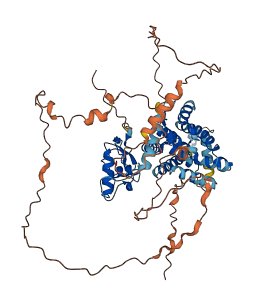
Descriptions
The autoinhibited protein was predicted that may have potential autoinhibitory elements via cis-regPred.
Autoinhibitory domains (AIDs)
Target domain |
|
Relief mechanism |
|
Assay |
cis-regPred |
Accessory elements
No accessory elements
Autoinhibited structure

Activated structure
1 structures for Q19345
| Entry ID | Method | Resolution | Chain | Position | Source |
|---|---|---|---|---|---|
| AF-Q19345-F1 | Predicted | AlphaFoldDB |
No variants for Q19345
| Variant ID(s) | Position | Change | Description | Diseaes Association | Provenance |
|---|---|---|---|---|---|
| No variants for Q19345 | |||||
No associated diseases with Q19345
2 GO annotations of cellular component
| Name | Definition |
|---|---|
| nucleus | A membrane-bounded organelle of eukaryotic cells in which chromosomes are housed and replicated. In most cells, the nucleus contains all of the cell's chromosomes except the organellar chromosomes, and is the site of RNA synthesis and processing. In some species, or in specialized cell types, RNA metabolism or DNA replication may be absent. |
| RNA polymerase II transcription regulator complex | A transcription factor complex that acts at a regulatory region of a gene transcribed by RNA polymerase II. |
4 GO annotations of molecular function
| Name | Definition |
|---|---|
| armadillo repeat domain binding | Binding to an armadillo repeat domain, an approximately 40 amino acid long tandemly repeated sequence motif first identified in the Drosophila segment polarity protein armadillo. Arm-repeat proteins are involved in various processes, including intracellular signalling and cytoskeletal regulation. |
| nuclear receptor activity | A DNA-binding transcription factor activity regulated by binding to a ligand that modulates the transcription of specific gene sets transcribed by RNA polymerase II. Nuclear receptor ligands are usually lipid-based (such as a steroid hormone) and the binding of the ligand to its receptor often occurs in the cytoplasm, which leads to its tranlocation to the nucleus. |
| RNA polymerase II cis-regulatory region sequence-specific DNA binding | Binding to a specific upstream regulatory DNA sequence (transcription factor recognition sequence or binding site) located in cis relative to the transcription start site (i.e., on the same strand of DNA) of a gene transcribed by RNA polymerase II. |
| zinc ion binding | Binding to a zinc ion (Zn). |
6 GO annotations of biological process
| Name | Definition |
|---|---|
| hormone-mediated signaling pathway | The series of molecular signals mediated by the detection of a hormone. |
| molting cycle, collagen and cuticulin-based cuticle | The periodic shedding of part or all of a collagen and cuticulin-based cuticle, which is then replaced by a new collagen and cuticulin-based cuticle. An example of this is found in the Nematode worm, Caenorhabditis elegans. |
| positive regulation of nematode male tail tip morphogenesis | Any process that activates or increases the frequency, rate or extent of nematode male tail tip morphogenesis. |
| positive regulation of transcription by RNA polymerase II | Any process that activates or increases the frequency, rate or extent of transcription from an RNA polymerase II promoter. |
| regulation of transcription by RNA polymerase II | Any process that modulates the frequency, rate or extent of transcription mediated by RNA polymerase II. |
| tissue development | The process whose specific outcome is the progression of a tissue over time, from its formation to the mature structure. |
10 homologous proteins in AiPD
| UniProt AC | Gene Name | Protein Name | Species | Evidence Code |
|---|---|---|---|---|
| Q04752 | NR5A1 | Steroidogenic factor 1 | Bos taurus (Bovine) | PR |
| O42101 | NR5A2 | Nuclear receptor subfamily 5 group A member 2 | Gallus gallus (Chicken) | PR |
| Q9GKL2 | NR5A1 | Steroidogenic factor 1 | Equus caballus (Horse) | PR |
| Q13285 | NR5A1 | Steroidogenic factor 1 | Homo sapiens (Human) | PR |
| O00482 | NR5A2 | Nuclear receptor subfamily 5 group A member 2 | Homo sapiens (Human) | PR |
| P45448 | Nr5a2 | Nuclear receptor subfamily 5 group A member 2 | Mus musculus (Mouse) | PR |
| P33242 | Nr5a1 | Steroidogenic factor 1 | Mus musculus (Mouse) | PR |
| P79387 | NR5A1 | Steroidogenic factor 1 | Sus scrofa (Pig) | PR |
| Q9QWM1 | Nr5a2 | Nuclear receptor subfamily 5 group A member 2 | Rattus norvegicus (Rat) | PR |
| P50569 | Nr5a1 | Steroidogenic factor 1 | Rattus norvegicus (Rat) | PR |
| 10 | 20 | 30 | 40 | 50 | 60 |
| MTDVERMVLR | PNHEGEMCPV | CGDRVSGYHY | GLLTCESCKG | FFKRTVQNKK | QYQCSAEANC |
| 70 | 80 | 90 | 100 | 110 | 120 |
| HVDRTCRKRC | PSCRFQKCLT | MGMKMEAVRA | DRMRGGRNKF | GSFYKKDRAH | RMQRNAMRVS |
| 130 | 140 | 150 | 160 | 170 | 180 |
| TVQVPAVLGA | QSQAQTFYQP | PEHQVSSSTT | DQNNQINYFD | QTKIKTEYIK | TEYDAHLQSP |
| 190 | 200 | 210 | 220 | 230 | 240 |
| TLSSSTNQQL | SVSDFIMRPG | YLVDPQDSLA | VLLGSTIDDP | LLRHTFPAAY | QLNEVKQEPF |
| 250 | 260 | 270 | 280 | 290 | 300 |
| DYSEQFIHHS | LHDYPTYTSN | TTNYATMMPM | TTVSSTQSLV | TSTSSTTTGR | MTEASSTSPI |
| 310 | 320 | 330 | 340 | 350 | 360 |
| LPLCPAPTEK | TVDHFYNSSI | AEMCKTLPDD | AQIARIFTSV | KGTSKPEKHA | FSIQVAEENL |
| 370 | 380 | 390 | 400 | 410 | 420 |
| KDIVIWAKND | QLFSKLSLDD | QMILLQTSWT | TVHIVDITNA | MVHGNLLSQY | KMSNGDEVPV |
| 430 | 440 | 450 | 460 | 470 | 480 |
| GLVALLGNQT | FVSSWNDVVI | RLRNMGFTNF | DYCAFRFLAL | FDQSMDSFPA | VSTARSRVLQ |
| 490 | 500 | 510 | 520 | 530 | 540 |
| SWREVRCTTA | FLEIFEQIRR | LAYDSLRYLW | NLHSNCPTNW | EQFFPEASLV | LEMIRTTVNR |
| 550 | 560 | 570 | |||
| SASSSVTAIT | QVPAIQLPTP | QATYTAVPYM | AS |