P33242
Gene name |
Nr5a1 (Ftzf1) |
Protein name |
Steroidogenic factor 1 |
Names |
SF-1, STF-1, Adrenal 4-binding protein, Embryonal LTR-binding protein, ELP, Embryonal long terminal repeat-binding protein, Fushi tarazu factor homolog 1, Nuclear receptor subfamily 5 group A member 1, Steroid hormone receptor Ad4BP, Steroid hydroxylase positive regulator |
Species |
Mus musculus (Mouse) |
KEGG Pathway |
mmu:26423 |
EC number |
|
Protein Class |
|
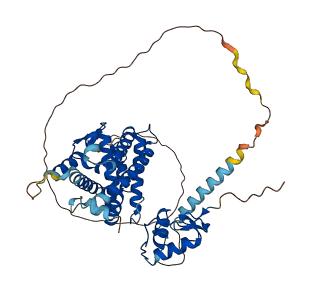
Descriptions
The autoinhibited protein was predicted that may have potential autoinhibitory elements via cis-regPred.
Autoinhibitory domains (AIDs)
Target domain |
|
Relief mechanism |
|
Assay |
cis-regPred |
Accessory elements
No accessory elements
Autoinhibited structure

Activated structure
5 structures for P33242
| Entry ID | Method | Resolution | Chain | Position | Source |
|---|---|---|---|---|---|
| 1YMT | X-ray | 120 A | A | 219-462 | PDB |
| 1YP0 | X-ray | 150 A | A | 223-461 | PDB |
| 2FF0 | NMR | - | A | 10-111 | PDB |
| 3F7D | X-ray | 220 A | A | 219-462 | PDB |
| AF-P33242-F1 | Predicted | AlphaFoldDB |
24 variants for P33242
| Variant ID(s) | Position | Change | Description | Diseaes Association | Provenance |
|---|---|---|---|---|---|
| rs3388544851 | 61 | Q>* | No | EVA | |
| rs3388551837 | 92 | R>P | No | EVA | |
| rs3388551580 | 93 | N>S | No | EVA | |
| rs3388551836 | 100 | K>M | No | EVA | |
| rs3388547619 | 137 | D>E | No | EVA | |
| rs3388542990 | 158 | S>R | No | EVA | |
| rs3388547342 | 167 | P>T | No | EVA | |
| rs3388547589 | 170 | P>H | No | EVA | |
| rs3142929 | 172 | A>S | strain: C3H/HeJ and DBA/2J; does not change transcriptional activity [UniProt] | No | EVA |
| rs3388544790 | 198 | P>L | No | EVA | |
| rs3388547349 | 202 | A>V | No | EVA | |
| rs3388542271 | 214 | Y>H | No | EVA | |
| rs16819535 | 217 | P>S | No | EVA | |
| rs3388548387 | 259 | Q>* | No | EVA | |
| rs3388552437 | 287 | F>L | No | EVA | |
| rs3391496776 | 322 | D>A | No | EVA | |
| rs3391428440 | 322 | D>N | No | EVA | |
| rs3391473974 | 324 | I>M | No | EVA | |
| rs3391478555 | 324 | I>S | No | EVA | |
| rs3391527476 | 325 | L>M | No | EVA | |
| rs3388549954 | 362 | L>M | No | EVA | |
| rs3388548414 | 367 | Q>K | No | EVA | |
| rs3388546151 | 415 | D>N | No | EVA | |
| rs3388548474 | 423 | C>Y | No | EVA |
No associated diseases with P33242
4 GO annotations of cellular component
| Name | Definition |
|---|---|
| cytosol | The part of the cytoplasm that does not contain organelles but which does contain other particulate matter, such as protein complexes. |
| nucleoplasm | That part of the nuclear content other than the chromosomes or the nucleolus. |
| nucleus | A membrane-bounded organelle of eukaryotic cells in which chromosomes are housed and replicated. In most cells, the nucleus contains all of the cell's chromosomes except the organellar chromosomes, and is the site of RNA synthesis and processing. In some species, or in specialized cell types, RNA metabolism or DNA replication may be absent. |
| RNA polymerase II transcription regulator complex | A transcription factor complex that acts at a regulatory region of a gene transcribed by RNA polymerase II. |
14 GO annotations of molecular function
| Name | Definition |
|---|---|
| chromatin binding | Binding to chromatin, the network of fibers of DNA, protein, and sometimes RNA, that make up the chromosomes of the eukaryotic nucleus during interphase. |
| DNA binding | Any molecular function by which a gene product interacts selectively and non-covalently with DNA (deoxyribonucleic acid). |
| DNA-binding transcription factor activity | A transcription regulator activity that modulates transcription of gene sets via selective and non-covalent binding to a specific double-stranded genomic DNA sequence (sometimes referred to as a motif) within a cis-regulatory region. Regulatory regions include promoters (proximal and distal) and enhancers. Genes are transcriptional units, and include bacterial operons. |
| DNA-binding transcription factor activity, RNA polymerase II-specific | A DNA-binding transcription factor activity that modulates the transcription of specific gene sets transcribed by RNA polymerase II. |
| double-stranded DNA binding | Binding to double-stranded DNA. |
| enzyme binding | Binding to an enzyme, a protein with catalytic activity. |
| nuclear receptor activity | A DNA-binding transcription factor activity regulated by binding to a ligand that modulates the transcription of specific gene sets transcribed by RNA polymerase II. Nuclear receptor ligands are usually lipid-based (such as a steroid hormone) and the binding of the ligand to its receptor often occurs in the cytoplasm, which leads to its tranlocation to the nucleus. |
| phospholipid binding | Binding to a phospholipid, a class of lipids containing phosphoric acid as a mono- or diester. |
| RNA polymerase II cis-regulatory region sequence-specific DNA binding | Binding to a specific upstream regulatory DNA sequence (transcription factor recognition sequence or binding site) located in cis relative to the transcription start site (i.e., on the same strand of DNA) of a gene transcribed by RNA polymerase II. |
| RNA polymerase II transcription regulatory region sequence-specific DNA binding | Binding to a specific sequence of DNA that is part of a regulatory region that controls the transcription of a gene or cistron by RNA polymerase II. |
| sequence-specific DNA binding | Binding to DNA of a specific nucleotide composition, e.g. GC-rich DNA binding, or with a specific sequence motif or type of DNA e.g. promotor binding or rDNA binding. |
| sequence-specific double-stranded DNA binding | Binding to double-stranded DNA of a specific nucleotide composition, e.g. GC-rich DNA binding, or with a specific sequence motif or type of DNA, e.g. promotor binding or rDNA binding. |
| transcription coregulator binding | Binding to a transcription coregulator, a protein involved in regulation of transcription via protein-protein interactions with transcription factors and other transcription regulatory proteins. Cofactors do not bind DNA directly, but rather mediate protein-protein interactions between regulatory transcription factors and the basal transcription machinery. |
| zinc ion binding | Binding to a zinc ion (Zn). |
24 GO annotations of biological process
| Name | Definition |
|---|---|
| adrenal gland development | The process whose specific outcome is the progression of the adrenal gland over time, from its formation to the mature structure. This gland can either be a discrete structure located bilaterally above each kidney, or a cluster of cells in the head kidney that perform the functions of the adrenal gland. In either case, this organ consists of two cells types, aminergic chromaffin cells and steroidogenic cortical cells. |
| calcineurin-mediated signaling | Any intracellular signal transduction in which the signal is passed on within the cell by activation of a transcription factor as a consequence of dephosphorylation by Ca(2+)-activated calcineurin. The process begins with calcium-dependent activation of the phosphatase calcineurin. Calcineurin is a calcium- and calmodulin-dependent serine/threonine protein phosphatase with a conserved function in eukaryotic species from yeast to humans. In yeast and fungi, calcineurin regulates stress signaling and cell cycle, and sporulation and virulence in pathogenic fungi. In metazoans, calcineurin is involved in cell commitment, organogenesis and organ development and immune function of T-lymphocytes. By a conserved mechanism, calcineurin phosphatase activates fungal Crz1 and mammalian NFATc by dephosphorylation and translocation of these transcription factors to the nucleus to regulate gene expression. |
| female gonad development | The process whose specific outcome is the progression of the female gonad over time, from its formation to the mature structure. |
| hormone metabolic process | The chemical reactions and pathways involving any hormone, naturally occurring substances secreted by specialized cells that affects the metabolism or behavior of other cells possessing functional receptors for the hormone. |
| hormone-mediated signaling pathway | The series of molecular signals mediated by the detection of a hormone. |
| Leydig cell differentiation | The process in which a relatively unspecialized cell acquires specialized structural and/or functional features of a Leydig cell. A Leydig cell is a testosterone-secreting cell in the interstitial area, between the seminiferous tubules, in the testis. |
| luteinization | The set of processes resulting in differentiation of theca and granulosa cells into luteal cells and in the formation of a corpus luteum after ovulation. |
| maintenance of protein location in nucleus | Any process in which a protein is maintained in the nucleus and prevented from moving elsewhere. These include sequestration within the nucleus, protein stabilization to prevent transport elsewhere and the active retrieval of proteins that escape the nucleus. |
| male gonad development | The process whose specific outcome is the progression of the male gonad over time, from its formation to the mature structure. |
| male sex determination | The specification of male sex of an individual organism. |
| multicellular organism aging | An aging process that has as participant a whole multicellular organism. Multicellular organism aging includes loss of functions such as resistance to disease, homeostasis, and fertility, as well as wear and tear. Multicellular organisms aging includes processes like cellular senescence and organ senescence, but is more inclusive. May precede death (GO:0016265) of an organism and may succeed developmental maturation (GO:0021700). |
| negative regulation of female gonad development | Any process that stops, prevents, or reduces the frequency, rate or extent of female gonad development. |
| positive regulation of DNA-templated transcription | Any process that activates or increases the frequency, rate or extent of cellular DNA-templated transcription. |
| positive regulation of gene expression | Any process that increases the frequency, rate or extent of gene expression. Gene expression is the process in which a gene's coding sequence is converted into a mature gene product (protein or RNA). |
| positive regulation of male gonad development | Any process that activates or increases the frequency, rate or extent of male gonad development. |
| positive regulation of transcription by RNA polymerase II | Any process that activates or increases the frequency, rate or extent of transcription from an RNA polymerase II promoter. |
| regulation of DNA-templated transcription | Any process that modulates the frequency, rate or extent of cellular DNA-templated transcription. |
| regulation of transcription by RNA polymerase II | Any process that modulates the frequency, rate or extent of transcription mediated by RNA polymerase II. |
| reproductive process | A biological process that directly contributes to the process of producing new individuals by one or two organisms. The new individuals inherit some proportion of their genetic material from the parent or parents. |
| response to gonadotropin-releasing hormone | Any process that results in a change in state or activity of a cell or an organism (in terms of movement, secretion, enzyme production, gene expression, etc.) as a result of a gonadotropin-releasing hormone stimulus. Gonadotropin-releasing hormone (GnRH) is a peptide hormone responsible for the release of follicle-stimulating hormone (FSH) and luteinizing hormone (LH) from the anterior pituitary. GnRH is synthesized and released by the hypothalamus. |
| Sertoli cell differentiation | The process in which a relatively unspecialized cell acquires specialized structural and/or functional features of a Sertoli cell. A Sertoli cell is a supporting cell projecting inward from the basement membrane of seminiferous tubules. |
| sex determination | Any process that establishes and transmits the specification of sexual status of an individual organism. |
| tissue development | The process whose specific outcome is the progression of a tissue over time, from its formation to the mature structure. |
| transcription by RNA polymerase II | The synthesis of RNA from a DNA template by RNA polymerase II (RNAP II), originating at an RNA polymerase II promoter. Includes transcription of messenger RNA (mRNA) and certain small nuclear RNAs (snRNAs). |
10 homologous proteins in AiPD
| UniProt AC | Gene Name | Protein Name | Species | Evidence Code |
|---|---|---|---|---|
| Q04752 | NR5A1 | Steroidogenic factor 1 | Bos taurus (Bovine) | PR |
| O42101 | NR5A2 | Nuclear receptor subfamily 5 group A member 2 | Gallus gallus (Chicken) | PR |
| Q9GKL2 | NR5A1 | Steroidogenic factor 1 | Equus caballus (Horse) | PR |
| O00482 | NR5A2 | Nuclear receptor subfamily 5 group A member 2 | Homo sapiens (Human) | PR |
| Q13285 | NR5A1 | Steroidogenic factor 1 | Homo sapiens (Human) | PR |
| P45448 | Nr5a2 | Nuclear receptor subfamily 5 group A member 2 | Mus musculus (Mouse) | PR |
| P79387 | NR5A1 | Steroidogenic factor 1 | Sus scrofa (Pig) | PR |
| Q9QWM1 | Nr5a2 | Nuclear receptor subfamily 5 group A member 2 | Rattus norvegicus (Rat) | PR |
| P50569 | Nr5a1 | Steroidogenic factor 1 | Rattus norvegicus (Rat) | PR |
| Q19345 | nhr-25 | Nuclear hormone receptor family member nhr-25 | Caenorhabditis elegans | PR |
| 10 | 20 | 30 | 40 | 50 | 60 |
| MDYSYDEDLD | ELCPVCGDKV | SGYHYGLLTC | ESCKGFFKRT | VQNNKHYTCT | ESQSCKIDKT |
| 70 | 80 | 90 | 100 | 110 | 120 |
| QRKRCPFCRF | QKCLTVGMRL | EAVRADRMRG | GRNKFGPMYK | RDRALKQQKK | AQIRANGFKL |
| 130 | 140 | 150 | 160 | 170 | 180 |
| ETGPPMGVPP | PPPPPPDYML | PPSLHAPEPK | ALVSGPPSGP | LGDFGAPSLP | MAVPGPHGPL |
| 190 | 200 | 210 | 220 | 230 | 240 |
| AGYLYPAFSN | RTIKSEYPEP | YASPPQQPGP | PYSYPEPFSG | GPNVPELILQ | LLQLEPEEDQ |
| 250 | 260 | 270 | 280 | 290 | 300 |
| VRARIVGCLQ | EPAKSRSDQP | APFSLLCRMA | DQTFISIVDW | ARRCMVFKEL | EVADQMTLLQ |
| 310 | 320 | 330 | 340 | 350 | 360 |
| NCWSELLVLD | HIYRQVQYGK | EDSILLVTGQ | EVELSTVAVQ | AGSLLHSLVL | RAQELVLQLH |
| 370 | 380 | 390 | 400 | 410 | 420 |
| ALQLDRQEFV | CLKFLILFSL | DVKFLNNHSL | VKDAQEKANA | ALLDYTLCHY | PHCGDKFQQL |
| 430 | 440 | 450 | 460 | ||
| LLCLVEVRAL | SMQAKEYLYH | KHLGNEMPRN | NLLIEMLQAK | QT |