Q08351
Gene name |
Mpl (Tpor) |
Protein name |
Thrombopoietin receptor |
Names |
|
Species |
Mus musculus (Mouse) |
KEGG Pathway |
mmu:17480 |
EC number |
|
Protein Class |
|
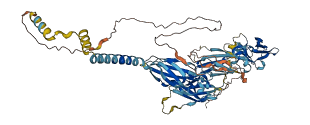
Descriptions
The autoinhibited protein was predicted that may have potential autoinhibitory elements via cis-regPred.
Autoinhibitory domains (AIDs)
Target domain |
|
Relief mechanism |
|
Assay |
cis-regPred |
Accessory elements
No accessory elements
Autoinhibited structure

Activated structure
2 structures for Q08351
| Entry ID | Method | Resolution | Chain | Position | Source |
|---|---|---|---|---|---|
| 8U18 | EM | 360 A | A/B | 26-482 | PDB |
| AF-Q08351-F1 | Predicted | AlphaFoldDB |
45 variants for Q08351
| Variant ID(s) | Position | Change | Description | Diseaes Association | Provenance |
|---|---|---|---|---|---|
| rs3388702143 | 52 | W>S | No | EVA | |
| rs3388708036 | 58 | A>T | No | EVA | |
| rs3388695429 | 90 | R>W | No | EVA | |
| rs3388695437 | 96 | P>S | No | EVA | |
| rs3388706239 | 98 | Q>K | No | EVA | |
| rs3394220774 | 137 | R>W | No | EVA | |
| rs3394220775 | 146 | Q>H | No | EVA | |
| rs3394710714 | 146 | Q>L | No | EVA | |
| rs3394220742 | 148 | G>V | No | EVA | |
| rs3394485342 | 149 | E>D | No | EVA | |
| rs3394778764 | 151 | Q>K | No | EVA | |
| rs3394756968 | 152 | I>F | No | EVA | |
| rs3388707360 | 153 | H>N | No | EVA | |
| rs3394756987 | 153 | H>P | No | EVA | |
| rs3394778788 | 155 | E>* | No | EVA | |
| rs3394757008 | 155 | E>V | No | EVA | |
| rs255425955 | 179 | A>T | No | EVA | |
| rs3388706288 | 194 | C>W | No | EVA | |
| rs3394472844 | 197 | L>* | No | EVA | |
| rs3394756996 | 197 | L>M | No | EVA | |
| rs3388691788 | 205 | V>F | No | EVA | |
| rs212516431 | 218 | Q>H | No | EVA | |
| rs250145356 | 221 | G>E | No | EVA | |
| rs27478930 | 241 | G>S | No | EVA | |
| rs212174532 | 271 | D>N | No | EVA | |
| rs27478931 | 275 | D>N | No | EVA | |
| rs3388699063 | 301 | T>I | No | EVA | |
| rs3388695406 | 343 | C>Y | No | EVA | |
| rs3388702073 | 356 | L>I | No | EVA | |
| rs216812986 | 362 | A>E | No | EVA | |
| rs3388707991 | 383 | P>H | No | EVA | |
| rs3388707988 | 424 | E>V | No | EVA | |
| rs3388708018 | 438 | G>R | No | EVA | |
| rs3388710927 | 458 | G>D | No | EVA | |
| rs3388707350 | 496 | S>N | No | EVA | |
| rs3388707361 | 509 | P>H | No | EVA | |
| rs1131740603 | 514 | R>* | No | EVA | |
| rs222923982 | 549 | D>N | No | EVA | |
| rs27495468 | 556 | P>T | No | EVA | |
| rs3388703937 | 558 | L>P | No | EVA | |
| rs3394734641 | 574 | C>* | No | EVA | |
| rs3394802770 | 579 | Q>E | No | EVA | |
| rs3394472812 | 580 | M>V | No | EVA | |
| rs258247637 | 601 | A>T | No | EVA | |
| rs13477939 | 625 | P>S | No | EVA |
No associated diseases with Q08351
4 regional properties for Q08351
| Type | Name | Position | InterPro Accession |
|---|---|---|---|
| conserved_site | Long hematopoietin receptor, single chain, conserved site | 397 - 474 | IPR003528 |
| domain | Fibronectin type III | 133 - 256 | IPR003961-1 |
| domain | Fibronectin type III | 381 - 479 | IPR003961-2 |
| domain | Growth hormone/erythropoietin receptor, ligand binding | 26 - 128 | IPR015152 |
8 GO annotations of cellular component
| Name | Definition |
|---|---|
| cell surface | The external part of the cell wall and/or plasma membrane. |
| external side of plasma membrane | The leaflet of the plasma membrane that faces away from the cytoplasm and any proteins embedded or anchored in it or attached to its surface. |
| Golgi apparatus | A membrane-bound cytoplasmic organelle of the endomembrane system that further processes the core oligosaccharides (e.g. N-glycans) added to proteins in the endoplasmic reticulum and packages them into membrane-bound vesicles. The Golgi apparatus operates at the intersection of the secretory, lysosomal, and endocytic pathways. |
| integral component of membrane | The component of a membrane consisting of the gene products and protein complexes having at least some part of their peptide sequence embedded in the hydrophobic region of the membrane. |
| neuron projection | A prolongation or process extending from a nerve cell, e.g. an axon or dendrite. |
| neuronal cell body | The portion of a neuron that includes the nucleus, but excludes cell projections such as axons and dendrites. |
| nuclear membrane | Either of the lipid bilayers that surround the nucleus and form the nuclear envelope; excludes the intermembrane space. |
| plasma membrane | The membrane surrounding a cell that separates the cell from its external environment. It consists of a phospholipid bilayer and associated proteins. |
2 GO annotations of molecular function
| Name | Definition |
|---|---|
| cytokine receptor activity | Combining with a cytokine and transmitting the signal from one side of the membrane to the other to initiate a change in cell activity. |
| thrombopoietin receptor activity | Combining with the glycoprotein thrombopoietin and transmitting the signal from one side of the membrane to the other to initiate a change in cell activity. |
18 GO annotations of biological process
| Name | Definition |
|---|---|
| basophil homeostasis | The process of regulating the proliferation and elimination of basophils such that the total number of basophils within a whole or part of an organism is stable over time in the absence of an outside stimulus. |
| cytokine-mediated signaling pathway | The series of molecular signals initiated by the binding of a cytokine to a receptor on the surface of a cell, and ending with the regulation of a downstream cellular process, e.g. transcription. |
| definitive hemopoiesis | A second wave of blood cell production that, in vertebrates, generates long-term hemopoietic stem cells that continously provide erythroid, myeloid and lymphoid lineages throughout adulthood. |
| eosinophil homeostasis | The process of regulating the proliferation and elimination of eosinophils such that the total number of eosinophils within a whole or part of an organism is stable over time in the absence of an outside stimulus. |
| hemopoiesis | The process whose specific outcome is the progression of the myeloid and lymphoid derived organ/tissue systems of the blood and other parts of the body over time, from formation to the mature structure. The site of hemopoiesis is variable during development, but occurs primarily in bone marrow or kidney in many adult vertebrates. |
| homeostasis of number of cells | Any biological process involved in the maintenance of the steady-state number of cells within a population of cells. |
| monocyte homeostasis | The process of regulating the proliferation and elimination of monocytes such that the total number of monocytes within a whole or part of an organism is stable over time in the absence of an outside stimulus. |
| negative regulation of apoptotic process | Any process that stops, prevents, or reduces the frequency, rate or extent of cell death by apoptotic process. |
| neutrophil homeostasis | The process of regulating the proliferation and elimination of neutrophils such that the total number of neutrophils within a whole or part of an organism is stable over time in the absence of an outside stimulus. |
| platelet formation | The process in which platelets bud from long processes extended by megakaryocytes. |
| positive regulation of cell population proliferation | Any process that activates or increases the rate or extent of cell proliferation. |
| positive regulation of gene expression | Any process that increases the frequency, rate or extent of gene expression. Gene expression is the process in which a gene's coding sequence is converted into a mature gene product (protein or RNA). |
| positive regulation of lymphocyte proliferation | Any process that activates or increases the rate or extent of lymphocyte proliferation. |
| positive regulation of platelet formation | Any process that activates or increases the frequency, rate or extent of platelet formation. |
| regulation of chemokine production | Any process that modulates the frequency, rate, or extent of chemokine production. |
| regulation of stem cell division | Any process that modulates the frequency, rate or extent of stem cell division. |
| regulation of stem cell proliferation | Any process that modulates the frequency, rate or extent of stem cell proliferation. A stem cell is a cell that retains the ability to divide and proliferate throughout life to provide progenitor cells that can differentiate into specialized cells. |
| thrombopoietin-mediated signaling pathway | The series of molecular signals initiated by thrombopoietin binding to its receptor on the surface of a target cell, and ending with the regulation of a downstream cellular process, e.g. transcription. |
6 homologous proteins in AiPD
| UniProt AC | Gene Name | Protein Name | Species | Evidence Code |
|---|---|---|---|---|
| P19235 | EPOR | Erythropoietin receptor | Homo sapiens (Human) | PR |
| P14753 | Epor | Erythropoietin receptor | Mus musculus (Mouse) | PR |
| P26954 | Csf2rb2 | Interleukin-3 receptor class 2 subunit beta | Mus musculus (Mouse) | PR |
| P26955 | Csf2rb | Cytokine receptor common subunit beta | Mus musculus (Mouse) | PR |
| Q01114 | Il9r | Interleukin-9 receptor | Mus musculus (Mouse) | PR |
| Q9MYZ9 | EPOR | Erythropoietin receptor | Sus scrofa (Pig) | PR |
| 10 | 20 | 30 | 40 | 50 | 60 |
| MPSWALFMVT | SCLLLALPNQ | AQVTSQDVFL | LALGTEPLNC | FSQTFEDLTC | FWDEEEAAPS |
| 70 | 80 | 90 | 100 | 110 | 120 |
| GTYQLLYAYR | GEKPRACPLY | SQSVPTFGTR | YVCQFPAQDE | VRLFFPLHLW | VKNVSLNQTL |
| 130 | 140 | 150 | 160 | 170 | 180 |
| IQRVLFVDSV | GLPAPPRVIK | ARGGSQPGEL | QIHWEAPAPE | ISDFLRHELR | YGPTDSSNAT |
| 190 | 200 | 210 | 220 | 230 | 240 |
| APSVIQLLST | ETCCPTLWMP | NPVPVLDQPP | CVHPTASQPH | GPAPFLTVKG | GSCLVSGLQA |
| 250 | 260 | 270 | 280 | 290 | 300 |
| GKSYWLQLRS | QPDGVSLRGS | WGPWSFPVTV | DLPGDAVTIG | LQCFTLDLKM | VTCQWQQQDR |
| 310 | 320 | 330 | 340 | 350 | 360 |
| TSSQGFFRHS | RTRCCPTDRD | PTWEKCEEEE | PRPGSQPALV | SRCHFKSRND | SVIHILVEVT |
| 370 | 380 | 390 | 400 | 410 | 420 |
| TAQGAVHSYL | GSPFWIHQAV | LLPTPSLHWR | EVSSGRLELE | WQHQSSWAAQ | ETCYQLRYTG |
| 430 | 440 | 450 | 460 | 470 | 480 |
| EGREDWKVLE | PSLGARGGTL | ELRPRARYSL | QLRARLNGPT | YQGPWSAWSP | PARVSTGSET |
| 490 | 500 | 510 | 520 | 530 | 540 |
| AWITLVTALL | LVLSLSALLG | LLLLKWQFPA | HYRRLRHALW | PSLPDLHRVL | GQYLRDTAAL |
| 550 | 560 | 570 | 580 | 590 | 600 |
| SPSKATVTDS | CEEVEPSLLE | ILPKSSESTP | LPLCPSQPQM | DYRGLQPCLR | TMPLSVCPPM |
| 610 | 620 | ||||
| AETGSCCTTH | IANHSYLPLS | YWQQP |