P97629
Gene name |
Lnpep (Irap, Otase) |
Protein name |
Leucyl-cystinyl aminopeptidase |
Names |
Cystinyl aminopeptidase, GP160, Insulin-regulated membrane aminopeptidase, Insulin-responsive aminopeptidase, IRAP, Oxytocinase, OTase, Placental leucine aminopeptidase, P-LAP, Vesicle protein of 165 kDa, Vp165 |
Species |
Rattus norvegicus (Rat) |
KEGG Pathway |
rno:171105 |
EC number |
3.4.11.3: Aminopeptidases |
Protein Class |
|
Descriptions
The autoinhibited protein was predicted that may have potential autoinhibitory elements via cis-regPred.
Autoinhibitory domains (AIDs)
Target domain |
|
Relief mechanism |
|
Assay |
cis-regPred |
Accessory elements
No accessory elements
Autoinhibited structure

Activated structure
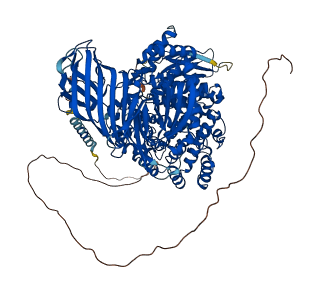
1 structures for P97629
| Entry ID | Method | Resolution | Chain | Position | Source |
|---|---|---|---|---|---|
| AF-P97629-F1 | Predicted | AlphaFoldDB |
2 variants for P97629
| Variant ID(s) | Position | Change | Description | Diseaes Association | Provenance |
|---|---|---|---|---|---|
| rs8174502 | 212 | T>A | No | EVA | |
| rs199074439 | 583 | A>T | No | EVA |
No associated diseases with P97629
Functions
| Description | ||
|---|---|---|
| EC Number | 3.4.11.3 | Aminopeptidases |
| Subcellular Localization |
|
|
| PANTHER Family | ||
| PANTHER Subfamily | ||
| PANTHER Protein Class | ||
| PANTHER Pathway Category | No pathway information available | |
12 GO annotations of cellular component
| Name | Definition |
|---|---|
| cell surface | The external part of the cell wall and/or plasma membrane. |
| cytoplasm | The contents of a cell excluding the plasma membrane and nucleus, but including other subcellular structures. |
| cytoplasmic vesicle membrane | The lipid bilayer surrounding a cytoplasmic vesicle. |
| insulin-responsive compartment | A small membrane-bounded vesicle that releases its contents by exocytosis in response to insulin stimulation; the contents are enriched in GLUT4, IRAP and VAMP2. |
| integral component of plasma membrane | The component of the plasma membrane consisting of the gene products and protein complexes having at least some part of their peptide sequence embedded in the hydrophobic region of the membrane. |
| intracellular membrane-bounded organelle | Organized structure of distinctive morphology and function, bounded by a single or double lipid bilayer membrane and occurring within the cell. Includes the nucleus, mitochondria, plastids, vacuoles, and vesicles. Excludes the plasma membrane. |
| intracellular organelle | Organized structure of distinctive morphology and function, occurring within the cell. Includes the nucleus, mitochondria, plastids, vacuoles, vesicles, ribosomes and the cytoskeleton. Excludes the plasma membrane. |
| membrane | A lipid bilayer along with all the proteins and protein complexes embedded in it an attached to it. |
| neuronal cell body | The portion of a neuron that includes the nucleus, but excludes cell projections such as axons and dendrites. |
| perinuclear region of cytoplasm | Cytoplasm situated near, or occurring around, the nucleus. |
| plasma membrane | The membrane surrounding a cell that separates the cell from its external environment. It consists of a phospholipid bilayer and associated proteins. |
| vesicle | Any small, fluid-filled, spherical organelle enclosed by membrane. |
4 GO annotations of molecular function
| Name | Definition |
|---|---|
| aminopeptidase activity | Catalysis of the hydrolysis of a single N-terminal amino acid residue from a polypeptide chain. |
| metalloaminopeptidase activity | Catalysis of the hydrolysis of a single N-terminal amino acid residue from a polypeptide chain by a mechanism in which water acts as a nucleophile, one or two metal ions hold the water molecule in place, and charged amino acid side chains are ligands for the metal ions. |
| peptide binding | Binding to a peptide, an organic compound comprising two or more amino acids linked by peptide bonds. |
| zinc ion binding | Binding to a zinc ion (Zn). |
11 GO annotations of biological process
| Name | Definition |
|---|---|
| negative regulation of cold-induced thermogenesis | Any process that stops, prevents, or reduces the rate of cold-induced thermogenesis. |
| neuropeptide catabolic process | The chemical reactions and pathways resulting in the breakdown of neuropeptides. Neuropeptides are signaling peptides that travel across a synaptic junction. |
| peptide catabolic process | The chemical reactions and pathways resulting in the breakdown of peptides, compounds of 2 or more (but usually less than 100) amino acids where the alpha carboxyl group of one is bound to the alpha amino group of another. |
| positive regulation of blood pressure | Any process in which the force of blood traveling through the circulatory system is increased. |
| protein catabolic process | The chemical reactions and pathways resulting in the breakdown of a protein by the destruction of the native, active configuration, with or without the hydrolysis of peptide bonds. |
| proteolysis | The hydrolysis of proteins into smaller polypeptides and/or amino acids by cleavage of their peptide bonds. |
| regulation of blood pressure | Any process that modulates the force with which blood travels through the circulatory system. The process is controlled by a balance of processes that increase pressure and decrease pressure. |
| regulation of long-term neuronal synaptic plasticity | A process that modulates long-term neuronal synaptic plasticity, the ability of neuronal synapses to change long-term as circumstances require. Long-term neuronal synaptic plasticity generally involves increase or decrease in actual synapse numbers. |
| response to hormone | Any process that results in a change in state or activity of a cell or an organism (in terms of movement, secretion, enzyme production, gene expression, etc.) as a result of a hormone stimulus. |
| signal transduction | The cellular process in which a signal is conveyed to trigger a change in the activity or state of a cell. Signal transduction begins with reception of a signal (e.g. a ligand binding to a receptor or receptor activation by a stimulus such as light), or for signal transduction in the absence of ligand, signal-withdrawal or the activity of a constitutively active receptor. Signal transduction ends with regulation of a downstream cellular process, e.g. regulation of transcription or regulation of a metabolic process. Signal transduction covers signaling from receptors located on the surface of the cell and signaling via molecules located within the cell. For signaling between cells, signal transduction is restricted to events at and within the receiving cell. |
| SMAD protein signal transduction | The cascade of processes by which a signal interacts with a receptor, causing a change in the activity of a SMAD protein, and ultimately effecting a change in the functioning of the cell. |
22 homologous proteins in AiPD
| UniProt AC | Gene Name | Protein Name | Species | Evidence Code |
|---|---|---|---|---|
| P40462 | TMA108 | Protein TMA108 | Saccharomyces cerevisiae (strain ATCC 204508 / S288c) (Baker's yeast) | PR |
| P32454 | APE2 | Aminopeptidase 2, mitochondrial | Saccharomyces cerevisiae (strain ATCC 204508 / S288c) (Baker's yeast) | PR |
| P79171 | ANPEP | Aminopeptidase N | Felis catus (Cat) (Felis silvestris catus) | PR |
| Q9UKU6 | TRHDE | Thyrotropin-releasing hormone-degrading ectoenzyme | Homo sapiens (Human) | PR |
| Q9NZ08 | ERAP1 | Endoplasmic reticulum aminopeptidase 1 | Homo sapiens (Human) | PR |
| P15144 | ANPEP | Aminopeptidase N | Homo sapiens (Human) | PR |
| P55786 | NPEPPS | Puromycin-sensitive aminopeptidase | Homo sapiens (Human) | PR |
| Q9UIQ6 | LNPEP | Leucyl-cystinyl aminopeptidase | Homo sapiens (Human) | PR |
| Q11011 | Npepps | Puromycin-sensitive aminopeptidase | Mus musculus (Mouse) | PR |
| Q8K093 | Trhde | Thyrotropin-releasing hormone-degrading ectoenzyme | Mus musculus (Mouse) | PR |
| P97449 | Anpep | Aminopeptidase N | Mus musculus (Mouse) | PR |
| Q9EQH2 | Erap1 | Endoplasmic reticulum aminopeptidase 1 | Mus musculus (Mouse) | PR |
| Q8C129 | Lnpep | Leucyl-cystinyl aminopeptidase | Mus musculus (Mouse) | PR |
| P15145 | ANPEP | Aminopeptidase N | Sus scrofa (Pig) | PR |
| Q9JJ22 | Erap1 | Endoplasmic reticulum aminopeptidase 1 | Rattus norvegicus (Rat) | PR |
| P15684 | Anpep | Aminopeptidase N | Rattus norvegicus (Rat) | PR |
| Q10836 | Trhde | Thyrotropin-releasing hormone-degrading ectoenzyme | Rattus norvegicus (Rat) | PR |
| Q0J5V5 | Os08g0398700 | Aminopeptidase M1-B | Oryza sativa subsp japonica (Rice) | PR |
| Q6Z6L4 | Os02g0218200 | Aminopeptidase M1-A | Oryza sativa subsp japonica (Rice) | PR |
| Q6K4E7 | Os09g0362800 | Aminopeptidase M1-D | Oryza sativa subsp japonica (Rice) | PR |
| Q17405 | AC3.5 | Aminopeptidase-like protein AC3.5 | Caenorhabditis elegans | PR |
| Q8VZH2 | APM1 | Aminopeptidase M1 | Arabidopsis thaliana (Mouse-ear cress) | PR |
| 10 | 20 | 30 | 40 | 50 | 60 |
| METFTNDRLQ | LPRNMIENSM | FEEEPDVVDL | AKEPCLHPLE | PDEVEYEPRG | SRLLVRGLGE |
| 70 | 80 | 90 | 100 | 110 | 120 |
| HEMDEDEEDY | ESSAKLLGMS | FMNRSSGLRN | SATGYRQSPD | GTCSVPSART | LVICVFVIVV |
| 130 | 140 | 150 | 160 | 170 | 180 |
| AVSVIMVIYL | LPRCTFTKEG | CHKTNQSAEL | IQPIATNGKV | FPWAQIRLPT | AIIPQRYELS |
| 190 | 200 | 210 | 220 | 230 | 240 |
| LHPNLTSMTF | RGSVTISLQA | LQDTRDIILH | STGHNISSVT | FMSAVSSQEK | QVEILEYPYH |
| 250 | 260 | 270 | 280 | 290 | 300 |
| EQIAVVAPES | LLTGHNYTLK | IEYSANISNS | YYGFYGITYT | DKSNEKKNFA | ATQFEPLAAR |
| 310 | 320 | 330 | 340 | 350 | 360 |
| SAFPCFDEPA | FKATFIIKIT | RDEHHTALSN | MPKKSSVPTE | EGLIQDEFSE | SVKMSTYLVA |
| 370 | 380 | 390 | 400 | 410 | 420 |
| FIVGEMRNLS | QDVNGTLVSV | YAVPEKIDQV | YHALDTTVKL | LEFYQNYFEI | QYPLKKLDLV |
| 430 | 440 | 450 | 460 | 470 | 480 |
| AIPDFEAGAM | ENWGLLTFRE | ETLLYDNATS | SVADRKLVTK | IIAHELAHQW | FGNLVTMQWW |
| 490 | 500 | 510 | 520 | 530 | 540 |
| NDLWLNEGFA | TFMEYFSVEK | IFKELNSYED | FLDARFKTMR | KDSLNSSHPI | SSSVQSSEQI |
| 550 | 560 | 570 | 580 | 590 | 600 |
| EEMFDSLSYF | KGASLLLMLK | SYLSEDVFQH | AIILYLHNHS | YAAIQSDDLW | DSFNEVTGKT |
| 610 | 620 | 630 | 640 | 650 | 660 |
| LDVKKMMKTW | TLQKGFPLVT | VQRKGTELLL | QQERFFPSMQ | PEIQDSDTSH | LWHIPISYVT |
| 670 | 680 | 690 | 700 | 710 | 720 |
| DGRNYSEYRS | VSLLDKKSDV | INLTEQVQWV | KVNTNMTGYY | IVHYAHDGWA | ALINQLKRNP |
| 730 | 740 | 750 | 760 | 770 | 780 |
| YVLSDKDRAN | LINNIFELAG | LGKVPLQMAF | DLIDYLRNET | HTAPITEALF | QTDLIYNLLE |
| 790 | 800 | 810 | 820 | 830 | 840 |
| KLGHMDLSSR | LVTRVHKLLQ | NQIQQQTWTD | EGTPSMRELR | SALLEFACAH | SLENCTTMAT |
| 850 | 860 | 870 | 880 | 890 | 900 |
| KLFDGWMASN | GTQSLPTDVM | TTVFKVGART | EKGWLFLFSM | YSSMGSEAEK | DKILEALASS |
| 910 | 920 | 930 | 940 | 950 | 960 |
| ADAHKLYWLM | KSSLDGDIIR | TQKLSLIIRT | VGRQFPGHLL | AWDFVKENWN | KLVHKFHLGS |
| 970 | 980 | 990 | 1000 | 1010 | 1020 |
| YTIQSIVAGS | THLFSTKTHL | SEVQEFFENQ | SEATLQLRCV | QEAFEVIELN | IQWMARNLKT |
| LTLWL |