P63100
Gene name |
Ppp3r1 (Cna2, Cnb) |
Protein name |
Calcineurin subunit B type 1 |
Names |
Protein phosphatase 2B regulatory subunit 1, Protein phosphatase 3 regulatory subunit B alpha isoform 1 |
Species |
Rattus norvegicus (Rat) |
KEGG Pathway |
rno:29748 |
EC number |
|
Protein Class |
|
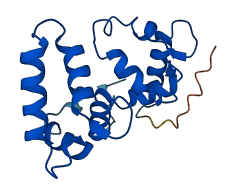
Descriptions
The autoinhibited protein was predicted that may have potential autoinhibitory elements via cis-regPred.
Autoinhibitory domains (AIDs)
Target domain |
|
Relief mechanism |
|
Assay |
cis-regPred |
Accessory elements
No accessory elements
Autoinhibited structure

Activated structure
2 structures for P63100
| Entry ID | Method | Resolution | Chain | Position | Source |
|---|---|---|---|---|---|
| 4IL1 | X-ray | 300 A | A/B/C/D | 2-170 | PDB |
| AF-P63100-F1 | Predicted | AlphaFoldDB |
No variants for P63100
| Variant ID(s) | Position | Change | Description | Diseaes Association | Provenance |
|---|---|---|---|---|---|
| No variants for P63100 | |||||
No associated diseases with P63100
5 regional properties for P63100
| Type | Name | Position | InterPro Accession |
|---|---|---|---|
| domain | EF-hand domain | 22 - 85 | IPR002048-1 |
| domain | EF-hand domain | 87 - 163 | IPR002048-2 |
| binding_site | EF-Hand 1, calcium-binding site | 63 - 75 | IPR018247-1 |
| binding_site | EF-Hand 1, calcium-binding site | 100 - 112 | IPR018247-2 |
| binding_site | EF-Hand 1, calcium-binding site | 141 - 153 | IPR018247-3 |
Functions
8 GO annotations of cellular component
| Name | Definition |
|---|---|
| calcineurin complex | A heterodimeric calcium ion and calmodulin dependent protein phosphatase composed of catalytic and regulatory subunits; the regulatory subunit is very similar in sequence to calmodulin. |
| cytosol | The part of the cytoplasm that does not contain organelles but which does contain other particulate matter, such as protein complexes. |
| glutamatergic synapse | A synapse that uses glutamate as a neurotransmitter. |
| parallel fiber to Purkinje cell synapse | An excitatory synapse formed by the parallel fibers of granule cells synapsing onto the dendrites of Purkinje cells. |
| postsynapse | The part of a synapse that is part of the post-synaptic cell. |
| sarcolemma | The outer membrane of a muscle cell, consisting of the plasma membrane, a covering basement membrane (about 100 nm thick and sometimes common to more than one fiber), and the associated loose network of collagen fibers. |
| Schaffer collateral - CA1 synapse | A synapse between the Schaffer collateral axon of a CA3 pyramidal cell and a CA1 pyramidal cell. |
| synapse | The junction between an axon of one neuron and a dendrite of another neuron, a muscle fiber or a glial cell. As the axon approaches the synapse it enlarges into a specialized structure, the presynaptic terminal bouton, which contains mitochondria and synaptic vesicles. At the tip of the terminal bouton is the presynaptic membrane; facing it, and separated from it by a minute cleft (the synaptic cleft) is a specialized area of membrane on the receiving cell, known as the postsynaptic membrane. In response to the arrival of nerve impulses, the presynaptic terminal bouton secretes molecules of neurotransmitters into the synaptic cleft. These diffuse across the cleft and transmit the signal to the postsynaptic membrane. |
7 GO annotations of molecular function
| Name | Definition |
|---|---|
| calcium ion binding | Binding to a calcium ion (Ca2+). |
| calcium-dependent protein serine/threonine phosphatase regulator activity | Binds to and modulates of the activity of the enzyme calcium-dependent protein serine/threonine phosphatase. |
| cyclosporin A binding | Binding to cyclosporin A, a cyclic undecapeptide that contains several N-methylated and unusual amino acids. |
| enzyme binding | Binding to an enzyme, a protein with catalytic activity. |
| phosphatase binding | Binding to a phosphatase. |
| phosphoprotein phosphatase activity | Catalysis of the reaction: a phosphoprotein + H2O = a protein + phosphate. Together with protein kinases, these enzymes control the state of phosphorylation of cellular proteins and thereby provide an important mechanism for regulating cellular activity. |
| protein domain specific binding | Binding to a specific domain of a protein. |
14 GO annotations of biological process
| Name | Definition |
|---|---|
| branching involved in blood vessel morphogenesis | The process of coordinated growth and sprouting of blood vessels giving rise to the organized vascular system. |
| calcineurin-mediated signaling | Any intracellular signal transduction in which the signal is passed on within the cell by activation of a transcription factor as a consequence of dephosphorylation by Ca(2+)-activated calcineurin. The process begins with calcium-dependent activation of the phosphatase calcineurin. Calcineurin is a calcium- and calmodulin-dependent serine/threonine protein phosphatase with a conserved function in eukaryotic species from yeast to humans. In yeast and fungi, calcineurin regulates stress signaling and cell cycle, and sporulation and virulence in pathogenic fungi. In metazoans, calcineurin is involved in cell commitment, organogenesis and organ development and immune function of T-lymphocytes. By a conserved mechanism, calcineurin phosphatase activates fungal Crz1 and mammalian NFATc by dephosphorylation and translocation of these transcription factors to the nucleus to regulate gene expression. |
| calcineurin-NFAT signaling cascade | Any intracellular signal transduction in which the signal is passed on within the cell by activation of a member of the NFAT protein family as a consequence of NFAT dephosphorylation by Ca(2+)-activated calcineurin. The cascade begins with calcium-dependent activation of the phosphatase calcineurin. Calcineurin dephosphorylates multiple phosphoserine residues on NFAT, resulting in the translocation of NFAT to the nucleus. The cascade ends with regulation of transcription by NFAT. The calcineurin-NFAT cascade lies downstream of many cell surface receptors, including G protein-coupled receptors (GPCRs) and receptor tyrosine kinases (RTKs) that signal to mobilize calcium ions (Ca2+). |
| epithelial to mesenchymal transition | A transition where an epithelial cell loses apical/basolateral polarity, severs intercellular adhesive junctions, degrades basement membrane components and becomes a migratory mesenchymal cell. |
| heart development | The process whose specific outcome is the progression of the heart over time, from its formation to the mature structure. The heart is a hollow, muscular organ, which, by contracting rhythmically, keeps up the circulation of the blood. |
| lung epithelial cell differentiation | The process in which a relatively unspecialized cell acquires specialized features of an epithelial cell that contributes to the epithelium of the lung. |
| myelination in peripheral nervous system | The process in which neuronal axons and dendrites become coated with a segmented lipid-rich sheath (myelin) to enable faster and more energetically efficient conduction of electrical impulses. The sheath is formed by the cell membranes of Schwann cells in the peripheral nervous system. Adjacent myelin segments are separated by a non-myelinated stretch of axon called a node of Ranvier. |
| positive regulation of transcription by RNA polymerase II | Any process that activates or increases the frequency, rate or extent of transcription from an RNA polymerase II promoter. |
| postsynaptic modulation of chemical synaptic transmission | Any process, acting in the postsynapse that results in modulation of chemical synaptic transmission. |
| protein dephosphorylation | The process of removing one or more phosphoric residues from a protein. |
| protein import into nucleus | The directed movement of a protein from the cytoplasm to the nucleus. |
| protein localization to nucleus | A process in which a protein transports or maintains the localization of another protein to the nucleus. |
| regulation of postsynaptic neurotransmitter receptor internalization | Any process that modulates the frequency, rate or extent of endocytosis of neurotransmitter receptor at the postsynapse. |
| Schwann cell development | The process aimed at the progression of a Schwann cell over time, from initial commitment of the cell to a specific fate, to the fully functional differentiated cell. Schwann cells are found in the peripheral nervous system, where they insulate neurons and axons, and regulate the environment in which neurons function. |
10 homologous proteins in AiPD
| UniProt AC | Gene Name | Protein Name | Species | Evidence Code |
|---|---|---|---|---|
| P63099 | PPP3R1 | Calcineurin subunit B type 1 | Bos taurus (Bovine) | PR |
| A0AVX7 | TESC | Calcineurin B homologous protein 3 | Gallus gallus (Chicken) | PR |
| Q96BS2 | TESC | Calcineurin B homologous protein 3 | Homo sapiens (Human) | PR |
| Q96LZ3 | PPP3R2 | Calcineurin subunit B type 2 | Homo sapiens (Human) | PR |
| P63098 | PPP3R1 | Calcineurin subunit B type 1 | Homo sapiens (Human) | PR |
| Q9JKL5 | Tesc | Calcineurin B homologous protein 3 | Mus musculus (Mouse) | PR |
| Q63810 | Ppp3r1 | Calcineurin subunit B type 1 | Mus musculus (Mouse) | PR |
| P28470 | Ppp3r2 | Calcineurin subunit B type 2 | Rattus norvegicus (Rat) | PR |
| Q75KU4 | CBL4 | Calcineurin B-like protein 4 | Oryza sativa subsp japonica (Rice) | PR |
| Q7XC27 | CBL1 | Calcineurin B-like protein 1 | Oryza sativa subsp japonica (Rice) | PR |
| 10 | 20 | 30 | 40 | 50 | 60 |
| MGNEASYPLE | MCSHFDADEI | KRLGKRFKKL | DLDNSGSLSV | EEFMSLPELQ | QNPLVQRVID |
| 70 | 80 | 90 | 100 | 110 | 120 |
| IFDTDGNGEV | DFKEFIEGVS | QFSVKGDKEQ | KLRFAFRIYD | MDKDGYISNG | ELFQVLKMMV |
| 130 | 140 | 150 | 160 | ||
| GNNLKDTQLQ | QIVDKTIINA | DKDGDGRISF | EEFCAVVGGL | DIHKKMVVDV |