P56079
Gene name |
Cds |
Protein name |
Phosphatidate cytidylyltransferase, photoreceptor-specific |
Names |
CDP-DAG synthase, CDP-DG synthase, CDP-diacylglycerol synthase, CDS, CDP-diglyceride pyrophosphorylase, CDP-diglyceride synthase, CTP:phosphatidate cytidylyltransferase |
Species |
Drosophila melanogaster (Fruit fly) |
KEGG Pathway |
dme:Dmel_CG7962 |
EC number |
2.7.7.41: Nucleotidyltransferases |
Protein Class |
|
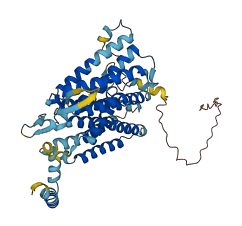
Descriptions
The autoinhibited protein was predicted that may have potential autoinhibitory elements via cis-regPred.
Autoinhibitory domains (AIDs)
Target domain |
|
Relief mechanism |
|
Assay |
cis-regPred |
Accessory elements
No accessory elements
Autoinhibited structure

Activated structure
1 structures for P56079
| Entry ID | Method | Resolution | Chain | Position | Source |
|---|---|---|---|---|---|
| AF-P56079-F1 | Predicted | AlphaFoldDB |
No variants for P56079
| Variant ID(s) | Position | Change | Description | Diseaes Association | Provenance |
|---|---|---|---|---|---|
| No variants for P56079 | |||||
No associated diseases with P56079
Functions
| Description | ||
|---|---|---|
| EC Number | 2.7.7.41 | Nucleotidyltransferases |
| Subcellular Localization |
|
|
| PANTHER Family | ||
| PANTHER Subfamily | ||
| PANTHER Protein Class | ||
| PANTHER Pathway Category | No pathway information available | |
2 GO annotations of cellular component
| Name | Definition |
|---|---|
| endoplasmic reticulum membrane | The lipid bilayer surrounding the endoplasmic reticulum. |
| integral component of membrane | The component of a membrane consisting of the gene products and protein complexes having at least some part of their peptide sequence embedded in the hydrophobic region of the membrane. |
1 GO annotations of molecular function
| Name | Definition |
|---|---|
| phosphatidate cytidylyltransferase activity | Catalysis of the reaction: CTP + phosphatidate = diphosphate + CDP-diacylglycerol. |
11 GO annotations of biological process
| Name | Definition |
|---|---|
| CDP-diacylglycerol biosynthetic process | The chemical reactions and pathways resulting in the formation of CDP-diacylglycerol, CDP-1,2-diacylglycerol, a substance composed of diacylglycerol in glycosidic linkage with cytidine diphosphate. |
| lipid biosynthetic process | The chemical reactions and pathways resulting in the formation of lipids, compounds soluble in an organic solvent but not, or sparingly, in an aqueous solvent. |
| negative regulation of triglyceride biosynthetic process | Any process that decreases the rate, frequency, or extent of triglyceride biosynthesis. Triglyceride biosynthesis is the collection of chemical reactions and pathways resulting in the formation of triglyceride, any triester of glycerol. |
| phototransduction | The sequence of reactions within a cell required to convert absorbed photons into a molecular signal. |
| positive regulation of phosphatidylinositol biosynthetic process | Any process that increases the frequency, rate or extent of the chemical reactions and pathways resulting in the formation of phosphatidylinositol. |
| regulation of lipid storage | Any process that modulates the rate, frequency or extent of lipid storage. Lipid storage is the accumulation and maintenance in cells or tissues of lipids, compounds soluble in organic solvents but insoluble or sparingly soluble in aqueous solvents. Lipid reserves can be accumulated during early developmental stages for mobilization and utilization at later stages of development. |
| rhodopsin mediated signaling pathway | A G protein-coupled receptor signaling pathway initiated by the excitation of rhodopsin by a photon, and ending with the regulation of a downstream cellular process. |
| sperm individualization | The resolution of the male germline syncytium or cyst into individual gametes by packaging each spermatid into its own plasma membrane. |
| terminal branching, open tracheal system | Formation of terminal branches in the open tracheal system. These are long cytoplasmic extensions that form fine tubules that transport oxygen directly to the tissues. An example of the process is found in Drosophila melanogaster. |
| thermotaxis | The directed movement of a motile cell or organism in response to a temperature gradient. Movement may be towards either a higher or lower temperature. |
| visual perception | The series of events required for an organism to receive a visual stimulus, convert it to a molecular signal, and recognize and characterize the signal. Visual stimuli are detected in the form of photons and are processed to form an image. |
9 homologous proteins in AiPD
| UniProt AC | Gene Name | Protein Name | Species | Evidence Code |
|---|---|---|---|---|
| P38221 | CDS1 | Phosphatidate cytidylyltransferase | Saccharomyces cerevisiae (strain ATCC 204508 / S288c) (Baker's yeast) | PR |
| A0JNC1 | CDS2 | Phosphatidate cytidylyltransferase 2 | Bos taurus (Bovine) | PR |
| Q92903 | CDS1 | Phosphatidate cytidylyltransferase 1 | Homo sapiens (Human) | PR |
| O95674 | CDS2 | Phosphatidate cytidylyltransferase 2 | Homo sapiens (Human) | PR |
| P98191 | Cds1 | Phosphatidate cytidylyltransferase 1 | Mus musculus (Mouse) | PR |
| Q99L43 | Cds2 | Phosphatidate cytidylyltransferase 2 | Mus musculus (Mouse) | PR |
| O35052 | Cds1 | Phosphatidate cytidylyltransferase 1 | Rattus norvegicus (Rat) | PR |
| Q91XU8 | Cds2 | Phosphatidate cytidylyltransferase 2 | Rattus norvegicus (Rat) | PR |
| Q1PE48 | CDS3 | Phosphatidate cytidylyltransferase 3 | Arabidopsis thaliana (Mouse-ear cress) | PR |
| 10 | 20 | 30 | 40 | 50 | 60 |
| MAEVRRRKGE | DEPLEDTAIS | GSDAANKRNS | AADSSDHVDS | EEEKIPEEKF | VDELAKNLPQ |
| 70 | 80 | 90 | 100 | 110 | 120 |
| GTDKTPEILD | SALKDLPDRW | KNWVIRGIFT | WIMICGFALI | IYGGPLALMI | TTLLVQVKCF |
| 130 | 140 | 150 | 160 | 170 | 180 |
| QEIISIGYQV | YRIHGLPWFR | SLSWYFLLTS | NYFFYGENLV | DYFGVVINRV | EYLKFLVTYH |
| 190 | 200 | 210 | 220 | 230 | 240 |
| RFLSFALYII | GFVWFVLSLV | KKYYIKQFSL | FAWTHVSLLI | VVTQSYLIIQ | NIFEGLIWFI |
| 250 | 260 | 270 | 280 | 290 | 300 |
| VPVSMIVCND | VMAYVFGFFF | GRTPLIKLSP | KKTWEGFIGG | GFATVLFGIL | FSYVLCNYQY |
| 310 | 320 | 330 | 340 | 350 | 360 |
| FICPIQYSEE | QGRMTMSCVP | SYLFTPQEYS | LKLFGIGKTL | NLYPFIWHSI | SLSLFSSIIG |
| 370 | 380 | 390 | 400 | 410 | 420 |
| PFGGFFASGF | KRAFKIKDFG | DMIPGHGGIM | DRFDCQFLMA | TFVNVYISSF | IRTPSPAKLL |
| 430 | 440 | ||||
| TQIYNLKPDQ | QYQIYQSLKD | NLGDMLT |