P54823
Gene name |
Ddx6 (Hlr2, Rck) |
Protein name |
Probable ATP-dependent RNA helicase DDX6 |
Names |
ATP-dependent RNA helicase p54, DEAD box protein 6, Oncogene RCK homolog |
Species |
Mus musculus (Mouse) |
KEGG Pathway |
mmu:13209 |
EC number |
3.6.4.13: Acting on ATP; involved in cellular and subcellular movement |
Protein Class |
|
Descriptions
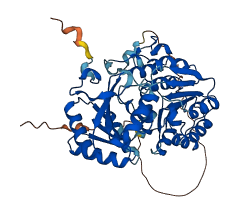
The autoinhibited protein was predicted that may have potential autoinhibitory elements via cis-regPred.
Autoinhibitory domains (AIDs)
Target domain |
|
Relief mechanism |
|
Assay |
cis-regPred |
Accessory elements
No accessory elements
Autoinhibited structure

Activated structure
1 structures for P54823
| Entry ID | Method | Resolution | Chain | Position | Source |
|---|---|---|---|---|---|
| AF-P54823-F1 | Predicted | AlphaFoldDB |
16 variants for P54823
| Variant ID(s) | Position | Change | Description | Diseaes Association | Provenance |
|---|---|---|---|---|---|
| rs3400092442 | 23 | G>A | No | EVA | |
| rs30403127 | 42 | L>M | No | EVA | |
| rs3389007310 | 53 | N>I | No | EVA | |
| rs3389039561 | 70 | D>E | No | EVA | |
| rs3389042289 | 76 | L>F | No | EVA | |
| rs3389033486 | 79 | P>L | No | EVA | |
| rs3389042293 | 116 | W>C | No | EVA | |
| rs3389046266 | 173 | T>S | No | EVA | |
| rs3389046794 | 193 | G>R | No | EVA | |
| rs3389039575 | 232 | K>Q | No | EVA | |
| rs3389046264 | 249 | D>V | No | EVA | |
| rs3389036873 | 258 | Q>* | No | EVA | |
| rs3389042288 | 270 | N>Y | No | EVA | |
| rs3389042240 | 399 | D>V | No | EVA | |
| rs3389020613 | 406 | V>E | No | EVA | |
| rs3389040503 | 482 | K>R | No | EVA |
No associated diseases with P54823
5 regional properties for P54823
| Type | Name | Position | InterPro Accession |
|---|---|---|---|
| conserved_site | ATP-dependent RNA helicase DEAD-box, conserved site | 244 - 252 | IPR000629 |
| domain | Helicase, C-terminal | 308 - 468 | IPR001650 |
| domain | DEAD/DEAH box helicase domain | 121 - 286 | IPR011545 |
| domain | Helicase superfamily 1/2, ATP-binding domain | 115 - 312 | IPR014001 |
| domain | RNA helicase, DEAD-box type, Q motif | 96 - 124 | IPR014014 |
Functions
| Description | ||
|---|---|---|
| EC Number | 3.6.4.13 | Acting on ATP; involved in cellular and subcellular movement |
| Subcellular Localization |
|
|
| PANTHER Family | ||
| PANTHER Subfamily | ||
| PANTHER Protein Class | ||
| PANTHER Pathway Category | No pathway information available | |
16 GO annotations of cellular component
| Name | Definition |
|---|---|
| adherens junction | A cell-cell junction composed of the epithelial cadherin-catenin complex. The epithelial cadherins, or E-cadherins, of each interacting cell extend through the plasma membrane into the extracellular space and bind to each other. The E-cadherins bind to catenins on the cytoplasmic side of the membrane, where the E-cadherin-catenin complex binds to cytoskeletal components and regulatory and signaling molecules. |
| chromatoid body | A ribonucleoprotein complex found in the cytoplasm of male germ cells, composed of exceedingly thin filaments that are consolidated into a compact mass or into dense strands of varying thickness that branch to form an irregular network. Contains mRNAs, miRNAs, and protein components involved in miRNA processing (such as Argonaute proteins and the endonuclease Dicer) and in RNA decay (such as the decapping enzyme DCP1a and GW182). |
| concave side of sperm head | The concave part of the late spermatid head or spermatozoon head that forms the ventral portion of the head, particularly in some rodent species. |
| cytoplasm | The contents of a cell excluding the plasma membrane and nucleus, but including other subcellular structures. |
| cytoplasmic ribonucleoprotein granule | A ribonucleoprotein granule located in the cytoplasm. |
| cytoplasmic stress granule | A dense aggregation in the cytosol composed of proteins and RNAs that appear when the cell is under stress. |
| cytosol | The part of the cytoplasm that does not contain organelles but which does contain other particulate matter, such as protein complexes. |
| heterochromatin | A compact and highly condensed form of chromatin that is refractory to transcription. |
| mitochondrion | A semiautonomous, self replicating organelle that occurs in varying numbers, shapes, and sizes in the cytoplasm of virtually all eukaryotic cells. It is notably the site of tissue respiration. |
| nucleolus | A small, dense body one or more of which are present in the nucleus of eukaryotic cells. It is rich in RNA and protein, is not bounded by a limiting membrane, and is not seen during mitosis. Its prime function is the transcription of the nucleolar DNA into 45S ribosomal-precursor RNA, the processing of this RNA into 5.8S, 18S, and 28S components of ribosomal RNA, and the association of these components with 5S RNA and proteins synthesized outside the nucleolus. This association results in the formation of ribonucleoprotein precursors; these pass into the cytoplasm and mature into the 40S and 60S subunits of the ribosome. |
| nucleus | A membrane-bounded organelle of eukaryotic cells in which chromosomes are housed and replicated. In most cells, the nucleus contains all of the cell's chromosomes except the organellar chromosomes, and is the site of RNA synthesis and processing. In some species, or in specialized cell types, RNA metabolism or DNA replication may be absent. |
| outer dense fiber | A supramolecular fiber found in the flagella of mammalian sperm that surrounds the nine microtubule doublets. These dense fibers are stiff and noncontractile. In human, they consist of about 10 major and at least 15 minor proteins, where all major proteins are ODF1, ODF2 or ODF2-related proteins. |
| P-body | A focus in the cytoplasm where mRNAs may become inactivated by decapping or some other mechanism. Protein and RNA localized to these foci are involved in mRNA degradation, nonsense-mediated mRNA decay (NMD), translational repression, and RNA-mediated gene silencing. |
| perinuclear region of cytoplasm | Cytoplasm situated near, or occurring around, the nucleus. |
| RISC complex | A ribonucleoprotein complex that contains members of the Argonaute family of proteins, small interfering RNAs (siRNAs) or microRNAs (miRNAs), and miRNA or siRNA-complementary mRNAs, in addition to a number of accessory factors. The RISC complex is involved in posttranscriptional repression of gene expression through downregulation of translation or induction of mRNA degradation. |
| sperm annulus | The ring-like, filamentous structure located at the distal end of the midpiece of the sperm flagellum; the annulus is thought to form a diffusion barrier between the midpiece and the principal piece and serve as a stabilizing structure for tail rigidity. |
5 GO annotations of molecular function
| Name | Definition |
|---|---|
| ATP binding | Binding to ATP, adenosine 5'-triphosphate, a universally important coenzyme and enzyme regulator. |
| ATP hydrolysis activity | Catalysis of the reaction: ATP + H2O = ADP + H+ phosphate. ATP hydrolysis is used in some reactions as an energy source, for example to catalyze a reaction or drive transport against a concentration gradient. |
| mRNA binding | Binding to messenger RNA (mRNA), an intermediate molecule between DNA and protein. mRNA includes UTR and coding sequences, but does not contain introns. |
| protein domain specific binding | Binding to a specific domain of a protein. |
| RNA helicase activity | Unwinding of an RNA helix, driven by ATP hydrolysis. |
8 GO annotations of biological process
| Name | Definition |
|---|---|
| miRNA-mediated gene silencing by inhibition of translation | An RNA interference pathway in which microRNAs (miRNAs) block the translation of target mRNAs into proteins. Once incorporated into a RNA-induced silencing complex (RISC), a miRNA will typically mediate repression of translation if the miRNA imperfectly base-pairs with the 3' untranslated regions of target mRNAs. |
| negative regulation of neuron differentiation | Any process that stops, prevents, or reduces the frequency, rate or extent of neuron differentiation. |
| negative regulation of translation | Any process that stops, prevents, or reduces the frequency, rate or extent of the chemical reactions and pathways resulting in the formation of proteins by the translation of mRNA or circRNA. |
| neuron differentiation | The process in which a relatively unspecialized cell acquires specialized features of a neuron. |
| P-body assembly | The aggregation, arrangement and bonding together of proteins and RNA molecules to form a cytoplasmic mRNA processing body. |
| stem cell population maintenance | The process by which an organism or tissue maintains a population of stem cells of a single type. This can be achieved by a number of mechanisms: stem cell asymmetric division maintains stem cell numbers; stem cell symmetric division increases them; maintenance of a stem cell niche maintains the conditions for commitment to the stem cell fate for some types of stem cell; stem cells may arise de novo from other cell types. |
| stress granule assembly | The aggregation, arrangement and bonding together of proteins and RNA molecules to form a stress granule. |
| viral RNA genome packaging | The packaging of viral RNA (single-stranded or double-stranded) into a nucleocapsid. |
10 homologous proteins in AiPD
| UniProt AC | Gene Name | Protein Name | Species | Evidence Code |
|---|---|---|---|---|
| P39517 | DHH1 | ATP-dependent RNA helicase DHH1 | Saccharomyces cerevisiae (strain ATCC 204508 / S288c) (Baker's yeast) | PR |
| Q5ZKB9 | DDX6 | Probable ATP-dependent RNA helicase DDX6 | Gallus gallus (Chicken) | PR |
| P26196 | DDX6 | Probable ATP-dependent RNA helicase DDX6 | Homo sapiens (Human) | PR |
| Q109G2 | Os10g0503700 | DEAD-box ATP-dependent RNA helicase 12 | Oryza sativa subsp japonica (Rice) | PR |
| Q7XMK8 | Os04g0533000 | DEAD-box ATP-dependent RNA helicase 6 | Oryza sativa subsp japonica (Rice) | PR |
| Q6H7S2 | Os02g0641800 | DEAD-box ATP-dependent RNA helicase 8 | Oryza sativa subsp japonica (Rice) | PR |
| Q8RXK6 | RH8 | DEAD-box ATP-dependent RNA helicase 8 | Arabidopsis thaliana (Mouse-ear cress) | PR |
| Q94BV4 | RH6 | DEAD-box ATP-dependent RNA helicase 6 | Arabidopsis thaliana (Mouse-ear cress) | PR |
| Q9M2E0 | RH12 | DEAD-box ATP-dependent RNA helicase 12 | Arabidopsis thaliana (Mouse-ear cress) | PR |
| Q0IHV9 | ddx6 | Probable ATP-dependent RNA helicase ddx6 | Xenopus tropicalis (Western clawed frog) (Silurana tropicalis) | PR |
| 10 | 20 | 30 | 40 | 50 | 60 |
| MSTARTENPV | IMGLSSQNGQ | LRGPVKASAG | PGGGGTQPQP | QLNQLKNTST | INNGTPQQAQ |
| 70 | 80 | 90 | 100 | 110 | 120 |
| SMAATIKPGD | DWKKTLKLPP | KDLRIKTSDV | TSTKGNEFED | YCLKRELLMG | IFEMGWEKPS |
| 130 | 140 | 150 | 160 | 170 | 180 |
| PIQEESIPIA | LSGRDILARA | KNGTGKSGAY | LIPLLERLDL | KKDNIQAMVI | VPTRELALQV |
| 190 | 200 | 210 | 220 | 230 | 240 |
| SQICIQVSKH | MGGAKVMATT | GGTNLRDDIM | RLDDTVHVVI | ATPGRILDLI | KKGVAKVDHV |
| 250 | 260 | 270 | 280 | 290 | 300 |
| QMIVLDEADK | LLSQDFVQIM | EDIILTLPKN | RQILLYSATF | PLSVQKFMNS | HLQKPYEINL |
| 310 | 320 | 330 | 340 | 350 | 360 |
| MEELTLKGVT | QYYAYVTERQ | KVHCLNTLFS | RLQINQSIIF | CNSSQRVELL | AKKISQLGYS |
| 370 | 380 | 390 | 400 | 410 | 420 |
| CFYIHAKMRQ | EHRNRVFHDF | RNGLCRNLVC | TDLFTRGIDI | QAVNVVINFD | FPKLAETYLH |
| 430 | 440 | 450 | 460 | 470 | 480 |
| RIGRSGRFGH | LGLAINLITY | DDRFNLKSIE | EQLGTEIKPI | PSNIDKSLYV | AEYHSEPAED |
| EKP |