P47743
Gene name |
Grm8 (Gprc1h, Mglur8) |
Protein name |
Metabotropic glutamate receptor 8 |
Names |
mGluR8 |
Species |
Mus musculus (Mouse) |
KEGG Pathway |
mmu:14823 |
EC number |
|
Protein Class |
|
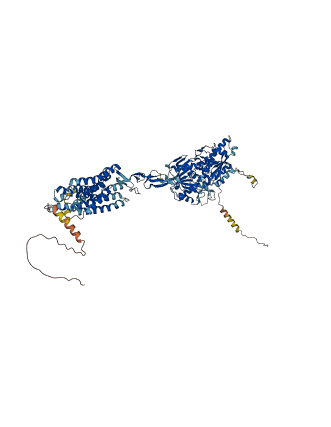
Descriptions
The autoinhibited protein was predicted that may have potential autoinhibitory elements via cis-regPred.
Autoinhibitory domains (AIDs)
Target domain |
|
Relief mechanism |
|
Assay |
cis-regPred |
Accessory elements
No accessory elements
Autoinhibited structure

Activated structure
1 structures for P47743
| Entry ID | Method | Resolution | Chain | Position | Source |
|---|---|---|---|---|---|
| AF-P47743-F1 | Predicted | AlphaFoldDB |
52 variants for P47743
| Variant ID(s) | Position | Change | Description | Diseaes Association | Provenance |
|---|---|---|---|---|---|
| rs3388808353 | 13 | C>* | No | EVA | |
| rs3388816237 | 36 | Y>* | No | EVA | |
| rs3388811104 | 36 | Y>D | No | EVA | |
| rs236835328 | 42 | L>M | No | EVA | |
| rs3388802855 | 75 | R>G | No | EVA | |
| rs3388808356 | 83 | I>L | No | EVA | |
| rs3388797922 | 131 | V>A | No | EVA | |
| rs3388805481 | 169 | F>L | No | EVA | |
| rs3388815960 | 246 | C>Y | No | EVA | |
| rs3388787252 | 247 | I>N | No | EVA | |
| rs3388802856 | 388 | E>G | No | EVA | |
| rs3388816034 | 407 | D>H | No | EVA | |
| rs50318219 | 411 | S>P | No | EVA | |
| rs3396641849 | 427 | Y>* | No | EVA | |
| rs3388797920 | 441 | E>* | No | EVA | |
| rs3388797971 | 463 | E>V | No | EVA | |
| rs3388813625 | 464 | N>S | No | EVA | |
| rs3388813556 | 467 | A>V | No | EVA | |
| rs3388818692 | 468 | P>A | No | EVA | |
| rs3388805425 | 481 | K>Q | No | EVA | |
| rs3396625988 | 518 | L>Q | No | EVA | |
| rs3396588876 | 519 | P>A | No | EVA | |
| rs235790232 | 519 | P>L | No | EVA | |
| rs3396634023 | 522 | P>A | No | EVA | |
| rs3388816023 | 545 | N>I | No | EVA | |
| rs3388808358 | 581 | S>P | No | EVA | |
| rs3388816319 | 590 | I>L | No | EVA | |
| rs3388802826 | 609 | N>K | No | EVA | |
| rs3388805426 | 615 | R>S | No | EVA | |
| rs3388813612 | 616 | A>G | No | EVA | |
| rs3388818697 | 633 | Y>* | No | EVA | |
| rs3388802873 | 637 | F>I | No | EVA | |
| rs3396164509 | 641 | A>V | No | EVA | |
| rs3396626025 | 642 | A>S | No | EVA | |
| rs3396640975 | 643 | P>A | No | EVA | |
| rs3396571265 | 643 | P>R | No | EVA | |
| rs3396164480 | 644 | D>A | No | EVA | |
| rs3396496953 | 645 | T>A | No | EVA | |
| rs3388818656 | 702 | L>R | No | EVA | |
| rs3388797979 | 758 | L>V | No | EVA | |
| rs3413000369 | 770 | T>N | No | EVA | |
| rs3388824912 | 780 | A>P | No | EVA | |
| rs3388802886 | 784 | G>V | No | EVA | |
| rs3388797926 | 789 | T>N | No | EVA | |
| rs3388822027 | 822 | M>L | No | EVA | |
| rs3396538525 | 828 | V>E | No | EVA | |
| rs3396633948 | 829 | S>T | No | EVA | |
| rs3388818539 | 861 | T>M | No | EVA | |
| rs3388818533 | 867 | S>N | No | EVA | |
| rs3388802849 | 873 | G>E | No | EVA | |
| rs3388805442 | 881 | V>M | No | EVA | |
| rs3388821990 | 898 | T>I | No | EVA |
No associated diseases with P47743
6 regional properties for P47743
| Type | Name | Position | InterPro Accession |
|---|---|---|---|
| domain | Receptor, ligand binding region | 74 - 477 | IPR001828 |
| domain | GPCR, family 3, nine cysteines domain | 512 - 562 | IPR011500 |
| domain | GPCR family 3, C-terminal | 577 - 857 | IPR017978 |
| conserved_site | GPCR, family 3, conserved site | 162 - 180 | IPR017979-1 |
| conserved_site | GPCR, family 3, conserved site | 534 - 556 | IPR017979-2 |
| conserved_site | GPCR, family 3, conserved site | 777 - 787 | IPR017979-3 |
7 GO annotations of cellular component
| Name | Definition |
|---|---|
| GABA-ergic synapse | A synapse that uses GABA as a neurotransmitter. These synapses are typically inhibitory. |
| glutamatergic synapse | A synapse that uses glutamate as a neurotransmitter. |
| integral component of plasma membrane | The component of the plasma membrane consisting of the gene products and protein complexes having at least some part of their peptide sequence embedded in the hydrophobic region of the membrane. |
| integral component of presynaptic active zone membrane | The component of the presynaptic active zone membrane consisting of the gene products and protein complexes having at least some part of their peptide sequence embedded in the hydrophobic region of the membrane. |
| neuron projection | A prolongation or process extending from a nerve cell, e.g. an axon or dendrite. |
| neuronal cell body | The portion of a neuron that includes the nucleus, but excludes cell projections such as axons and dendrites. |
| presynaptic membrane | A specialized area of membrane of the axon terminal that faces the plasma membrane of the neuron or muscle fiber with which the axon terminal establishes a synaptic junction; many synaptic junctions exhibit structural presynaptic characteristics, such as conical, electron-dense internal protrusions, that distinguish it from the remainder of the axon plasma membrane. |
4 GO annotations of molecular function
| Name | Definition |
|---|---|
| adenylate cyclase inhibiting G protein-coupled glutamate receptor activity | Combining with glutamate and transmitting the signal across the membrane by activating the alpha-subunit of an associated heterotrimeric G-protein complex to inhibit downstream adenylate cyclase activity. |
| G protein-coupled receptor activity | Combining with an extracellular signal and transmitting the signal across the membrane by activating an associated G-protein; promotes the exchange of GDP for GTP on the alpha subunit of a heterotrimeric G-protein complex. |
| glutamate receptor activity | Combining with glutamate and transmitting the signal from one side of the membrane to the other to initiate a change in cell activity. |
| group III metabotropic glutamate receptor activity | A G protein-coupled receptor that is activated by L-AP-4 and inhibits adenylate cyclase activity. |
9 GO annotations of biological process
| Name | Definition |
|---|---|
| adenylate cyclase-inhibiting G protein-coupled glutamate receptor signaling pathway | An adenylate cyclase-inhibiting G protein-coupled receptor signaling pathway initiated by glutamate binding to its receptor, and ending with the regulation of a downstream cellular process. |
| adenylate cyclase-inhibiting G protein-coupled receptor signaling pathway | A G protein-coupled receptor signaling pathway in which the signal is transmitted via the inhibition of adenylyl cyclase activity and a subsequent decrease in the intracellular concentration of cyclic AMP (cAMP). |
| chemical synaptic transmission | The vesicular release of classical neurotransmitter molecules from a presynapse, across a chemical synapse, the subsequent activation of neurotransmitter receptors at the postsynapse of a target cell (neuron, muscle, or secretory cell) and the effects of this activation on the postsynaptic membrane potential and ionic composition of the postsynaptic cytosol. This process encompasses both spontaneous and evoked release of neurotransmitter and all parts of synaptic vesicle exocytosis. Evoked transmission starts with the arrival of an action potential at the presynapse. |
| detection of mechanical stimulus involved in sensory perception of pain | The series of events involved in the perception of pain in which a mechanical stimulus is received and converted into a molecular signal. |
| G protein-coupled glutamate receptor signaling pathway | A G protein-coupled receptor signaling pathway initiated by glutamate binding to its receptor on the surface of a target cell, and ending with the regulation of a downstream cellular process. |
| regulation of neurotransmitter secretion | Any process that modulates the frequency, rate or extent of the regulated release of a neurotransmitter from a cell. |
| regulation of synaptic transmission, glutamatergic | Any process that modulates the frequency, rate or extent of glutamatergic synaptic transmission, the process of communication from a neuron to another neuron across a synapse using the neurotransmitter glutamate. |
| regulation of synaptic vesicle exocytosis | Any process that modulates the frequency, rate or extent of synaptic vesicle exocytosis. |
| synaptic transmission, glutamatergic | The vesicular release of glutamate from a presynapse, across a chemical synapse, the subsequent activation of glutamate receptors at the postsynapse of a target cell (neuron, muscle, or secretory cell) and the effects of this activation on the postsynaptic membrane potential and ionic composition of the postsynaptic cytosol. This process encompasses both spontaneous and evoked release of neurotransmitter and all parts of synaptic vesicle exocytosis. Evoked transmission starts with the arrival of an action potential at the presynapse. |
8 homologous proteins in AiPD
| UniProt AC | Gene Name | Protein Name | Species | Evidence Code |
|---|---|---|---|---|
| Q14416 | GRM2 | Metabotropic glutamate receptor 2 | Homo sapiens (Human) | PR |
| P41180 | CASR | Extracellular calcium-sensing receptor | Homo sapiens (Human) | PR |
| O00222 | GRM8 | Metabotropic glutamate receptor 8 | Homo sapiens (Human) | PR |
| Q14BI2 | Grm2 | Metabotropic glutamate receptor 2 | Mus musculus (Mouse) | PR |
| Q9QYS2 | Grm3 | Metabotropic glutamate receptor 3 | Mus musculus (Mouse) | PR |
| Q3UVX5 | Grm5 | Metabotropic glutamate receptor 5 | Mus musculus (Mouse) | PR |
| P31422 | Grm3 | Metabotropic glutamate receptor 3 | Rattus norvegicus (Rat) | PR |
| P31421 | Grm2 | Metabotropic glutamate receptor 2 | Rattus norvegicus (Rat) | PR |
| 10 | 20 | 30 | 40 | 50 | 60 |
| MVCEGKRSTS | CPCFFLLTAK | FYWILTMMQR | THSQEYAHSI | RLDGDIILGG | LFPVHAKGER |
| 70 | 80 | 90 | 100 | 110 | 120 |
| GVPCGDLKKE | KGIHRLEAML | YAIDQINKDP | DLLSNITLGV | RILDTCSRDT | YALEQSLTFV |
| 130 | 140 | 150 | 160 | 170 | 180 |
| QALIEKDASD | VKCANGDPPI | FTKPDKISGV | IGAAASSVSI | MVANILRLFK | IPQISYASTA |
| 190 | 200 | 210 | 220 | 230 | 240 |
| PELSDNTRYD | FFSRVVPPDS | YQAQAMVDIV | TALGWNYVST | LASEGNYGES | GVEAFTQISR |
| 250 | 260 | 270 | 280 | 290 | 300 |
| EIGGVCIAQS | QKIPREPRPG | EFEKIIKRLL | ETPNARAVIM | FANEDDIRRI | LEAAKKLNQS |
| 310 | 320 | 330 | 340 | 350 | 360 |
| GHFLWIGSDS | WGSKIAPVYQ | QEEIAEGAVT | ILPKRASIDG | FDRYFRSRTL | ANNRRNVWFA |
| 370 | 380 | 390 | 400 | 410 | 420 |
| EFWEENFGCK | LGSHGKRNSH | IKKCTGLERI | ARDSSYEQEG | KVQFVIDAVY | SMAYALHNMH |
| 430 | 440 | 450 | 460 | 470 | 480 |
| KELCPGYIGL | CPRMVTIDGK | ELLGYIRAVN | FNGSAGTPVT | FNENGDAPGR | YDIFQYQINN |
| 490 | 500 | 510 | 520 | 530 | 540 |
| KSTEYKIIGH | WTNQLHLKVE | DMQWANREHT | HPASVCSLPC | KPGERKKTVK | GVPCCWHCER |
| 550 | 560 | 570 | 580 | 590 | 600 |
| CEGYNYQVDE | LSCELCPLDQ | RPNINRTGCQ | RIPIIKLEWH | SPWAVVPVFI | AILGIIATTF |
| 610 | 620 | 630 | 640 | 650 | 660 |
| VIVTFVRYND | TPIVRASGRE | LSYVLLTGIF | LCYSITFLMI | AAPDTIICSF | RRIFLGLGMC |
| 670 | 680 | 690 | 700 | 710 | 720 |
| FSYAALLTKT | NRIHRIFEQG | KKSVTAPKFI | SPASQLVITF | SLISVQLLGV | FVWFVVDPPH |
| 730 | 740 | 750 | 760 | 770 | 780 |
| TIIDYGEQRT | LDPENARGVL | KCDISDLSLI | CSLGYSILLM | VTCTVYAIKT | RGVPETFNEA |
| 790 | 800 | 810 | 820 | 830 | 840 |
| KPIGFTMYTT | CIIWLAFIPI | FFGTAQSAEK | MYIQTTTLTV | SMSLSASVSL | GMLYMPKVYI |
| 850 | 860 | 870 | 880 | 890 | 900 |
| IIFHPEQNVQ | KRKRSFKAVV | TAATMQSKLI | QKGNDRPNGE | VKSELCESLE | TNTSSTKTTY |
| ISYSNHSI |