P41516
Gene name |
Top2a (Top-2, Top2) |
Protein name |
DNA topoisomerase 2-alpha |
Names |
DNA topoisomerase II, alpha isozyme |
Species |
Rattus norvegicus (Rat) |
KEGG Pathway |
rno:360243 |
EC number |
5.6.2.2: Enzymes altering nucleic acid conformation |
Protein Class |
|
Descriptions
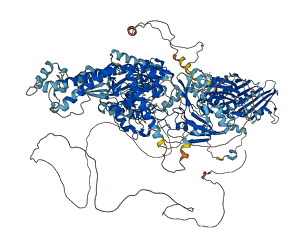
The autoinhibited protein was predicted that may have potential autoinhibitory elements via cis-regPred.
Autoinhibitory domains (AIDs)
Target domain |
|
Relief mechanism |
|
Assay |
cis-regPred |
Accessory elements
No accessory elements
Autoinhibited structure

Activated structure
1 structures for P41516
| Entry ID | Method | Resolution | Chain | Position | Source |
|---|---|---|---|---|---|
| AF-P41516-F1 | Predicted | AlphaFoldDB |
No variants for P41516
| Variant ID(s) | Position | Change | Description | Diseaes Association | Provenance |
|---|---|---|---|---|---|
| No variants for P41516 | |||||
No associated diseases with P41516
8 regional properties for P41516
| Type | Name | Position | InterPro Accession |
|---|---|---|---|
| domain | DNA topoisomerase, type IIA, domain A | 691 - 1171 | IPR002205 |
| domain | Histidine kinase/HSP90-like ATPase | 78 - 222 | IPR003594 |
| domain | TOPRIM domain | 453 - 570 | IPR006171 |
| domain | DTHCT | 1429 - 1518 | IPR012542 |
| domain | DNA topoisomerase, type IIA, subunit B, domain 2 | 264 - 424 | IPR013506 |
| conserved_site | DNA topoisomerase, type IIA, conserved site | 457 - 465 | IPR018522 |
| domain | C-terminal associated domain of TOPRIM | 571 - 709 | IPR031660 |
| domain | DNA topoisomerase 2, TOPRIM domain | 453 - 573 | IPR034157 |
Functions
| Description | ||
|---|---|---|
| EC Number | 5.6.2.2 | Enzymes altering nucleic acid conformation |
| Subcellular Localization |
|
|
| PANTHER Family | ||
| PANTHER Subfamily | ||
| PANTHER Protein Class | ||
| PANTHER Pathway Category | No pathway information available | |
10 GO annotations of cellular component
| Name | Definition |
|---|---|
| chromosome, centromeric region | The region of a chromosome that includes the centromeric DNA and associated proteins. In monocentric chromosomes, this region corresponds to a single area of the chromosome, whereas in holocentric chromosomes, it is evenly distributed along the chromosome. |
| condensed chromosome | A highly compacted molecule of DNA and associated proteins resulting in a cytologically distinct structure. |
| cytoplasm | The contents of a cell excluding the plasma membrane and nucleus, but including other subcellular structures. |
| DNA topoisomerase type II (double strand cut, ATP-hydrolyzing) complex | Complex that possesses DNA topoisomerase II (double strand cut, ATP-hydrolyzing) activity. |
| male germ cell nucleus | The nucleus of a male germ cell, a reproductive cell in males. |
| nucleolus | A small, dense body one or more of which are present in the nucleus of eukaryotic cells. It is rich in RNA and protein, is not bounded by a limiting membrane, and is not seen during mitosis. Its prime function is the transcription of the nucleolar DNA into 45S ribosomal-precursor RNA, the processing of this RNA into 5.8S, 18S, and 28S components of ribosomal RNA, and the association of these components with 5S RNA and proteins synthesized outside the nucleolus. This association results in the formation of ribonucleoprotein precursors; these pass into the cytoplasm and mature into the 40S and 60S subunits of the ribosome. |
| nucleoplasm | That part of the nuclear content other than the chromosomes or the nucleolus. |
| nucleus | A membrane-bounded organelle of eukaryotic cells in which chromosomes are housed and replicated. In most cells, the nucleus contains all of the cell's chromosomes except the organellar chromosomes, and is the site of RNA synthesis and processing. In some species, or in specialized cell types, RNA metabolism or DNA replication may be absent. |
| protein-containing complex | A stable assembly of two or more macromolecules, i.e. proteins, nucleic acids, carbohydrates or lipids, in which at least one component is a protein and the constituent parts function together. |
| ribonucleoprotein complex | A macromolecular complex that contains both RNA and protein molecules. |
16 GO annotations of molecular function
| Name | Definition |
|---|---|
| ATP binding | Binding to ATP, adenosine 5'-triphosphate, a universally important coenzyme and enzyme regulator. |
| ATP-dependent activity, acting on DNA | Catalytic activity that acts to modify DNA, driven by ATP hydrolysis. |
| chromatin binding | Binding to chromatin, the network of fibers of DNA, protein, and sometimes RNA, that make up the chromosomes of the eukaryotic nucleus during interphase. |
| DNA binding | Any molecular function by which a gene product interacts selectively and non-covalently with DNA (deoxyribonucleic acid). |
| DNA binding, bending | The activity of binding selectively and non-covalently to and distorting the original structure of DNA, typically a straight helix, into a bend, or increasing the bend if the original structure was intrinsically bent due to its sequence. |
| DNA topoisomerase activity | Catalysis of the transient cleavage and passage of individual DNA strands or double helices through one another, resulting a topological transformation in double-stranded DNA. |
| DNA topoisomerase type II (double strand cut, ATP-hydrolyzing) activity | Catalysis of a DNA topological transformation by transiently cleaving a pair of complementary DNA strands to form a gate through which a second double-stranded DNA segment is passed, after which the severed strands in the first DNA segment are rejoined, driven by ATP hydrolysis. The enzyme changes the linking number in multiples of 2. |
| enzyme binding | Binding to an enzyme, a protein with catalytic activity. |
| histone deacetylase binding | Binding to histone deacetylase. |
| magnesium ion binding | Binding to a magnesium (Mg) ion. |
| protein C-terminus binding | Binding to a protein C-terminus, the end of a peptide chain at which the 1-carboxyl function of a constituent amino acid is not attached in peptide linkage to another amino-acid residue. |
| protein heterodimerization activity | Binding to a nonidentical protein to form a heterodimer. |
| protein homodimerization activity | Binding to an identical protein to form a homodimer. |
| protein kinase C binding | Binding to protein kinase C. |
| sequence-specific DNA binding | Binding to DNA of a specific nucleotide composition, e.g. GC-rich DNA binding, or with a specific sequence motif or type of DNA e.g. promotor binding or rDNA binding. |
| ubiquitin binding | Binding to ubiquitin, a protein that when covalently bound to other cellular proteins marks them for proteolytic degradation. |
24 GO annotations of biological process
| Name | Definition |
|---|---|
| aging | A developmental process that is a deterioration and loss of function over time. Aging includes loss of functions such as resistance to disease, homeostasis, and fertility, as well as wear and tear. Aging includes cellular senescence, but is more inclusive. May precede death and may succeed developmental maturation (GO:0021700). |
| apoptotic chromosome condensation | The compaction of chromatin during apoptosis. |
| brain development | The process whose specific outcome is the progression of the brain over time, from its formation to the mature structure. Brain development begins with patterning events in the neural tube and ends with the mature structure that is the center of thought and emotion. The brain is responsible for the coordination and control of bodily activities and the interpretation of information from the senses (sight, hearing, smell, etc.). |
| cellular response to DNA damage stimulus | Any process that results in a change in state or activity of a cell (in terms of movement, secretion, enzyme production, gene expression, etc.) as a result of a stimulus indicating damage to its DNA from environmental insults or errors during metabolism. |
| cerebellar granule cell differentiation | The process in which neuroblasts acquire specialized structural and/or functional features that characterize the mature cerebellar granule cell. Differentiation includes the processes involved in commitment of a neuroblast to a granule cell fate. A granule cell is a glutamatergic interneuron found in the cerebellar cortex. |
| cerebellar Purkinje cell differentiation | The process in which neuroblasts acquire specialized structural and/or functional features that characterize the mature cerebellar Purkinje cell. Differentiation includes the processes involved in commitment of a neuroblast to a Purkinje cell fate. A Purkinje cell is an inhibitory GABAergic neuron found in the cerebellar cortex that projects to the deep cerebellar nuclei and brain stem. |
| chromosome condensation | The progressive compaction of dispersed interphase chromatin into threadlike chromosomes prior to mitotic or meiotic nuclear division, or during apoptosis, in eukaryotic cells. |
| chromosome segregation | The process in which genetic material, in the form of chromosomes, is organized into specific structures and then physically separated and apportioned to two or more sets. In eukaryotes, chromosome segregation begins with the condensation of chromosomes, includes chromosome separation, and ends when chromosomes have completed movement to the spindle poles. |
| DNA ligation | The re-formation of a broken phosphodiester bond in the DNA backbone, carried out by DNA ligase. |
| DNA topological change | The process in which a transformation is induced in the topological structure of a double-stranded DNA helix, resulting in a change in linking number. |
| embryonic cleavage | The first few specialized divisions of an activated animal egg. |
| female meiotic nuclear division | A cell cycle process by which the cell nucleus divides as part of a meiotic cell cycle in the female germline. |
| hematopoietic progenitor cell differentiation | The process in which precursor cell type acquires the specialized features of a hematopoietic progenitor cell, a class of cell types including myeloid progenitor cells and lymphoid progenitor cells. |
| negative regulation of DNA duplex unwinding | Any process that stops, prevents or reduces the frequency, rate or extent of DNA duplex unwinding. |
| positive regulation of apoptotic process | Any process that activates or increases the frequency, rate or extent of cell death by apoptotic process. |
| positive regulation of single stranded viral RNA replication via double stranded DNA intermediate | Any process that activates or increases the frequency, rate or extent of retroviral genome replication. |
| positive regulation of transcription by RNA polymerase II | Any process that activates or increases the frequency, rate or extent of transcription from an RNA polymerase II promoter. |
| regulation of circadian rhythm | Any process that modulates the frequency, rate or extent of a circadian rhythm. A circadian rhythm is a biological process in an organism that recurs with a regularity of approximately 24 hours. |
| resolution of meiotic recombination intermediates | The cleavage and rejoining of intermediates, such as Holliday junctions, formed during meiotic recombination to produce two intact molecules in which genetic material has been exchanged. |
| response to ionizing radiation | Any process that results in a change in state or activity of a cell or an organism (in terms of movement, secretion, enzyme production, gene expression, etc.) as a result of a ionizing radiation stimulus. Ionizing radiation is radiation with sufficient energy to remove electrons from atoms and may arise from spontaneous decay of unstable isotopes, resulting in alpha and beta particles and gamma rays. Ionizing radiation also includes X-rays. |
| response to parathyroid hormone | Any process that results in a change in state or activity of a cell or an organism (in terms of movement, secretion, enzyme production, gene expression, etc.) as a result of a parathyroid hormone stimulus. |
| response to xenobiotic stimulus | Any process that results in a change in state or activity of a cell or an organism (in terms of movement, secretion, enzyme production, gene expression, etc.) as a result of a stimulus from a xenobiotic, a compound foreign to the organim exposed to it. It may be synthesized by another organism (like ampicilin) or it can be a synthetic chemical. |
| rhythmic process | Any process pertinent to the generation and maintenance of rhythms in the physiology of an organism. |
| sister chromatid segregation | The cell cycle process in which sister chromatids are organized and then physically separated and apportioned to two or more sets. |
6 homologous proteins in AiPD
| UniProt AC | Gene Name | Protein Name | Species | Evidence Code |
|---|---|---|---|---|
| Q02880 | TOP2B | DNA topoisomerase 2-beta | Homo sapiens (Human) | PR |
| P11388 | TOP2A | DNA topoisomerase 2-alpha | Homo sapiens (Human) | PR |
| Q64511 | Top2b | DNA topoisomerase 2-beta | Mus musculus (Mouse) | PR |
| Q01320 | Top2a | DNA topoisomerase 2-alpha | Mus musculus (Mouse) | PR |
| O46374 | TOP2A | DNA topoisomerase 2-alpha | Sus scrofa (Pig) | PR |
| Q23670 | top-2 | DNA topoisomerase 2 top-2 | Caenorhabditis elegans | PR |
| 10 | 20 | 30 | 40 | 50 | 60 |
| MELSPLQPVN | ENMLLNKKKN | EDGKKRLSVE | RIYQKKTQLE | HILLRPDTYI | GSVELVTQQM |
| 70 | 80 | 90 | 100 | 110 | 120 |
| WVYDEDVGIN | YREVTFVPGL | YKIFDEILVN | AADNKQRDPK | MSCIRVTMMR | NNLISIWNNG |
| 130 | 140 | 150 | 160 | 170 | 180 |
| KGIPVVEHKV | EKMYVPALIF | GQLLTSSNYD | DDEKKVTGGR | NGYGAKLCNI | FSTKFTVETA |
| 190 | 200 | 210 | 220 | 230 | 240 |
| SREYKKMFKQ | TWMDNMGRAG | DMELKPFSGE | DYTCITFQPD | LSKFKMQSLD | KDIVALMVRR |
| 250 | 260 | 270 | 280 | 290 | 300 |
| AYDIAGSTKD | VKVFLNGNRL | PVKGFRSYVD | MYLKDKVDET | GNALKVVHEQ | VNPRWEVCLT |
| 310 | 320 | 330 | 340 | 350 | 360 |
| MSEKGFQQIS | FVNSIATSKG | GRHVDYVADQ | IVSKLVDVVK | KKNKGGVAVK | ADQVKNHMWI |
| 370 | 380 | 390 | 400 | 410 | 420 |
| FGNAVIENPT | FDSQTKENMT | LQAKSFGSTC | QLSEKFIKAA | IGCGIVESIL | NWVKFKAQIQ |
| 430 | 440 | 450 | 460 | 470 | 480 |
| LNKKCSAVKH | NRIKGIPKLD | DANDAGSRNS | AECTLILTEG | DSAKTLAVSG | LGVVGRDKYG |
| 490 | 500 | 510 | 520 | 530 | 540 |
| VFPLRGKILN | VREASHKQIM | ENAEINNIIK | IVGLQYKKNY | EDEDSLKTLR | YGKIMIMTDQ |
| 550 | 560 | 570 | 580 | 590 | 600 |
| DQDGSHIKGL | LINFIHHNWP | SLLRHRFLEE | FITPIVKVSK | NKQEIAFYSL | PEFEEWKSTN |
| 610 | 620 | 630 | 640 | 650 | 660 |
| PNHKKWKVKY | YKGLGTSTSK | EAKEYFANMK | RHRIQFKYSG | PEDDAAISLA | FSKKQVDDRK |
| 670 | 680 | 690 | 700 | 710 | 720 |
| EWLTNFMEDR | RQRKLLGLPE | DYLYGQTTMY | LTYNDFINKE | LILFSNSDNE | RSIPSMVDGL |
| 730 | 740 | 750 | 760 | 770 | 780 |
| KPGQRKVLFT | CFKRNDKREV | KVAQLAGSVA | EMSSYHHGEM | SLMMTIINLA | QNFVGSNNLN |
| 790 | 800 | 810 | 820 | 830 | 840 |
| LLQPIGQFGT | RLHGGKDSAS | PRYIFTMLSP | LARLLFPSKD | DHTLRFLYDD | NQRVEPEWYI |
| 850 | 860 | 870 | 880 | 890 | 900 |
| PIIPMVLING | AEGIGTGWSC | KIPNFDVREV | VNNIRRLLDG | EEPLPMLPSY | KNYKGTIEEL |
| 910 | 920 | 930 | 940 | 950 | 960 |
| ASNQYVINGE | VAILNSTTIE | ITELPIRTWT | QTYKEQVLEP | MLNGTEKTPP | LITDYREYHT |
| 970 | 980 | 990 | 1000 | 1010 | 1020 |
| DTTVKFVIKM | TEEKLAEAER | VGLHKVFKLQ | TSLTCNSMVL | FDHVGCLKKY | DTVLDILRDF |
| 1030 | 1040 | 1050 | 1060 | 1070 | 1080 |
| FELRLKYYGL | RKEWLLGMLG | AESSKLNNQA | RFILEKIDGK | IVIENKPKKE | LIKVLIQRGY |
| 1090 | 1100 | 1110 | 1120 | 1130 | 1140 |
| DSDPVKAWKE | AQQKVPEEEE | NEENEESESE | STSPAAESGP | TFNYLLDMPL | WYLTKEKKDE |
| 1150 | 1160 | 1170 | 1180 | 1190 | 1200 |
| LCKQRDEKEQ | ELNTLKKKTP | SDLWKEDLAA | FVEELEVVEA | KEKQDEQVGL | PGKGVKAKGK |
| 1210 | 1220 | 1230 | 1240 | 1250 | 1260 |
| KAQISEVLPS | PVGKRVIPQV | TMEMRAEAEK | KIRRKIKSEN | VEGTPAEDGA | EPGLRQRLEK |
| 1270 | 1280 | 1290 | 1300 | 1310 | 1320 |
| RQKREPGTRA | KKQTTLPFKP | IKKAQKQNPW | SDSESDMSSN | ESNFDVPPRE | KEPRIAATKA |
| 1330 | 1340 | 1350 | 1360 | 1370 | 1380 |
| KFTADLDSDD | DFSGLDEKDE | DEDFFPLDDT | PPKTKMPPKN | TKKALKPQKS | STSVDLESDG |
| 1390 | 1400 | 1410 | 1420 | 1430 | 1440 |
| KDSVPASPGA | SAADVPAETE | PSKPSSKQTV | GVKRTITKGQ | SLTSTAGTKK | RAVPKETKSD |
| 1450 | 1460 | 1470 | 1480 | 1490 | 1500 |
| SALNAHVSKK | PAPAKAKNSR | KRMPSSSDSS | DSEFEKAISK | GATSKKLKGE | ERDFHVDLDD |
| 1510 | 1520 | ||||
| TVAPRAKSGR | ARKPIKYLEE | SDDDLF |