P34022
Gene name |
Ranbp1 (Htf9-a, Htf9a) |
Protein name |
Ran-specific GTPase-activating protein |
Names |
HpaII tiny fragments locus 9a protein, Ran-binding protein 1, RANBP1 |
Species |
Mus musculus (Mouse) |
KEGG Pathway |
mmu:19385 |
EC number |
|
Protein Class |
|
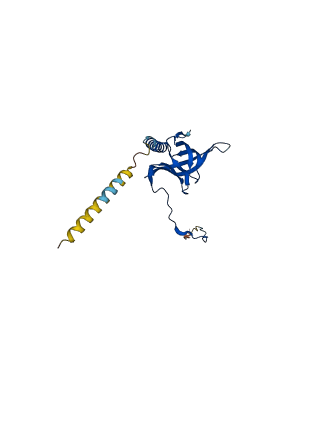
Descriptions
The autoinhibited protein was predicted that may have potential autoinhibitory elements via cis-regPred.
Autoinhibitory domains (AIDs)
Target domain |
|
Relief mechanism |
|
Assay |
cis-regPred |
Accessory elements
No accessory elements
Autoinhibited structure

Activated structure
1 structures for P34022
| Entry ID | Method | Resolution | Chain | Position | Source |
|---|---|---|---|---|---|
| AF-P34022-F1 | Predicted | AlphaFoldDB |
7 variants for P34022
| Variant ID(s) | Position | Change | Description | Diseaes Association | Provenance |
|---|---|---|---|---|---|
| rs3406707375 | 55 | L>Q | No | EVA | |
| rs3389321644 | 68 | K>R | No | EVA | |
| rs3389414569 | 85 | T>S | No | EVA | |
| rs3406136168 | 87 | R>C | No | EVA | |
| rs3389398770 | 94 | K>R | No | EVA | |
| rs3389397106 | 101 | N>K | No | EVA | |
| rs3406724239 | 170 | P>T | No | EVA |
No associated diseases with P34022
7 GO annotations of cellular component
| Name | Definition |
|---|---|
| axon cytoplasm | Any cytoplasm that is part of a axon. |
| centrosome | A structure comprised of a core structure (in most organisms, a pair of centrioles) and peripheral material from which a microtubule-based structure, such as a spindle apparatus, is organized. Centrosomes occur close to the nucleus during interphase in many eukaryotic cells, though in animal cells it changes continually during the cell-division cycle. |
| cytoplasm | The contents of a cell excluding the plasma membrane and nucleus, but including other subcellular structures. |
| cytosol | The part of the cytoplasm that does not contain organelles but which does contain other particulate matter, such as protein complexes. |
| nuclear pore | A protein complex providing a discrete opening in the nuclear envelope of a eukaryotic cell, where the inner and outer nuclear membranes are joined. |
| nucleus | A membrane-bounded organelle of eukaryotic cells in which chromosomes are housed and replicated. In most cells, the nucleus contains all of the cell's chromosomes except the organellar chromosomes, and is the site of RNA synthesis and processing. In some species, or in specialized cell types, RNA metabolism or DNA replication may be absent. |
| plasma membrane bounded cell projection cytoplasm | All of the contents of a plasma membrane bounded cell projection, excluding the plasma membrane surrounding the projection. |
2 GO annotations of molecular function
| Name | Definition |
|---|---|
| GDP-dissociation inhibitor activity | Prevents the dissociation of GDP from a GTPase, thereby preventing GTP from binding. |
| GTPase activator activity | Binds to and increases the activity of a GTPase, an enzyme that catalyzes the hydrolysis of GTP. |
5 GO annotations of biological process
| Name | Definition |
|---|---|
| cellular response to leptomycin B | Any process that results in a change in state or activity of a cell (in terms of movement, secretion, enzyme production, gene expression, etc.) as a result of a leptomycin B stimulus. |
| nucleocytoplasmic transport | The directed movement of molecules between the nucleus and the cytoplasm. |
| positive regulation of mitotic centrosome separation | Any process that activates or increases the frequency, rate or extent of centrosome separation. |
| positive regulation of neuron projection development | Any process that increases the rate, frequency or extent of neuron projection development. Neuron projection development is the process whose specific outcome is the progression of a neuron projection over time, from its formation to the mature structure. A neuron projection is any process extending from a neural cell, such as axons or dendrites (collectively called neurites). |
| spindle organization | A process that is carried out at the cellular level which results in the assembly, arrangement of constituent parts, or disassembly of the spindle, the array of microtubules and associated molecules that forms between opposite poles of a eukaryotic cell during DNA segregation and serves to move the duplicated chromosomes apart. |
5 homologous proteins in AiPD
| UniProt AC | Gene Name | Protein Name | Species | Evidence Code |
|---|---|---|---|---|
| Q3T0M7 | RANBP1 | Ran-specific GTPase-activating protein | Bos taurus (Bovine) | PR |
| P43487 | RANBP1 | Ran-specific GTPase-activating protein | Homo sapiens (Human) | PR |
| P92985 | POX1 | Ran-binding protein 1 homolog c | Arabidopsis thaliana (Mouse-ear cress) | PR |
| Q8RWG8 | RANBP1B | Ran-binding protein 1 homolog b | Arabidopsis thaliana (Mouse-ear cress) | PR |
| Q9LMK7 | RANBP1A | Ran-binding protein 1 homolog a | Arabidopsis thaliana (Mouse-ear cress) | PR |
| 10 | 20 | 30 | 40 | 50 | 60 |
| MAAAKDSHED | HDTSTENADE | SNHDPQFEPI | VSLPEQEIKT | LEEDEEELFK | MRAKLFRFAS |
| 70 | 80 | 90 | 100 | 110 | 120 |
| ENDLPEWKER | GTGDVKLLKH | KEKGTIRLLM | RRDKTLKICA | NHYITPMMEL | KPNAGSDRAW |
| 130 | 140 | 150 | 160 | 170 | 180 |
| VWNTHADFAD | ECPKPELLAI | RFLNAENAQK | FKTKFEECRK | EIEEREKKGP | GKNDNAEKVA |
| 190 | 200 | ||||
| EKLEALSVRE | AREEAEEKSE | EKQ |