P28240
Gene name |
ICL1 |
Protein name |
Isocitrate lyase |
Names |
ICL, Methylisocitrate lyase, MICA, Threo-D(S)-isocitrate glyoxylate-lyase |
Species |
Saccharomyces cerevisiae (strain ATCC 204508 / S288c) (Baker's yeast) |
KEGG Pathway |
sce:YER065C |
EC number |
4.1.3.1: Oxo-acid-lyases |
Protein Class |
|
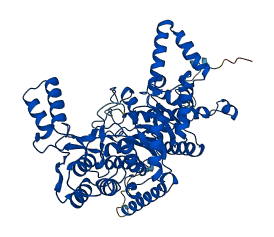
Descriptions
The autoinhibited protein was predicted that may have potential autoinhibitory elements via cis-regPred.
Autoinhibitory domains (AIDs)
Target domain |
|
Relief mechanism |
|
Assay |
cis-regPred |
Accessory elements
No accessory elements
Autoinhibited structure

Activated structure
2 structures for P28240
| Entry ID | Method | Resolution | Chain | Position | Source |
|---|---|---|---|---|---|
| 7EBC | X-ray | 230 A | A/B/C/D | 1-557 | PDB |
| AF-P28240-F1 | Predicted | AlphaFoldDB |
3 variants for P28240
| Variant ID(s) | Position | Change | Description | Diseaes Association | Provenance |
|---|---|---|---|---|---|
| s05-286439 | 158 | K>N | No | SGRP | |
| s05-286036 | 293 | A>T | No | SGRP | |
| s05-285736 | 393 | I>V | No | SGRP |
No associated diseases with P28240
Functions
| Description | ||
|---|---|---|
| EC Number | 4.1.3.1 | Oxo-acid-lyases |
| Subcellular Localization |
|
|
| PANTHER Family | ||
| PANTHER Subfamily | ||
| PANTHER Protein Class | ||
| PANTHER Pathway Category | No pathway information available | |
3 GO annotations of cellular component
| Name | Definition |
|---|---|
| cytoplasm | The contents of a cell excluding the plasma membrane and nucleus, but including other subcellular structures. |
| extracellular region | The space external to the outermost structure of a cell. For cells without external protective or external encapsulating structures this refers to space outside of the plasma membrane. This term covers the host cell environment outside an intracellular parasite. |
| vacuole | A closed structure, found only in eukaryotic cells, that is completely surrounded by unit membrane and contains liquid material. Cells contain one or several vacuoles, that may have different functions from each other. Vacuoles have a diverse array of functions. They can act as a storage organelle for nutrients or waste products, as a degradative compartment, as a cost-effective way of increasing cell size, and as a homeostatic regulator controlling both turgor pressure and pH of the cytosol. |
3 GO annotations of molecular function
| Name | Definition |
|---|---|
| isocitrate lyase activity | Catalysis of the reaction: isocitrate = glyoxylate + succinate. |
| metal ion binding | Binding to a metal ion. |
| methylisocitrate lyase activity | Catalysis of the reaction: (2S,3R)-3-hydroxybutane-1,2,3-tricarboxylate = pyruvate + succinate. |
2 GO annotations of biological process
| Name | Definition |
|---|---|
| glyoxylate cycle | A modification of the TCA cycle occurring in some plants and microorganisms, in which isocitrate is cleaved to glyoxylate and succinate. Glyoxylate can then react with acetyl-CoA to form malate. |
| tricarboxylic acid cycle | A nearly universal metabolic pathway in which the acetyl group of acetyl coenzyme A is effectively oxidized to two CO2 and four pairs of electrons are transferred to coenzymes. The acetyl group combines with oxaloacetate to form citrate, which undergoes successive transformations to isocitrate, 2-oxoglutarate, succinyl-CoA, succinate, fumarate, malate, and oxaloacetate again, thus completing the cycle. In eukaryotes the tricarboxylic acid is confined to the mitochondria. See also glyoxylate cycle. |
8 homologous proteins in AiPD
| UniProt AC | Gene Name | Protein Name | Species | Evidence Code |
|---|---|---|---|---|
| Q12031 | ICL2 | Mitochondrial 2-methylisocitrate lyase ICL2 | Saccharomyces cerevisiae (strain ATCC 204508 / S288c) (Baker's yeast) | PR |
| P17069 | Isocitrate lyase | Gossypium hirsutum (Upland cotton) (Gossypium mexicanum) | PR | |
| Q6Z6M4 | ICL | Isocitrate lyase | Oryza sativa subsp japonica (Rice) | PR |
| Q10663 | icl-1 | Bifunctional glyoxylate cycle protein | Caenorhabditis elegans | PR |
| P45457 | ICL2 | Isocitrate lyase 2 | Glycine max (Soybean) (Glycine hispida) | PR |
| P45456 | ICL1 | Isocitrate lyase 1 | Glycine max (Soybean) (Glycine hispida) | PR |
| P28297 | ICL | Isocitrate lyase | Arabidopsis thaliana (Mouse-ear cress) | PR |
| P49297 | Isocitrate lyase | Solanum lycopersicum (Tomato) (Lycopersicon esculentum) | PR |
| 10 | 20 | 30 | 40 | 50 | 60 |
| MPIPVGNTKN | DFAALQAKLD | ADAAEIEKWW | SDSRWSKTKR | NYSARDIAVR | RGTFPPIEYP |
| 70 | 80 | 90 | 100 | 110 | 120 |
| SSVMARKLFK | VLEKHHNEGT | VSKTFGALDP | VQISQMAKYL | DTIYISGWQC | SSTASTSNEP |
| 130 | 140 | 150 | 160 | 170 | 180 |
| GPDLADYPMD | TVPNKVEHLF | KAQLFHDRKQ | LEARSKAKSQ | EELDEMGAPI | DYLTPIVADA |
| 190 | 200 | 210 | 220 | 230 | 240 |
| DAGHGGLTAV | FKLTKMFIER | GAAGIHMEDQ | TSTNKKCGHM | AGRCVIPVQE | HVNRLVTIRM |
| 250 | 260 | 270 | 280 | 290 | 300 |
| CADIMHSDLI | VVARTDSEAA | TLISSTIDTR | DHYFIVGATN | PNIEPFAEVL | NDAIMSGASG |
| 310 | 320 | 330 | 340 | 350 | 360 |
| QELADIEQKW | CRDAGLKLFH | EAVIDEIERS | ALSNKQELIK | KFTSKVGPLT | ETSHREAKKL |
| 370 | 380 | 390 | 400 | 410 | 420 |
| AKEILGHEIF | FDWELPRVRE | GLYRYRGGTQ | CSIMRARAFA | PYADLVWMES | NYPDFQQAKE |
| 430 | 440 | 450 | 460 | 470 | 480 |
| FAEGVKEKFP | DQWLAYNLSP | SFNWPKAMSV | DEQHTFIQRL | GDLGYIWQFI | TLAGLHTNAL |
| 490 | 500 | 510 | 520 | 530 | 540 |
| AVHNFSRDFA | KDGMKAYAQN | VQQREMDDGV | DVLKHQKWSG | AEYIDGLLKL | AQGGVSATAA |
| 550 | |||||
| MGTGVTEDQF | KENGVKK |