P24270
Gene name |
Cat (Cas-1, Cas1) |
Protein name |
Catalase |
Names |
|
Species |
Mus musculus (Mouse) |
KEGG Pathway |
mmu:12359 |
EC number |
1.11.1.6: Peroxidases |
Protein Class |
|
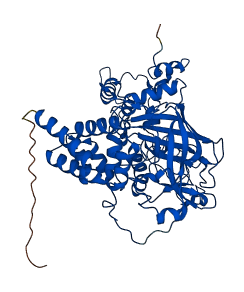
Descriptions
The autoinhibited protein was predicted that may have potential autoinhibitory elements via cis-regPred.
Autoinhibitory domains (AIDs)
Target domain |
|
Relief mechanism |
|
Assay |
cis-regPred |
Accessory elements
No accessory elements
Autoinhibited structure

Activated structure
1 structures for P24270
| Entry ID | Method | Resolution | Chain | Position | Source |
|---|---|---|---|---|---|
| AF-P24270-F1 | Predicted | AlphaFoldDB |
51 variants for P24270
| Variant ID(s) | Position | Change | Description | Diseaes Association | Provenance |
|---|---|---|---|---|---|
| rs3388457506 | 15 | W>* | No | EVA | |
| rs3388457321 | 55 | V>E | No | EVA | |
| rs3388457138 | 71 | E>K | No | EVA | |
| rs3388574270 | 74 | V>L | No | EVA | |
| rs3388569151 | 93 | R>K | No | EVA | |
| rs3388569119 | 116 | V>L | No | EVA | |
| rs33653481 | 117 | T>A | No | EVA | |
| rs3388569069 | 141 | G>V | No | EVA | |
| rs3388456441 | 171 | N>K | No | EVA | |
| rs3388456449 | 181 | M>I | No | EVA | |
| rs3388457018 | 207 | D>Y | No | EVA | |
| rs3388572570 | 218 | H>Y | No | EVA | |
| rs3388456171 | 250 | A>T | No | EVA | |
| rs3388569226 | 258 | P>Q | No | EVA | |
| rs3388573039 | 265 | L>P | No | EVA | |
| rs3391929745 | 275 | P>* | No | EVA | |
| rs3391837401 | 277 | W>* | No | EVA | |
| rs3388569098 | 319 | N>K | No | EVA | |
| rs3391999011 | 321 | N>* | No | EVA | |
| rs3388573103 | 336 | P>S | No | EVA | |
| rs3388456880 | 372 | Q>* | No | EVA | |
| rs3388573097 | 377 | C>* | No | EVA | |
| rs3388456418 | 377 | C>R | No | EVA | |
| rs3388456948 | 384 | A>T | No | EVA | |
| rs3388456198 | 388 | R>C | No | EVA | |
| rs3388456198 | 388 | R>S | No | EVA | |
| rs3388562908 | 408 | S>C | No | EVA | |
| rs3392011384 | 408 | S>I | No | EVA | |
| rs3391899629 | 409 | F>Y | No | EVA | |
| rs3392011334 | 412 | P>L | No | EVA | |
| rs3391704117 | 414 | Q>L | No | EVA | |
| rs3392039246 | 417 | S>* | No | EVA | |
| rs3388456721 | 418 | A>S | No | EVA | |
| rs3388569077 | 422 | S>C | No | EVA | |
| rs3388569077 | 422 | S>R | No | EVA | |
| rs3391975927 | 424 | Q>* | No | EVA | |
| rs3392000508 | 424 | Q>R | No | EVA | |
| rs3392009243 | 427 | V>E | No | EVA | |
| rs3388566064 | 434 | S>T | No | EVA | |
| rs3388574231 | 437 | E>K | No | EVA | |
| rs27356437 | 465 | G>C | No | EVA | |
| rs3388456999 | 495 | A>D | No | EVA | |
| rs3388456966 | 496 | L>I | No | EVA | |
| rs3388457162 | 503 | E>* | No | EVA | |
| rs3388456143 | 505 | P>H | No | EVA | |
| rs241604303 | 508 | A>T | No | EVA | |
| rs3388456413 | 510 | H>N | No | EVA | |
| rs3388576188 | 511 | T>I | No | EVA | |
| rs3388574206 | 512 | Y>N | No | EVA | |
| rs3388576203 | 516 | G>S | No | EVA | |
| rs3388457261 | 526 | N>K | No | EVA |
No associated diseases with P24270
Functions
| Description | ||
|---|---|---|
| EC Number | 1.11.1.6 | Peroxidases |
| Subcellular Localization |
|
|
| PANTHER Family | ||
| PANTHER Subfamily | ||
| PANTHER Protein Class | ||
| PANTHER Pathway Category | No pathway information available | |
14 GO annotations of cellular component
| Name | Definition |
|---|---|
| catalase complex | A protein-containing complex that is capable of catalase activity. |
| cytoplasm | The contents of a cell excluding the plasma membrane and nucleus, but including other subcellular structures. |
| cytosol | The part of the cytoplasm that does not contain organelles but which does contain other particulate matter, such as protein complexes. |
| endoplasmic reticulum | The irregular network of unit membranes, visible only by electron microscopy, that occurs in the cytoplasm of many eukaryotic cells. The membranes form a complex meshwork of tubular channels, which are often expanded into slitlike cavities called cisternae. The ER takes two forms, rough (or granular), with ribosomes adhering to the outer surface, and smooth (with no ribosomes attached). |
| extracellular space | That part of a multicellular organism outside the cells proper, usually taken to be outside the plasma membranes, and occupied by fluid. |
| Golgi apparatus | A membrane-bound cytoplasmic organelle of the endomembrane system that further processes the core oligosaccharides (e.g. N-glycans) added to proteins in the endoplasmic reticulum and packages them into membrane-bound vesicles. The Golgi apparatus operates at the intersection of the secretory, lysosomal, and endocytic pathways. |
| intracellular membrane-bounded organelle | Organized structure of distinctive morphology and function, bounded by a single or double lipid bilayer membrane and occurring within the cell. Includes the nucleus, mitochondria, plastids, vacuoles, and vesicles. Excludes the plasma membrane. |
| lysosome | A small lytic vacuole that has cell cycle-independent morphology found in most animal cells and that contains a variety of hydrolases, most of which have their maximal activities in the pH range 5-6. The contained enzymes display latency if properly isolated. About 40 different lysosomal hydrolases are known and lysosomes have a great variety of morphologies and functions. |
| mitochondrial intermembrane space | The region between the inner and outer lipid bilayers of the mitochondrial envelope. |
| mitochondrion | A semiautonomous, self replicating organelle that occurs in varying numbers, shapes, and sizes in the cytoplasm of virtually all eukaryotic cells. It is notably the site of tissue respiration. |
| peroxisomal membrane | The lipid bilayer surrounding a peroxisome. |
| peroxisome | A small organelle enclosed by a single membrane, and found in most eukaryotic cells. Contains peroxidases and other enzymes involved in a variety of metabolic processes including free radical detoxification, lipid catabolism and biosynthesis, and hydrogen peroxide metabolism. |
| plasma membrane | The membrane surrounding a cell that separates the cell from its external environment. It consists of a phospholipid bilayer and associated proteins. |
| protein-containing complex | A stable assembly of two or more macromolecules, i.e. proteins, nucleic acids, carbohydrates or lipids, in which at least one component is a protein and the constituent parts function together. |
11 GO annotations of molecular function
| Name | Definition |
|---|---|
| aminoacylase activity | Catalysis of the reaction: an N-acyl-L-amino acid + H2O = a carboxylate + an L-amino acid. |
| antioxidant activity | Inhibition of the reactions brought about by dioxygen (O2) or peroxides. Usually the antioxidant is effective because it can itself be more easily oxidized than the substance protected. The term is often applied to components that can trap free radicals, thereby breaking the chain reaction that normally leads to extensive biological damage. |
| catalase activity | Catalysis of the reaction: 2 hydrogen peroxide = O2 + 2 H2O. |
| enzyme binding | Binding to an enzyme, a protein with catalytic activity. |
| heme binding | Binding to a heme, a compound composed of iron complexed in a porphyrin (tetrapyrrole) ring. |
| identical protein binding | Binding to an identical protein or proteins. |
| metal ion binding | Binding to a metal ion. |
| NADP binding | Binding to nicotinamide-adenine dinucleotide phosphate, a coenzyme involved in many redox and biosynthetic reactions; binding may be to either the oxidized form, NADP+, or the reduced form, NADPH. |
| oxidoreductase activity, acting on peroxide as acceptor | Catalysis of an oxidation-reduction (redox) reaction in which the peroxide group acts as a hydrogen or electron acceptor. |
| peroxisome targeting sequence binding | Binding to a peroxisomal targeting sequence, a sequence of amino acids within a protein that acts as a signal for the localization of a protein into the peroxisome. |
| protein homodimerization activity | Binding to an identical protein to form a homodimer. |
36 GO annotations of biological process
| Name | Definition |
|---|---|
| aerobic respiration | The enzymatic release of energy from inorganic and organic compounds (especially carbohydrates and fats) which requires oxygen as the terminal electron acceptor. |
| aging | A developmental process that is a deterioration and loss of function over time. Aging includes loss of functions such as resistance to disease, homeostasis, and fertility, as well as wear and tear. Aging includes cellular senescence, but is more inclusive. May precede death and may succeed developmental maturation (GO:0021700). |
| cellular detoxification of hydrogen peroxide | Any process that reduces or removes the toxicity of hydrogen peroxide in a cell. These include transport of hydrogen peroxide away from sensitive areas and to compartments or complexes whose purpose is sequestration. |
| cellular response to growth factor stimulus | Any process that results in a change in state or activity of a cell (in terms of movement, secretion, enzyme production, gene expression, etc.) as a result of a growth factor stimulus. |
| cholesterol metabolic process | The chemical reactions and pathways involving cholesterol, cholest-5-en-3 beta-ol, the principal sterol of vertebrates and the precursor of many steroids, including bile acids and steroid hormones. It is a component of the plasma membrane lipid bilayer and of plasma lipoproteins and can be found in all animal tissues. |
| hemoglobin metabolic process | The chemical reactions and pathways involving hemoglobin, including its uptake and utilization. |
| hydrogen peroxide catabolic process | The chemical reactions and pathways resulting in the breakdown of hydrogen peroxide (H2O2). |
| kidney development | The process whose specific outcome is the progression of the kidney over time, from its formation to the mature structure. The kidney is an organ that filters the blood and/or excretes the end products of body metabolism in the form of urine. |
| negative regulation of apoptotic process | Any process that stops, prevents, or reduces the frequency, rate or extent of cell death by apoptotic process. |
| negative regulation of NF-kappaB transcription factor activity | Any process that stops, prevents, or reduces the frequency, rate or extent of the activity of the transcription factor NF-kappaB. |
| positive regulation of cell division | Any process that activates or increases the frequency, rate or extent of cell division. |
| positive regulation of NF-kappaB transcription factor activity | Any process that activates or increases the frequency, rate or extent of activity of the transcription factor NF-kappaB. |
| positive regulation of phosphatidylinositol 3-kinase signaling | Any process that activates or increases the frequency, rate or extent of signal transduction mediated by the phosphatidylinositol 3-kinase cascade. |
| response to activity | Any process that results in a change in state or activity of a cell or an organism (in terms of movement, secretion, enzyme production, gene expression, etc.) as a result of an activity stimulus. |
| response to cadmium ion | Any process that results in a change in state or activity of a cell or an organism (in terms of movement, secretion, enzyme production, gene expression, etc.) as a result of a cadmium (Cd) ion stimulus. |
| response to estradiol | Any process that results in a change in state or activity of a cell or an organism (in terms of movement, secretion, enzyme production, gene expression, etc.) as a result of stimulus by estradiol, a C18 steroid hormone hydroxylated at C3 and C17 that acts as a potent estrogen. |
| response to ethanol | Any process that results in a change in state or activity of a cell or an organism (in terms of movement, secretion, enzyme production, gene expression, etc.) as a result of an ethanol stimulus. |
| response to fatty acid | Any process that results in a change in state or activity of a cell or an organism (in terms of movement, secretion, enzyme production, gene expression, etc.) as a result of a fatty acid stimulus. |
| response to hydrogen peroxide | Any process that results in a change in state or activity of a cell or an organism (in terms of movement, secretion, enzyme production, gene expression, etc.) as a result of a hydrogen peroxide (H2O2) stimulus. |
| response to hyperoxia | Any process that results in a change in state or activity of a cell or an organism (in terms of movement, secretion, enzyme production, gene expression, etc.) as a result of a stimulus indicating increased oxygen tension. |
| response to hypoxia | Any process that results in a change in state or activity of a cell or an organism (in terms of movement, secretion, enzyme production, gene expression, etc.) as a result of a stimulus indicating lowered oxygen tension. Hypoxia, defined as a decline in O2 levels below normoxic levels of 20.8 - 20.95%, results in metabolic adaptation at both the cellular and organismal level. |
| response to inactivity | Any process that results in a change in state or activity of a cell or an organism (in terms of movement, secretion, enzyme production, gene expression, etc.) as a result of an inactivity stimulus. |
| response to insulin | Any process that results in a change in state or activity of a cell or an organism (in terms of movement, secretion, enzyme production, gene expression, etc.) as a result of an insulin stimulus. Insulin is a polypeptide hormone produced by the islets of Langerhans of the pancreas in mammals, and by the homologous organs of other organisms. |
| response to L-ascorbic acid | Any process that results in a change in state or activity of a cell or an organism (in terms of movement, secretion, enzyme production, gene expression, etc.) as a result of an L-ascorbic acid (vitamin C) stimulus. |
| response to lead ion | Any process that results in a change in state or activity of a cell or an organism (in terms of movement, secretion, enzyme production, gene expression, etc.) as a result of a lead ion stimulus. |
| response to light intensity | Any process that results in a change in state or activity of a cell or an organism (in terms of movement, secretion, enzyme production, gene expression, etc.) as a result of a light intensity stimulus. |
| response to oxidative stress | Any process that results in a change in state or activity of a cell or an organism (in terms of movement, secretion, enzyme production, gene expression, etc.) as a result of oxidative stress, a state often resulting from exposure to high levels of reactive oxygen species, e.g. superoxide anions, hydrogen peroxide (H2O2), and hydroxyl radicals. |
| response to ozone | Any process that results in a change in state or activity of a cell or an organism (in terms of movement, secretion, enzyme production, gene expression, etc.) as a result of a ozone stimulus. |
| response to phenylpropanoid | Any process that results in a change in state or activity of a cell or organism (in terms of movement, secretion, enzyme production, gene expression, etc.) as the result of a phenylpropanoid stimulus. The process begins with detection of the stimulus and ends with a change in state or activity or the cell or organism. A phenylpropanoid is any of secondary metabolites with structures based on a phenylpropane skeleton. The class includes phenylpropanoid esters, flavonoids, anthocyanins, coumarins and many small phenolic molecules. Phenylpropanoids are also precursors of lignin. |
| response to reactive oxygen species | Any process that results in a change in state or activity of a cell or an organism (in terms of movement, secretion, enzyme production, gene expression, etc.) as a result of a reactive oxygen species stimulus. Reactive oxygen species include singlet oxygen, superoxide, and oxygen free radicals. |
| response to vitamin A | Any process that results in a change in state or activity of a cell or an organism (in terms of movement, secretion, enzyme production, gene expression, etc.) as a result of a vitamin A stimulus. |
| response to vitamin E | Any process that results in a change in state or activity of a cell or an organism (in terms of movement, secretion, enzyme production, gene expression, etc.) as a result of a vitamin E stimulus. |
| response to xenobiotic stimulus | Any process that results in a change in state or activity of a cell or an organism (in terms of movement, secretion, enzyme production, gene expression, etc.) as a result of a stimulus from a xenobiotic, a compound foreign to the organim exposed to it. It may be synthesized by another organism (like ampicilin) or it can be a synthetic chemical. |
| triglyceride metabolic process | The chemical reactions and pathways involving triglyceride, any triester of glycerol. The three fatty acid residues may all be the same or differ in any permutation. Triglycerides are important components of plant oils, animal fats and animal plasma lipoproteins. |
| ureteric bud development | The process whose specific outcome is the progression of the ureteric bud over time, from its formation to the mature structure. |
| UV protection | Any process in which an organism or cell protects itself from ultraviolet radiation (UV), which may also result in resistance to repeated exposure to UV. |
11 homologous proteins in AiPD
| UniProt AC | Gene Name | Protein Name | Species | Evidence Code |
|---|---|---|---|---|
| Q43206 | CAT1 | Catalase-1 | Triticum aestivum (Wheat) | PR |
| O97492 | CAT | Catalase | Canis lupus familiaris (Dog) (Canis familiaris) | PR |
| P17336 | Cat | Catalase | Drosophila melanogaster (Fruit fly) | PR |
| P18122 | CAT1 | Catalase isozyme 1 | Zea mays (Maize) | PR |
| P04762 | Cat | Catalase | Rattus norvegicus (Rat) | PR |
| Q0D9C4 | CATB | Catalase isozyme B | Oryza sativa subsp japonica (Rice) | PR |
| Q0E4K1 | CATA | Catalase isozyme A | Oryza sativa subsp japonica (Rice) | PR |
| O61235 | ctl-1 | Catalase-2 | Caenorhabditis elegans | PR |
| Q27487 | ctl-2 | Peroxisomal catalase 1 | Caenorhabditis elegans | PR |
| Q42547 | CAT3 | Catalase-3 | Arabidopsis thaliana (Mouse-ear cress) | PR |
| P25819 | CAT2 | Catalase-2 | Arabidopsis thaliana (Mouse-ear cress) | PR |
| 10 | 20 | 30 | 40 | 50 | 60 |
| MSDSRDPASD | QMKQWKEQRA | SQRPDVLTTG | GGNPIGDKLN | IMTAGSRGPL | LVQDVVFTDE |
| 70 | 80 | 90 | 100 | 110 | 120 |
| MAHFDRERIP | ERVVHAKGAG | AFGYFEVTHD | ITRYSKAKVF | EHIGKRTPIA | VRFSTVTGES |
| 130 | 140 | 150 | 160 | 170 | 180 |
| GSADTVRDPR | GFAVKFYTED | GNWDLVGNNT | PIFFIRDAIL | FPSFIHSQKR | NPQTHLKDPD |
| 190 | 200 | 210 | 220 | 230 | 240 |
| MVWDFWSLRP | ESLHQVSFLF | SDRGIPDGHR | HMNGYGSHTF | KLVNADGEAV | YCKFHYKTDQ |
| 250 | 260 | 270 | 280 | 290 | 300 |
| GIKNLPVGEA | GRLAQEDPDY | GLRDLFNAIA | NGNYPSWTFY | IQVMTFKEAE | TFPFNPFDLT |
| 310 | 320 | 330 | 340 | 350 | 360 |
| KVWPHKDYPL | IPVGKLVLNK | NPVNYFAEVE | QMAFDPSNMP | PGIEPSPDKM | LQGRLFAYPD |
| 370 | 380 | 390 | 400 | 410 | 420 |
| THRHRLGPNY | LQIPVNCPYR | ARVANYQRDG | PMCMHDNQGG | APNYYPNSFS | APEQQRSALE |
| 430 | 440 | 450 | 460 | 470 | 480 |
| HSVQCAVDVK | RFNSANEDNV | TQVRTFYTKV | LNEEERKRLC | ENIAGHLKDA | QLFIQKKAVK |
| 490 | 500 | 510 | 520 | ||
| NFTDVHPDYG | ARIQALLDKY | NAEKPKNAIH | TYTQAGSHMA | AKGKANL |