P18122
Gene name |
CAT1 |
Protein name |
Catalase isozyme 1 |
Names |
|
Species |
Zea mays (Maize) |
KEGG Pathway |
|
EC number |
1.11.1.6: Peroxidases |
Protein Class |
|
Descriptions
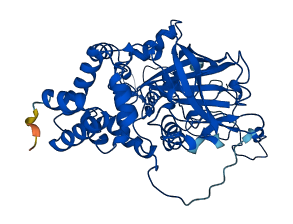
The autoinhibited protein was predicted that may have potential autoinhibitory elements via cis-regPred.
Autoinhibitory domains (AIDs)
Target domain |
|
Relief mechanism |
|
Assay |
cis-regPred |
Accessory elements
No accessory elements
Autoinhibited structure

Activated structure
1 structures for P18122
| Entry ID | Method | Resolution | Chain | Position | Source |
|---|---|---|---|---|---|
| AF-P18122-F1 | Predicted | AlphaFoldDB |
4 variants for P18122
| Variant ID(s) | Position | Change | Description | Diseaes Association | Provenance |
|---|---|---|---|---|---|
| 157 | A>V | strain: cv. W64A [UniProt] | No | ||
| 211 | S>T | strain: cv. W64A [UniProt] | No | ||
| 329 | S>I | strain: cv. W64A [UniProt] | No | ||
| 483 | P>A | strain: cv. W64A [UniProt] | No |
No associated diseases with P18122
Functions
| Description | ||
|---|---|---|
| EC Number | 1.11.1.6 | Peroxidases |
| Subcellular Localization |
|
|
| PANTHER Family | ||
| PANTHER Subfamily | ||
| PANTHER Protein Class | ||
| PANTHER Pathway Category | No pathway information available | |
3 GO annotations of cellular component
| Name | Definition |
|---|---|
| cytoplasm | The contents of a cell excluding the plasma membrane and nucleus, but including other subcellular structures. |
| peroxisome | A small organelle enclosed by a single membrane, and found in most eukaryotic cells. Contains peroxidases and other enzymes involved in a variety of metabolic processes including free radical detoxification, lipid catabolism and biosynthesis, and hydrogen peroxide metabolism. |
| plasma membrane | The membrane surrounding a cell that separates the cell from its external environment. It consists of a phospholipid bilayer and associated proteins. |
3 GO annotations of molecular function
| Name | Definition |
|---|---|
| catalase activity | Catalysis of the reaction: 2 hydrogen peroxide = O2 + 2 H2O. |
| heme binding | Binding to a heme, a compound composed of iron complexed in a porphyrin (tetrapyrrole) ring. |
| metal ion binding | Binding to a metal ion. |
16 GO annotations of biological process
| Name | Definition |
|---|---|
| circadian rhythm | Any biological process in an organism that recurs with a regularity of approximately 24 hours. |
| cold acclimation | Any process that increases freezing tolerance of an organism in response to low, nonfreezing temperatures. |
| hydrogen peroxide catabolic process | The chemical reactions and pathways resulting in the breakdown of hydrogen peroxide (H2O2). |
| regulation of cellular response to heat | Any process that modulates the frequency, rate or extent of cellular response to heat. |
| response to abscisic acid | Any process that results in a change in state or activity of a cell or an organism (in terms of movement, secretion, enzyme production, gene expression, etc.) as a result of an abscisic acid stimulus. |
| response to absence of light | Any process that results in a change in state or activity of a cell or an organism (in terms of movement, secretion, enzyme production, gene expression, etc.) as a result of an absence of light stimuli. |
| response to auxin | Any process that results in a change in state or activity of a cell or an organism (in terms of movement, secretion, enzyme production, gene expression, etc.) as a result of an auxin stimulus. |
| response to cadmium ion | Any process that results in a change in state or activity of a cell or an organism (in terms of movement, secretion, enzyme production, gene expression, etc.) as a result of a cadmium (Cd) ion stimulus. |
| response to heat | Any process that results in a change in state or activity of a cell or an organism (in terms of movement, secretion, enzyme production, gene expression, etc.) as a result of a heat stimulus, a temperature stimulus above the optimal temperature for that organism. |
| response to hydrogen peroxide | Any process that results in a change in state or activity of a cell or an organism (in terms of movement, secretion, enzyme production, gene expression, etc.) as a result of a hydrogen peroxide (H2O2) stimulus. |
| response to oxidative stress | Any process that results in a change in state or activity of a cell or an organism (in terms of movement, secretion, enzyme production, gene expression, etc.) as a result of oxidative stress, a state often resulting from exposure to high levels of reactive oxygen species, e.g. superoxide anions, hydrogen peroxide (H2O2), and hydroxyl radicals. |
| response to reactive oxygen species | Any process that results in a change in state or activity of a cell or an organism (in terms of movement, secretion, enzyme production, gene expression, etc.) as a result of a reactive oxygen species stimulus. Reactive oxygen species include singlet oxygen, superoxide, and oxygen free radicals. |
| response to salicylic acid | Any process that results in a change in state or activity of a cell or an organism (in terms of movement, secretion, enzyme production, gene expression, etc.) as a result of a salicylic acid stimulus. |
| response to salt | Any process that results in a change in state or activity of a cell or an organism (in terms of movement, secretion, enzyme production, gene expression, etc.) as a result of a salt stimulus. |
| response to water deprivation | Any process that results in a change in state or activity of a cell or an organism (in terms of movement, secretion, enzyme production, gene expression, etc.) as a result of a water deprivation stimulus, prolonged deprivation of water. |
| response to xenobiotic stimulus | Any process that results in a change in state or activity of a cell or an organism (in terms of movement, secretion, enzyme production, gene expression, etc.) as a result of a stimulus from a xenobiotic, a compound foreign to the organim exposed to it. It may be synthesized by another organism (like ampicilin) or it can be a synthetic chemical. |
10 homologous proteins in AiPD
| UniProt AC | Gene Name | Protein Name | Species | Evidence Code |
|---|---|---|---|---|
| Q43206 | CAT1 | Catalase-1 | Triticum aestivum (Wheat) | PR |
| P17336 | Cat | Catalase | Drosophila melanogaster (Fruit fly) | PR |
| P24270 | Cat | Catalase | Mus musculus (Mouse) | PR |
| P04762 | Cat | Catalase | Rattus norvegicus (Rat) | PR |
| Q0E4K1 | CATA | Catalase isozyme A | Oryza sativa subsp japonica (Rice) | PR |
| Q0D9C4 | CATB | Catalase isozyme B | Oryza sativa subsp japonica (Rice) | PR |
| Q27487 | ctl-2 | Peroxisomal catalase 1 | Caenorhabditis elegans | PR |
| O61235 | ctl-1 | Catalase-2 | Caenorhabditis elegans | PR |
| Q42547 | CAT3 | Catalase-3 | Arabidopsis thaliana (Mouse-ear cress) | PR |
| P25819 | CAT2 | Catalase-2 | Arabidopsis thaliana (Mouse-ear cress) | PR |
| 10 | 20 | 30 | 40 | 50 | 60 |
| MDPYKHRPSS | GSNSSFWTTN | SGAPVWNNNS | ALTVGQRGPI | LLEDYHLIEK | LAQFDRERIP |
| 70 | 80 | 90 | 100 | 110 | 120 |
| ERVVHARGAS | AKGFFEVTHD | VSHLTCADFL | RAPGVQTPVI | VRFSTVVHER | GSPETLRDPR |
| 130 | 140 | 150 | 160 | 170 | 180 |
| GFAVKFYTRE | GNFDLVGNNM | PVFFIRDGMK | FPDMVHAFKP | NPKTNLQENW | RIVDFFSHHP |
| 190 | 200 | 210 | 220 | 230 | 240 |
| ESLHMFTFLF | DDVGIPLNYR | HMEGFGVNTY | SLINRDGKPH | LVKFHWKPTC | GVKCLLDNEA |
| 250 | 260 | 270 | 280 | 290 | 300 |
| VTVGGTCHSH | ATKDLYDSIA | AGNYPEWKLY | IQTIDLDHED | KFDFDPLDVT | KTWPEDIIPL |
| 310 | 320 | 330 | 340 | 350 | 360 |
| QPVGRMVLNK | NVDNFFAENE | QIAFCPAISV | PAIHYSDDKL | LQTRIFSYAD | TQRHRLGPNY |
| 370 | 380 | 390 | 400 | 410 | 420 |
| LMLPVNAPKC | AHHNNHHDGF | MNFMHRDEEV | NYFPSRFDPA | RHAEKVPIPP | RVLTRCREKC |
| 430 | 440 | 450 | 460 | 470 | 480 |
| IIQKENNFKQ | AGERYRSFDP | ARQDRFIQRW | VDALTHPRVT | HEHRTIWISY | WSQCDAALGQ |
| 490 | |||||
| KLPSRLNLKP | SM |