Q42547
Gene name |
CAT3 (At1g20620, F2D10.40, F5M15.5) |
Protein name |
Catalase-3 |
Names |
|
Species |
Arabidopsis thaliana (Mouse-ear cress) |
KEGG Pathway |
ath:AT1G20620 |
EC number |
1.11.1.6: Peroxidases |
Protein Class |
|
Descriptions
The autoinhibited protein was predicted that may have potential autoinhibitory elements via cis-regPred.
Autoinhibitory domains (AIDs)
Target domain |
|
Relief mechanism |
|
Assay |
cis-regPred |
Accessory elements
No accessory elements
Autoinhibited structure

Activated structure
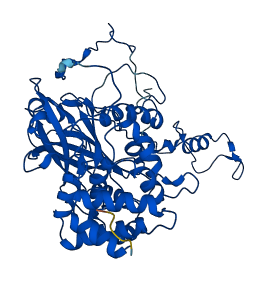
1 structures for Q42547
| Entry ID | Method | Resolution | Chain | Position | Source |
|---|---|---|---|---|---|
| AF-Q42547-F1 | Predicted | AlphaFoldDB |
10 variants for Q42547
| Variant ID(s) | Position | Change | Description | Diseaes Association | Provenance |
|---|---|---|---|---|---|
| ENSVATH11638950 | 79 | H>Y | No | 1000Genomes | |
| tmp_1_7144633_A_G | 96 | Q>R | No | 1000Genomes | |
| tmp_1_7145015_G_A | 193 | V>I | No | 1000Genomes | |
| tmp_1_7145314_C_G | 292 | I>M | No | 1000Genomes | |
| ENSVATH04610329 | 378 | E>D | No | 1000Genomes | |
| tmp_1_7145921_C_G | 433 | D>E | No | 1000Genomes | |
| ENSVATH11639196 | 454 | L>I | No | 1000Genomes | |
| ENSVATH00034232 | 466 | I>V | No | 1000Genomes | |
| ENSVATH13933512 | 479 | G>R | No | 1000Genomes | |
| tmp_1_7146188_A_C | 492 | I>L | No | 1000Genomes |
No associated diseases with Q42547
Functions
| Description | ||
|---|---|---|
| EC Number | 1.11.1.6 | Peroxidases |
| Subcellular Localization |
|
|
| PANTHER Family | ||
| PANTHER Subfamily | ||
| PANTHER Protein Class | ||
| PANTHER Pathway Category | No pathway information available | |
14 GO annotations of cellular component
| Name | Definition |
|---|---|
| apoplast | The cell membranes and intracellular regions in a plant are connected through plasmodesmata, and plants may be described as having two major compartments: the living symplast and the non-living apoplast. The apoplast is external to the plasma membrane and includes cell walls, intercellular spaces and the lumen of dead structures such as xylem vessels. Water and solutes pass freely through it. |
| chloroplast | A chlorophyll-containing plastid with thylakoids organized into grana and frets, or stroma thylakoids, and embedded in a stroma. |
| chloroplast envelope | The double lipid bilayer enclosing the chloroplast and separating its contents from the rest of the cytoplasm; includes the intermembrane space. |
| chloroplast stroma | The space enclosed by the double membrane of a chloroplast but excluding the thylakoid space. It contains DNA, ribosomes and some temporary products of photosynthesis. |
| cytoplasm | The contents of a cell excluding the plasma membrane and nucleus, but including other subcellular structures. |
| cytosol | The part of the cytoplasm that does not contain organelles but which does contain other particulate matter, such as protein complexes. |
| cytosolic ribosome | A ribosome located in the cytosol. |
| mitochondrion | A semiautonomous, self replicating organelle that occurs in varying numbers, shapes, and sizes in the cytoplasm of virtually all eukaryotic cells. It is notably the site of tissue respiration. |
| nucleus | A membrane-bounded organelle of eukaryotic cells in which chromosomes are housed and replicated. In most cells, the nucleus contains all of the cell's chromosomes except the organellar chromosomes, and is the site of RNA synthesis and processing. In some species, or in specialized cell types, RNA metabolism or DNA replication may be absent. |
| peroxisome | A small organelle enclosed by a single membrane, and found in most eukaryotic cells. Contains peroxidases and other enzymes involved in a variety of metabolic processes including free radical detoxification, lipid catabolism and biosynthesis, and hydrogen peroxide metabolism. |
| plant-type cell wall | A more or less rigid stucture lying outside the cell membrane of a cell and composed of cellulose and pectin and other organic and inorganic substances. |
| plant-type vacuole | A closed structure that is completely surrounded by a unit membrane, contains liquid, and retains the same shape regardless of cell cycle phase. An example of this structure is found in Arabidopsis thaliana. |
| plasma membrane | The membrane surrounding a cell that separates the cell from its external environment. It consists of a phospholipid bilayer and associated proteins. |
| plasmodesma | A fine cytoplasmic channel, found in all higher plants, that connects the cytoplasm of one cell to that of an adjacent cell. |
5 GO annotations of molecular function
| Name | Definition |
|---|---|
| catalase activity | Catalysis of the reaction: 2 hydrogen peroxide = O2 + 2 H2O. |
| cobalt ion binding | Binding to a cobalt ion (Co). |
| heme binding | Binding to a heme, a compound composed of iron complexed in a porphyrin (tetrapyrrole) ring. |
| mRNA binding | Binding to messenger RNA (mRNA), an intermediate molecule between DNA and protein. mRNA includes UTR and coding sequences, but does not contain introns. |
| peptidyl-cysteine S-nitrosylase activity | Catalysis of the transfer of a nitric oxide (NO) group to a sulphur atom within a cysteine residue of a protein. |
8 GO annotations of biological process
| Name | Definition |
|---|---|
| cellular response to nitrogen starvation | Any process that results in a change in state or activity of a cell (in terms of movement, secretion, enzyme production, gene expression, etc.) as a result of deprivation of nitrogen. |
| cellular response to phosphate starvation | Any process that results in a change in state or activity of a cell (in terms of movement, secretion, enzyme production, gene expression, etc.) as a result of deprivation of phosphate. |
| cellular response to sulfate starvation | Any process that results in a change in state or activity of a cell (in terms of movement, secretion, enzyme production, gene expression, etc.) as a result of deprivation of sulfate. |
| hydrogen peroxide catabolic process | The chemical reactions and pathways resulting in the breakdown of hydrogen peroxide (H2O2). |
| peptidyl-cysteine S-trans-nitrosylation | Transfer of a nitric oxide (NO) group from one cysteine residue to another. |
| response to cold | Any process that results in a change in state or activity of a cell or an organism (in terms of movement, secretion, enzyme production, gene expression, etc.) as a result of a cold stimulus, a temperature stimulus below the optimal temperature for that organism. |
| response to hydrogen peroxide | Any process that results in a change in state or activity of a cell or an organism (in terms of movement, secretion, enzyme production, gene expression, etc.) as a result of a hydrogen peroxide (H2O2) stimulus. |
| response to light stimulus | Any process that results in a change in state or activity of a cell or an organism (in terms of movement, secretion, enzyme production, gene expression, etc.) as a result of a light stimulus, electromagnetic radiation of wavelengths classified as infrared, visible or ultraviolet light. |
10 homologous proteins in AiPD
| UniProt AC | Gene Name | Protein Name | Species | Evidence Code |
|---|---|---|---|---|
| Q43206 | CAT1 | Catalase-1 | Triticum aestivum (Wheat) | PR |
| P17336 | Cat | Catalase | Drosophila melanogaster (Fruit fly) | PR |
| P18122 | CAT1 | Catalase isozyme 1 | Zea mays (Maize) | PR |
| P24270 | Cat | Catalase | Mus musculus (Mouse) | PR |
| P04762 | Cat | Catalase | Rattus norvegicus (Rat) | PR |
| Q0E4K1 | CATA | Catalase isozyme A | Oryza sativa subsp japonica (Rice) | PR |
| Q0D9C4 | CATB | Catalase isozyme B | Oryza sativa subsp japonica (Rice) | PR |
| Q27487 | ctl-2 | Peroxisomal catalase 1 | Caenorhabditis elegans | PR |
| O61235 | ctl-1 | Catalase-2 | Caenorhabditis elegans | PR |
| P25819 | CAT2 | Catalase-2 | Arabidopsis thaliana (Mouse-ear cress) | PR |
| 10 | 20 | 30 | 40 | 50 | 60 |
| MDPYKYRPSS | AYNAPFYTTN | GGAPVSNNIS | SLTIGERGPV | LLEDYHLIEK | VANFTRERIP |
| 70 | 80 | 90 | 100 | 110 | 120 |
| ERVVHARGIS | AKGFFEVTHD | ISNLTCADFL | RAPGVQTPVI | VRFSTVVHER | ASPETMRDIR |
| 130 | 140 | 150 | 160 | 170 | 180 |
| GFAVKFYTRE | GNFDLVGNNT | PVFFIRDGIQ | FPDVVHALKP | NPKTNIQEYW | RILDYMSHLP |
| 190 | 200 | 210 | 220 | 230 | 240 |
| ESLLTWCWMF | DDVGIPQDYR | HMEGFGVHTY | TLIAKSGKVL | FVKFHWKPTC | GIKNLTDEEA |
| 250 | 260 | 270 | 280 | 290 | 300 |
| KVVGGANHSH | ATKDLHDAIA | SGNYPEWKLF | IQTMDPADED | KFDFDPLDVT | KIWPEDILPL |
| 310 | 320 | 330 | 340 | 350 | 360 |
| QPVGRLVLNR | TIDNFFNETE | QLAFNPGLVV | PGIYYSDDKL | LQCRIFAYGD | TQRHRLGPNY |
| 370 | 380 | 390 | 400 | 410 | 420 |
| LQLPVNAPKC | AHHNNHHEGF | MNFMHRDEEI | NYYPSKFDPV | RCAEKVPTPT | NSYTGIRTKC |
| 430 | 440 | 450 | 460 | 470 | 480 |
| VIKKENNFKQ | AGDRYRSWAP | DRQDRFVKRW | VEILSEPRLT | HEIRGIWISY | WSQADRSLGQ |
| 490 | |||||
| KLASRLNVRP | SI |