P24049
Gene name |
Rpl17 |
Protein name |
60S ribosomal protein L17 |
Names |
Amino acid starvation-induced protein, ASI, L23 |
Species |
Rattus norvegicus (Rat) |
KEGG Pathway |
rno:291434 |
EC number |
|
Protein Class |
|
Descriptions
The autoinhibited protein was predicted that may have potential autoinhibitory elements via cis-regPred.
Autoinhibitory domains (AIDs)
Target domain |
|
Relief mechanism |
|
Assay |
cis-regPred |
Accessory elements
No accessory elements
Autoinhibited structure

Activated structure
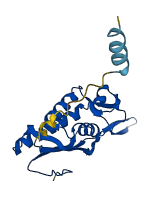
1 structures for P24049
| Entry ID | Method | Resolution | Chain | Position | Source |
|---|---|---|---|---|---|
| AF-P24049-F1 | Predicted | AlphaFoldDB |
1 variants for P24049
| Variant ID(s) | Position | Change | Description | Diseaes Association | Provenance |
|---|---|---|---|---|---|
| rs8169209 | 123 | P>L | No | EVA |
No associated diseases with P24049
1 regional properties for P24049
| Type | Name | Position | InterPro Accession |
|---|---|---|---|
| conserved_site | Ribosomal protein L22/L17, conserved site | 126 - 150 | IPR018260 |
6 GO annotations of cellular component
| Name | Definition |
|---|---|
| A band | The dark-staining region of a sarcomere, in which myosin thick filaments are present; the center is traversed by the paler H zone, which in turn contains the M line. |
| cytosolic large ribosomal subunit | The large subunit of a ribosome located in the cytosol. |
| cytosolic ribosome | A ribosome located in the cytosol. |
| nucleus | A membrane-bounded organelle of eukaryotic cells in which chromosomes are housed and replicated. In most cells, the nucleus contains all of the cell's chromosomes except the organellar chromosomes, and is the site of RNA synthesis and processing. In some species, or in specialized cell types, RNA metabolism or DNA replication may be absent. |
| polysome | A multiribosomal structure representing a linear array of ribosomes held together by messenger RNA. They represent the active complexes in cellular protein synthesis and are able to incorporate amino acids into polypeptides both in vivo and in vitro. |
| synapse | The junction between an axon of one neuron and a dendrite of another neuron, a muscle fiber or a glial cell. As the axon approaches the synapse it enlarges into a specialized structure, the presynaptic terminal bouton, which contains mitochondria and synaptic vesicles. At the tip of the terminal bouton is the presynaptic membrane; facing it, and separated from it by a minute cleft (the synaptic cleft) is a specialized area of membrane on the receiving cell, known as the postsynaptic membrane. In response to the arrival of nerve impulses, the presynaptic terminal bouton secretes molecules of neurotransmitters into the synaptic cleft. These diffuse across the cleft and transmit the signal to the postsynaptic membrane. |
2 GO annotations of molecular function
| Name | Definition |
|---|---|
| large ribosomal subunit rRNA binding | Binding to large ribosomal subunit RNA (LSU rRNA), a constituent of the large ribosomal subunit. In S. cerevisiae, this is the 25S rRNA. |
| structural constituent of ribosome | The action of a molecule that contributes to the structural integrity of the ribosome. |
4 GO annotations of biological process
| Name | Definition |
|---|---|
| cellular response to amino acid starvation | Any process that results in a change in state or activity of a cell (in terms of movement, secretion, enzyme production, gene expression, etc.) as a result of deprivation of amino acids. |
| cytoplasmic translation | The chemical reactions and pathways resulting in the formation of a protein in the cytoplasm. This is a ribosome-mediated process in which the information in messenger RNA (mRNA) is used to specify the sequence of amino acids in the protein. |
| positive regulation of G1/S transition of mitotic cell cycle | Any signalling pathway that increases or activates a cell cycle cyclin-dependent protein kinase to modulate the switch from G1 phase to S phase of the mitotic cell cycle. |
| response to amino acid starvation | Any process that results in a change in state or activity of a cell or an organism (in terms of movement, secretion, enzyme production, gene expression, etc.) as a result of deprivation of amino acids. |
9 homologous proteins in AiPD
| UniProt AC | Gene Name | Protein Name | Species | Evidence Code |
|---|---|---|---|---|
| P46990 | RPL17B | 60S ribosomal protein L17-B | Saccharomyces cerevisiae (strain ATCC 204508 / S288c) (Baker's yeast) | PR |
| P05740 | RPL17A | 60S ribosomal protein L17-A | Saccharomyces cerevisiae (strain ATCC 204508 / S288c) (Baker's yeast) | PR |
| Q3T025 | RPL17 | 60S ribosomal protein L17 | Bos taurus (Bovine) | PR |
| Q5XTY7 | RPL17 | 60S ribosomal protein L17 | Felis catus (Cat) (Felis silvestris catus) | PR |
| Q9W3W8 | RpL17 | 60S ribosomal protein L17 | Drosophila melanogaster (Fruit fly) | PR |
| P18621 | RPL17 | 60S ribosomal protein L17 | Homo sapiens (Human) | PR |
| Q5UAS2 | RpL17 | 60S ribosomal protein L17 | Bombyx mori (Silk moth) | PR |
| Q93VI3 | RPL17A | 60S ribosomal protein L17-1 | Arabidopsis thaliana (Mouse-ear cress) | PR |
| P51413 | RPL17B | 60S ribosomal protein L17-2 | Arabidopsis thaliana (Mouse-ear cress) | PR |
| 10 | 20 | 30 | 40 | 50 | 60 |
| MVRYSLDPEN | PTKSCKSRGS | NLRVHFKNTR | ETAQAIKGMH | IRKATKYLKD | VTLKKQCVPF |
| 70 | 80 | 90 | 100 | 110 | 120 |
| RRYNGGVGRC | AQAKQWGWTQ | GRWPKKSAEF | LLHMLKNAES | NAELKGLDVD | SLVIEHIQVN |
| 130 | 140 | 150 | 160 | 170 | 180 |
| KAPKMRRRTY | RAHGRINPYM | SSPCHIEMIL | TEKEQIVPKP | EEEVAQKKKI | SQKKLKKQKL |
| MARE |