P13020
Gene name |
Gsn (Gsb) |
Protein name |
Gelsolin |
Names |
Actin-depolymerizing factor, ADF, Brevin |
Species |
Mus musculus (Mouse) |
KEGG Pathway |
mmu:227753 |
EC number |
|
Protein Class |
|
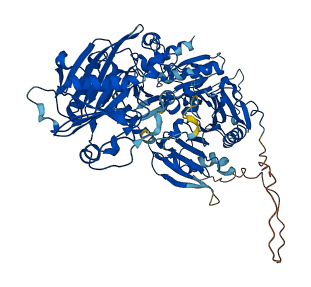
Descriptions
The autoinhibited protein was predicted that may have potential autoinhibitory elements via cis-regPred.
Autoinhibitory domains (AIDs)
Target domain |
|
Relief mechanism |
|
Assay |
cis-regPred |
Accessory elements
No accessory elements
Autoinhibited structure

Activated structure
16 structures for P13020
| Entry ID | Method | Resolution | Chain | Position | Source |
|---|---|---|---|---|---|
| 1NPH | X-ray | 300 A | A | 439-767 | PDB |
| 4CBU | X-ray | 130 A | G | 50-174 | PDB |
| 4CBW | X-ray | 250 A | G | 50-174 | PDB |
| 4CBX | X-ray | 220 A | G | 50-174 | PDB |
| 5MVV | X-ray | 140 A | G | 50-174 | PDB |
| 6I4D | X-ray | 124 A | G | 50-174 | PDB |
| 6I4E | X-ray | 122 A | G | 50-174 | PDB |
| 6I4F | X-ray | 150 A | G | 50-174 | PDB |
| 6I4G | X-ray | 200 A | G/H | 50-174 | PDB |
| 6I4H | X-ray | 140 A | G | 50-174 | PDB |
| 6I4I | X-ray | 190 A | G | 50-174 | PDB |
| 6I4J | X-ray | 150 A | G | 50-174 | PDB |
| 6I4K | X-ray | 183 A | G | 50-174 | PDB |
| 6I4L | X-ray | 183 A | G | 50-174 | PDB |
| 6I4M | X-ray | 187 A | G | 50-174 | PDB |
| AF-P13020-F1 | Predicted | AlphaFoldDB |
36 variants for P13020
| Variant ID(s) | Position | Change | Description | Diseaes Association | Provenance |
|---|---|---|---|---|---|
| rs3391455388 | 12 | L>Q | No | EVA | |
| rs3391451240 | 13 | L>R | No | EVA | |
| rs3391444895 | 16 | A>E | No | EVA | |
| rs3391451309 | 17 | L>Q | No | EVA | |
| rs3391467032 | 18 | C>R | No | EVA | |
| rs3391467031 | 20 | L>Q | No | EVA | |
| rs3388551123 | 41 | R>W | No | EVA | |
| rs3391444872 | 81 | P>T | No | EVA | |
| rs3388551116 | 98 | T>I | No | EVA | |
| rs3388545050 | 178 | V>I | No | EVA | |
| rs3388548300 | 215 | I>F | No | EVA | |
| rs3388550613 | 227 | G>S | No | EVA | |
| rs238428339 | 232 | K>R | No | EVA | |
| rs3391478081 | 269 | L>R | No | EVA | |
| rs3388545992 | 270 | Q>H | No | EVA | |
| rs3388550295 | 273 | G>D | No | EVA | |
| rs3388545118 | 347 | Q>E | No | EVA | |
| rs3388550287 | 363 | F>L | No | EVA | |
| rs3388547913 | 399 | Q>H | No | EVA | |
| rs3388547952 | 417 | R>C | No | EVA | |
| rs3391507024 | 489 | Y>F | No | EVA | |
| rs3388550643 | 492 | Q>H | No | EVA | |
| rs3388547782 | 496 | S>F | No | EVA | |
| rs3388548946 | 508 | T>S | No | EVA | |
| rs3388540068 | 514 | E>K | No | EVA | |
| rs3388550331 | 536 | L>F | No | EVA | |
| rs3388547932 | 541 | P>S | No | EVA | |
| rs3388547936 | 562 | R>S | No | EVA | |
| rs3391327695 | 571 | S>P | No | EVA | |
| rs3391444899 | 573 | A>G | No | EVA | |
| rs3391317339 | 574 | T>S | No | EVA | |
| rs232489359 | 606 | A>T | No | EVA | |
| rs3388540042 | 640 | W>* | No | EVA | |
| rs3391448914 | 700 | D>H | No | EVA | |
| rs3391480129 | 703 | D>A | No | EVA | |
| rs3391480152 | 703 | D>Y | No | EVA |
No associated diseases with P13020
6 regional properties for P13020
| Type | Name | Position | InterPro Accession |
|---|---|---|---|
| domain | Gelsolin-like domain | 74 - 155 | IPR007123-1 |
| domain | Gelsolin-like domain | 196 - 268 | IPR007123-2 |
| domain | Gelsolin-like domain | 315 - 387 | IPR007123-3 |
| domain | Gelsolin-like domain | 453 - 534 | IPR007123-4 |
| domain | Gelsolin-like domain | 575 - 640 | IPR007123-5 |
| domain | Gelsolin-like domain | 679 - 754 | IPR007123-6 |
17 GO annotations of cellular component
| Name | Definition |
|---|---|
| actin cap | Polarized accumulation of cytoskeletal proteins (including F-actin) and regulatory proteins in a cell. An example of this is the actin cap found in Saccharomyces cerevisiae. |
| actin cytoskeleton | The part of the cytoskeleton (the internal framework of a cell) composed of actin and associated proteins. Includes actin cytoskeleton-associated complexes. |
| cortical actin cytoskeleton | The portion of the actin cytoskeleton, comprising filamentous actin and associated proteins, that lies just beneath the plasma membrane. |
| cytoplasm | The contents of a cell excluding the plasma membrane and nucleus, but including other subcellular structures. |
| cytosol | The part of the cytoplasm that does not contain organelles but which does contain other particulate matter, such as protein complexes. |
| extracellular region | The space external to the outermost structure of a cell. For cells without external protective or external encapsulating structures this refers to space outside of the plasma membrane. This term covers the host cell environment outside an intracellular parasite. |
| extracellular space | That part of a multicellular organism outside the cells proper, usually taken to be outside the plasma membranes, and occupied by fluid. |
| lamellipodium | A thin sheetlike process extended by the leading edge of a migrating cell or extending cell process; contains a dense meshwork of actin filaments. |
| myelin sheath | An electrically insulating fatty layer that surrounds the axons of many neurons. It is an outgrowth of glial cells: Schwann cells supply the myelin for peripheral neurons while oligodendrocytes supply it to those of the central nervous system. |
| nucleus | A membrane-bounded organelle of eukaryotic cells in which chromosomes are housed and replicated. In most cells, the nucleus contains all of the cell's chromosomes except the organellar chromosomes, and is the site of RNA synthesis and processing. In some species, or in specialized cell types, RNA metabolism or DNA replication may be absent. |
| perinuclear region of cytoplasm | Cytoplasm situated near, or occurring around, the nucleus. |
| phagocytic vesicle | A membrane-bounded intracellular vesicle that arises from the ingestion of particulate material by phagocytosis. |
| plasma membrane | The membrane surrounding a cell that separates the cell from its external environment. It consists of a phospholipid bilayer and associated proteins. |
| podosome | An actin-rich adhesion structure characterized by formation upon cell substrate contact and localization at the substrate-attached part of the cell, contain an F-actin-rich core surrounded by a ring structure containing proteins such as vinculin and talin, and have a diameter of 0.5 mm. |
| protein-containing complex | A stable assembly of two or more macromolecules, i.e. proteins, nucleic acids, carbohydrates or lipids, in which at least one component is a protein and the constituent parts function together. |
| ruffle | Projection at the leading edge of a crawling cell; the protrusions are supported by a microfilament meshwork. |
| sarcoplasm | The cytoplasm of a muscle cell; includes the sarcoplasmic reticulum. |
6 GO annotations of molecular function
| Name | Definition |
|---|---|
| actin binding | Binding to monomeric or multimeric forms of actin, including actin filaments. |
| actin filament binding | Binding to an actin filament, also known as F-actin, a helical filamentous polymer of globular G-actin subunits. |
| calcium ion binding | Binding to a calcium ion (Ca2+). |
| myosin II binding | Binding to a class II myosin, any member of the class of 'conventional' double-headed myosins that includes muscle myosin. |
| phosphatidylinositol 3-kinase catalytic subunit binding | Binding to the catalytic subunit of a phosphatidylinositol 3-kinase. The catalytic subunit catalyzes the addition of a phosphate group to an inositol lipid at the 3' position of the inositol ring. |
| phosphatidylinositol-4,5-bisphosphate binding | Binding to phosphatidylinositol-4,5-bisphosphate, a derivative of phosphatidylinositol in which the inositol ring is phosphorylated at the 4' and 5' positions. |
38 GO annotations of biological process
| Name | Definition |
|---|---|
| actin cytoskeleton organization | A process that is carried out at the cellular level which results in the assembly, arrangement of constituent parts, or disassembly of cytoskeletal structures comprising actin filaments and their associated proteins. |
| actin filament capping | The binding of a protein or protein complex to the end of an actin filament, thus preventing the addition, exchange or removal of further actin subunits. |
| actin filament depolymerization | Disassembly of actin filaments by the removal of actin monomers from a filament. |
| actin filament polymerization | Assembly of actin filaments by the addition of actin monomers to a filament. |
| actin filament reorganization | A process that is carried out at the cellular level which results in dynamic structural changes to the arrangement of actin filaments. |
| actin filament severing | The process in which an actin filament is broken down into smaller filaments. |
| actin nucleation | The initial step in the formation of an actin filament, in which actin monomers combine to form a new filament. Nucleation is slow relative to the subsequent addition of more monomers to extend the filament. |
| actin polymerization or depolymerization | Assembly or disassembly of actin filaments by the addition or removal of actin monomers from a filament. |
| amyloid fibril formation | The generation of amyloid fibrils, insoluble fibrous protein aggregates exhibiting beta sheet structure, from proteins. |
| apoptotic process | A programmed cell death process which begins when a cell receives an internal (e.g. DNA damage) or external signal (e.g. an extracellular death ligand), and proceeds through a series of biochemical events (signaling pathway phase) which trigger an execution phase. The execution phase is the last step of an apoptotic process, and is typically characterized by rounding-up of the cell, retraction of pseudopodes, reduction of cellular volume (pyknosis), chromatin condensation, nuclear fragmentation (karyorrhexis), plasma membrane blebbing and fragmentation of the cell into apoptotic bodies. When the execution phase is completed, the cell has died. |
| barbed-end actin filament capping | The binding of a protein or protein complex to the barbed (or plus) end of an actin filament, thus preventing the addition, exchange or removal of further actin subunits. |
| cardiac muscle cell contraction | The actin filament-based process in which cytoplasmic actin filaments slide past one another resulting in contraction of a cardiac muscle cell. |
| cell projection assembly | Formation of a prolongation or process extending from a cell, e.g. a flagellum or axon. |
| cellular response to cadmium ion | Any process that results in a change in state or activity of a cell (in terms of movement, secretion, enzyme production, gene expression, etc.) as a result of a cadmium (Cd) ion stimulus. |
| cellular response to interferon-gamma | Any process that results in a change in state or activity of a cell (in terms of movement, secretion, enzyme production, gene expression, etc.) as a result of an interferon-gamma stimulus. Interferon gamma is the only member of the type II interferon found so far. |
| central nervous system development | The process whose specific outcome is the progression of the central nervous system over time, from its formation to the mature structure. The central nervous system is the core nervous system that serves an integrating and coordinating function. In vertebrates it consists of the brain and spinal cord. In those invertebrates with a central nervous system it typically consists of a brain, cerebral ganglia and a nerve cord. |
| cilium assembly | The assembly of a cilium, a specialized eukaryotic organelle that consists of a filiform extrusion of the cell surface. Each cilium is bounded by an extrusion of the cytoplasmic membrane, and contains a regular longitudinal array of microtubules, anchored basally in a centriole. |
| hepatocyte apoptotic process | Any apoptotic process in a hepatocyte, the main structural component of the liver. |
| negative regulation of viral entry into host cell | Any process that stops, prevents, or reduces the frequency, rate or extent of the entry of viral entry into a host cell. |
| phagocytosis, engulfment | The internalization of bacteria, immune complexes and other particulate matter or of an apoptotic cell by phagocytosis, including the membrane and cytoskeletal processes required, which involves one of three mechanisms: zippering of pseudopods around a target via repeated receptor-ligand interactions, sinking of the target directly into plasma membrane of the phagocytosing cell, or induced uptake via an enhanced membrane ruffling of the phagocytosing cell similar to macropinocytosis. |
| phosphatidylinositol-mediated signaling | The series of molecular signals in which a cell uses a phosphatidylinositol-mediated signaling to convert a signal into a response. Phosphatidylinositols include phosphatidylinositol (PtdIns) and its phosphorylated derivatives. |
| positive regulation of actin nucleation | Any process that activates or increases the frequency, rate or extent of actin nucleation, the initial step in the formation of an actin filament in which actin monomers combine to form a new filament. |
| positive regulation of cysteine-type endopeptidase activity involved in apoptotic signaling pathway | Any process that activates or increases the frequency, rate or extent of cysteine-type endopeptidase activity involved in apoptotic signaling pathway. |
| positive regulation of gene expression | Any process that increases the frequency, rate or extent of gene expression. Gene expression is the process in which a gene's coding sequence is converted into a mature gene product (protein or RNA). |
| positive regulation of keratinocyte apoptotic process | Any process that activates or increases the frequency, rate or extent of keratinocyte apoptotic process. |
| positive regulation of protein processing in phagocytic vesicle | Any process that activates or increases the frequency, rate or extent of protein processing in phagocytic vesicle. |
| protein destabilization | Any process that decreases the stability of a protein, making it more vulnerable to degradative processes or aggregation. |
| regulation of cell adhesion | Any process that modulates the frequency, rate or extent of attachment of a cell to another cell or to the extracellular matrix. |
| regulation of establishment of T cell polarity | Any process that modulates the frequency, rate or extent of establishment of T cell polarity. |
| regulation of plasma membrane raft polarization | Any process that modulates the frequency, rate or extent of plasma membrane raft polarization. |
| regulation of podosome assembly | Any process that modulates the frequency, rate or extent of podosome assembly. |
| regulation of receptor clustering | Any process that modulates the frequency, rate or extent of receptor clustering. |
| relaxation of cardiac muscle | The process in which the extent of cardiac muscle contraction is reduced. |
| renal protein absorption | A renal system process in which proteins are taken up from the collecting ducts, glomerulus and proximal and distal loops of the nephron. In non-mammalian species, absorption may occur in related structures (e.g. protein absorption is observed in nephrocytes in Drosophila, see PMID:23264686). |
| response to muscle stretch | Any process that results in a change in state or activity of a cell or an organism (in terms of movement, secretion, enzyme production, gene expression, etc.) as a result of a myofibril being extended beyond its slack length. |
| sequestering of actin monomers | The selective interaction of actin monomers with specific molecules that inhibit their polymerization by preventing their access to other monomers. |
| striated muscle atrophy | A process, occurring in striated muscle, that is characterized by a decrease in protein content, fiber diameter, force production and fatigue resistance in response to different conditions such as starvation, aging and disuse. |
| vesicle-mediated transport | A cellular transport process in which transported substances are moved in membrane-bounded vesicles; transported substances are enclosed in the vesicle lumen or located in the vesicle membrane. The process begins with a step that directs a substance to the forming vesicle, and includes vesicle budding and coating. Vesicles are then targeted to, and fuse with, an acceptor membrane. |
6 homologous proteins in AiPD
| UniProt AC | Gene Name | Protein Name | Species | Evidence Code |
|---|---|---|---|---|
| Q3SX14 | GSN | Gelsolin | Bos taurus (Bovine) | PR |
| Q24020 | fliI | Protein flightless-1 | Drosophila melanogaster (Fruit fly) | PR |
| O75366 | AVIL | Advillin | Homo sapiens (Human) | PR |
| P06396 | GSN | Gelsolin | Homo sapiens (Human) | PR |
| Q68FP1 | Gsn | Gelsolin | Rattus norvegicus (Rat) | PR |
| O65570 | VLN4 | Villin-4 | Arabidopsis thaliana (Mouse-ear cress) | PR |
| 10 | 20 | 30 | 40 | 50 | 60 |
| MAPYRSSLLC | ALLLLALCAL | SPSHAATTSR | GRAQERAPQS | RVSEARPSTM | VVEHPEFLKA |
| 70 | 80 | 90 | 100 | 110 | 120 |
| GKEPGLQIWR | VEKFDLVPVP | PNLYGDFFTG | DAYVILKTVQ | LRNGNLQYDL | HYWLGNECSQ |
| 130 | 140 | 150 | 160 | 170 | 180 |
| DESGAAAIFT | VQLDDYLNGR | AVQHREVQGF | ESSTFSGYFK | SGLKYKKGGV | ASGFKHVVPN |
| 190 | 200 | 210 | 220 | 230 | 240 |
| EVVVQRLFQV | KGRRVVRATE | VPVSWDSFNN | GDCFILDLGN | NIYQWCGSGS | NKFERLKATQ |
| 250 | 260 | 270 | 280 | 290 | 300 |
| VSKGIRDNER | SGRAQVHVSE | EGGEPEAMLQ | VLGPKPALPE | GTEDTAKEDA | ANRRLAKLYK |
| 310 | 320 | 330 | 340 | 350 | 360 |
| VSNGAGSMSV | SLVADENPFA | QGALRSEDCF | ILDHGRDGKI | FVWKGKQANM | EERKAALKTA |
| 370 | 380 | 390 | 400 | 410 | 420 |
| SDFISKMQYP | RQTQVSVLPE | GGETPLFKQF | FKNWRDPDQT | DGPGLGYLSS | HIANVERVPF |
| 430 | 440 | 450 | 460 | 470 | 480 |
| DAATLHTSTA | MAAQHGMDDD | GTGQKQIWRI | EGSNKVPVDP | ATYGQFYGGD | SYIILYNYRH |
| 490 | 500 | 510 | 520 | 530 | 540 |
| GGRQGQIIYN | WQGAQSTQDE | VAASAILTAQ | LDEELGGTPV | QSRVVQGKEP | AHLMSLFGGK |
| 550 | 560 | 570 | 580 | 590 | 600 |
| PMIIYKGGTS | RDGGQTAPAS | IRLFQVRASS | SGATRAVEVM | PKSGALNSND | AFVLKTPSAA |
| 610 | 620 | 630 | 640 | 650 | 660 |
| YLWVGAGASE | AEKTGAQELL | KVLRSQHVQV | EEGSEPDAFW | EALGGKTAYR | TSPRLKDKKM |
| 670 | 680 | 690 | 700 | 710 | 720 |
| DAHPPRLFAC | SNRIGRFVIE | EVPGELMQED | LATDDVMLLD | TWDQVFVWVG | KDSQEEEKTE |
| 730 | 740 | 750 | 760 | 770 | |
| ALTSAKRYIE | TDPANRDRRT | PITVVRQGFE | PPSFVGWFLG | WDDNYWSVDP | LDRALAELAA |