O89040
Gene name |
Plcb2 |
Protein name |
1-phosphatidylinositol 4,5-bisphosphate phosphodiesterase beta-2 |
Names |
Phosphoinositide phospholipase C-beta-2, Phospholipase C-beta-2, PLC-beta-2 |
Species |
Rattus norvegicus (Rat) |
KEGG Pathway |
rno:85240 |
EC number |
3.1.4.11: Phosphoric diester hydrolases |
Protein Class |
|
Descriptions
(Annotation based on sequence homology with Q00722)
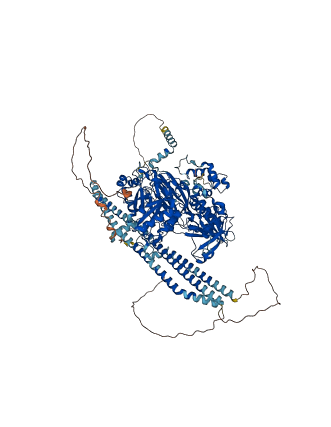
PLCB2 encodes for 1-phosphatidylinositol 4,5-bisphosphate phosphodiesterase beta-2, hydrolyzes phosphatidylinositol 4,5-bisphosphate (PtdIns[4,5]P2) into the second messengers diacylglycerol (DAG) and inositol 1,4,5-trisphosphate (IP3). Autoinhibitory region is a portion of the linker that separates the conserved X and Y boxes comprising the catalytic TIM barrel, at residues 466-537, and occludes the active site of PLCB2. Specifically, the ordered region of X/Y linker at residues 516-535 seems to fine-tune access to the active site, in which deletion of this region only gave partial activation of PLCB2. However, the disordered region of X/Y linker at residues 470-515 is the major autoinhibitory region, in which deletion of this region enhanced activity by 10-fold higher basal activity relative to the ordered region.
Autoinhibitory domains (AIDs)
Target domain |
|
Relief mechanism |
|
Assay |
cis-regPred |
Accessory elements
No accessory elements
Autoinhibited structure

Activated structure
1 structures for O89040
| Entry ID | Method | Resolution | Chain | Position | Source |
|---|---|---|---|---|---|
| AF-O89040-F1 | Predicted | AlphaFoldDB |
7 variants for O89040
| Variant ID(s) | Position | Change | Description | Diseaes Association | Provenance |
|---|---|---|---|---|---|
| rs3319985897 | 1015 | M>I | No | EVA | |
| rs105561320 | 1020 | R>I | No | EVA | |
| rs105647278 | 1030 | F>L | No | EVA | |
| rs106050987 | 1033 | T>P | No | EVA | |
| rs105854020 | 1036 | T>P | No | EVA | |
| rs3320002478 | 1140 | M>I | No | EVA | |
| rs3319889292 | 1146 | A>V | No | EVA |
4 associated diseases with O89040
[MIM: 606579]: Vitiligo-associated multiple autoimmune disease 1 (VAMAS1)
A disorder characterized by the association of vitiligo with several autoimmune and autoinflammatory diseases including autoimmune thyroid disease, rheumatoid arthritis and systemic lupus erythematosus. {ECO:0000269|PubMed:17377159}. Note=Disease susceptibility is associated with variants affecting the gene represented in this entry.
[MIM: 615225]: Palmoplantar carcinoma, multiple self-healing (MSPC)
An autosomal dominant disease characterized by keratopathy with neovascularization, bilateral corneal opacification, palmoplantar hyperkeratosis, dyshidrosis, dystrophic nails, and recurrent keratoacanthomas in palmoplantar skin as well as in conjunctival and corneal epithelia. In addition, patients experience a high susceptibility to malignant squamous cell carcinoma. {ECO:0000269|PubMed:23349227, ECO:0000269|PubMed:27662089, ECO:0000269|PubMed:33093214}. Note=The disease is caused by variants affecting the gene represented in this entry.
[MIM: 617388]: Autoinflammation with arthritis and dyskeratosis (AIADK)
A disorder characterized by recurrent fever, diffuse skin dyskeratosis, autoinflammation, autoimmunity, arthritis and high transitional B-cell level. Inheritance can be autosomal dominant or autosomal recessive. {ECO:0000269|PubMed:27965258, ECO:0000269|PubMed:30291141, ECO:0000269|PubMed:33731932}. Note=The disease may be caused by variants affecting the gene represented in this entry.
[MIM: 618803]: Respiratory papillomatosis, juvenile recurrent, congenital (JRRP)
An autosomal recessive disease characterized by recurrent growth of papillomas in the respiratory tract, and onset in early childhood. Papillomas are most commonly found in the larynx but may occur anywhere from the mouth to the bronchi. Children typically present within the first years of life with hoarseness or, in more severe cases, respiratory distress or stridor and airway obstruction. JRRP is associated with infection of the upper airway by human papillomaviruses of the alpha genus. The infection is thought to occur by vertical transmission at birth. {ECO:0000269|PubMed:31484767}. Note=The disease may be caused by variants affecting the gene represented in this entry.
Without disease ID
- A disorder characterized by the association of vitiligo with several autoimmune and autoinflammatory diseases including autoimmune thyroid disease, rheumatoid arthritis and systemic lupus erythematosus. {ECO:0000269|PubMed:17377159}. Note=Disease susceptibility is associated with variants affecting the gene represented in this entry.
- An autosomal dominant disease characterized by keratopathy with neovascularization, bilateral corneal opacification, palmoplantar hyperkeratosis, dyshidrosis, dystrophic nails, and recurrent keratoacanthomas in palmoplantar skin as well as in conjunctival and corneal epithelia. In addition, patients experience a high susceptibility to malignant squamous cell carcinoma. {ECO:0000269|PubMed:23349227, ECO:0000269|PubMed:27662089, ECO:0000269|PubMed:33093214}. Note=The disease is caused by variants affecting the gene represented in this entry.
- A disorder characterized by recurrent fever, diffuse skin dyskeratosis, autoinflammation, autoimmunity, arthritis and high transitional B-cell level. Inheritance can be autosomal dominant or autosomal recessive. {ECO:0000269|PubMed:27965258, ECO:0000269|PubMed:30291141, ECO:0000269|PubMed:33731932}. Note=The disease may be caused by variants affecting the gene represented in this entry.
- An autosomal recessive disease characterized by recurrent growth of papillomas in the respiratory tract, and onset in early childhood. Papillomas are most commonly found in the larynx but may occur anywhere from the mouth to the bronchi. Children typically present within the first years of life with hoarseness or, in more severe cases, respiratory distress or stridor and airway obstruction. JRRP is associated with infection of the upper airway by human papillomaviruses of the alpha genus. The infection is thought to occur by vertical transmission at birth. {ECO:0000269|PubMed:31484767}. Note=The disease may be caused by variants affecting the gene represented in this entry.
10 regional properties for O89040
| Type | Name | Position | InterPro Accession |
|---|---|---|---|
| domain | CARD domain | 1380 - 1463 | IPR001315 |
| repeat | Leucine-rich repeat | 809 - 830 | IPR001611-1 |
| repeat | Leucine-rich repeat | 864 - 886 | IPR001611-2 |
| repeat | Leucine-rich repeat | 921 - 943 | IPR001611-3 |
| domain | DAPIN domain | 1 - 92 | IPR004020 |
| domain | NACHT nucleoside triphosphatase | 328 - 637 | IPR007111 |
| domain | FIIND domain | 1079 - 1364 | IPR025307 |
| domain | CARD8/ASC/NALP1, CARD domain | 1380 - 1460 | IPR033516 |
| domain | NOD2, winged helix domain | 567 - 613 | IPR041075 |
| domain | NACHT, LRR and PYD domains-containing protein, helical domain HD2 | 623 - 733 | IPR041267 |
Functions
| Description | ||
|---|---|---|
| EC Number | 3.1.4.11 | Phosphoric diester hydrolases |
| Subcellular Localization |
|
|
| PANTHER Family | ||
| PANTHER Subfamily | ||
| PANTHER Protein Class | ||
| PANTHER Pathway Category | No pathway information available | |
5 GO annotations of cellular component
| Name | Definition |
|---|---|
| cytoplasm | The contents of a cell excluding the plasma membrane and nucleus, but including other subcellular structures. |
| cytosol | The part of the cytoplasm that does not contain organelles but which does contain other particulate matter, such as protein complexes. |
| G-protein beta/gamma-subunit complex | The heterodimer formed by the beta and gamma subunits of a heterotrimeric G protein, which dissociates from the alpha subunit upon guanine nuclotide exchange. |
| Golgi apparatus | A membrane-bound cytoplasmic organelle of the endomembrane system that further processes the core oligosaccharides (e.g. N-glycans) added to proteins in the endoplasmic reticulum and packages them into membrane-bound vesicles. The Golgi apparatus operates at the intersection of the secretory, lysosomal, and endocytic pathways. |
| plasma membrane | The membrane surrounding a cell that separates the cell from its external environment. It consists of a phospholipid bilayer and associated proteins. |
5 GO annotations of molecular function
| Name | Definition |
|---|---|
| calcium ion binding | Binding to a calcium ion (Ca2+). |
| G-protein beta/gamma-subunit complex binding | Binding to a complex of G-protein beta/gamma subunits. |
| phosphatidylinositol phospholipase C activity | Catalysis of the reaction: 1-phosphatidyl-1D-myo-inositol 4,5-bisphosphate + H(2)O = 1,2-diacylglycerol + 1D-myo-inositol 1,4,5-trisphosphate + H(+). |
| phospholipase C activity | Catalysis of the reaction: a phospholipid + H2O = 1,2-diacylglycerol + a phosphatidate. |
| phospholipid binding | Binding to a phospholipid, a class of lipids containing phosphoric acid as a mono- or diester. |
6 GO annotations of biological process
| Name | Definition |
|---|---|
| detection of chemical stimulus involved in sensory perception of bitter taste | The series of events required for a bitter taste stimulus to be received and converted to a molecular signal. |
| lipid catabolic process | The chemical reactions and pathways resulting in the breakdown of lipids, compounds soluble in an organic solvent but not, or sparingly, in an aqueous solvent. |
| phosphatidylinositol metabolic process | The chemical reactions and pathways involving phosphatidylinositol, any glycophospholipid in which a sn-glycerol 3-phosphate residue is esterified to the 1-hydroxyl group of 1D-myo-inositol. |
| phosphatidylinositol-mediated signaling | The series of molecular signals in which a cell uses a phosphatidylinositol-mediated signaling to convert a signal into a response. Phosphatidylinositols include phosphatidylinositol (PtdIns) and its phosphorylated derivatives. |
| phospholipase C-activating G protein-coupled receptor signaling pathway | A G protein-coupled receptor signaling pathway in which the signal is transmitted via the activation of phospholipase C (PLC) and a subsequent increase in the intracellular concentration of inositol trisphosphate (IP3) and diacylglycerol (DAG). |
| sensory perception of bitter taste | The series of events required to receive a bitter taste stimulus, convert it to a molecular signal, and recognize and characterize the signal. This is a neurological process. |
16 homologous proteins in AiPD
| UniProt AC | Gene Name | Protein Name | Species | Evidence Code |
|---|---|---|---|---|
| P32383 | PLC1 | 1-phosphatidylinositol 4,5-bisphosphate phosphodiesterase 1 | Saccharomyces cerevisiae (strain ATCC 204508 / S288c) (Baker's yeast) | PR |
| Q00722 | PLCB2 | 1-phosphatidylinositol 4,5-bisphosphate phosphodiesterase beta-2 | Homo sapiens (Human) | EV |
| A3KGF7 | Plcb2 | 1-phosphatidylinositol 4,5-bisphosphate phosphodiesterase beta-2 | Mus musculus (Mouse) | PR |
| P24135 | Plcg2 | 1-phosphatidylinositol 4,5-bisphosphate phosphodiesterase gamma-2 | Rattus norvegicus (Rat) | SS |
| P10686 | Plcg1 | 1-phosphatidylinositol 4,5-bisphosphate phosphodiesterase gamma-1 | Rattus norvegicus (Rat) | EV |
| P10687 | Plcb1 | 1-phosphatidylinositol 4,5-bisphosphate phosphodiesterase beta-1 | Rattus norvegicus (Rat) | SS |
| Q99P84 | Plce1 | 1-phosphatidylinositol 4,5-bisphosphate phosphodiesterase epsilon-1 | Rattus norvegicus (Rat) | EV |
| P10688 | Plcd1 | 1-phosphatidylinositol 4,5-bisphosphate phosphodiesterase delta-1 | Rattus norvegicus (Rat) | SS |
| Q99JE6 | Plcb3 | 1-phosphatidylinositol 4,5-bisphosphate phosphodiesterase beta-3 | Rattus norvegicus (Rat) | SS |
| Q39032 | PLC1 | Phosphoinositide phospholipase C 1 | Arabidopsis thaliana (Mouse-ear cress) | PR |
| Q944C2 | PLC5 | Phosphoinositide phospholipase C 5 | Arabidopsis thaliana (Mouse-ear cress) | PR |
| Q9STZ3 | PLC8 | Phosphoinositide phospholipase C 8 | Arabidopsis thaliana (Mouse-ear cress) | PR |
| Q8GV43 | PLC6 | Phosphoinositide phospholipase C 6 | Arabidopsis thaliana (Mouse-ear cress) | PR |
| Q56W08 | PLC3 | Phosphoinositide phospholipase C 3 | Arabidopsis thaliana (Mouse-ear cress) | PR |
| Q6NMA7 | PLC9 | Phosphoinositide phospholipase C 9 | Arabidopsis thaliana (Mouse-ear cress) | PR |
| Q944C1 | PLC4 | Phosphoinositide phospholipase C 4 | Arabidopsis thaliana (Mouse-ear cress) | PR |
| 10 | 20 | 30 | 40 | 50 | 60 |
| MSLLNPVLLP | PKVKAYLSQG | ERFIKWDDET | SIASPVILRV | DPKGYYLYWT | HQSKEMEFLD |
| 70 | 80 | 90 | 100 | 110 | 120 |
| VTSIRDTRFG | KFAKIPKSQK | LREVFNMDFP | DNHFLLKTFT | VVSGPDMVGL | TFHNFVSYKE |
| 130 | 140 | 150 | 160 | 170 | 180 |
| NVGKDWAEDV | LALAKHPMTA | NASRSTFLDK | ILVKLKMQLS | PEGKIPVKNF | FQMFPADRKR |
| 190 | 200 | 210 | 220 | 230 | 240 |
| VEAALSACHL | AKGKNDAINP | EDFPESVYKS | FLMSLCPRPE | IDEIFTSYHA | KAKPYMTKEH |
| 250 | 260 | 270 | 280 | 290 | 300 |
| LTKFINQKQR | DPRLNSLLFP | PARPEQVQAL | IDKYEPSGIN | VQRGQLSPEG | MVWFLCGPEN |
| 310 | 320 | 330 | 340 | 350 | 360 |
| SVLAHDTLRI | HQDMTQPLNH | YFINSSHNTY | LTAGQFSGPS | SAEMYRQVLL | SGCRCVELDC |
| 370 | 380 | 390 | 400 | 410 | 420 |
| WKGKPPDEEP | IITHGFTMTT | DILFKEAVEA | IAESAFKTSP | YPVILSFENH | VDSPRQQAKM |
| 430 | 440 | 450 | 460 | 470 | 480 |
| AEYCRTMFGE | TLLTEPLENF | PLKPGMPLPS | PEDLRGKILI | KNKKNQFSGP | ASPNKKPDGV |
| 490 | 500 | 510 | 520 | 530 | 540 |
| SEGGFPSSVP | VEEDTGWTAE | DRTEVEEGEE | EEEVEEEEEE | ESGNLDEEEI | KKMQSDEGTA |
| 550 | 560 | 570 | 580 | 590 | 600 |
| GLEVTAYEEM | SSLVNYIQPT | KFISFEFSAQ | KNRSYLVSSF | TELKAYELLS | KASMQFVDYN |
| 610 | 620 | 630 | 640 | 650 | 660 |
| KRQMSRVYPK | GTRMDSSNYM | PQMFWNAGCQ | MVALNFQTMD | LPMQQNMALF | EFNGQSGYLL |
| 670 | 680 | 690 | 700 | 710 | 720 |
| KHEFMRRQDK | QFNPFSVDRI | DVVVATTLSI | TVISGQFLSE | RSVRTYVEVE | LFGLPGDPKR |
| 730 | 740 | 750 | 760 | 770 | 780 |
| RYRTKLSPTA | NSINPVWKEE | PFIFEKILVP | ELASLRIAVM | EEGGKFIGHR | IIPINALHSG |
| 790 | 800 | 810 | 820 | 830 | 840 |
| YHHLCLRSES | NMPLTMPALF | VFLEMKDYVP | DTWADLTVAL | ANPIKYFSAH | DKKSVKLKEV |
| 850 | 860 | 870 | 880 | 890 | 900 |
| TGSLPEKLFS | GIPVASQSNG | APVSAGNGST | APGTKAKEEA | TKEVAEPQTT | SLEELRELKG |
| 910 | 920 | 930 | 940 | 950 | 960 |
| VVKLQRRHEK | ELRELERRGA | RRWEELLQRG | AAQLAELQDP | AASCKLRPGK | GSRKKRIVPC |
| 970 | 980 | 990 | 1000 | 1010 | 1020 |
| EETIVVPREV | LEGPDPRVQD | LKDRLEQELQ | QQGEEQYRSV | LKRKEQHVTE | QIAKMMELAR |
| 1030 | 1040 | 1050 | 1060 | 1070 | 1080 |
| EKQAAELKSF | KETSETDTKE | MKKKLEAKRL | ERIQAMTKVT | TDKVAQERLK | REINNSHIQE |
| 1090 | 1100 | 1110 | 1120 | 1130 | 1140 |
| VVQAVKQMTE | TLERHQEKLE | EKQTACLEQI | QAMEKQFQEK | ALAEYEAKMK | GLEAEVKESM |
| 1150 | 1160 | 1170 | 1180 | ||
| RACFKACFPT | EAEEKPERPC | EASEESCPQE | PLVNKTDTQE | SRL |