Q9Z2S9
Gene name |
Flot2 (Reg1) |
Protein name |
Flotillin-2 |
Names |
Reggie-1, REG-1 |
Species |
Rattus norvegicus (Rat) |
KEGG Pathway |
rno:83764 |
EC number |
|
Protein Class |
|
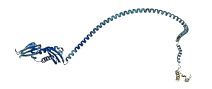
Descriptions
The autoinhibited protein was predicted that may have potential autoinhibitory elements via cis-regPred.
Autoinhibitory domains (AIDs)
Target domain |
|
Relief mechanism |
|
Assay |
cis-regPred |
Accessory elements
No accessory elements
Autoinhibited structure

Activated structure
1 structures for Q9Z2S9
| Entry ID | Method | Resolution | Chain | Position | Source |
|---|---|---|---|---|---|
| AF-Q9Z2S9-F1 | Predicted | AlphaFoldDB |
No variants for Q9Z2S9
| Variant ID(s) | Position | Change | Description | Diseaes Association | Provenance |
|---|---|---|---|---|---|
| No variants for Q9Z2S9 | |||||
No associated diseases with Q9Z2S9
1 regional properties for Q9Z2S9
| Type | Name | Position | InterPro Accession |
|---|---|---|---|
| domain | Band 7 domain | 6 - 269 | IPR001107 |
20 GO annotations of cellular component
| Name | Definition |
|---|---|
| acrosomal membrane | The membrane that surrounds the acrosomal lumen. The acrosome is a special type of lysosome in the head of a spermatozoon that contains acid hydrolases and is concerned with the breakdown of the outer membrane of the ovum during fertilization. |
| adherens junction | A cell-cell junction composed of the epithelial cadherin-catenin complex. The epithelial cadherins, or E-cadherins, of each interacting cell extend through the plasma membrane into the extracellular space and bind to each other. The E-cadherins bind to catenins on the cytoplasmic side of the membrane, where the E-cadherin-catenin complex binds to cytoskeletal components and regulatory and signaling molecules. |
| anchored component of presynaptic active zone membrane | The component of the presynaptic active zone membrane consisting of the gene products that are tethered to the membrane only by a covalently attached anchor, such as a lipid group that is embedded in the membrane. Gene products with peptide sequences that are embedded in the membrane are excluded from this grouping. |
| basolateral plasma membrane | The region of the plasma membrane that includes the basal end and sides of the cell. Often used in reference to animal polarized epithelial membranes, where the basal membrane is the part attached to the extracellular matrix, or in plant cells, where the basal membrane is defined with respect to the zygotic axis. |
| caveola | A membrane raft that forms small pit, depression, or invagination that communicates with the outside of a cell and extends inward, indenting the cytoplasm and the cell membrane. Examples include flask-shaped invaginations of the plasma membrane in adipocytes associated with caveolin proteins, and minute pits or incuppings of the cell membrane formed during pinocytosis. Caveolae may be pinched off to form free vesicles within the cytoplasm. |
| cell-cell contact zone | Extended zone of intimate apposition between two cells containing one or more types of intercellular junctions, e.g., the intercalated disk of muscle. |
| cytoplasmic vesicle | A vesicle found in the cytoplasm of a cell. |
| dendrite cytoplasm | All of the contents of a dendrite, excluding the surrounding plasma membrane. |
| endocytic vesicle | A membrane-bounded intracellular vesicle formed by invagination of the plasma membrane around an extracellular substance. Endocytic vesicles fuse with early endosomes to deliver the cargo for further sorting. |
| endosome | A vacuole to which materials ingested by endocytosis are delivered. |
| flotillin complex | A protein complex that contains flotillin-1 and flotillin-2, and may contain associated proteins. Flotillins associate into membrane microdomains resembling caveolae. |
| glutamatergic synapse | A synapse that uses glutamate as a neurotransmitter. |
| lamellipodium | A thin sheetlike process extended by the leading edge of a migrating cell or extending cell process; contains a dense meshwork of actin filaments. |
| membrane | A lipid bilayer along with all the proteins and protein complexes embedded in it an attached to it. |
| membrane raft | Any of the small (10-200 nm), heterogeneous, highly dynamic, sterol- and sphingolipid-enriched membrane domains that compartmentalize cellular processes. Small rafts can sometimes be stabilized to form larger platforms through protein-protein and protein-lipid interactions. |
| perinuclear region of cytoplasm | Cytoplasm situated near, or occurring around, the nucleus. |
| plasma membrane | The membrane surrounding a cell that separates the cell from its external environment. It consists of a phospholipid bilayer and associated proteins. |
| synapse | The junction between an axon of one neuron and a dendrite of another neuron, a muscle fiber or a glial cell. As the axon approaches the synapse it enlarges into a specialized structure, the presynaptic terminal bouton, which contains mitochondria and synaptic vesicles. At the tip of the terminal bouton is the presynaptic membrane; facing it, and separated from it by a minute cleft (the synaptic cleft) is a specialized area of membrane on the receiving cell, known as the postsynaptic membrane. In response to the arrival of nerve impulses, the presynaptic terminal bouton secretes molecules of neurotransmitters into the synaptic cleft. These diffuse across the cleft and transmit the signal to the postsynaptic membrane. |
| uropod | A membrane projection with related cytoskeletal components at the trailing edge of a cell in the process of migrating or being activated, found on the opposite side of the cell from the leading edge or immunological synapse, respectively. |
| vesicle | Any small, fluid-filled, spherical organelle enclosed by membrane. |
2 GO annotations of molecular function
| Name | Definition |
|---|---|
| ionotropic glutamate receptor binding | Binding to an ionotropic glutamate receptor. Ionotropic glutamate receptors bind glutamate and exert an effect through the regulation of ion channels. |
| protease binding | Binding to a protease or a peptidase. |
12 GO annotations of biological process
| Name | Definition |
|---|---|
| anterograde dendritic transport | The directed movement of organelles or molecules along microtubules from the cell body toward the postsynapse in dendrites. |
| cell adhesion | The attachment of a cell, either to another cell or to an underlying substrate such as the extracellular matrix, via cell adhesion molecules. |
| membrane raft assembly | The aggregation, arrangement and bonding together of a set of components to form a membrane raft, a small (10-200 nm), heterogeneous, highly dynamic, sterol- and sphingolipid-enriched membrane domains that compartmentalizes cellular processes. |
| negative regulation of amyloid precursor protein catabolic process | Any process that stops, prevents or reduces the frequency, rate or extent of amyloid precursor protein catabolic process. |
| negative regulation of gene expression | Any process that decreases the frequency, rate or extent of gene expression. Gene expression is the process in which a gene's coding sequence is converted into a mature gene product (protein or RNA). |
| positive regulation of establishment of T cell polarity | Any process that activates or increases the frequency, rate or extent of establishment of T cell polarity. |
| positive regulation of NF-kappaB transcription factor activity | Any process that activates or increases the frequency, rate or extent of activity of the transcription factor NF-kappaB. |
| protein localization to plasma membrane | A process in which a protein is transported to, or maintained in, a specific location in the plasma membrane. |
| protein localization to plasma membrane raft | A process in which a protein is transported to, or maintained in, a location within a plasma membrane raft. |
| protein stabilization | Any process involved in maintaining the structure and integrity of a protein and preventing it from degradation or aggregation. |
| regulation of myoblast differentiation | Any process that modulates the frequency, rate or extent of myoblast differentiation. A myoblast is a mononucleate cell type that, by fusion with other myoblasts, gives rise to the myotubes that eventually develop into skeletal muscle fibers. |
| regulation of postsynaptic membrane neurotransmitter receptor levels | Any process that regulates the the local concentration of neurotransmitter receptor at the postsynaptic membrane. |
11 homologous proteins in AiPD
| UniProt AC | Gene Name | Protein Name | Species | Evidence Code |
|---|---|---|---|---|
| Q08DN8 | FLOT1 | Flotillin-1 | Bos taurus (Bovine) | PR |
| A6QLR4 | FLOT2 | Flotillin-2 | Bos taurus (Bovine) | PR |
| Q7YR41 | FLOT1 | Flotillin-1 | Pan troglodytes (Chimpanzee) | PR |
| O61491 | Flo1 | Flotillin-1 | Drosophila melanogaster (Fruit fly) | PR |
| O75955 | FLOT1 | Flotillin-1 | Homo sapiens (Human) | PR |
| Q14254 | FLOT2 | Flotillin-2 | Homo sapiens (Human) | PR |
| O08917 | Flot1 | Flotillin-1 | Mus musculus (Mouse) | PR |
| Q60634 | Flot2 | Flotillin-2 | Mus musculus (Mouse) | PR |
| Q767L6 | FLOT1 | Flotillin-1 | Sus scrofa (Pig) | PR |
| Q9Z1E1 | Flot1 | Flotillin-1 | Rattus norvegicus (Rat) | PR |
| Q5TM70 | FLOT1 | Flotillin-1 | Macaca mulatta (Rhesus macaque) | PR |
| 10 | 20 | 30 | 40 | 50 | 60 |
| MGNCHTVGPN | EALVVSGGCC | GSDYKQYVFG | GWAWAWWCIS | DTQRISLEIM | TLQPRCEDVE |
| 70 | 80 | 90 | 100 | 110 | 120 |
| TAEGVALTVT | GVAQVKIMTE | KELLAVACEQ | FLGKNVQDIK | NVVLQTLEGH | LRSILGTLTV |
| 130 | 140 | 150 | 160 | 170 | 180 |
| EQIYQDRDQF | AKLVREVAAP | DVGRMGIEIL | SFTIKDVYDK | VDYLSSLGKT | QTAVVQRDAD |
| 190 | 200 | 210 | 220 | 230 | 240 |
| IGVAEAERDA | GIREAECKKE | MLDVKFMADT | KIADSKRAFE | LQKSAFSEEV | NIKTAEAQLA |
| 250 | 260 | 270 | 280 | 290 | 300 |
| YELQGAREQQ | KIRQEEIEIE | VVQRKKQIAV | EAQEILRTDK | ELIATVRRPA | EAEAHRIQQI |
| 310 | 320 | 330 | 340 | 350 | 360 |
| AEGEKVKQVL | LAQAEAEKIR | KIGEAEAAVI | EAMGKAEAER | MKLKAEAYQK | YGDAAKMALV |
| 370 | 380 | 390 | 400 | 410 | 420 |
| LEALPQIAAK | ISAPLTKVDE | IVVLSGDNSK | VTSEVNRLLA | ELPASVHALT | GVDLSKIPLI |
| KNATGAQV |